SE: K-State Athletics Hall of Fame — A Look at the Lives of Ed Klimek, Margaret Thompson and FI Reynolds
Aug 16, 2018 | Athletics
By Corbin McGuire
The 12th class in the history of the K-State Athletics Hall of Fame was announced in June. The nine-member group will be honored the weekend of September 27-29. Between now and then, K-State Sports Extra will highlight these former Wildcats, their time at K-State and beyond.
The entire class consists of Christine Boucher (women's golf), Rita Graves (women's track and field), David Hall (men's basketball), Ed Klimek (FB/MBB/BSB/TF), Margaret Thompson (honorary), Terence Newman (football), F.I. Reynolds (men's basketball), Mark Simoneau (football) and Max Urick (administration).
For the first part in this series, three inductees — Klimek, Reynolds and Thompson — will be featured.
Ed Klimek (1936-38)
"There's absolutely no way that's going to happen again," Ed Klimek said of the man he was named after, his uncle, Ed Klimek, whose accomplishments at K-State earned him a spot in this year's Hall of Fame class.
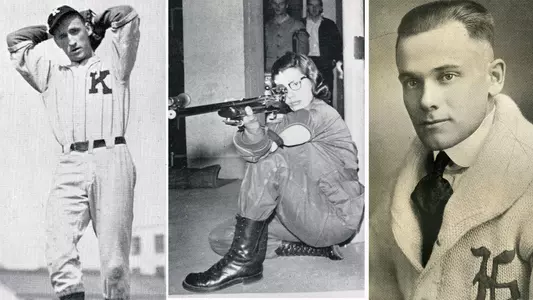
The first Ed Klimek accomplished something that will, as his nephew indicated, likely never happen again in major college athletics. He lettered in four sports at K-State: football (1936-37), basketball (1936-37-38), baseball (1936-37-38) and track and field (1936).
"You think about him and his accomplishments and having those recognized after all these years is a real tribute to Ed's abilities and what he accomplished there at K-State," Klimek, who lives in Manhattan and works at Kansas State Bank, said of his uncle. "As far as the family's concerned, most of us weren't even around when he was competing but certainly the legend carries on in the family and it's something that we're all pretty proud of."
While a versatile athlete, Ed Klimek's top passion was for baseball. He once struck out a record 17 batters in a game at K-State. After finishing at K-State, he signed a professional contract but tragically died while on a jog in 1940 before his career could start.
Despite his early passing, his reputation as an incredible athlete lived on.
When Klimek's nephew was at Manhattan High School in the 1960s, he ran middle and long distance for the track and field team. His name, however, was listed as the school record holder for the shot put, thanks to his uncle who set it in the 1930s.
"I could barely pick up a shot put but up on the board was my name as the shot put record holder. It was kind of the joke around the school that Ed, me, could set the shot put record," Klimek laughed. "That was probably as close as I got to what he did."
The men's dormitory at Memorial Stadium was named after Klimek in 1946. While facility upgrades since then eliminated the dormitory, Klimek's family has maintained a strong connection to K-State.
Brandon Klimek, the son of the second Ed Klimek, played for K-State's football team as a kicker from 2008-12.
William Klimek, another nephew of Ed's who lives in California, said he's held season tickets for K-State football since the 1960s. William added that though he did not graduate from K-State, he feels a strong connection to the university.
"I just think I have purple in my blood. I bleed purple. I've been going to games since I was five or six," William said, excited to return to Manhattan for the Hall of Fame weekend. "The whole family is taking pride in it."
Margaret Thompson (Murdock), honorary (1963-65)
Most days, Margaret Thompson spends her free time reading books. It's a hobby she had to put on the backburner when she was one of the best rifle shooters in the world 30 to 40 years ago because it bothered her eyes.
Truth be told, Thompson's life might be worthy of a book. This year her accomplishments, highlighted by a silver medal at the 1976 Olympics, earned her a spot in the K-State Athletics Hall of Fame.
"It's pretty special," Thompson, who still lives in Topeka, said over the phone. "It's not something that happens to every athlete. I was very pleased that it was going to happen to me."
A Topeka native, Thompson grew up on a farm, where coyotes liked to prey on sheep the family raised and, therefore, she learned to shoot at an early age. She was competing by age 11. When it came time to pick a college, she knew K-State had a rifle team and, thus, she knew where she was going to college.
"We'd always rooted for K-State, listening to them on the radio, listening to the basketball games, particularly," she recalled. "I said maybe I'll go to K-State on get on the rifle team. That's what I did."
While not able to compete as a freshman, Thompson took advantage of the essentially unlimited access to a top-notch shooting range at K-State.
"You could have as much practice as you wanted at that point. I was probably spending more time on the range than I should have, but you have to do something to make college fun," Thompson said, laughing. "I really loved it."
After capturing two Big Eight titles in 1963 and 1964, Thompson enlisted in the Army because she knew it also had shooting teams. She was assigned to the marksmanship unit in Fort Benning, Georgia, where her job revolved around her passion of shooting — teaching it, practicing it and perfecting it.
"That was my job every day. You shot until you got tired," she said. "There couldn't have been a better unit to be in in the Army, or anywhere really, because the whole thing was devoted to helping you shoot your best so that you could win. And that's what we did."
Thompson stayed in the Army for 20 years, retiring after a career that saw her become the first woman ever to win an Olympic shooting medal. She also won five gold medals at the Pan American Games, all in men's competition. At one point, she held 13 world records.
Not that she had any of this mapped out for herself.
"My life hasn't been coordinated and planned beforehand like all these people do now. I just kind of took it, like, 'Well, now what am I going to do?' And I had a good life," said Thompson, whose son, Brett, graduated from K-State with a double major of electrical engineering and computer engineering in 1996. "I was very happy that I went to K-State because I liked K-State and the people up there were friendly and nice. I really enjoyed my time there."
FI Reynolds (1915-1917)
FI (Frank Irving) Reynolds was K-State's first All-American in men's basketball in 1917, but his grandchildren knew him as a quiet, humble man, who enjoyed fishing and golfing in his retirement life in Florida.
"You would think that would have been a big deal but my dad was not a big talker," said Jenny Towner (Reynolds), the daughter of Reynold's son, Frank Reynolds, Jr. "They definitely were very humble men, weren't always talking about themselves, really loved their families, providing for their families, both did a very good job at that."
Reynolds was a three-time letterwinner at K-State. He helped lead the Wildcats to records of 13-3 in 1916 and 15-2 in 1917. His senior season included a Missouri Valley Conference title, the school's first conference championship, that was made possible by 13 consecutive wins to end the season.
"We had no idea that he did that well, was such an athlete, because he wasn't super tall, at least when we knew him," Towner said of her grandfather, a standout guard for the Wildcats. "On the other hand, it doesn't surprise me because my dad was also very athletic and played lots of sports."
After college, Towner said her grandfather worked for Pet Milk in Neosho, Missouri, rising to district manager. He retired in Fort Myers, Florida, living in a house next to the water. He had a boat to fish on, a pool to relax by and a group of friends to play golf with. Towner also remembers his Sunday night routine of watching The Lawrence Welk Show.
While the remaining family members lack an abundance of stories about Reynolds' playing days, Towner said they are eager to return to Manhattan to see his legacy honored.
"We're very excited," Towner said. "My dad really loved his father, and we had tons of respect for him, so it's just very exciting to see him honored this way."
The 12th class in the history of the K-State Athletics Hall of Fame was announced in June. The nine-member group will be honored the weekend of September 27-29. Between now and then, K-State Sports Extra will highlight these former Wildcats, their time at K-State and beyond.
The entire class consists of Christine Boucher (women's golf), Rita Graves (women's track and field), David Hall (men's basketball), Ed Klimek (FB/MBB/BSB/TF), Margaret Thompson (honorary), Terence Newman (football), F.I. Reynolds (men's basketball), Mark Simoneau (football) and Max Urick (administration).
For the first part in this series, three inductees — Klimek, Reynolds and Thompson — will be featured.
Ed Klimek (1936-38)
"There's absolutely no way that's going to happen again," Ed Klimek said of the man he was named after, his uncle, Ed Klimek, whose accomplishments at K-State earned him a spot in this year's Hall of Fame class.
The first Ed Klimek accomplished something that will, as his nephew indicated, likely never happen again in major college athletics. He lettered in four sports at K-State: football (1936-37), basketball (1936-37-38), baseball (1936-37-38) and track and field (1936).
"You think about him and his accomplishments and having those recognized after all these years is a real tribute to Ed's abilities and what he accomplished there at K-State," Klimek, who lives in Manhattan and works at Kansas State Bank, said of his uncle. "As far as the family's concerned, most of us weren't even around when he was competing but certainly the legend carries on in the family and it's something that we're all pretty proud of."
While a versatile athlete, Ed Klimek's top passion was for baseball. He once struck out a record 17 batters in a game at K-State. After finishing at K-State, he signed a professional contract but tragically died while on a jog in 1940 before his career could start.
Despite his early passing, his reputation as an incredible athlete lived on.
When Klimek's nephew was at Manhattan High School in the 1960s, he ran middle and long distance for the track and field team. His name, however, was listed as the school record holder for the shot put, thanks to his uncle who set it in the 1930s.
"I could barely pick up a shot put but up on the board was my name as the shot put record holder. It was kind of the joke around the school that Ed, me, could set the shot put record," Klimek laughed. "That was probably as close as I got to what he did."
The men's dormitory at Memorial Stadium was named after Klimek in 1946. While facility upgrades since then eliminated the dormitory, Klimek's family has maintained a strong connection to K-State.
Brandon Klimek, the son of the second Ed Klimek, played for K-State's football team as a kicker from 2008-12.
William Klimek, another nephew of Ed's who lives in California, said he's held season tickets for K-State football since the 1960s. William added that though he did not graduate from K-State, he feels a strong connection to the university.
"I just think I have purple in my blood. I bleed purple. I've been going to games since I was five or six," William said, excited to return to Manhattan for the Hall of Fame weekend. "The whole family is taking pride in it."
Margaret Thompson (Murdock), honorary (1963-65)
Most days, Margaret Thompson spends her free time reading books. It's a hobby she had to put on the backburner when she was one of the best rifle shooters in the world 30 to 40 years ago because it bothered her eyes.
Truth be told, Thompson's life might be worthy of a book. This year her accomplishments, highlighted by a silver medal at the 1976 Olympics, earned her a spot in the K-State Athletics Hall of Fame.
"It's pretty special," Thompson, who still lives in Topeka, said over the phone. "It's not something that happens to every athlete. I was very pleased that it was going to happen to me."
A Topeka native, Thompson grew up on a farm, where coyotes liked to prey on sheep the family raised and, therefore, she learned to shoot at an early age. She was competing by age 11. When it came time to pick a college, she knew K-State had a rifle team and, thus, she knew where she was going to college.
"We'd always rooted for K-State, listening to them on the radio, listening to the basketball games, particularly," she recalled. "I said maybe I'll go to K-State on get on the rifle team. That's what I did."
While not able to compete as a freshman, Thompson took advantage of the essentially unlimited access to a top-notch shooting range at K-State.
"You could have as much practice as you wanted at that point. I was probably spending more time on the range than I should have, but you have to do something to make college fun," Thompson said, laughing. "I really loved it."
After capturing two Big Eight titles in 1963 and 1964, Thompson enlisted in the Army because she knew it also had shooting teams. She was assigned to the marksmanship unit in Fort Benning, Georgia, where her job revolved around her passion of shooting — teaching it, practicing it and perfecting it.
"That was my job every day. You shot until you got tired," she said. "There couldn't have been a better unit to be in in the Army, or anywhere really, because the whole thing was devoted to helping you shoot your best so that you could win. And that's what we did."
Thompson stayed in the Army for 20 years, retiring after a career that saw her become the first woman ever to win an Olympic shooting medal. She also won five gold medals at the Pan American Games, all in men's competition. At one point, she held 13 world records.
Not that she had any of this mapped out for herself.
"My life hasn't been coordinated and planned beforehand like all these people do now. I just kind of took it, like, 'Well, now what am I going to do?' And I had a good life," said Thompson, whose son, Brett, graduated from K-State with a double major of electrical engineering and computer engineering in 1996. "I was very happy that I went to K-State because I liked K-State and the people up there were friendly and nice. I really enjoyed my time there."
FI Reynolds (1915-1917)
FI (Frank Irving) Reynolds was K-State's first All-American in men's basketball in 1917, but his grandchildren knew him as a quiet, humble man, who enjoyed fishing and golfing in his retirement life in Florida.
"You would think that would have been a big deal but my dad was not a big talker," said Jenny Towner (Reynolds), the daughter of Reynold's son, Frank Reynolds, Jr. "They definitely were very humble men, weren't always talking about themselves, really loved their families, providing for their families, both did a very good job at that."
Reynolds was a three-time letterwinner at K-State. He helped lead the Wildcats to records of 13-3 in 1916 and 15-2 in 1917. His senior season included a Missouri Valley Conference title, the school's first conference championship, that was made possible by 13 consecutive wins to end the season.
"We had no idea that he did that well, was such an athlete, because he wasn't super tall, at least when we knew him," Towner said of her grandfather, a standout guard for the Wildcats. "On the other hand, it doesn't surprise me because my dad was also very athletic and played lots of sports."
After college, Towner said her grandfather worked for Pet Milk in Neosho, Missouri, rising to district manager. He retired in Fort Myers, Florida, living in a house next to the water. He had a boat to fish on, a pool to relax by and a group of friends to play golf with. Towner also remembers his Sunday night routine of watching The Lawrence Welk Show.
While the remaining family members lack an abundance of stories about Reynolds' playing days, Towner said they are eager to return to Manhattan to see his legacy honored.
"We're very excited," Towner said. "My dad really loved his father, and we had tons of respect for him, so it's just very exciting to see him honored this way."


K-State Athletics | Gene Taylor Press Conference - February 15, 2026
Monday, February 16
K-State Men's Basketball | Postgame Press Conference at Houston
Sunday, February 15
K-State Football | Stanton Weber Press Conference - Feb. 12, 2026
Thursday, February 12
K-State Football | Thad Ward Press Conference - Feb. 12, 2026
Thursday, February 12