

Kansas State University Athletics
Making a Positive Impact
Jul 08, 2024 | Women's Basketball, Sports Extra
By: D. Scott Fritchen
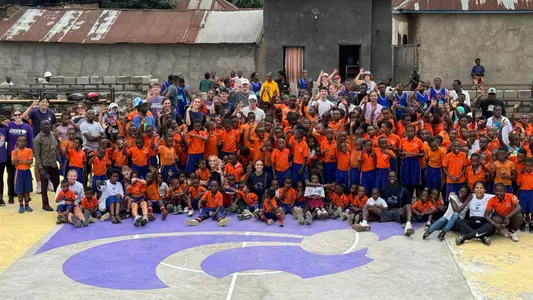
The Kansas State women's basketball team experienced a once-in-a-lifetime adventure when players, coaches and staff visited Rwanda, Africa, in mid-May. The six-day excursion included the construction of a basketball court bearing a Powercat at midcourt. But the experience was simply so much more.
In fact, it might be best for the players on the trip to describe their experiences in their own words.
Senior guard Brylee Glenn offers a tremendously written and detailed account of her experience. Other players follow with excerpts of their experiences as well.
Enjoy.
BRYLEE GLENN
Thirty-plus hours of travel, but we made it! I was a bit skeptical when we arrived at our hotel in the middle of Kigali. The beds were hard, rooms questionable, my pillow was like flattened cardboard, the showers were dirty, there was no air conditioning, barely electricity, and we drank from water bottles. I carried a negative attitude into the first full day on May 16. That changed when we made our first stop at the Kigali Genocide Museum, which was one of the harder but more informative experiences I had in Africa. Upon arriving at the museum, we received a set of headphones, gained historical context of the genocide, and viewed a video of a few select survivors, who detailed their genocide experiences, how they lost their families, and how they survived. It was touching that they referred to the museum as their second home because it's where their family members are buried. The whole thing was truly heartbreaking. The museum keeps alive the memory of loved ones.

Our headphones were connected to an audio device that played as we toured various areas of the museum, emphasizing the importance or historical context of each stop of the tour. I began my journey outside, where I came upon the graves and a wall inscribed with the names of individuals tragically taken. Fresh flowers adorned the graves. I moved onto the fountains, the gardens, and paused at a timeline of events upon a wall that chronologically detailed the genocide, the aftermath and its impact. I made my way through the museum very slowly, soaking it in, listening to every second of audio on my headphones, and absorbed every image. It was brutal, hard to read about these experiences, the fear, and what one would endure, and how the animosity between these two ethnic groups was so vicious that people would actually pay for a bullet rather than risk death by machete. There are truly no words. A whole civilization was destroyed due to senseless violence and an unthinkable number of children were left with no one and nothing.
I found myself in utter shock in the next room. Pictures of genocide victims covered the walls. Upstairs, a memorial remembered child genocide victims. Some children had been only a few months old. The memorial included pictures of children, their names, ages, favorite foods, and the brutal manner in which they passed. It was gut-wrenching. I realized I had fallen behind everybody else in our party, and it wasn't until Coach Mittie found me that I learned that it was time to go. We stopped to get food and were off to Flfuali, which was four hours away. We navigated a scenic, winding road through mountains. Upon reaching the nunnery, where we stayed, we dined and retreated to our rooms. We had a big day tomorrow.

Friday, May 17
This was a long day. We got up at 7:30 a.m. and ate breakfast at 8 a.m. The breakfast was always standard and probably less than what we all usually eat. Before we headed out, we drenched ourselves in spray-on sunscreen and bug spray, which was mandatory. Our destination, the village where we would work, was about a 20-minute drive. Along the way, we saw people walking along the sides of the roadway or pushing bikes loaded with materials up the mountain road. There were even two small children, no older than six, walking alone.
I felt that the people around the village were definitely wary of us at first as we arrived at the village and walked onto the basketball court where we'd work over the next few days. The natives stared and were quite shy at first. The group of outcasts — us — huddled up and each of us were assigned jobs such as playing with the kids, painting, or building. My duty entailed engaging with the kids. We brought basketballs. The kids' faces lit up in excitement and they crowded around us with their little hands begging for a ball. The kids' clothes were ripped, stained, smelly, and their shoes were falling apart, but all they wanted to do was play. We tossed out basketballs, formed a circle, and tossed the ball with the kids. We attempted to teach them how to dribble, and although basketballs flew everywhere, nobody cared. It was fun even in the scorching heat. After about four hours of playing or working on projects, it was time to go. It's hard, though, when you're leaving the circumstance of the village, as kids ask you for food, or tell you they're thirsty, or point at your wrist because they want your bracelet, or they tell you they need money.
Next, we visited the Pygmy Village and were greeted with smiles and welcoming arms. It was a small area where they lived off selling handmade pottery. As we strolled in, they began dancing for us — dances they practice year round yet barely had the chance to perform due to a lack of visitors. They were so joyful, pulled us in to join them as they wrapped traditional cloths around our waists, and we laughed and enjoyed ourselves. Then we walked into a little room where they stored certain pottery. We picked our favorite piece, sat on the ground with a Pygmy, and learned how to create the pottery. I was god-awful at making pottery, but it was one of my favorite experiences and I left with a pretty cool souvenir.

Next stop: A school. Our first visit to a local school was quite interesting, as schools had uniforms. We had a friendly game of basketball against a select few girls who attended the school. Although we started out bad, we got the win. After the game, we handed out the t-shirt that each of us had in our bags. Mine went to a kid who said I was his favorite player. As soon as I handed him the t-shirt, other students swarmed me, asking for a t-shirt, or money, or my sunglasses — whatever I had, really. It was unlike anything I'd ever experienced. All my teammates fell prey to the same thing. Our only concern was making it back to the bus. Then kids surrounded the bus. Some of us threw t-shirts out of windows, thinking that was a better idea, but little did we know that the kids would literally fight over a t-shirt. It was shocking. As the bus pulled away, a wave of relief flowed over us.
Back at the nunnery, we had 30 minutes to shower and change for church service. Simon, our guide, wanted us to attend church service with him. It poured rain outside as we headed to church, so our clothes, hands, and hair were wet, but the service was so good! It featured some of the best gospel singers I'd ever heard. Dinner time came at 8 p.m. We drove to Simon's home, a big house, where his wife had cooked a meal for us. Simon is wealthy and dedicates his time purchasing churches or schools and renovating them for use by communities. He puts extraordinary effort into positively impacting villages.
Saturday, May 18
Our typical morning began with one egg and some bread before applying sunscreen and bug spray, of course (to be fair, the bugs weren't as bad as I feared), as we headed to the village. Surprisingly enough, I hadn't felt much travel fatigue despite the seven-hour time difference, which was a plus. Today, we painted the big Powercat on the basketball court. The kids were very happy to see us and the basketballs. At some point as we tossed basketballs, we began playing soccer, which wasn't my strong suit. Little, little kids showed me up, but I tried to keep up. Nearby some kids performed cartwheels. I began my own cartwheel line and at least 10 kids followed me in doing cartwheels from one corner of the field to another. I felt like an acrobat and the kids were so smiley and giggly that it was worth the heavy breathing and soreness in my calves. At this point, we were all growing tired, so we transitioned from running to forming a dance circle.

Soon after, we collected the basketballs and went to lunch, which was fire — coffee, fish and even a strawberry smoothie — followed by a boat tour to the nunnery. We saw the gorgeous mountain views, neighboring houses, and even a huge volcano hidden amongst the clouds. It was relaxing to be on the water and just sit back and enjoy the views. We showered, had dinner and game night. Also, pretty much every night it rained hard, so we constantly lost power.
Sunday, May 19
Woo-hoo! Church day! After breakfast, we all got pretty, put on nice outfits, loaded up our Bible to give away, hopped into the cars, and were off. I hadn't attended church in a while, so attending Friday's church service and the one on Sunday was enjoyable, but during this service, I found myself growing emotional, like literal tears forming in my eyes. I had to tell myself to get it together. I'm not sure why I was emotional. Maybe it was because of the older man I looked at and thought about the hardships he might have endured throughout his life. The singers were amazing, once again, and all of a sudden a little girl in a pink dress approached me and gave me a big hug. She was attached to my hip for the rest of the service. I let her play with my phone, just the camera, and she was so mesmerized, and took so many pictures of nothing, but it was so cute. After church, I gave the little girl a French Bible. Then I found the older man and gave him the choice of taking a French Bible or English Bible. He took the French Bible. He was very grateful and once again I found myself holding back tears. I gave him a water bottle and he went on his way. I gave the English Bible to the pastor/minister, and he was very happy as well.
Heading out of the church, I spoke with some girls and went on a house tour of this sweet young lady. I learned that the parents lock the house when they leave for work, so we were unable to go inside, but looked at the backyard, and a big cow stood next to a mud pile taller than me. The house was connected to two other houses, and they shared the same backyard. Four or five chickens ran around. I walked back on rocky dirt roads with clothes scattered out to dry.
Next, we went to the music room of a local school and listened to a drum performance, one of my favorite activities. Simon told us that you had to attend school to play drums, sports, or participate in any extracurricular activities, as they put a big emphasis on education. The drum performance was amazing, unlike anything I've heard, and the kids also danced with bells around their ankles to create that extra sound. After the performance, we greeted the children with wristbands and basketballs for their school. They were so sweet and joyful.
Monday, May 20
This day was all about work and we got it done! We arrived at the village at around 9 a.m. and everyone was assigned to paint. While one group painted the poles surrounding the court red, another group went in with green to match the fence that would be put up. I'm not a painter. You couldn't tell if I got more paint on myself or on the poles, but it was fun! We spent less time with the kids because we were so focused on work, but some kids even helped me paint the bleachers after they were built. I snuck a t-shirt to one boy who was such a good helper. We handed out water bottles after we finished painting and headed to another local school, where we played a friendly game of basketball. They were quite good. Hundreds of kids surrounded the basketball court and cheered after each made basket. We came out with the win and then handed out basketballs to our MVPs of the game. We ended the night at Maddy's Restaurant, where we hung out, played games, and just really enjoyed ourselves for the night. The owner was from America.
Tuesday, May 21
The last and final day. Camp Day! While some of the staff headed to the village early to finish painting each lane on the basketball court a solid purple, the rest of us arrived at around 10 a.m. and went straight to work carrying heavy cinderblocks to the opposite side of the court, building a wall that separated some of the housing from the court. The blocks were heavy, and I was surprised my forearms weren't more sore the following day. After the hard lifting, it was time for basketball camp. The players were partnered with each other on separate sections of the court. Some were in charge of layups, and some were in charge of jump shots, and others were in charge of passing or ballhandling. Others were in charge of defensive slides and activities that didn't involve basketballs.
Each station was five minutes. The first wave of campers were really young kids, but we got to work on stationary dribbling and some running from side to side on the court. They loved it. The kids had so much fun even if they couldn't keep the ball bouncing. The teachers/mentors also joined in and couldn't get enough of dribbling those basketballs. We had an hour with the younger kids and then we repeated the same process of stationary dribbling and running with older kids. The camp was so fun and was 100% my favorite part — being able to teach kids the game I love.
Once we got through all the kids, we rounded them up for a group picture, and also gave each kid a bracelet and/or a trading card. The kids surrounded the court outside of the fence to make way for an elite group of students. Some of our Kenyan friends, who joined us and came to help with the camp, and also two of our managers, played this group of men in a game of five-on-five. The group was known to be one of the top men's teams in Africa. It was an entertaining game to watch, and everybody hooped. Our managers got their butts kicked (ha) but after the game, we gave them all t-shirts.
But we weren't finished yet.
Us players took on this men's team in a 3-point shooting contest and boom… we came out with the dub! We ended the camp with a big prayer circle, and just like that, our Africa journey was over.
It was a very exhausting day but so fulfilling as well. We said goodbye to the kids, giving away the last of our water bottles, posters, cards — all of it. We also packed a huge suitcase with clothes for Simon's office, which he could distribute to kids who really needed it. We also left all the basketballs, at least 30, in there as well. A lot of us left our shoes, too, so some aspiring basketball player or student could have decent shoes to wear.
Pulling out of the village was bittersweet. I thought about the kids we formed bonds with and how I'd miss them and had to swallow the hard pill of knowing they'd look forward to our arrival tomorrow and we wouldn't be there. Three kids chased the bus as we drove away, one of them a kid I grew quite fond of, so as my last gift I threw him my sunglasses as I waved my last goodbye. I felt my throat start to dry up like I was about to grow teary-eyed.
I didn't know how grateful I'd be for this trip, and I was sad to leave the kids, yet it warmed my heart knowing that we as a group were able to positively impact this village and hopefully inspire these kids. I'm so glad Coach Mittie organized this once-in-a-lifetime trip and will forever cherish the memories made and the experiences. I'm so blessed to have had the opportunity to travel to a small village in Africa and help build a basketball court — something people only dream about. I lived it, and I'm eternally grateful for all of it.
Until next time, thank you for having me, Rwanda.
Taryn Sides
We were in the villages painting the fence around the basketball court and a boy, probably 15 years old, called me over and asked if he could show me his talent. I said, "Yes, of course." So, he did. He was very talented in doing tricks — backflips, handstands, and many more cool things. He asked if he could show off a performance with his buddies the following day. So, the next day he and a few of his buddies performed for me, and it was really good. Afterward, he said that he wanted to teach me a couple of his tricks, which was really fun. Before I left, I gave him money, and what stuck with me was how unselfish and compassionate he was because he kept saying he was going to help his friends with the money. Not once did he ever mention using the money himself. That memory was just so eye-opening because he didn't have much and all he cared about was helping his friends. He was also so thankful and appreciative for what I did, as he told me countless times. This is one of my most favorite heartfelt memories.

Serena Sundell
The first stop we made was at the Rwandan Genocide Memorial. I did some research before our visit, yet it was still such an intense and heavy experience. We watched a video with around five different first-hand witness stories and then we were sent to look around. We first saw the mass graves where around 250,000 people had been buried on top of one another. There were various flowers placed on these graves, but it would be impossible to know where your loved ones are. There was a wall of about 500 names because that was all that could be found or recognized. It was very hard to imagine visiting this memorial for a loved one, not knowing if they were there or not. We then went inside and learned about the history and actual parts of the genocide. Eight-hundred thousand people were killed in 100 days. The most difficult part of the museum to get through, for me, was the children's part at the very end. There was no mercy for anyone. This section gave their name, age, favorite food, color, character trait, a picture of them, and how they were killed. There were a lot of kids who were killed by machete. I remember one baby less than a year old was smashed against a wall. In order to be killed by a bullet, you had to pay money.

Eliza Maupin
After spending time in Kigali, we headed to Gisenyi, Rwanda, where we would be building a basketball court and bring hope and joy to the families around the community. When we got there, we unloaded our bags and luggage to our rooms where we would be staying for a week. A nunnery. There was no air conditioning, no drinking water from the faucets, a mosquito net, and an 8 x 11 square-feet room. I wanted to be so positive, but right then and there I wanted to go back to my sweet little air conditioner, safe and home, and you couldn't convince me otherwise. The next day rolls around, and we pack up to leave for the day to start working on our project, and the people of Rwanda are the most hardworking people I've ever seen. Now this is for multiple reasons due to poverty, the government, and lack of resources. They are living in survival mode, and yet they are the sweetest and happiest people on earth. It's a prime example of how money cannot buy you happiness. These people find happiness through relationships, community, and the traditions of the culture.

Imani Lester
The first day many of the people just stared. As the days went by more and more of the locals began to help us, which was an amazing thing to witness. People not working were playing with the kids gathered. This was one of the best parts. Kids were joyful, even with little water, food or money. They began to teach us the games they play and dances. Many would ask for money, clothes and shoes, but some even asked for an empty water bottle, trash, or a ball. My favorite experience during this part was the friendships we developed with some of the kids. One kid specifically I nicknamed "The Dancing Man," who was known as the best dancer in the village. He was very talented and a good teacher but couldn't speak English because his family couldn't afford specific things for his school. The Dancing Man would come back every day at the same time not to beg, but to play, dance, and talk to us. He asked for us to meet his family, but they worked all day and left him alone until very late at night. The day we held the camp he waited for us to finish so he could talk afterward. Seeing a child with that much patience was incredible to see. Even teaching us how to dance, he kept on for three hours until we all got the moves that he wanted us to learn. The last day, I learned that he and his friend provided water and food for their own all by themselves. On the last day, I gave them both a few shirts simply for everything they shared with us, and he said it was "the best gift." It was hard to leave those two on the last day. I wondered if he'd return the next day and wait again.

Jaelyn Glenn
I will say, I was not excited to go to Africa. The plane rides were long, the packing stressed me out, and we had to get multiple shots and medications for this trip. But by the end of our five days, I was sad to be leaving. I was able to meet the sweetest children, and I even found myself a boyfriend in Africa named "Joshua." I was able to connect with people I would have never gotten to meet without this trip, and I will cherish the memories made for a lifetime. I will never forget this trip, and I hope I was able to make an impact on their life as they made on mine.
Zyanna Walker
This trip was really an eye-opening experience. It made me realize how much of my everyday life I take for granted. To see how many people were living in poverty was crazy. They look to you and beg for food, water or clothes. I wish there was a way to give them all they need. I was thinking to myself a lot during this trip about how we could help this country get out of poverty. It would take a whole lot of people to do that, but I think it's possible. One day I want to go back and help them.
Mikayla Parks
First day at the village and driving through Africa is pretty in many areas. But seeing the way people live hurts my heart. We arrived at the village not really knowing what was going on yet. I was assigned to play with the kids. It was hard to see the living conditions and the sickness that the kids and families are going through. But their pure joy was the best part.
Alexis Hess
The days of helping finish the court and playing with the kids was an amazing experience. Being able to provide not only the kids, but the whole village with something to bring a smile to their face was rewarding. Not only putting the finishing touches on the court, but giving them the small things like a bracelet, a card, or a shirt made my day, and I assume theirs as well. Personally, I had given two kids something to eat on our way to the boats, and seeing how grateful and happy they were to receive such a small amount of food was both sad and eye opening. I genuinely had a great time providing something for them that will hopefully last a long time. Taking the time to meet some of the kids and build a relationship with them over the few days we were there made it harder to leave. Just seeing the absolute joy they felt just throwing or kicking the ball around is something I'll never forget.
The Kansas State women's basketball team experienced a once-in-a-lifetime adventure when players, coaches and staff visited Rwanda, Africa, in mid-May. The six-day excursion included the construction of a basketball court bearing a Powercat at midcourt. But the experience was simply so much more.
In fact, it might be best for the players on the trip to describe their experiences in their own words.
Senior guard Brylee Glenn offers a tremendously written and detailed account of her experience. Other players follow with excerpts of their experiences as well.
Enjoy.
BRYLEE GLENN
Thirty-plus hours of travel, but we made it! I was a bit skeptical when we arrived at our hotel in the middle of Kigali. The beds were hard, rooms questionable, my pillow was like flattened cardboard, the showers were dirty, there was no air conditioning, barely electricity, and we drank from water bottles. I carried a negative attitude into the first full day on May 16. That changed when we made our first stop at the Kigali Genocide Museum, which was one of the harder but more informative experiences I had in Africa. Upon arriving at the museum, we received a set of headphones, gained historical context of the genocide, and viewed a video of a few select survivors, who detailed their genocide experiences, how they lost their families, and how they survived. It was touching that they referred to the museum as their second home because it's where their family members are buried. The whole thing was truly heartbreaking. The museum keeps alive the memory of loved ones.
Our headphones were connected to an audio device that played as we toured various areas of the museum, emphasizing the importance or historical context of each stop of the tour. I began my journey outside, where I came upon the graves and a wall inscribed with the names of individuals tragically taken. Fresh flowers adorned the graves. I moved onto the fountains, the gardens, and paused at a timeline of events upon a wall that chronologically detailed the genocide, the aftermath and its impact. I made my way through the museum very slowly, soaking it in, listening to every second of audio on my headphones, and absorbed every image. It was brutal, hard to read about these experiences, the fear, and what one would endure, and how the animosity between these two ethnic groups was so vicious that people would actually pay for a bullet rather than risk death by machete. There are truly no words. A whole civilization was destroyed due to senseless violence and an unthinkable number of children were left with no one and nothing.
I found myself in utter shock in the next room. Pictures of genocide victims covered the walls. Upstairs, a memorial remembered child genocide victims. Some children had been only a few months old. The memorial included pictures of children, their names, ages, favorite foods, and the brutal manner in which they passed. It was gut-wrenching. I realized I had fallen behind everybody else in our party, and it wasn't until Coach Mittie found me that I learned that it was time to go. We stopped to get food and were off to Flfuali, which was four hours away. We navigated a scenic, winding road through mountains. Upon reaching the nunnery, where we stayed, we dined and retreated to our rooms. We had a big day tomorrow.
Friday, May 17
This was a long day. We got up at 7:30 a.m. and ate breakfast at 8 a.m. The breakfast was always standard and probably less than what we all usually eat. Before we headed out, we drenched ourselves in spray-on sunscreen and bug spray, which was mandatory. Our destination, the village where we would work, was about a 20-minute drive. Along the way, we saw people walking along the sides of the roadway or pushing bikes loaded with materials up the mountain road. There were even two small children, no older than six, walking alone.
I felt that the people around the village were definitely wary of us at first as we arrived at the village and walked onto the basketball court where we'd work over the next few days. The natives stared and were quite shy at first. The group of outcasts — us — huddled up and each of us were assigned jobs such as playing with the kids, painting, or building. My duty entailed engaging with the kids. We brought basketballs. The kids' faces lit up in excitement and they crowded around us with their little hands begging for a ball. The kids' clothes were ripped, stained, smelly, and their shoes were falling apart, but all they wanted to do was play. We tossed out basketballs, formed a circle, and tossed the ball with the kids. We attempted to teach them how to dribble, and although basketballs flew everywhere, nobody cared. It was fun even in the scorching heat. After about four hours of playing or working on projects, it was time to go. It's hard, though, when you're leaving the circumstance of the village, as kids ask you for food, or tell you they're thirsty, or point at your wrist because they want your bracelet, or they tell you they need money.
Next, we visited the Pygmy Village and were greeted with smiles and welcoming arms. It was a small area where they lived off selling handmade pottery. As we strolled in, they began dancing for us — dances they practice year round yet barely had the chance to perform due to a lack of visitors. They were so joyful, pulled us in to join them as they wrapped traditional cloths around our waists, and we laughed and enjoyed ourselves. Then we walked into a little room where they stored certain pottery. We picked our favorite piece, sat on the ground with a Pygmy, and learned how to create the pottery. I was god-awful at making pottery, but it was one of my favorite experiences and I left with a pretty cool souvenir.
Next stop: A school. Our first visit to a local school was quite interesting, as schools had uniforms. We had a friendly game of basketball against a select few girls who attended the school. Although we started out bad, we got the win. After the game, we handed out the t-shirt that each of us had in our bags. Mine went to a kid who said I was his favorite player. As soon as I handed him the t-shirt, other students swarmed me, asking for a t-shirt, or money, or my sunglasses — whatever I had, really. It was unlike anything I'd ever experienced. All my teammates fell prey to the same thing. Our only concern was making it back to the bus. Then kids surrounded the bus. Some of us threw t-shirts out of windows, thinking that was a better idea, but little did we know that the kids would literally fight over a t-shirt. It was shocking. As the bus pulled away, a wave of relief flowed over us.
Back at the nunnery, we had 30 minutes to shower and change for church service. Simon, our guide, wanted us to attend church service with him. It poured rain outside as we headed to church, so our clothes, hands, and hair were wet, but the service was so good! It featured some of the best gospel singers I'd ever heard. Dinner time came at 8 p.m. We drove to Simon's home, a big house, where his wife had cooked a meal for us. Simon is wealthy and dedicates his time purchasing churches or schools and renovating them for use by communities. He puts extraordinary effort into positively impacting villages.
Saturday, May 18
Our typical morning began with one egg and some bread before applying sunscreen and bug spray, of course (to be fair, the bugs weren't as bad as I feared), as we headed to the village. Surprisingly enough, I hadn't felt much travel fatigue despite the seven-hour time difference, which was a plus. Today, we painted the big Powercat on the basketball court. The kids were very happy to see us and the basketballs. At some point as we tossed basketballs, we began playing soccer, which wasn't my strong suit. Little, little kids showed me up, but I tried to keep up. Nearby some kids performed cartwheels. I began my own cartwheel line and at least 10 kids followed me in doing cartwheels from one corner of the field to another. I felt like an acrobat and the kids were so smiley and giggly that it was worth the heavy breathing and soreness in my calves. At this point, we were all growing tired, so we transitioned from running to forming a dance circle.
Soon after, we collected the basketballs and went to lunch, which was fire — coffee, fish and even a strawberry smoothie — followed by a boat tour to the nunnery. We saw the gorgeous mountain views, neighboring houses, and even a huge volcano hidden amongst the clouds. It was relaxing to be on the water and just sit back and enjoy the views. We showered, had dinner and game night. Also, pretty much every night it rained hard, so we constantly lost power.
Sunday, May 19
Woo-hoo! Church day! After breakfast, we all got pretty, put on nice outfits, loaded up our Bible to give away, hopped into the cars, and were off. I hadn't attended church in a while, so attending Friday's church service and the one on Sunday was enjoyable, but during this service, I found myself growing emotional, like literal tears forming in my eyes. I had to tell myself to get it together. I'm not sure why I was emotional. Maybe it was because of the older man I looked at and thought about the hardships he might have endured throughout his life. The singers were amazing, once again, and all of a sudden a little girl in a pink dress approached me and gave me a big hug. She was attached to my hip for the rest of the service. I let her play with my phone, just the camera, and she was so mesmerized, and took so many pictures of nothing, but it was so cute. After church, I gave the little girl a French Bible. Then I found the older man and gave him the choice of taking a French Bible or English Bible. He took the French Bible. He was very grateful and once again I found myself holding back tears. I gave him a water bottle and he went on his way. I gave the English Bible to the pastor/minister, and he was very happy as well.
Heading out of the church, I spoke with some girls and went on a house tour of this sweet young lady. I learned that the parents lock the house when they leave for work, so we were unable to go inside, but looked at the backyard, and a big cow stood next to a mud pile taller than me. The house was connected to two other houses, and they shared the same backyard. Four or five chickens ran around. I walked back on rocky dirt roads with clothes scattered out to dry.
Next, we went to the music room of a local school and listened to a drum performance, one of my favorite activities. Simon told us that you had to attend school to play drums, sports, or participate in any extracurricular activities, as they put a big emphasis on education. The drum performance was amazing, unlike anything I've heard, and the kids also danced with bells around their ankles to create that extra sound. After the performance, we greeted the children with wristbands and basketballs for their school. They were so sweet and joyful.
Monday, May 20
This day was all about work and we got it done! We arrived at the village at around 9 a.m. and everyone was assigned to paint. While one group painted the poles surrounding the court red, another group went in with green to match the fence that would be put up. I'm not a painter. You couldn't tell if I got more paint on myself or on the poles, but it was fun! We spent less time with the kids because we were so focused on work, but some kids even helped me paint the bleachers after they were built. I snuck a t-shirt to one boy who was such a good helper. We handed out water bottles after we finished painting and headed to another local school, where we played a friendly game of basketball. They were quite good. Hundreds of kids surrounded the basketball court and cheered after each made basket. We came out with the win and then handed out basketballs to our MVPs of the game. We ended the night at Maddy's Restaurant, where we hung out, played games, and just really enjoyed ourselves for the night. The owner was from America.
Tuesday, May 21
The last and final day. Camp Day! While some of the staff headed to the village early to finish painting each lane on the basketball court a solid purple, the rest of us arrived at around 10 a.m. and went straight to work carrying heavy cinderblocks to the opposite side of the court, building a wall that separated some of the housing from the court. The blocks were heavy, and I was surprised my forearms weren't more sore the following day. After the hard lifting, it was time for basketball camp. The players were partnered with each other on separate sections of the court. Some were in charge of layups, and some were in charge of jump shots, and others were in charge of passing or ballhandling. Others were in charge of defensive slides and activities that didn't involve basketballs.
Each station was five minutes. The first wave of campers were really young kids, but we got to work on stationary dribbling and some running from side to side on the court. They loved it. The kids had so much fun even if they couldn't keep the ball bouncing. The teachers/mentors also joined in and couldn't get enough of dribbling those basketballs. We had an hour with the younger kids and then we repeated the same process of stationary dribbling and running with older kids. The camp was so fun and was 100% my favorite part — being able to teach kids the game I love.
Once we got through all the kids, we rounded them up for a group picture, and also gave each kid a bracelet and/or a trading card. The kids surrounded the court outside of the fence to make way for an elite group of students. Some of our Kenyan friends, who joined us and came to help with the camp, and also two of our managers, played this group of men in a game of five-on-five. The group was known to be one of the top men's teams in Africa. It was an entertaining game to watch, and everybody hooped. Our managers got their butts kicked (ha) but after the game, we gave them all t-shirts.
But we weren't finished yet.
Us players took on this men's team in a 3-point shooting contest and boom… we came out with the dub! We ended the camp with a big prayer circle, and just like that, our Africa journey was over.
It was a very exhausting day but so fulfilling as well. We said goodbye to the kids, giving away the last of our water bottles, posters, cards — all of it. We also packed a huge suitcase with clothes for Simon's office, which he could distribute to kids who really needed it. We also left all the basketballs, at least 30, in there as well. A lot of us left our shoes, too, so some aspiring basketball player or student could have decent shoes to wear.
Pulling out of the village was bittersweet. I thought about the kids we formed bonds with and how I'd miss them and had to swallow the hard pill of knowing they'd look forward to our arrival tomorrow and we wouldn't be there. Three kids chased the bus as we drove away, one of them a kid I grew quite fond of, so as my last gift I threw him my sunglasses as I waved my last goodbye. I felt my throat start to dry up like I was about to grow teary-eyed.
I didn't know how grateful I'd be for this trip, and I was sad to leave the kids, yet it warmed my heart knowing that we as a group were able to positively impact this village and hopefully inspire these kids. I'm so glad Coach Mittie organized this once-in-a-lifetime trip and will forever cherish the memories made and the experiences. I'm so blessed to have had the opportunity to travel to a small village in Africa and help build a basketball court — something people only dream about. I lived it, and I'm eternally grateful for all of it.
Until next time, thank you for having me, Rwanda.
Taryn Sides
We were in the villages painting the fence around the basketball court and a boy, probably 15 years old, called me over and asked if he could show me his talent. I said, "Yes, of course." So, he did. He was very talented in doing tricks — backflips, handstands, and many more cool things. He asked if he could show off a performance with his buddies the following day. So, the next day he and a few of his buddies performed for me, and it was really good. Afterward, he said that he wanted to teach me a couple of his tricks, which was really fun. Before I left, I gave him money, and what stuck with me was how unselfish and compassionate he was because he kept saying he was going to help his friends with the money. Not once did he ever mention using the money himself. That memory was just so eye-opening because he didn't have much and all he cared about was helping his friends. He was also so thankful and appreciative for what I did, as he told me countless times. This is one of my most favorite heartfelt memories.
Serena Sundell
The first stop we made was at the Rwandan Genocide Memorial. I did some research before our visit, yet it was still such an intense and heavy experience. We watched a video with around five different first-hand witness stories and then we were sent to look around. We first saw the mass graves where around 250,000 people had been buried on top of one another. There were various flowers placed on these graves, but it would be impossible to know where your loved ones are. There was a wall of about 500 names because that was all that could be found or recognized. It was very hard to imagine visiting this memorial for a loved one, not knowing if they were there or not. We then went inside and learned about the history and actual parts of the genocide. Eight-hundred thousand people were killed in 100 days. The most difficult part of the museum to get through, for me, was the children's part at the very end. There was no mercy for anyone. This section gave their name, age, favorite food, color, character trait, a picture of them, and how they were killed. There were a lot of kids who were killed by machete. I remember one baby less than a year old was smashed against a wall. In order to be killed by a bullet, you had to pay money.
Eliza Maupin
After spending time in Kigali, we headed to Gisenyi, Rwanda, where we would be building a basketball court and bring hope and joy to the families around the community. When we got there, we unloaded our bags and luggage to our rooms where we would be staying for a week. A nunnery. There was no air conditioning, no drinking water from the faucets, a mosquito net, and an 8 x 11 square-feet room. I wanted to be so positive, but right then and there I wanted to go back to my sweet little air conditioner, safe and home, and you couldn't convince me otherwise. The next day rolls around, and we pack up to leave for the day to start working on our project, and the people of Rwanda are the most hardworking people I've ever seen. Now this is for multiple reasons due to poverty, the government, and lack of resources. They are living in survival mode, and yet they are the sweetest and happiest people on earth. It's a prime example of how money cannot buy you happiness. These people find happiness through relationships, community, and the traditions of the culture.
Imani Lester
The first day many of the people just stared. As the days went by more and more of the locals began to help us, which was an amazing thing to witness. People not working were playing with the kids gathered. This was one of the best parts. Kids were joyful, even with little water, food or money. They began to teach us the games they play and dances. Many would ask for money, clothes and shoes, but some even asked for an empty water bottle, trash, or a ball. My favorite experience during this part was the friendships we developed with some of the kids. One kid specifically I nicknamed "The Dancing Man," who was known as the best dancer in the village. He was very talented and a good teacher but couldn't speak English because his family couldn't afford specific things for his school. The Dancing Man would come back every day at the same time not to beg, but to play, dance, and talk to us. He asked for us to meet his family, but they worked all day and left him alone until very late at night. The day we held the camp he waited for us to finish so he could talk afterward. Seeing a child with that much patience was incredible to see. Even teaching us how to dance, he kept on for three hours until we all got the moves that he wanted us to learn. The last day, I learned that he and his friend provided water and food for their own all by themselves. On the last day, I gave them both a few shirts simply for everything they shared with us, and he said it was "the best gift." It was hard to leave those two on the last day. I wondered if he'd return the next day and wait again.
Jaelyn Glenn
I will say, I was not excited to go to Africa. The plane rides were long, the packing stressed me out, and we had to get multiple shots and medications for this trip. But by the end of our five days, I was sad to be leaving. I was able to meet the sweetest children, and I even found myself a boyfriend in Africa named "Joshua." I was able to connect with people I would have never gotten to meet without this trip, and I will cherish the memories made for a lifetime. I will never forget this trip, and I hope I was able to make an impact on their life as they made on mine.
Zyanna Walker
This trip was really an eye-opening experience. It made me realize how much of my everyday life I take for granted. To see how many people were living in poverty was crazy. They look to you and beg for food, water or clothes. I wish there was a way to give them all they need. I was thinking to myself a lot during this trip about how we could help this country get out of poverty. It would take a whole lot of people to do that, but I think it's possible. One day I want to go back and help them.
Mikayla Parks
First day at the village and driving through Africa is pretty in many areas. But seeing the way people live hurts my heart. We arrived at the village not really knowing what was going on yet. I was assigned to play with the kids. It was hard to see the living conditions and the sickness that the kids and families are going through. But their pure joy was the best part.
Alexis Hess
The days of helping finish the court and playing with the kids was an amazing experience. Being able to provide not only the kids, but the whole village with something to bring a smile to their face was rewarding. Not only putting the finishing touches on the court, but giving them the small things like a bracelet, a card, or a shirt made my day, and I assume theirs as well. Personally, I had given two kids something to eat on our way to the boats, and seeing how grateful and happy they were to receive such a small amount of food was both sad and eye opening. I genuinely had a great time providing something for them that will hopefully last a long time. Taking the time to meet some of the kids and build a relationship with them over the few days we were there made it harder to leave. Just seeing the absolute joy they felt just throwing or kicking the ball around is something I'll never forget.

Players Mentioned

G
/ Women's Basketball
G
/ Women's Basketball
F
/ Women's Basketball
F
/ Women's Basketball
F
/ Women's Basketball
G
/ Women's Basketball
G
/ Women's Basketball
G
/ Women's Basketball
G
/ Women's BasketballK-State Men's Basketball | Head Coach Jerome Tang Press Conference - December 6, 2025
Monday, December 08
K-State Men's Basketball | Players Press Conference - December 6, 2025
Monday, December 08
K-State Men's Basketball | Postgame Highlights vs Seton Hall
Monday, December 08
K-State Football | Welcome back Collin Klein
Monday, December 08