SE: K-State Athletics Helps University Become Military-Inclusive Environment
Nov 10, 2017 | Football, Sports Extra
By Corbin McGuire
Many major players were involved with creating the uniquely powerful relationship between Kansas State University and Fort Riley, its soldiers and families, but one of them was undoubtedly K-State Athletics.
In 2006, K-State's football team partnered with the Black Lions and, since the group was inactivated, the relationship has continued with the Iron Rangers at Fort Riley. On Thursday, K-State was named as the recipient of the Armed Forces Merit Award presented by the Football Writers Association of America (FWAA) for its relationship with Fort Riley.
K-State's football team, a finalist for the Armed Forces Merit Award the past two years, was the first team to form a relationship with Fort Riley. Now, however, every Wildcat program has a partner unit.
"The partnerships that each of our athletic teams have with Fort Riley, including our football team, are a special and unique component of the experience that we provide all of our student-athletes at our school," said Kansas State Athletics Director Gene Taylor. "Both groups have an immense respect for what each does, and it is a tremendous honor for our student-athletes to build relationships and greater understanding of the work and lifestyles of our service men and women, all whom have sacrificed so much for our country."
When the partnerships began between K-State Athletics and units at Fort Riley, they helped push forward a wider-reaching plan started by U.S. Army Lt. Col. Arthur DeGroat.
"It kind of changed the game," said DeGroat, who retired from the military in 2006 to serve as the director for the newly created Office of Military and Veteran Affairs at K-State.
Throughout each year, K-State's teams travel to Fort Riley for physical training and to get a glimpse into the life of a soldier. In return, their partner units will participate in joint workouts with the Wildcats in Manhattan, where occasionally they also will simply spend time with the coaches and players.
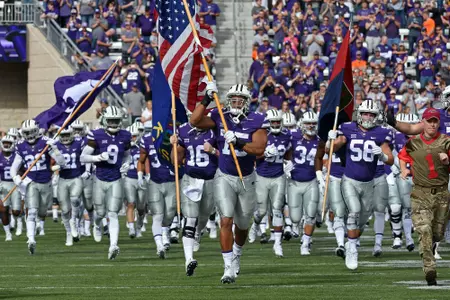
Each team also recognizes its partner unit in various ways. For the football team, this includes the captains carrying the Iron Rangers and Big Red One flags out of the locker room every home game. For other teams, this might mean wearing patches on their jerseys to honor their unit, or even designating a postseason award in their name.
DeGroat has seen the impact these partnerships have created firsthand. In 2006, he remembers driving around the parking lots at Fort Riley and counting the number of Powercat stickers on cars. It was easy.
"You'd never see one," DeGroat said. Now, he said 20 to 30 percent of cars there have one.
"And these people didn't go to K-State. They're not from Kansas," DeGroat added. "That's a subtle way that I think they feel they're belonging to an institution beyond the Army, that gives them another sense of connection and a sense of normalcy while they're living this nomadic life of hopping around the country from military bases intermittently, while they're going back and forth to Iraq and Afghanistan and wherever else.
"I think it has an enormous power of affinity to be a part of something that is value-based, something to be proud of."
Saturday's Fort Riley Day game against West Virginia is another example of how K-State Athletics has taken its appreciation of the military to a higher level. Throughout the years, thousands of soldiers and their family members have enjoyed a K-State game with tickets donated by various sponsors.
"It's really quite an appreciation and it's quite an event," DeGroat said. "There's really nothing like it, a whole-game theme as a tribute to this population."
With K-State Athletics on board, DeGroat has led a whole-of-university approach to education, research and outreach toward military-connected and veteran students.
Since DeGroat started, he said the percentage of military-connected students at K-State has jumped from less than three percent to nearly 14 percent. University scholarships to military students have increased more than threefold, and many outreach programs have been developed for military members and their families have been created.
Now, because of the success at K-State, DeGroat gets a chance to implement the same principles throughout the state.
During Saturday's game, the Kansas Masons will present a donation of $750,000 — part of a $2.5 million gift to Kansas State that will support three other programs on campus —to partner with K-State's Office of Military and Veteran Affairs. The partnership centers on a five-year campaign to implement K-State's approach of how to assist currently serving and veteran service members across the state.
"We're going to teach them to more fully understand who these people are, what they've been through and how to best help them reintegrate back into the Kansas communities," DeGroat said. "The Masons see the value of that, of helping Kansas. It's helping the veterans primarily but it's also helping Kansas be better at accepting them and helping our military veterans and their families at relocating back. That's the nature of the program."
This program, part of the Masons' initiative, "Building Kansas: Facing Challenges & Enriching Lives," was made possible by years of successful practices from K-State's Office of Military and Veteran Affairs. Led by DeGroat, the office started small and slow, steadily growing into the nationally recognized enterprise it is currently.
"It took all of 10 years to get to this point and build this from a small little thing all the way to what is now," he said. "I'm, A, honored but we have, B, earned it. It was a very wise, thoughtful and responsible decision to partner with someone who wants to touch veterans, improve their lives and do it based on science and evidence-based approaches."
Getting to this point required many pieces coming together, from local businesses to student government to deans and presidents. No one piece can explain the progress made in becoming a military-inclusive university, DeGroat said, but K-State Athletics has played a large part.
"Athletics has been a great partner in helping us build K-State into one of the most military-inclusive public universities in America. That's a K-State 2025 aspirational objective. That's the vision of all of this body of work that my office does for the university, is to build us out to be the most military inclusive university in America," said DeGroat, eager to participate in another Fort Riley Day football game that fittingly lands on Veterans Day. "These athletic events are huge because of the audiences that you bring. It's just a wonderful mechanism and platform for helping us advance this vision."
Many major players were involved with creating the uniquely powerful relationship between Kansas State University and Fort Riley, its soldiers and families, but one of them was undoubtedly K-State Athletics.
In 2006, K-State's football team partnered with the Black Lions and, since the group was inactivated, the relationship has continued with the Iron Rangers at Fort Riley. On Thursday, K-State was named as the recipient of the Armed Forces Merit Award presented by the Football Writers Association of America (FWAA) for its relationship with Fort Riley.
K-State's football team, a finalist for the Armed Forces Merit Award the past two years, was the first team to form a relationship with Fort Riley. Now, however, every Wildcat program has a partner unit.
"The partnerships that each of our athletic teams have with Fort Riley, including our football team, are a special and unique component of the experience that we provide all of our student-athletes at our school," said Kansas State Athletics Director Gene Taylor. "Both groups have an immense respect for what each does, and it is a tremendous honor for our student-athletes to build relationships and greater understanding of the work and lifestyles of our service men and women, all whom have sacrificed so much for our country."
When the partnerships began between K-State Athletics and units at Fort Riley, they helped push forward a wider-reaching plan started by U.S. Army Lt. Col. Arthur DeGroat.
"It kind of changed the game," said DeGroat, who retired from the military in 2006 to serve as the director for the newly created Office of Military and Veteran Affairs at K-State.
Throughout each year, K-State's teams travel to Fort Riley for physical training and to get a glimpse into the life of a soldier. In return, their partner units will participate in joint workouts with the Wildcats in Manhattan, where occasionally they also will simply spend time with the coaches and players.
Each team also recognizes its partner unit in various ways. For the football team, this includes the captains carrying the Iron Rangers and Big Red One flags out of the locker room every home game. For other teams, this might mean wearing patches on their jerseys to honor their unit, or even designating a postseason award in their name.
DeGroat has seen the impact these partnerships have created firsthand. In 2006, he remembers driving around the parking lots at Fort Riley and counting the number of Powercat stickers on cars. It was easy.
"You'd never see one," DeGroat said. Now, he said 20 to 30 percent of cars there have one.
"And these people didn't go to K-State. They're not from Kansas," DeGroat added. "That's a subtle way that I think they feel they're belonging to an institution beyond the Army, that gives them another sense of connection and a sense of normalcy while they're living this nomadic life of hopping around the country from military bases intermittently, while they're going back and forth to Iraq and Afghanistan and wherever else.
"I think it has an enormous power of affinity to be a part of something that is value-based, something to be proud of."
Saturday's Fort Riley Day game against West Virginia is another example of how K-State Athletics has taken its appreciation of the military to a higher level. Throughout the years, thousands of soldiers and their family members have enjoyed a K-State game with tickets donated by various sponsors.
"It's really quite an appreciation and it's quite an event," DeGroat said. "There's really nothing like it, a whole-game theme as a tribute to this population."
With K-State Athletics on board, DeGroat has led a whole-of-university approach to education, research and outreach toward military-connected and veteran students.
Since DeGroat started, he said the percentage of military-connected students at K-State has jumped from less than three percent to nearly 14 percent. University scholarships to military students have increased more than threefold, and many outreach programs have been developed for military members and their families have been created.
Now, because of the success at K-State, DeGroat gets a chance to implement the same principles throughout the state.
During Saturday's game, the Kansas Masons will present a donation of $750,000 — part of a $2.5 million gift to Kansas State that will support three other programs on campus —to partner with K-State's Office of Military and Veteran Affairs. The partnership centers on a five-year campaign to implement K-State's approach of how to assist currently serving and veteran service members across the state.
"We're going to teach them to more fully understand who these people are, what they've been through and how to best help them reintegrate back into the Kansas communities," DeGroat said. "The Masons see the value of that, of helping Kansas. It's helping the veterans primarily but it's also helping Kansas be better at accepting them and helping our military veterans and their families at relocating back. That's the nature of the program."
This program, part of the Masons' initiative, "Building Kansas: Facing Challenges & Enriching Lives," was made possible by years of successful practices from K-State's Office of Military and Veteran Affairs. Led by DeGroat, the office started small and slow, steadily growing into the nationally recognized enterprise it is currently.
"It took all of 10 years to get to this point and build this from a small little thing all the way to what is now," he said. "I'm, A, honored but we have, B, earned it. It was a very wise, thoughtful and responsible decision to partner with someone who wants to touch veterans, improve their lives and do it based on science and evidence-based approaches."
Getting to this point required many pieces coming together, from local businesses to student government to deans and presidents. No one piece can explain the progress made in becoming a military-inclusive university, DeGroat said, but K-State Athletics has played a large part.
"Athletics has been a great partner in helping us build K-State into one of the most military-inclusive public universities in America. That's a K-State 2025 aspirational objective. That's the vision of all of this body of work that my office does for the university, is to build us out to be the most military inclusive university in America," said DeGroat, eager to participate in another Fort Riley Day football game that fittingly lands on Veterans Day. "These athletic events are huge because of the audiences that you bring. It's just a wonderful mechanism and platform for helping us advance this vision."
K-State FB | Welcome back Collin Klein
Monday, December 08
K-State FB | Head Coach Collin Klein Radio Interview
Friday, December 05
K-State FB | Head Coach Collin Klein Official Introductory Event
Friday, December 05
K-State FB | Thank You Coach Klieman
Wednesday, December 03