SE: Former K-State TE Jeron Mastrud Uses Football Experience to Start Business, Write Book
Jan 23, 2018 | Football, Sports Extra
By Corbin McGuire
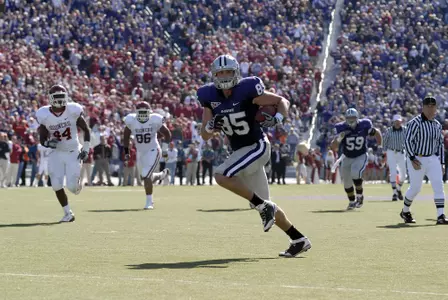
Jeron Mastrud defied long odds coming out of K-State, overcoming injuries and other bumps along the way toward an NFL career. Now, through his experiences in football and business, the former Wildcat is trying to help others accomplish their goals — on the field, at work and in life.
Mastrud's experience with injury and rehabilitation prompted him to start up his own business, Pacific Neuro Therapy in 2014. He founded PNT in his hometown of Portland, Oregon, shortly before being cut by the Chicago Bears and calling it quits on playing football.
What started with one small treatment room and a goal to help younger athletes recover from injuries quickly has grown into a business that has worked with professional and college athletes across the country.
The company has also evolved from strictly using personal training techniques to treat chronic pain, sports injury and surgery rehab, to now employing multiple certified physical therapists. This step has allowed it to bill health insurance companies.
"We worked with some guys on the Seahawks, Cowboys, BYU, Utah, Real Salt Lake, so we got around some different athletes that way, while still seeing guys locally," Mastrud said. "But adding that insurance piece made it a lot easier to have access to work with more people."
Mastrud traces much of his business success back to his journey through football. So much so that he wrote a book, "Stand Tall: How to Lead from Within and Create High Performance Teams," that was released in December.
"I thought to write it from my experiences in high school, college and NFL football, and how I've used things I learned through football and athletics in business and real world situations," said Mastrud, whose book is available to purchase on Amazon (link), while signed copies can be reserved on his website (link). "Whether it's just leading yourself each day, running a company, being a manager or leading a family, a lot of stuff I didn't know at the time applied, from when I was just so focused on playing football, in many other ways."
While examples of the beneficial carryovers from football to life and business are printed throughout the book, Mastrud pointed out a few of the most prominent in his experience.
The first, he said, is visualization.
As a quarterback in high school, Mastrud, who played for his father, began to appreciate the idea behind forming mental images of future situations. His respect for it only grew during his time at K-State, where his 1,219 receiving and 106 receptions still rank first among tight ends in program history.
"(Terence) Newman came in and spoke to us about it. He gave me more details on not just visualizing the plays and what you're doing but other things surrounding yourself. Like, what's the field look like? Are you home or away? Is the game in the afternoon, morning or night? What does it smell like? What's the weather like? So you can really put your brain in that situation and then capitalize on it, so you were never caught off guard with the different situations a football game presents you," Mastrud said. "With all of that, I used it more and more as I was playing to get more comfortable and be able to have more success because I wasn't overly athletic compared to other guys in the NFL. Then I realized all of those same things still apply when you're trying to make sales or get a new business started."
The next lesson Mastrud said he has carried from his life in football has been turning a loss or setback into a positive. And as an undrafted tight end out of K-State in 2010, he experienced plenty of setbacks.
Mastrud signed with the Tampa Bay Buccaneers in 2010 but was let go in the final roster cuts before the season. He was then signed to the New England Patriots' practice squad, a stint that lasted all of one day before he was cut again. Next came another practice squad spot for the Miami Dolphins, where he broke through and was promoted to the 53-man roster two games into the season. He stayed a Dolphin through the 2012 season. Matrud spent his next season as an Oakland Raider, signed with the Chicago Bears in 2014, was released before the regular season and then decided to stop pursuing a career in football.
His time at K-State, he said, prepared him to handle the trials he experienced afterward.
"Learning from a loss, so not looking at losses as negatives, treating them as a learning experience, is something else I learned in college. Because after our losses I'd be furious and not want to look at it, but it's also a great time to figure out you lost because of a reason, so figure out why that was and fix it and make sure it doesn't happen again," said Mastrud, who played three years for Ron Prince at K-State and one year for Bill Snyder. "I think Coach Prince and Coach Snyder presented that in a different manner. Both were good to combine and carry over for when I went to the NFL."
Along the same lines, Mastrud said his time in football taught him the importance of "building your own momentum," especially when adversity strikes.
"It's just like being an entrepreneur in business. You have to build up your own momentum and really taking things by small, piece-by-piece, victory-by-victory moments," he said. "So if you're having a slump of some kind or lost a lot in a row in sales or something like that, I just wrote about things I would do when we lost a lot or I was playing poorly to help rebuild myself because you have to play each week and bring the same intensity.
"I would just buckle it down to the very basic level of, 'Hey, I made my bed today. I got a glass of water in. I brushed my teeth.' That's three quick wins off the back, and now just build from there."
K-State's biggest impact, he said, inspired one of the chapters in his book, "Your Personal Power Players." This section boils down to the help everyone needs to be successful, which he found plenty of as a Wildcat.
"No successful person just makes it alone. They have a group of people around them. So whenever things go bad for them or aren't going well, someone's there to pick them up. Or when things are going right, humble them and bring them back down to reality or just continue to push them to the next level," Mastrud, a two-time Academic All-American at K-State, said. "I had a wide range of people that pushed me in different ways at Kansas State. I was able a network with a lot of great people out there that I felt really embodied the family spirit that K-State talked about when I was first getting recruited. With both Prince and Snyder, I felt nothing but love and as comfortable there as I did back home in Oregon. That one, I would say, is the biggest influence."
Jeron Mastrud defied long odds coming out of K-State, overcoming injuries and other bumps along the way toward an NFL career. Now, through his experiences in football and business, the former Wildcat is trying to help others accomplish their goals — on the field, at work and in life.
Mastrud's experience with injury and rehabilitation prompted him to start up his own business, Pacific Neuro Therapy in 2014. He founded PNT in his hometown of Portland, Oregon, shortly before being cut by the Chicago Bears and calling it quits on playing football.
What started with one small treatment room and a goal to help younger athletes recover from injuries quickly has grown into a business that has worked with professional and college athletes across the country.
The company has also evolved from strictly using personal training techniques to treat chronic pain, sports injury and surgery rehab, to now employing multiple certified physical therapists. This step has allowed it to bill health insurance companies.
"We worked with some guys on the Seahawks, Cowboys, BYU, Utah, Real Salt Lake, so we got around some different athletes that way, while still seeing guys locally," Mastrud said. "But adding that insurance piece made it a lot easier to have access to work with more people."
Mastrud traces much of his business success back to his journey through football. So much so that he wrote a book, "Stand Tall: How to Lead from Within and Create High Performance Teams," that was released in December.
"I thought to write it from my experiences in high school, college and NFL football, and how I've used things I learned through football and athletics in business and real world situations," said Mastrud, whose book is available to purchase on Amazon (link), while signed copies can be reserved on his website (link). "Whether it's just leading yourself each day, running a company, being a manager or leading a family, a lot of stuff I didn't know at the time applied, from when I was just so focused on playing football, in many other ways."
While examples of the beneficial carryovers from football to life and business are printed throughout the book, Mastrud pointed out a few of the most prominent in his experience.
The first, he said, is visualization.
As a quarterback in high school, Mastrud, who played for his father, began to appreciate the idea behind forming mental images of future situations. His respect for it only grew during his time at K-State, where his 1,219 receiving and 106 receptions still rank first among tight ends in program history.
"(Terence) Newman came in and spoke to us about it. He gave me more details on not just visualizing the plays and what you're doing but other things surrounding yourself. Like, what's the field look like? Are you home or away? Is the game in the afternoon, morning or night? What does it smell like? What's the weather like? So you can really put your brain in that situation and then capitalize on it, so you were never caught off guard with the different situations a football game presents you," Mastrud said. "With all of that, I used it more and more as I was playing to get more comfortable and be able to have more success because I wasn't overly athletic compared to other guys in the NFL. Then I realized all of those same things still apply when you're trying to make sales or get a new business started."
The next lesson Mastrud said he has carried from his life in football has been turning a loss or setback into a positive. And as an undrafted tight end out of K-State in 2010, he experienced plenty of setbacks.
Mastrud signed with the Tampa Bay Buccaneers in 2010 but was let go in the final roster cuts before the season. He was then signed to the New England Patriots' practice squad, a stint that lasted all of one day before he was cut again. Next came another practice squad spot for the Miami Dolphins, where he broke through and was promoted to the 53-man roster two games into the season. He stayed a Dolphin through the 2012 season. Matrud spent his next season as an Oakland Raider, signed with the Chicago Bears in 2014, was released before the regular season and then decided to stop pursuing a career in football.
His time at K-State, he said, prepared him to handle the trials he experienced afterward.
"Learning from a loss, so not looking at losses as negatives, treating them as a learning experience, is something else I learned in college. Because after our losses I'd be furious and not want to look at it, but it's also a great time to figure out you lost because of a reason, so figure out why that was and fix it and make sure it doesn't happen again," said Mastrud, who played three years for Ron Prince at K-State and one year for Bill Snyder. "I think Coach Prince and Coach Snyder presented that in a different manner. Both were good to combine and carry over for when I went to the NFL."
Along the same lines, Mastrud said his time in football taught him the importance of "building your own momentum," especially when adversity strikes.
"It's just like being an entrepreneur in business. You have to build up your own momentum and really taking things by small, piece-by-piece, victory-by-victory moments," he said. "So if you're having a slump of some kind or lost a lot in a row in sales or something like that, I just wrote about things I would do when we lost a lot or I was playing poorly to help rebuild myself because you have to play each week and bring the same intensity.
"I would just buckle it down to the very basic level of, 'Hey, I made my bed today. I got a glass of water in. I brushed my teeth.' That's three quick wins off the back, and now just build from there."
K-State's biggest impact, he said, inspired one of the chapters in his book, "Your Personal Power Players." This section boils down to the help everyone needs to be successful, which he found plenty of as a Wildcat.
"No successful person just makes it alone. They have a group of people around them. So whenever things go bad for them or aren't going well, someone's there to pick them up. Or when things are going right, humble them and bring them back down to reality or just continue to push them to the next level," Mastrud, a two-time Academic All-American at K-State, said. "I had a wide range of people that pushed me in different ways at Kansas State. I was able a network with a lot of great people out there that I felt really embodied the family spirit that K-State talked about when I was first getting recruited. With both Prince and Snyder, I felt nothing but love and as comfortable there as I did back home in Oregon. That one, I would say, is the biggest influence."
K-State FB | Welcome back Collin Klein
Monday, December 08
K-State FB | Head Coach Collin Klein Radio Interview
Friday, December 05
K-State FB | Head Coach Collin Klein Official Introductory Event
Friday, December 05
K-State FB | Thank You Coach Klieman
Wednesday, December 03