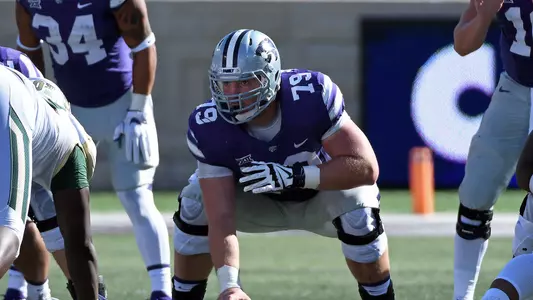
SE: Q&A with Former Ivy League Recruit, Academic All-American & Second-Year K-State Football Starter Adam Holtorf
Oct 31, 2018 | Football, Sports Extra
By Corbin McGuire
Adam Holtorf is used to doing interviews for football. A second-year starter at center for K-State, it comes with the territory. Lately, however, his interview requests have come from publications wanting to know more about his academic success.
Holtorf recently did an interview with the Kansas State Agriculturist, the College of Agriculture's bi-annual publication he will be featured in. He did another with the College of Agriculture's E-Newsletter.
Named a Second Team Academic All-American last December, these requests also come with the territory. K-State's first Academic All-American in football since Curry Sexton in 2014 and its first offensive lineman to earn the distinction since Ryan Lilja in 2003, Holtorf has grown accustomed to talking about agriculture as much as football.
A native of Seward, Nebraska, where his father is a professor at Concordia University, Holtorf's academic achievements are a product of many different factors. These range from family to athletics to help from everyone in between.
Once recruited by multiple Ivy League schools, he is now a redshirt junior with a 3.9-plus GPA for K-State, which travels to face TCU on Saturday at 2:30 p.m., on FS1. Holtorf, who will graduate with his bachelor's degree in December before starting his master's in business administration, sat down with K-State Sports Extra to talk about his academic success, his path to K-State and his journey so far as a Wildcat.
SE: Where would you say your academic drive came from?
AH: I would say a lot it came from a young age, from my parents. My dad's a college professor and both him and my mom have always, not pushed me in academics, but made it important to me. They said that a college education and your education in high school is something that is very important. So, taking that from a young age, putting that emphasis on school, I always wanted to do well. And I'm competitive in that respect, too, always wanting to do better than the people I was in class with, trying to compete. So, a little bit of that competitiveness from athletics kind of transferred into the classroom as well.
SE: I read somewhere you were also recruited by Harvard?
AH: I had a couple of Ivy League offers. I had a 4.0 GPA in high school, but my ACT was low enough that if I wanted to even pursue something like that, they would accept me, but I was pretty much on their lower band of acceptance. They would pretty much make an exception because of athletics. I could have probably gotten in, but it wouldn't have been a lock, so to speak. My ACT was decent, but it wasn't quite at the level that an Ivy League (school) looks for.
SE: Was the Ivy League ever a goal of yours? How did you process being recruited by those schools?
AH: It was more surreal when that happened. That was never a goal I actively pursued. The mail started showing up one day, and when you go through the recruiting process you kind of pursue every lead that you can. I started kind of pursuing those leads, and they ended up in a couple offers. That was something that I never expected but it was really exciting when that happened.
SE: When did K-State enter the picture for you?
AH: It was the spring of my junior year of high school. They were the second offer I ever got. So, in terms of the recruiting cycle, they entered really early. They were active in that whole process. They were always in contact with me, whether it was Coach (Taylor) Braet, the recruiting coordinator, Coach (Charlie) Dickey, Coach (Del) Miller, at the time the recruiter for Nebraska, they were very active throughout the recruiting process.
SE: In the end, what ultimately sold you on coming to K-State?
AH: There were a lot of things. It's fairly close to home for me. It's only about two and a half hours away. K-State's got a great College of Agriculture, great facilities, so it was kind of a culmination of all those parts. It seemed like a great fit from the academic side, from the athletics side. And just the bond within the (football) program… family's put out as a slogan and stuff, but that was something that I truly felt, that the team was a family, that the athletic department was a family, so to add that on to the academic side, it seemed like a great fit.
SE: You obviously had success in athletics and academics in high school. What is the biggest challenge of trying to replicate that at the college level?
AH: The biggest thing is time management. It's tricky just to balance the football commitments but the academic commitments are another big thing. (Academic counselors) Bill Banks, Kim Gross and all the staff down in the SAAC, the academic center, did a great job for me. They provided that structure I needed my first semester and then that second semester, too, with the mandatory study hours, filling out daily planners, charting out when your classes are, what kind of homework you had. Coming in from high school that was big for me because it helped develop a routine, and once I got that routine engrained and hammered out and what works for me, that was huge then going forward. That kind of a springboard sent me down the right direction throughout my college career in terms of learning how to balance those sort of things.
SE: You mentioned the help you got from people within K-State Athletics' academics and student-athlete services department. How would you describe the impact they have on student-athletes, especially early on in their careers?
AH: I think it's huge, especially early on for those athletes coming out of high school just because the time commitment for both sides is amplified by 100 in terms of the time commitment for practicing and the time commitment for classes. Classes are a lot harder as well, so that ability for them to be able to step in early on and say, 'This is what we recommend, this is what you should be doing in terms of how much you should be studying,' as well as making sure you're doing your homework at certain times is huge because it doesn't allow time for those bad habits to develop.
SE: About a year ago you were named an Academic All American. What does that honor mean to you even now?
AH: That means a lot to me, just because it's a recognition that's a culmination of academics and athletics, in my eyes. It's not that I'm just getting it done on the field or in the classroom. To me, it's a culmination of the two.
SE: You obviously spend a lot of time with Coach Dickey. What are some the biggest lessons you've taken from him so far?
AH: There's countless life lessons I've learned from him. Just the ability to deal with adversity. There's countless quotes he's had but there's one he's used, especially a lot lately this year, but he's used in the past, too: The ultimate measure of a man is not where he stands in times of comfort and convenience but where he stands at times of challenge and controversy. The idea that it's not who you are when things are going well but who you are when your back's against the wall and faced with tough times. That's one that's always stuck with me. Those sort of things. The idea that he really tries to instill in us to be the type of man your parents are proud of, your family's proud of, ultimately the type of man you're going to be after football. Those things are huge. Those are things that are going to stick with me way after my football career is done.
SE: You were a 4.0 student high school and have a 3.97 GPA at K-State. I'm not a numbers expert, so I'll just ask: How many Bs have you gotten in your K-State career?
AH: One. This semester, we'll have to see. I have a few borderline. But I've had one, it was a B in biology my freshman year. Other than that, I've had all As.
SE: Is that you being more of a perfectionist or your athletic competitiveness showing?
AH: Competitiveness first. I'm probably a little bit of a perfectionist, but it all comes back to my competitiveness, just knowing that I want to do the best I can.
Adam Holtorf is used to doing interviews for football. A second-year starter at center for K-State, it comes with the territory. Lately, however, his interview requests have come from publications wanting to know more about his academic success.
Holtorf recently did an interview with the Kansas State Agriculturist, the College of Agriculture's bi-annual publication he will be featured in. He did another with the College of Agriculture's E-Newsletter.
Named a Second Team Academic All-American last December, these requests also come with the territory. K-State's first Academic All-American in football since Curry Sexton in 2014 and its first offensive lineman to earn the distinction since Ryan Lilja in 2003, Holtorf has grown accustomed to talking about agriculture as much as football.
A native of Seward, Nebraska, where his father is a professor at Concordia University, Holtorf's academic achievements are a product of many different factors. These range from family to athletics to help from everyone in between.
Once recruited by multiple Ivy League schools, he is now a redshirt junior with a 3.9-plus GPA for K-State, which travels to face TCU on Saturday at 2:30 p.m., on FS1. Holtorf, who will graduate with his bachelor's degree in December before starting his master's in business administration, sat down with K-State Sports Extra to talk about his academic success, his path to K-State and his journey so far as a Wildcat.
SE: Where would you say your academic drive came from?
AH: I would say a lot it came from a young age, from my parents. My dad's a college professor and both him and my mom have always, not pushed me in academics, but made it important to me. They said that a college education and your education in high school is something that is very important. So, taking that from a young age, putting that emphasis on school, I always wanted to do well. And I'm competitive in that respect, too, always wanting to do better than the people I was in class with, trying to compete. So, a little bit of that competitiveness from athletics kind of transferred into the classroom as well.
SE: I read somewhere you were also recruited by Harvard?
AH: I had a couple of Ivy League offers. I had a 4.0 GPA in high school, but my ACT was low enough that if I wanted to even pursue something like that, they would accept me, but I was pretty much on their lower band of acceptance. They would pretty much make an exception because of athletics. I could have probably gotten in, but it wouldn't have been a lock, so to speak. My ACT was decent, but it wasn't quite at the level that an Ivy League (school) looks for.
SE: Was the Ivy League ever a goal of yours? How did you process being recruited by those schools?
AH: It was more surreal when that happened. That was never a goal I actively pursued. The mail started showing up one day, and when you go through the recruiting process you kind of pursue every lead that you can. I started kind of pursuing those leads, and they ended up in a couple offers. That was something that I never expected but it was really exciting when that happened.
SE: When did K-State enter the picture for you?
AH: It was the spring of my junior year of high school. They were the second offer I ever got. So, in terms of the recruiting cycle, they entered really early. They were active in that whole process. They were always in contact with me, whether it was Coach (Taylor) Braet, the recruiting coordinator, Coach (Charlie) Dickey, Coach (Del) Miller, at the time the recruiter for Nebraska, they were very active throughout the recruiting process.
SE: In the end, what ultimately sold you on coming to K-State?
AH: There were a lot of things. It's fairly close to home for me. It's only about two and a half hours away. K-State's got a great College of Agriculture, great facilities, so it was kind of a culmination of all those parts. It seemed like a great fit from the academic side, from the athletics side. And just the bond within the (football) program… family's put out as a slogan and stuff, but that was something that I truly felt, that the team was a family, that the athletic department was a family, so to add that on to the academic side, it seemed like a great fit.
SE: You obviously had success in athletics and academics in high school. What is the biggest challenge of trying to replicate that at the college level?
AH: The biggest thing is time management. It's tricky just to balance the football commitments but the academic commitments are another big thing. (Academic counselors) Bill Banks, Kim Gross and all the staff down in the SAAC, the academic center, did a great job for me. They provided that structure I needed my first semester and then that second semester, too, with the mandatory study hours, filling out daily planners, charting out when your classes are, what kind of homework you had. Coming in from high school that was big for me because it helped develop a routine, and once I got that routine engrained and hammered out and what works for me, that was huge then going forward. That kind of a springboard sent me down the right direction throughout my college career in terms of learning how to balance those sort of things.
SE: You mentioned the help you got from people within K-State Athletics' academics and student-athlete services department. How would you describe the impact they have on student-athletes, especially early on in their careers?
AH: I think it's huge, especially early on for those athletes coming out of high school just because the time commitment for both sides is amplified by 100 in terms of the time commitment for practicing and the time commitment for classes. Classes are a lot harder as well, so that ability for them to be able to step in early on and say, 'This is what we recommend, this is what you should be doing in terms of how much you should be studying,' as well as making sure you're doing your homework at certain times is huge because it doesn't allow time for those bad habits to develop.
SE: About a year ago you were named an Academic All American. What does that honor mean to you even now?
AH: That means a lot to me, just because it's a recognition that's a culmination of academics and athletics, in my eyes. It's not that I'm just getting it done on the field or in the classroom. To me, it's a culmination of the two.
SE: You obviously spend a lot of time with Coach Dickey. What are some the biggest lessons you've taken from him so far?
AH: There's countless life lessons I've learned from him. Just the ability to deal with adversity. There's countless quotes he's had but there's one he's used, especially a lot lately this year, but he's used in the past, too: The ultimate measure of a man is not where he stands in times of comfort and convenience but where he stands at times of challenge and controversy. The idea that it's not who you are when things are going well but who you are when your back's against the wall and faced with tough times. That's one that's always stuck with me. Those sort of things. The idea that he really tries to instill in us to be the type of man your parents are proud of, your family's proud of, ultimately the type of man you're going to be after football. Those things are huge. Those are things that are going to stick with me way after my football career is done.
SE: You were a 4.0 student high school and have a 3.97 GPA at K-State. I'm not a numbers expert, so I'll just ask: How many Bs have you gotten in your K-State career?
AH: One. This semester, we'll have to see. I have a few borderline. But I've had one, it was a B in biology my freshman year. Other than that, I've had all As.
SE: Is that you being more of a perfectionist or your athletic competitiveness showing?
AH: Competitiveness first. I'm probably a little bit of a perfectionist, but it all comes back to my competitiveness, just knowing that I want to do the best I can.
Players Mentioned
OL
/ FootballK-State FB | Welcome back Collin Klein
Monday, December 08
K-State FB | Head Coach Collin Klein Radio Interview
Friday, December 05
K-State FB | Head Coach Collin Klein Official Introductory Event
Friday, December 05
K-State FB | Thank You Coach Klieman
Wednesday, December 03