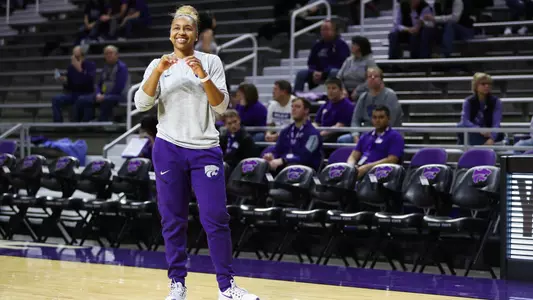
SE: Player to Coach — How an Injury Ended My Time on the Court, Started My Dream on the Sideline
Feb 13, 2018 | Women's Basketball, Sports Extra
By Karyla Middlebrook
July 30, 2017
We were about to have one of our last few practices in preparation for our four-game stint in Europe. I could barely walk. The pain, the swelling and the redness around my ankle were all too familiar. Becca Fitzgerald, the team trainer, took one look and called the team doctor.
Less than 30 minutes went by before the doctor was standing in front of me saying a sentence that I never thought I'd have to hear again, at least never again that summer.
"You're going to have to go into surgery…"
Before I knew it, I was leaving practice and calling my parents to let them know that I was about to undergo my fourth surgery since March 31.
It all happened so fast.
All I could think about was how would I be able to recover fast enough to still go on our trip to Europe? There was no way another infection would prevent me from going to Italy, Switzerland, and Austria — two of which I've never been to before.
I spent the next two days at the hospital in Manhattan, heavily pushing IV antibiotics and doing everything we could to speed up the healing... not knowing if I'd be able to join my team on its journey overseas. This was my lowest moment thus far.
After long discussions with my parents, the doctor and Becca, we came to an agreement that I could go on the trip IF I was willing to spend about half of each day in the hotel elevating my leg.
For four months prior, I had been hopping around on crutches everywhere. So once it was decided that I could go on the trip, I was gifted with a new pair of wheels: One of those cool scooters that you rest your knee on and push with your healthy leg to move around.
I was all set to take on the cobble streets of Europe.
It wasn't easy maneuvering that thing throughout the trip. In fact, when we got to Switzerland I think I may have spent more time hopping on one leg up the winding staircases of the hillsides than I did on my scooter. By day two I had completely exhausted the muscles in my left leg, so Kayla Goth, one of my teammates, carried me
on her back up the rest of the hill.


Although I had to miss a few touristy activities and was dog-tired from scooting around everywhere, I was so grateful that I was able to make new memories with my team. Not to mention having a flame of eagerness to get back on the court, sparked by watching my team play for the first time without me. My excitement for the season was at an all-time high after leaving Europe.
September 12, 2017
It was 5 a.m., and I was checking into yet another surgery. My family and I drove to Cleveland for what we thought would be a quick trip. We were under the impression that we were just going to confirm the positive diagnosis that we received from the Wound Care Specialist in Manhattan a few days prior. The unexpectedness of this surgery was almost just as shocking as the previous surgery.
To say the least, I was less than thrilled about going under again… but this one felt different.
I was at the Cleveland Clinic, one of the best hospitals in the United States, being taken care of by a top Infectious Disease Specialist, Dr. Steven Schmitt, and had a top orthopedic surgeon, Dr. Sara Miniaci-Coxhead, performing my surgery. I was confident that this would be my last one.
My confidence served correct. That was indeed my last surgery, but it did not come without another low moment.
For nearly a month after surgery, I was required to have an IV PICC-Line to pump antibiotics into my body, which my in-home nurse changed weekly. I hated the attention that the PICC-Line drew on me — I guess it's hard to not stare at a girl riding around on a scooter with a long clear tube sticking out of her arm leading into a very dated fanny pack around her waist. Not to mention the annoying suction noise that came from the fanny pack as a result of the wound VAC (vacuum-assisted closure) that was inside my splint. Because of that, I tried to hide it as best I could with long-sleeved shirts and jackets.
It took six total months, five surgeries, four months of being non-weight bearing, three weeks of IV antibiotics, two months of oral antibiotics after that, and one great support system consisting of my family, teammates, coaches and doctors before I was on the right road to recovery.
As you can probably imagine, that road was a long one, but I was finally on it.
December 18, 2017

Over the last couple of months, I worked my tail off for this day. I had all online classes, so I spent about five hours each day in rehab doing everything I could to get to this moment. It was time for all the work I put in to pay off.
Going into the game against Chicago State, Coach Mittie and Becca made it very clear that I was only ready to play 10 to 15 minutes that night, but that was 10 to 15 minutes that most of the dozens of trainers and doctors that we collaborated with throughout my journey said that I'd probably never see. So I was okay with that.
As expected, I was a little rusty and little gimpy during that game. I knew it would take a while before I would be back to being the quick, athletic point guard who used her explosiveness to finish at the rim.
The question I had in my head was: How long would it be before I was myself again?
January 2, 2018
This day was a tough day. I spent most of it with a knot in my stomach and a lump in my throat. I hated having to face the reality of the decision that I knew was time to make. I had to stop playing basketball.
I had prolonged this moment for a week. I did anything that I could think of to avoid this day. I had asked Coach Mittie for three things that I could focus on doing in games to help the team; and I had sat down with Coach Carr and had a conversation about dealing with coming back from long injuries. I did these things in hopes that the feeling I had of my career coming to an end was just a temporary and untruthful notion. After three more games, the realities of that feeling were inevitable.
See, within my personality lies the conundrum of balancing optimism and realism. I believe in focusing on the positive things in life and keeping a "glass half full, not half empty" perspective. However, I also like to stay realistic about situations to avoid unnecessarily getting my hopes up.

So, facing this decision was the epitome of my personality conundrum. On top of that, I feared the disappointment that came with this decision. I didn't want to let down my teammates and coaches, but more importantly I didn't want to let down my family.
I come from a basketball family. For as long as I can remember, we were always going to one of my cousins' games or watching a game on TV. I'm the youngest of three girls and I was also the only one to play basketball. So the pressure to succeed at this sport was something that I always felt. This made the phone call to tell my dad extremely nerve-wrecking! He was the one who got me involved in the sport before I was five. He even started an AAU program for me that eventually gained national notoriety.
But on January 1, I called my dad and informed him of the heartbreaking decision that I knew was right for me.
The conversation went something like this:
We were in agreeance that it would do no good for me to continue to put myself through so much pain playing on a less-than-100-percent ankle, since it was preventing me from being the player that I wanted to be… the player that I used to be… the player that my team needed me to be.
His understanding helped me come to peace with my decision. It gave me comfort in that I was making the right decision after all.
So on January 2, after practice, I told Coach Mittie where I stood and that despite being done on the court, I still wanted to be around and involved in with the team as much as possible. With empathy, he understood and suggested that I become a student assistant coach.
Evident that I wouldn't finish my senior year as a player, I knew finishing it as a coach would be the next best thing. The idea of getting what I viewed as an internship to the career I felt destined to was enticing. I could not have imagined a better way for Coach Mittie to handle the unfortunate situation he was presented with.
February 13, 2018
Basketball was my first love. I'm a junkie of game. It's in my blood. It's why coaching, for me, is the only thing that makes sense after school.
I have always been considered as someone with a relatively high basketball IQ, a gift I developed growing up. A gift I hope will help many players as a coach.

Like many aspiring coaches, I have been fortunate to grow up around some great basketball minds.
My cousin, Terry Nooner, played for the great Roy Williams at Kansas (1997-2000) and took me under his wing once his playing days were over. Starting in sixth grade, he worked me out multiple times a week, occasionally letting me join workouts with his best friend, Tyronn Lue — and yes, I'm talking about the same Tyronn Lue who now coaches LeBron James.
At the time, I did not realize the magnitude of the impact Terry, who coached the AAU team my dad started before becoming an assistant at Alabama for the first two of my three years at Alabama, and Tyronn would have on me.
Fast forward to K-State, a place that made sense to come to as a graduate transfer for many reasons — Big 12 experience, NCAA Tournament potential and well-respected coaches, just to name a few — and the amount of knowledge I have gained has been exponential.
This new role as a student assistant has allowed me to be able to do things like sit down with the coaches and watch how they approach a scout; or meet with our video coordinator, Tasha Dickey, to see how to break down film; or even get more insight on some of the in-game responsibilities that assistant coaches have by keeping track of offensive possessions, play calls and play results.
I was also given the assignment to really focus my attention on helping Cymone Goodrich, one of our athletic freshman guards, as well as Kayla Goth, our new starting point guard. Coach Mittie believed that I could really help these two players, in particular, considering at some point in my career, I too had to learn how and when to insert my athleticism, as well as how to handle the high demands that come with playing the point guard position.
Being so recently removed from my playing days has given me an advantage with my new assignment.
It was easy for me to see and understand the perspectives of both of the players and the coaches. In timeouts, as I watch coaches pull players aside to give them a mid-game adjustment, I can usually anticipate what critique the coach is going to make before he/she makes it and I can also predict what explanation the player might give back to the coach as to what they saw from the court. That ability has helped me learn how to take the knowledge that I have been receiving as a new student coach and translate it in a way in which is easy for the players to understand why it holds true.

The best part about my new role as student assistant coach is that it has given me the opportunity to build on the relationships with my teammates in a new way, while expanding my knowledge and understanding of the game. It has given me an opportunity to help carry them to different heights of improvement on the court, much like they helped carry me, literally and figuratively, through one of the most challenging periods of my life.
As I started writing this story… my story… it was surprisingly emotional to think back to everything I experienced. However, from the best moments to the worst, I wouldn't change a single thing. I am a strong believer that everything happens for a reason. So when the door closed on my playing career January 2, a new one opened for my coaching career on January 3.
I am excited to see where it leads me next.

July 30, 2017
We were about to have one of our last few practices in preparation for our four-game stint in Europe. I could barely walk. The pain, the swelling and the redness around my ankle were all too familiar. Becca Fitzgerald, the team trainer, took one look and called the team doctor.
Less than 30 minutes went by before the doctor was standing in front of me saying a sentence that I never thought I'd have to hear again, at least never again that summer.
"You're going to have to go into surgery…"
Before I knew it, I was leaving practice and calling my parents to let them know that I was about to undergo my fourth surgery since March 31.
It all happened so fast.
All I could think about was how would I be able to recover fast enough to still go on our trip to Europe? There was no way another infection would prevent me from going to Italy, Switzerland, and Austria — two of which I've never been to before.
I spent the next two days at the hospital in Manhattan, heavily pushing IV antibiotics and doing everything we could to speed up the healing... not knowing if I'd be able to join my team on its journey overseas. This was my lowest moment thus far.
After long discussions with my parents, the doctor and Becca, we came to an agreement that I could go on the trip IF I was willing to spend about half of each day in the hotel elevating my leg.
For four months prior, I had been hopping around on crutches everywhere. So once it was decided that I could go on the trip, I was gifted with a new pair of wheels: One of those cool scooters that you rest your knee on and push with your healthy leg to move around.
I was all set to take on the cobble streets of Europe.
It wasn't easy maneuvering that thing throughout the trip. In fact, when we got to Switzerland I think I may have spent more time hopping on one leg up the winding staircases of the hillsides than I did on my scooter. By day two I had completely exhausted the muscles in my left leg, so Kayla Goth, one of my teammates, carried me
on her back up the rest of the hill.
September 12, 2017
It was 5 a.m., and I was checking into yet another surgery. My family and I drove to Cleveland for what we thought would be a quick trip. We were under the impression that we were just going to confirm the positive diagnosis that we received from the Wound Care Specialist in Manhattan a few days prior. The unexpectedness of this surgery was almost just as shocking as the previous surgery.
To say the least, I was less than thrilled about going under again… but this one felt different.
I was at the Cleveland Clinic, one of the best hospitals in the United States, being taken care of by a top Infectious Disease Specialist, Dr. Steven Schmitt, and had a top orthopedic surgeon, Dr. Sara Miniaci-Coxhead, performing my surgery. I was confident that this would be my last one.
My confidence served correct. That was indeed my last surgery, but it did not come without another low moment.
For nearly a month after surgery, I was required to have an IV PICC-Line to pump antibiotics into my body, which my in-home nurse changed weekly. I hated the attention that the PICC-Line drew on me — I guess it's hard to not stare at a girl riding around on a scooter with a long clear tube sticking out of her arm leading into a very dated fanny pack around her waist. Not to mention the annoying suction noise that came from the fanny pack as a result of the wound VAC (vacuum-assisted closure) that was inside my splint. Because of that, I tried to hide it as best I could with long-sleeved shirts and jackets.
It took six total months, five surgeries, four months of being non-weight bearing, three weeks of IV antibiotics, two months of oral antibiotics after that, and one great support system consisting of my family, teammates, coaches and doctors before I was on the right road to recovery.
As you can probably imagine, that road was a long one, but I was finally on it.
December 18, 2017
Over the last couple of months, I worked my tail off for this day. I had all online classes, so I spent about five hours each day in rehab doing everything I could to get to this moment. It was time for all the work I put in to pay off.
Going into the game against Chicago State, Coach Mittie and Becca made it very clear that I was only ready to play 10 to 15 minutes that night, but that was 10 to 15 minutes that most of the dozens of trainers and doctors that we collaborated with throughout my journey said that I'd probably never see. So I was okay with that.
As expected, I was a little rusty and little gimpy during that game. I knew it would take a while before I would be back to being the quick, athletic point guard who used her explosiveness to finish at the rim.
The question I had in my head was: How long would it be before I was myself again?
January 2, 2018
This day was a tough day. I spent most of it with a knot in my stomach and a lump in my throat. I hated having to face the reality of the decision that I knew was time to make. I had to stop playing basketball.
I had prolonged this moment for a week. I did anything that I could think of to avoid this day. I had asked Coach Mittie for three things that I could focus on doing in games to help the team; and I had sat down with Coach Carr and had a conversation about dealing with coming back from long injuries. I did these things in hopes that the feeling I had of my career coming to an end was just a temporary and untruthful notion. After three more games, the realities of that feeling were inevitable.
See, within my personality lies the conundrum of balancing optimism and realism. I believe in focusing on the positive things in life and keeping a "glass half full, not half empty" perspective. However, I also like to stay realistic about situations to avoid unnecessarily getting my hopes up.
So, facing this decision was the epitome of my personality conundrum. On top of that, I feared the disappointment that came with this decision. I didn't want to let down my teammates and coaches, but more importantly I didn't want to let down my family.
I come from a basketball family. For as long as I can remember, we were always going to one of my cousins' games or watching a game on TV. I'm the youngest of three girls and I was also the only one to play basketball. So the pressure to succeed at this sport was something that I always felt. This made the phone call to tell my dad extremely nerve-wrecking! He was the one who got me involved in the sport before I was five. He even started an AAU program for me that eventually gained national notoriety.
But on January 1, I called my dad and informed him of the heartbreaking decision that I knew was right for me.
The conversation went something like this:
Me: "Sooo, I've been doing some thinking and I just don't think it's in my best interest to continue playing this season."
Him: "Are you sure?"
Me: "I think so. I just can't move the way I need to in order to be effective. I'm slower, I can't jump as high, and I'm always in pain… I just don't see it magically getting much better."
Him: "Honestly, 'Ry, I was thinking the same thing, but I wanted this to be your decision… I think it's time for you to go ahead and hang the shoes up."
Him: "Are you sure?"
Me: "I think so. I just can't move the way I need to in order to be effective. I'm slower, I can't jump as high, and I'm always in pain… I just don't see it magically getting much better."
Him: "Honestly, 'Ry, I was thinking the same thing, but I wanted this to be your decision… I think it's time for you to go ahead and hang the shoes up."
We were in agreeance that it would do no good for me to continue to put myself through so much pain playing on a less-than-100-percent ankle, since it was preventing me from being the player that I wanted to be… the player that I used to be… the player that my team needed me to be.
His understanding helped me come to peace with my decision. It gave me comfort in that I was making the right decision after all.
So on January 2, after practice, I told Coach Mittie where I stood and that despite being done on the court, I still wanted to be around and involved in with the team as much as possible. With empathy, he understood and suggested that I become a student assistant coach.
Evident that I wouldn't finish my senior year as a player, I knew finishing it as a coach would be the next best thing. The idea of getting what I viewed as an internship to the career I felt destined to was enticing. I could not have imagined a better way for Coach Mittie to handle the unfortunate situation he was presented with.
February 13, 2018
Basketball was my first love. I'm a junkie of game. It's in my blood. It's why coaching, for me, is the only thing that makes sense after school.
I have always been considered as someone with a relatively high basketball IQ, a gift I developed growing up. A gift I hope will help many players as a coach.
Like many aspiring coaches, I have been fortunate to grow up around some great basketball minds.
My cousin, Terry Nooner, played for the great Roy Williams at Kansas (1997-2000) and took me under his wing once his playing days were over. Starting in sixth grade, he worked me out multiple times a week, occasionally letting me join workouts with his best friend, Tyronn Lue — and yes, I'm talking about the same Tyronn Lue who now coaches LeBron James.
At the time, I did not realize the magnitude of the impact Terry, who coached the AAU team my dad started before becoming an assistant at Alabama for the first two of my three years at Alabama, and Tyronn would have on me.
Fast forward to K-State, a place that made sense to come to as a graduate transfer for many reasons — Big 12 experience, NCAA Tournament potential and well-respected coaches, just to name a few — and the amount of knowledge I have gained has been exponential.
This new role as a student assistant has allowed me to be able to do things like sit down with the coaches and watch how they approach a scout; or meet with our video coordinator, Tasha Dickey, to see how to break down film; or even get more insight on some of the in-game responsibilities that assistant coaches have by keeping track of offensive possessions, play calls and play results.
I was also given the assignment to really focus my attention on helping Cymone Goodrich, one of our athletic freshman guards, as well as Kayla Goth, our new starting point guard. Coach Mittie believed that I could really help these two players, in particular, considering at some point in my career, I too had to learn how and when to insert my athleticism, as well as how to handle the high demands that come with playing the point guard position.
Being so recently removed from my playing days has given me an advantage with my new assignment.
It was easy for me to see and understand the perspectives of both of the players and the coaches. In timeouts, as I watch coaches pull players aside to give them a mid-game adjustment, I can usually anticipate what critique the coach is going to make before he/she makes it and I can also predict what explanation the player might give back to the coach as to what they saw from the court. That ability has helped me learn how to take the knowledge that I have been receiving as a new student coach and translate it in a way in which is easy for the players to understand why it holds true.
The best part about my new role as student assistant coach is that it has given me the opportunity to build on the relationships with my teammates in a new way, while expanding my knowledge and understanding of the game. It has given me an opportunity to help carry them to different heights of improvement on the court, much like they helped carry me, literally and figuratively, through one of the most challenging periods of my life.
As I started writing this story… my story… it was surprisingly emotional to think back to everything I experienced. However, from the best moments to the worst, I wouldn't change a single thing. I am a strong believer that everything happens for a reason. So when the door closed on my playing career January 2, a new one opened for my coaching career on January 3.
I am excited to see where it leads me next.
Players Mentioned
G
/ Women's Basketball
G
/ Women's Basketball
G
/ Women's BasketballWednesday, September 23
Wednesday, September 23
Monday, September 21
Saturday, September 19