Feb 28, 2018 | Football, Sports Extra
By Dave Stewart
Guest Writer
I still remember the first time Jim Dickey was publicly interviewed at Kansas State, which preceded the first time he interviewed me in private.
James Howard Dickey was introduced as head coach at a press conference inside the student union, shortly after North Carolina lost to Nebraska in the 1977 Liberty Bowl, 21-17. He served as the Tar Heels' defensive coordinator for three years.
With his bride, Inez, at his elbow, Dickey admitted to the media and boosters he knew the dirty little secret that KSU hadn't won a conference championship since 1934, the year Dickey was born. That's when Pappy Waldorf led the Wildcats to a Big Six title.
Dickey joked that if he didn't win a championship in 43 years, then he'd quit.
And so began a run of one-liners and risky roster moves that led to his Wildcats making history with the school's first-ever bowl appearance in his fifth season.
Before moving to Manhattan, Dickey appeared to be content as a career assistant. His first 15 years in the business included coaching-up future Hall of Famer Lawrence Taylor at UNC. Defensive lineman Dee Hardison was also a consensus All-American who played a decade in the NFL, ending his career with the Kansas City Chiefs.
Dickey also worked the Oklahoma sideline as defensive backs coach in the "Game of the Century" against Nebraska, matching the top two teams in college football. It would be the Sooners' only loss in the 1972 season.
That was one of the fun facts I learned about Coach five years ago at a late-night poolside chat when I peppered him with questions about people, places and his past. I could've picked his brain even longer if he allowed it.
Since Dickey knew the rugged terrain in our conference, he was willing to take the K-State job, even though many considered it the worst in the country. Ellis Rainsberger had just been fired after losing all 21 of his league games.
"(Dad) had already been a defensive coach at three Big Eight schools (Oklahoma, OSU, Kansas)," Jimmy Dickey, Jr. thinks back. "So when he got the opportunity to return as a head coach, he thought he could make a difference, and he did."
Jim Dickey Sr. certainly sounded different with his melodic southern drawl and unique choice of words. As players, we quickly learned that helmets were bonnets in Coach's nomenclature. And his promise of a wide-open offensive style would lead to celebrations in the stands that included, "throwing babies in the aisles," one of his favorite expressions.
Directed by coordinator Carl Selmer, Dickey's offense was years ahead of the curve.
"(QB coach) Jim Donnan still says (our system) was the spread offense before the spread was the spread. That offense… what a breath of fresh air," quarterback Dan Manucci recalls.
When K-State went five-wide in a game with no running back, there was panic on the Nebraska side of the field. The Cornhuskers never saw it coming.
In Dickey's inaugural 1978 season, the senior Manucci led the Big Eight in passing yards, one of the goals he'd shared with Dickey in that initial batch of endless, individual player interviews. My interrogation was terrifying at the beginning, comforting by the end.

"He was sincere, he was interested in you as a person," Manucci remembers. "Coach wanted to know, 'What's your major? What do you like to do?' It was a whole different level of communication."
But that was the new normal where hard work was occasionally interrupted by the unlikely.
"We had a staff Halloween party," receivers coach Dennis Franchione says with a grin.
"Everybody came dressed as something. (My wife) Kim, Sandra Darnell and Mary Donnan were the Three Little Pigs. They were hilarious. That was Coach Dickey. He liked to work hard but also make sure the staff had fun."
"Coach's greatest strength was his people skills," Franchione (my position coach) reminds me after Dickey's funeral in Houston. "He had charisma and really made you feel special. He could draw you to him. Number one; he taught me how to handle people."
Compassion was a head coaching constant during his tenure, but it didn't mean Dickey was soft.
"He was one of the great butt chewers of all-time," defensive coordinator Gary Darnell still swears is true.
But Coach's wife would often try to soften the blow in her sweet Kentucky tone.
"Gary, you know Jimmy loves you," Inez would say. "Well, I wish he'd find another way to show it!"
Jim and Inez were married 62 years until her death in 2013.
Darnell, Donnan and Franchione were assistants off that first star-studded staff who went on to become head coaches. There were five total on Dickey's watch. Five of his players also advanced to the same ranks.
Being ready for that kind of a jump had something to do with witnessing his CEO strategy: hire good people then let them do their jobs, even if Dickey always had final say on the big decisions.
"He would ask your opinion. You always had the capability to bring up ideas, which I did," recalls longtime equipment manager Jim "Shorty" Kleinau. "I worked with Coach, instead of for Coach."
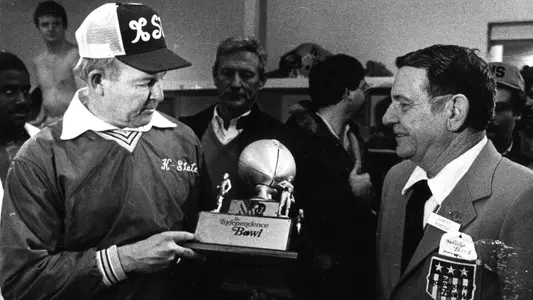
Dickey valued Shorty's judgment so much, Kleinau was the one who ultimately decided on an early travel list for the 1982 Independence Bowl, as long as he didn't go over 85 players.
"'Come to the staff meeting tomorrow with it,'" Dickey orders Kleinau. "The equipment guy ended up making the list," Shorty continues. "They basically kept what I proposed, and the assistants didn't know it was my list. But that was the confidence Coach had in me. Those are things that are priceless."
The balance of the bowl roster bused down to Shreveport, Louisiana, the day before the game, a trek also made by 10,000 Wildcat fans.
Dickey accepted out-of-the-box ideas like bringing motivational speaker Zig Ziglar to Manhattan in the Spring of 1982 when Ziglar was near his peak of popularity. Darnell proposed the plan since he'd seen it work when he was at SMU. What Ziglar preached wasn't chalkboard talk, but it represented a balance that Dickey wanted for all his student-athletes.
Offensive lineman Doug Hoppock says, "Zig didn't even talk football. He stressed that each part of our life has to be equal, whether it's church, family, friends or school. It helped change my life in football and in my career."
"Guys who went through it still talk about it today," Darnell says. "It was about finding that inner-peace, what it takes to be a champion. It was one of the pieces of the puzzle that made it work."
Dickey's most daring deviation was to redshirt eight starters who should've played their senior seasons in 1981. Delaying that last year allowed them to get bigger and stronger under the watchful eye of future NFL conditioning coach Russell Riederer. Size translated to confidence and wins.
"I would call it 'All In, Texas Hold 'Em.' We sacrificed a season to gamble on making a bowl game," kicker Steve Willis says. It took some courage on Coach Dickey's part to do that, but it showed me he wanted to have a bowl contender all the time. We started off 3-0 in 1982, had a lot of confidence and were just more mentally prepared."

The school's first bowl game would follow a 6-4-1 regular season, but momentum would not.
What remained in place after Dickey's departure in 1985 was proof that the purples could get there from here. At a bowl reunion, Bill Snyder told the 1982 squad he used their success for modern day motivation. Hoppock was proud to hear Snyder say, "I was able to tell our kids it could be done."
Dickey's last visit to campus was for the 2017 Spring Game. The school honored his trusted assistant, Joan Friederich, who spent more than 40 years working in Wildcat Athletics. He would not miss her retirement party, despite his own health challenges. That final mission to Manhattan was invigorating for Coach who, according to son Darrell, often said, "K-State was the highlight of his life!"
Almost 40 years after beginning his association with Wildcat football, Coach Dickey proved putting others first was a way of life he never abandoned.
"Oh, that meant so much to me (to have him there). It was so cold that day and he worried more about me being cold than him," Friederich reminisces.
At Thursday's visitation, former K-State defensive coordinator Phil Bennett said he was blown away by the presence of so many former players, coaching colleagues and friends. The common thread through all of the stories was that of a fair and caring man whose legacy will continue through the lives he touched.
Last Friday's funeral was exactly what Coach Dickey wanted: simple, sincere and concise.
Jim Bob Morris sums up Coach's impact like this: "I can't remember ever having a bad day on the football field, working for him, playing for him. He'd say, 'Boys, I don't have enough time to have a bad time. Let's go!'"
Jim Dickey Coaching Tree
Players Who Became Head Coaches:
Darrell Dickey: North Texas
Dana Dimel: Wyoming, Houston, UTEP
Vic Koenning: Wyoming
Brad Lambert: Charlotte
Gary Patterson: TCU
Assistants Who Became Head Coaches:
Gary Darnell: Tenn Tech, Western Michigan
Jim Donnan: Marshall, Georgia
Dennis Franchione: Pittsburg Sttate, SW Texas State, New Mexico, TCU, Alabama, Texas A&M, Texas State
Dave McGinnis: NFL-Arizona Cardinals
Tim McGuire: Morningside, Indiana State
A 1979 graduate of Kansas State who played on Dickey's second team at K-State, Stewart has been a fixture in the Kansas City sports scene since the mid-1980s as he worked 17 years at KMBC Channel 9 and another 17 years at MetroSports.
Guest Writer
I still remember the first time Jim Dickey was publicly interviewed at Kansas State, which preceded the first time he interviewed me in private.
James Howard Dickey was introduced as head coach at a press conference inside the student union, shortly after North Carolina lost to Nebraska in the 1977 Liberty Bowl, 21-17. He served as the Tar Heels' defensive coordinator for three years.
With his bride, Inez, at his elbow, Dickey admitted to the media and boosters he knew the dirty little secret that KSU hadn't won a conference championship since 1934, the year Dickey was born. That's when Pappy Waldorf led the Wildcats to a Big Six title.
Dickey joked that if he didn't win a championship in 43 years, then he'd quit.
And so began a run of one-liners and risky roster moves that led to his Wildcats making history with the school's first-ever bowl appearance in his fifth season.
Before moving to Manhattan, Dickey appeared to be content as a career assistant. His first 15 years in the business included coaching-up future Hall of Famer Lawrence Taylor at UNC. Defensive lineman Dee Hardison was also a consensus All-American who played a decade in the NFL, ending his career with the Kansas City Chiefs.
Dickey also worked the Oklahoma sideline as defensive backs coach in the "Game of the Century" against Nebraska, matching the top two teams in college football. It would be the Sooners' only loss in the 1972 season.
That was one of the fun facts I learned about Coach five years ago at a late-night poolside chat when I peppered him with questions about people, places and his past. I could've picked his brain even longer if he allowed it.
Since Dickey knew the rugged terrain in our conference, he was willing to take the K-State job, even though many considered it the worst in the country. Ellis Rainsberger had just been fired after losing all 21 of his league games.
"(Dad) had already been a defensive coach at three Big Eight schools (Oklahoma, OSU, Kansas)," Jimmy Dickey, Jr. thinks back. "So when he got the opportunity to return as a head coach, he thought he could make a difference, and he did."
Jim Dickey Sr. certainly sounded different with his melodic southern drawl and unique choice of words. As players, we quickly learned that helmets were bonnets in Coach's nomenclature. And his promise of a wide-open offensive style would lead to celebrations in the stands that included, "throwing babies in the aisles," one of his favorite expressions.
Directed by coordinator Carl Selmer, Dickey's offense was years ahead of the curve.
"(QB coach) Jim Donnan still says (our system) was the spread offense before the spread was the spread. That offense… what a breath of fresh air," quarterback Dan Manucci recalls.
When K-State went five-wide in a game with no running back, there was panic on the Nebraska side of the field. The Cornhuskers never saw it coming.
In Dickey's inaugural 1978 season, the senior Manucci led the Big Eight in passing yards, one of the goals he'd shared with Dickey in that initial batch of endless, individual player interviews. My interrogation was terrifying at the beginning, comforting by the end.
"He was sincere, he was interested in you as a person," Manucci remembers. "Coach wanted to know, 'What's your major? What do you like to do?' It was a whole different level of communication."
But that was the new normal where hard work was occasionally interrupted by the unlikely.
"We had a staff Halloween party," receivers coach Dennis Franchione says with a grin.
"Everybody came dressed as something. (My wife) Kim, Sandra Darnell and Mary Donnan were the Three Little Pigs. They were hilarious. That was Coach Dickey. He liked to work hard but also make sure the staff had fun."
"Coach's greatest strength was his people skills," Franchione (my position coach) reminds me after Dickey's funeral in Houston. "He had charisma and really made you feel special. He could draw you to him. Number one; he taught me how to handle people."
Compassion was a head coaching constant during his tenure, but it didn't mean Dickey was soft.
"He was one of the great butt chewers of all-time," defensive coordinator Gary Darnell still swears is true.
But Coach's wife would often try to soften the blow in her sweet Kentucky tone.
"Gary, you know Jimmy loves you," Inez would say. "Well, I wish he'd find another way to show it!"
Jim and Inez were married 62 years until her death in 2013.
Darnell, Donnan and Franchione were assistants off that first star-studded staff who went on to become head coaches. There were five total on Dickey's watch. Five of his players also advanced to the same ranks.
Being ready for that kind of a jump had something to do with witnessing his CEO strategy: hire good people then let them do their jobs, even if Dickey always had final say on the big decisions.
"He would ask your opinion. You always had the capability to bring up ideas, which I did," recalls longtime equipment manager Jim "Shorty" Kleinau. "I worked with Coach, instead of for Coach."
Dickey valued Shorty's judgment so much, Kleinau was the one who ultimately decided on an early travel list for the 1982 Independence Bowl, as long as he didn't go over 85 players.
"'Come to the staff meeting tomorrow with it,'" Dickey orders Kleinau. "The equipment guy ended up making the list," Shorty continues. "They basically kept what I proposed, and the assistants didn't know it was my list. But that was the confidence Coach had in me. Those are things that are priceless."
The balance of the bowl roster bused down to Shreveport, Louisiana, the day before the game, a trek also made by 10,000 Wildcat fans.
Dickey accepted out-of-the-box ideas like bringing motivational speaker Zig Ziglar to Manhattan in the Spring of 1982 when Ziglar was near his peak of popularity. Darnell proposed the plan since he'd seen it work when he was at SMU. What Ziglar preached wasn't chalkboard talk, but it represented a balance that Dickey wanted for all his student-athletes.
Offensive lineman Doug Hoppock says, "Zig didn't even talk football. He stressed that each part of our life has to be equal, whether it's church, family, friends or school. It helped change my life in football and in my career."
"Guys who went through it still talk about it today," Darnell says. "It was about finding that inner-peace, what it takes to be a champion. It was one of the pieces of the puzzle that made it work."
Dickey's most daring deviation was to redshirt eight starters who should've played their senior seasons in 1981. Delaying that last year allowed them to get bigger and stronger under the watchful eye of future NFL conditioning coach Russell Riederer. Size translated to confidence and wins.
"I would call it 'All In, Texas Hold 'Em.' We sacrificed a season to gamble on making a bowl game," kicker Steve Willis says. It took some courage on Coach Dickey's part to do that, but it showed me he wanted to have a bowl contender all the time. We started off 3-0 in 1982, had a lot of confidence and were just more mentally prepared."
The school's first bowl game would follow a 6-4-1 regular season, but momentum would not.
What remained in place after Dickey's departure in 1985 was proof that the purples could get there from here. At a bowl reunion, Bill Snyder told the 1982 squad he used their success for modern day motivation. Hoppock was proud to hear Snyder say, "I was able to tell our kids it could be done."
Dickey's last visit to campus was for the 2017 Spring Game. The school honored his trusted assistant, Joan Friederich, who spent more than 40 years working in Wildcat Athletics. He would not miss her retirement party, despite his own health challenges. That final mission to Manhattan was invigorating for Coach who, according to son Darrell, often said, "K-State was the highlight of his life!"
Almost 40 years after beginning his association with Wildcat football, Coach Dickey proved putting others first was a way of life he never abandoned.
"Oh, that meant so much to me (to have him there). It was so cold that day and he worried more about me being cold than him," Friederich reminisces.
At Thursday's visitation, former K-State defensive coordinator Phil Bennett said he was blown away by the presence of so many former players, coaching colleagues and friends. The common thread through all of the stories was that of a fair and caring man whose legacy will continue through the lives he touched.
Last Friday's funeral was exactly what Coach Dickey wanted: simple, sincere and concise.
Jim Bob Morris sums up Coach's impact like this: "I can't remember ever having a bad day on the football field, working for him, playing for him. He'd say, 'Boys, I don't have enough time to have a bad time. Let's go!'"
Jim Dickey Coaching Tree
Players Who Became Head Coaches:
Darrell Dickey: North Texas
Dana Dimel: Wyoming, Houston, UTEP
Vic Koenning: Wyoming
Brad Lambert: Charlotte
Gary Patterson: TCU
Assistants Who Became Head Coaches:
Gary Darnell: Tenn Tech, Western Michigan
Jim Donnan: Marshall, Georgia
Dennis Franchione: Pittsburg Sttate, SW Texas State, New Mexico, TCU, Alabama, Texas A&M, Texas State
Dave McGinnis: NFL-Arizona Cardinals
Tim McGuire: Morningside, Indiana State
A 1979 graduate of Kansas State who played on Dickey's second team at K-State, Stewart has been a fixture in the Kansas City sports scene since the mid-1980s as he worked 17 years at KMBC Channel 9 and another 17 years at MetroSports.
Monday, October 19
Saturday, October 17
Saturday, October 17
Thursday, October 15