SE: Snyder’s Commitment to K-State College of Education Demonstrates Passion for Educators
May 23, 2018 | Football, Sports Extra
By Corbin McGuire
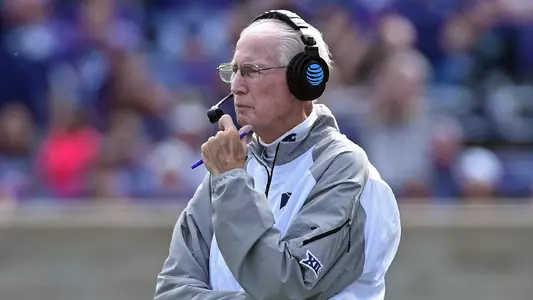
Hanging in Joe Hubener's classroom in Clearwater High School are Bill Snyder's 16 Goals for Success, a symbol of the K-State head coach's lasting impact beyond the football field.
Hubener recently finished his first year of teaching world history to sophomores. The former K-State quarterback said there was a "whole bunch of trial and error" in his first year by himself in the classroom, but there were also a lot of parallels with how Snyder runs his program — i.e., the 16 Goals.
"There's a lot of things that I model after Coach Snyder. As a coach, he is an educator. He is a teacher. His teaching went a lot further than just on the football field. There's a lot about life," said Hubener, who also helped coach football at Clearwater last fall. "There's a lot of aspects with his 16 Goals for Success, things like that I can incorporate into the workforce and into coaching. A lot of that has played a role into shaping my philosophies as an educator.
"(All 16 goals) play a role in every aspect of life. That's something that he really preached consistently to us as players. From 1 to 16, if you're not getting your job done in one of those categories, as a team we're unsuccessful."
Snyder's passion for education is well documented, as is his admiration of teachers. He once was one, many years ago, and he still credits much of his success to educators he had early in his life.
It's why when Lori Goodson, assistant professor in K-State's College of Education, sent an email "on a whim" last fall up to the Vanier Family Football Complex to see if Snyder would be willing to speak to one of her classes, the Hall of Fame coach responded with a better offer: Come here and bring your students.
"Our dean (Debbie Mercer) was just stunned," Todd Goodson, Lori's husband and associate professor in K-State's College of Education, said. "She went along and had to see it for herself and see, 'Is this real? Are we really going up there in season?'"
In April, Snyder again invited the Core Teaching Skills class to Vanier. He spoke for longer than 30 minutes, twice, to more than 60 students between a pair of sessions.
Mercer attended the spring session and came away just as impressed as the first time.
"It demonstrates, once again, what is so very special about K-State. K-State truly is a family, and when a revered figure like Coach Snyder invests time in future teachers, it communicates a great deal about his values and our value as educators in society," she said. "When an icon stands in room filled with a hushed reverence and tells you as a future teacher that he admires you for choosing to become a teacher, that's powerful. I hope it validated our students' decision to become teachers and helped them understand they are embarking on something much greater than a job."
Todd Goodson, who's attended all of Snyder's speeches to the Core Teaching Skills students, said each student probably took away something slightly different.
If nothing else, Goodson said he hopes all of them in the natural division of education undergraduates, between those who either want to teach and those who want to coach and teach, learned something valuable from Snyder.
"All of our teachers – and especially our secondary teachers – need to understand the importance of athletics in secondary schools and understand that coaches are some of your best partners. That wasn't addressed directly in the sessions with Coach Snyder but it was because they got to hear him speak about the importance of teaching," Goodson said. "No one has more credibility than Coach Snyder, and to hear him validate their decision to go into education but also to see him in a supporting role rather than a potentially adversarial role, I think that's valuable for a certain segment of our population. For our people who do want to be coaches, then it's reinforcing the idea that academics and athletics need to work in tandem and that they share the same goals. It's about community building and it's about everyone achieving to the best of their potential."
Snyder's speech started with him complimenting the students in the room for their choice in pursuing a career in education.
"In this day and age, it's not the most popular profession and yet I can't think of one that is any more significant and meaningful than to be in that role," he told them. "I share with our players frequently how important is for them to have people in their lives that genuinely care about them and people that want to and can make their life better. Teachers can do exactly that."
The 78-year-old head coach shared how pleased he is that his youngest daughter, Whitney, is an elementary school teacher in Manhattan and "works as long of hours as I do sometimes."
Snyder then discussed the significant impact educators had on his life, specifically naming a few from decades ago. One, Mrs. Houston, took a personal interest in him beyond school hours and gave him important guidance. Another, Walter Cronkite's sister, Dorothy, did the same at Snyder's elementary school in St. Joseph, Missouri. Then there was the principal at Lafayette High School who drove to the apartment Snyder and his mother were living in to make sure he attended class.
"To this day, I have a great appreciation for that," Snyder said to the students in the room. "I would not have had any degree of success whatsoever as a person in my life if it had not been for people that I had in elementary school as teachers and administrators. The same goes for in high school and at the college level, for that matter.
"You're in a profession where, in my way of thinking, there are a lot of things that are significant, but I don't think anything is more significant than genuinely caring about the young people that you work with."
From there, Snyder told the education students of his experiences as a teacher. He told the stories of his attempts at teaching Spanish at Gallatin, Missouri, and in Indio, California, two distinctly different populations of students.
He also brought up the importance of defining priorities, determining goals within them and developing a process to achieve those goals. While he related it to K-State's football program, he reinforced the fact that the concept applies to every part of life.
To finish, he indirectly referred to goal No. 12 — No Self-Limitations — as an important concept to get children to buy into.
"It is significant in an educational role to allow young people to understand that there shouldn't be any self-limitations on what your capabilities are. Once they have a greater understanding of not placing limitations on their abilities and a greater understanding of elevating their expectations, then the higher the goals become and obviously, if they work the process the right way, then they become even more successful than they might have believed they could have become."
Hanging in Joe Hubener's classroom in Clearwater High School are Bill Snyder's 16 Goals for Success, a symbol of the K-State head coach's lasting impact beyond the football field.
Hubener recently finished his first year of teaching world history to sophomores. The former K-State quarterback said there was a "whole bunch of trial and error" in his first year by himself in the classroom, but there were also a lot of parallels with how Snyder runs his program — i.e., the 16 Goals.
"There's a lot of things that I model after Coach Snyder. As a coach, he is an educator. He is a teacher. His teaching went a lot further than just on the football field. There's a lot about life," said Hubener, who also helped coach football at Clearwater last fall. "There's a lot of aspects with his 16 Goals for Success, things like that I can incorporate into the workforce and into coaching. A lot of that has played a role into shaping my philosophies as an educator.
"(All 16 goals) play a role in every aspect of life. That's something that he really preached consistently to us as players. From 1 to 16, if you're not getting your job done in one of those categories, as a team we're unsuccessful."
Snyder's passion for education is well documented, as is his admiration of teachers. He once was one, many years ago, and he still credits much of his success to educators he had early in his life.
It's why when Lori Goodson, assistant professor in K-State's College of Education, sent an email "on a whim" last fall up to the Vanier Family Football Complex to see if Snyder would be willing to speak to one of her classes, the Hall of Fame coach responded with a better offer: Come here and bring your students.
"Our dean (Debbie Mercer) was just stunned," Todd Goodson, Lori's husband and associate professor in K-State's College of Education, said. "She went along and had to see it for herself and see, 'Is this real? Are we really going up there in season?'"
In April, Snyder again invited the Core Teaching Skills class to Vanier. He spoke for longer than 30 minutes, twice, to more than 60 students between a pair of sessions.
Mercer attended the spring session and came away just as impressed as the first time.
"It demonstrates, once again, what is so very special about K-State. K-State truly is a family, and when a revered figure like Coach Snyder invests time in future teachers, it communicates a great deal about his values and our value as educators in society," she said. "When an icon stands in room filled with a hushed reverence and tells you as a future teacher that he admires you for choosing to become a teacher, that's powerful. I hope it validated our students' decision to become teachers and helped them understand they are embarking on something much greater than a job."
Todd Goodson, who's attended all of Snyder's speeches to the Core Teaching Skills students, said each student probably took away something slightly different.
If nothing else, Goodson said he hopes all of them in the natural division of education undergraduates, between those who either want to teach and those who want to coach and teach, learned something valuable from Snyder.
"All of our teachers – and especially our secondary teachers – need to understand the importance of athletics in secondary schools and understand that coaches are some of your best partners. That wasn't addressed directly in the sessions with Coach Snyder but it was because they got to hear him speak about the importance of teaching," Goodson said. "No one has more credibility than Coach Snyder, and to hear him validate their decision to go into education but also to see him in a supporting role rather than a potentially adversarial role, I think that's valuable for a certain segment of our population. For our people who do want to be coaches, then it's reinforcing the idea that academics and athletics need to work in tandem and that they share the same goals. It's about community building and it's about everyone achieving to the best of their potential."
Snyder's speech started with him complimenting the students in the room for their choice in pursuing a career in education.
"In this day and age, it's not the most popular profession and yet I can't think of one that is any more significant and meaningful than to be in that role," he told them. "I share with our players frequently how important is for them to have people in their lives that genuinely care about them and people that want to and can make their life better. Teachers can do exactly that."
The 78-year-old head coach shared how pleased he is that his youngest daughter, Whitney, is an elementary school teacher in Manhattan and "works as long of hours as I do sometimes."
Snyder then discussed the significant impact educators had on his life, specifically naming a few from decades ago. One, Mrs. Houston, took a personal interest in him beyond school hours and gave him important guidance. Another, Walter Cronkite's sister, Dorothy, did the same at Snyder's elementary school in St. Joseph, Missouri. Then there was the principal at Lafayette High School who drove to the apartment Snyder and his mother were living in to make sure he attended class.
"To this day, I have a great appreciation for that," Snyder said to the students in the room. "I would not have had any degree of success whatsoever as a person in my life if it had not been for people that I had in elementary school as teachers and administrators. The same goes for in high school and at the college level, for that matter.
"You're in a profession where, in my way of thinking, there are a lot of things that are significant, but I don't think anything is more significant than genuinely caring about the young people that you work with."
From there, Snyder told the education students of his experiences as a teacher. He told the stories of his attempts at teaching Spanish at Gallatin, Missouri, and in Indio, California, two distinctly different populations of students.
He also brought up the importance of defining priorities, determining goals within them and developing a process to achieve those goals. While he related it to K-State's football program, he reinforced the fact that the concept applies to every part of life.
To finish, he indirectly referred to goal No. 12 — No Self-Limitations — as an important concept to get children to buy into.
"It is significant in an educational role to allow young people to understand that there shouldn't be any self-limitations on what your capabilities are. Once they have a greater understanding of not placing limitations on their abilities and a greater understanding of elevating their expectations, then the higher the goals become and obviously, if they work the process the right way, then they become even more successful than they might have believed they could have become."
K-State Football | Coach Collin Klein First Pitch
Sunday, April 26
K-State Football | Collin Klein Press Conference - April 22, 2026
Wednesday, April 22
K-State Football | Sean Gleeson Press Conference - April 22, 2026
Wednesday, April 22
K-State Football | Jordan Peterson Press Conference - April 22, 2026
Wednesday, April 22