SE: K-State Student-Athletes Leave, Receive Lasting Impact from ‘Cats Across Continents’ Trip in Dominican Republic
May 28, 2018 | Sports Extra, Athletics, Evans Student-Athlete Success Program
By Corbin McGuire
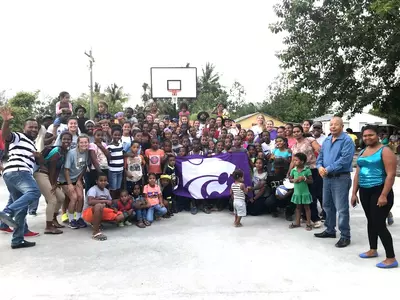
Sitting in the Dallas-Fort Worth International Airport on Saturday night, a contingent of K-State student-athletes awaited their final flight back to Manhattan from their time in the Dominican Republic.
After 10 days out of the United States for the third annual "Cats Across Continents" service trip in partnership with Courts for Kids, the Wildcats' phones expectedly started lighting up.
What they didn't expect was who would be trying to connect with them. It was some of the high schoolers from Matayaya, the small Dominican Republic community where 15 K-State student-athletes and five staff members helped build an all-purpose court.
"All the high schoolers have Facebook and they're calling us on Facebook, so we've been gone for like 24 hours and they're already calling us saying they miss us a lot," K-State volleyball senior Kylee Zumach said. "It's really cool to see that we have a lasting impression on them."
This is just one example of how what the Wildcats expected from the trip did not line up to what they ended up getting out of it, and in a good way.
Osvelt Joseph, a senior defensive end for K-State football, thought the experience would be pretty straightforward: The Wildcats would build a court and the community would say thanks.
"But as I went into the trip," Joseph said, "my whole perspective kind of changed throughout each and every day."
Notably, Joseph, whose family hails from Haiti and who speaks Creole, was able to connect with a Haitian family living in Matayaya.
"That was a pretty good opportunity and they also shared their story with me," he said. "So I think I became a better person because I feel like with that whole family, I was trying to give them as much as I could."
Joseph was one of only three male student-athletes to go on the trip, opening the door for the 12 Wildcat women to show off their strength during the three-day court-building process.
During this process, K-State's women helped stymie a stereotype held by at least one local.
"I was in charge of concrete a few days and you had to pick up 96 bags of concrete (that weighed about 100 pounds each) and carry them across the court and pour them in the mixer," Zumach said. "I remember this man came up to our translator and he was, like, 'Wow, I've never seen a woman this strong before,' and the translator then went on to tell me women in the community, they're not used to them doing any manual labor or playing sports. So I just remember that moment really sticking out. It was really cool seeing all the girls from K-State break some gender stereotypes."
Another unexpected takeaway Zumach pointed out was the sharing nature of the community members. Given how little some families had, she was blown away by what they were willing to give. She experienced this multiple times after befriending some children at the local school.
"After school when we were walking down the street toward the park and the court, they'd all run out of their house and give me little candies they had, or they would ask me if I needed water, and they don't have an endless amount of candy and cold water, but everything they have they wanted to share, and that was everyone in the community," she said. "They had so little, but they had such a neighborly feeling and they gave everything to make sure everyone felt welcome. Right now, I'm taking that feeling with me, give all you can."
While the language barrier between the two groups started out as a challenge, it became much less noticeable throughout the trip as they found other ways to communicate. These included nightly dancing sessions, swimming in the nearby river and playing lots of sports.
"Even though you might not be able to understand them, you could definitely understand what they're talking about through non-verbal cues and we learned that through sports," said K-State rowing's Mikaela Bennett. "It was just nice to see that people were playing sports just to have fun, because as a student-athlete sometimes you get caught up in the competitiveness in it and you can kind of lose focus as to why you're doing it. So to see the kids out there really getting into it and really just loving what they're doing, that was refreshing."
Individually, each Wildcat may have brought home a different memory as their favorite. Collectively, however, they shared the sight of watching the community members, from children to grandparents, fill the finished court to play all sorts of games.
"I'm not ashamed to say I cried," Zumach said of the moment. "It was so amazing to see the whole community together. They didn't really have a place in the community prior to the court for them all to come and interact. It was just amazing to see we had such a big impact on their lives."
Joseph described it as "satisfying."
"Seeing how much I gave into the court and how much work everybody in the group put toward the court, it was satisfying seeing the kids enjoying it," he said. "The cool thing about it was it was every kid that was in that village was on the court. They were all having a blast. To me, it was satisfying to see that the work we all put in created the atmosphere of the kids enjoying it."
Added Bennett: "It was just amazing to see the transformation of an area and just cool to see that the community was already out there and spending so much time on it and having a great time. It was such an awesome experience."
Starting today, K-State Sports Extra will be sent out three days a week — Monday, Wednesday, Friday. It will return to five days a week in August.
Sitting in the Dallas-Fort Worth International Airport on Saturday night, a contingent of K-State student-athletes awaited their final flight back to Manhattan from their time in the Dominican Republic.
After 10 days out of the United States for the third annual "Cats Across Continents" service trip in partnership with Courts for Kids, the Wildcats' phones expectedly started lighting up.
What they didn't expect was who would be trying to connect with them. It was some of the high schoolers from Matayaya, the small Dominican Republic community where 15 K-State student-athletes and five staff members helped build an all-purpose court.
"All the high schoolers have Facebook and they're calling us on Facebook, so we've been gone for like 24 hours and they're already calling us saying they miss us a lot," K-State volleyball senior Kylee Zumach said. "It's really cool to see that we have a lasting impression on them."
This is just one example of how what the Wildcats expected from the trip did not line up to what they ended up getting out of it, and in a good way.
Osvelt Joseph, a senior defensive end for K-State football, thought the experience would be pretty straightforward: The Wildcats would build a court and the community would say thanks.
"But as I went into the trip," Joseph said, "my whole perspective kind of changed throughout each and every day."
Notably, Joseph, whose family hails from Haiti and who speaks Creole, was able to connect with a Haitian family living in Matayaya.
"That was a pretty good opportunity and they also shared their story with me," he said. "So I think I became a better person because I feel like with that whole family, I was trying to give them as much as I could."
Joseph was one of only three male student-athletes to go on the trip, opening the door for the 12 Wildcat women to show off their strength during the three-day court-building process.
During this process, K-State's women helped stymie a stereotype held by at least one local.
"I was in charge of concrete a few days and you had to pick up 96 bags of concrete (that weighed about 100 pounds each) and carry them across the court and pour them in the mixer," Zumach said. "I remember this man came up to our translator and he was, like, 'Wow, I've never seen a woman this strong before,' and the translator then went on to tell me women in the community, they're not used to them doing any manual labor or playing sports. So I just remember that moment really sticking out. It was really cool seeing all the girls from K-State break some gender stereotypes."
Another unexpected takeaway Zumach pointed out was the sharing nature of the community members. Given how little some families had, she was blown away by what they were willing to give. She experienced this multiple times after befriending some children at the local school.
"After school when we were walking down the street toward the park and the court, they'd all run out of their house and give me little candies they had, or they would ask me if I needed water, and they don't have an endless amount of candy and cold water, but everything they have they wanted to share, and that was everyone in the community," she said. "They had so little, but they had such a neighborly feeling and they gave everything to make sure everyone felt welcome. Right now, I'm taking that feeling with me, give all you can."
While the language barrier between the two groups started out as a challenge, it became much less noticeable throughout the trip as they found other ways to communicate. These included nightly dancing sessions, swimming in the nearby river and playing lots of sports.
"Even though you might not be able to understand them, you could definitely understand what they're talking about through non-verbal cues and we learned that through sports," said K-State rowing's Mikaela Bennett. "It was just nice to see that people were playing sports just to have fun, because as a student-athlete sometimes you get caught up in the competitiveness in it and you can kind of lose focus as to why you're doing it. So to see the kids out there really getting into it and really just loving what they're doing, that was refreshing."
Individually, each Wildcat may have brought home a different memory as their favorite. Collectively, however, they shared the sight of watching the community members, from children to grandparents, fill the finished court to play all sorts of games.
"I'm not ashamed to say I cried," Zumach said of the moment. "It was so amazing to see the whole community together. They didn't really have a place in the community prior to the court for them all to come and interact. It was just amazing to see we had such a big impact on their lives."
Joseph described it as "satisfying."
"Seeing how much I gave into the court and how much work everybody in the group put toward the court, it was satisfying seeing the kids enjoying it," he said. "The cool thing about it was it was every kid that was in that village was on the court. They were all having a blast. To me, it was satisfying to see that the work we all put in created the atmosphere of the kids enjoying it."
Added Bennett: "It was just amazing to see the transformation of an area and just cool to see that the community was already out there and spending so much time on it and having a great time. It was such an awesome experience."
Starting today, K-State Sports Extra will be sent out three days a week — Monday, Wednesday, Friday. It will return to five days a week in August.

Players Mentioned


K-State Baseball | Highlights vs Michigan - Feb. 22, 2026
Monday, February 23
K-State Men's Basketball | Postgame Press Conference at Texas Tech
Sunday, February 22
K-State Women's Basketball | Tess Heal Senior Video
Sunday, February 22
K-State Women's Basketball | Mikayla Parks Senior Video
Sunday, February 22