SE: Fueled by Annual Giving Record, K-State Athletics Takes Next Step in Self-Sufficiency
Jul 16, 2018 | Sports Extra, Athletics
By Corbin McGuire
For four years in a row, K-State Athletics has operated without any direct and indirect university financial support. No other institution in the state and one of only a few dozen across the country can say the same.
In FY 2019, K-State Athletics took its self-sufficiency a step further. In conjunction with the Student Governing Association, K-State Athletics ended its receipt of student privilege fees a year earlier than originally planned.
Student privilege fees accounted for more than $500,000 of K-State Athletics' revenue in FY 2016. In FY 2010, direct and indirect university support of athletics was 6.1 percent, or $2.6 million, of the department's budget.
Now, the department is one of eight across the country to operate with no direct or indirect university and student funding or state support.
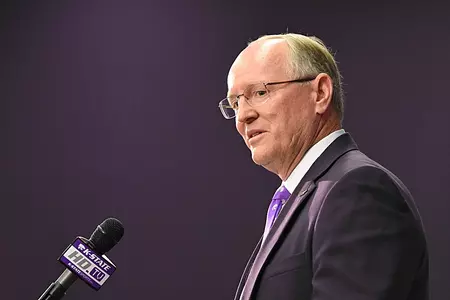
"It just solidifies the fact that we do care about our students," K-State Athletics Director Gene Taylor said. "We are one of eight institutions that do not have any sort of institutional funding. That's something certainly we take pride in."
With enrollment declines, former SGA president Jack Ayres said, "We were looking at a predicted $340,000 shortfall," and needed to make it up elsewhere. Since K-State Athletics was already in the midst of a plan to phase out the student privilege fee by FY 2020, the idea of ending it a year earlier, saving SGA $200,000 in FY 2019, was brought up and put into action.
"That takes care of a big chunk of it," Ayres said. "That really takes care of a lot of our challenges next year. That was very helpful."
Sarah Niederee, SGA privilege committee chair, said it's important to note that SGA and K-State Athletics have a strong history of working well together for the benefit of both sides. Examples include SGA's role in getting Ahearn Field House built in the 1940s and 1950s; its contribution toward the initial construction of Bill Snyder Family Stadium (then KSU Stadium) in 1968, Bramlage Coliseum in the 1980s and, most recently, K-State's tennis courts by the recreation facility.
"So I think that even though we won't have this monetary relationship, athletics really does care about the students and they understand that without students at their games and students supporting their athletes and their programs, then they're not going to have great programs," Niederee said. "Both sides have really been able to work in a really healthy relationship together and we look forward to continuing to do that. Although we won't have a monetary relationship, our executive team will have an athletics liaison still and that will keep that student/athletics relationship strong."
Both sides also understand that this latest step would not be possible without the generosity of K-State's fanbase.
K-State Athletics, which produced a balanced budget in FY 2018 and achieved a surplus for the ninth consecutive year, received a record $18.9 million through the Ahearn Fund's annual giving program, which surpassed its budgeted goal and boosted the overall cash gifts to the department to $30.9 million.
"That's one of the beautiful things about K-State is our fans are extremely supportive," Taylor said. "I would say our fans support us, pound-for-pound, equally as well as anybody in the country."
"K-State wouldn't be where it is if it wasn't for our awesome donors," Niederee added. "They're very important to every student and I hope that students do see that our donors really are making a difference for us."
In the $82.1 million approved FY 2019 budget, an increase of $8.6 million from last year, ticket purchases and contributions from loyal fans and Ahearn Fund members again will account for the bulk of the department's revenue. Specifically, its targeted at a combined $34 million, second only to the Big 12 Conference revenue, targeted at $38 million.
Both have been crucial in moving revenues from the state and university, and now its students, to zero.
"The support from our alumni and friends is absolutely critical," Ayres said. "The ability to not have to rely on university or student support, K-State Athletics has been one of the few programs in the country that can claim that distinction and that's something I think should be important to us."
For four years in a row, K-State Athletics has operated without any direct and indirect university financial support. No other institution in the state and one of only a few dozen across the country can say the same.
In FY 2019, K-State Athletics took its self-sufficiency a step further. In conjunction with the Student Governing Association, K-State Athletics ended its receipt of student privilege fees a year earlier than originally planned.
Student privilege fees accounted for more than $500,000 of K-State Athletics' revenue in FY 2016. In FY 2010, direct and indirect university support of athletics was 6.1 percent, or $2.6 million, of the department's budget.
Now, the department is one of eight across the country to operate with no direct or indirect university and student funding or state support.
"It just solidifies the fact that we do care about our students," K-State Athletics Director Gene Taylor said. "We are one of eight institutions that do not have any sort of institutional funding. That's something certainly we take pride in."
With enrollment declines, former SGA president Jack Ayres said, "We were looking at a predicted $340,000 shortfall," and needed to make it up elsewhere. Since K-State Athletics was already in the midst of a plan to phase out the student privilege fee by FY 2020, the idea of ending it a year earlier, saving SGA $200,000 in FY 2019, was brought up and put into action.
"That takes care of a big chunk of it," Ayres said. "That really takes care of a lot of our challenges next year. That was very helpful."
Sarah Niederee, SGA privilege committee chair, said it's important to note that SGA and K-State Athletics have a strong history of working well together for the benefit of both sides. Examples include SGA's role in getting Ahearn Field House built in the 1940s and 1950s; its contribution toward the initial construction of Bill Snyder Family Stadium (then KSU Stadium) in 1968, Bramlage Coliseum in the 1980s and, most recently, K-State's tennis courts by the recreation facility.
"So I think that even though we won't have this monetary relationship, athletics really does care about the students and they understand that without students at their games and students supporting their athletes and their programs, then they're not going to have great programs," Niederee said. "Both sides have really been able to work in a really healthy relationship together and we look forward to continuing to do that. Although we won't have a monetary relationship, our executive team will have an athletics liaison still and that will keep that student/athletics relationship strong."
Both sides also understand that this latest step would not be possible without the generosity of K-State's fanbase.
K-State Athletics, which produced a balanced budget in FY 2018 and achieved a surplus for the ninth consecutive year, received a record $18.9 million through the Ahearn Fund's annual giving program, which surpassed its budgeted goal and boosted the overall cash gifts to the department to $30.9 million.
"That's one of the beautiful things about K-State is our fans are extremely supportive," Taylor said. "I would say our fans support us, pound-for-pound, equally as well as anybody in the country."
"K-State wouldn't be where it is if it wasn't for our awesome donors," Niederee added. "They're very important to every student and I hope that students do see that our donors really are making a difference for us."
In the $82.1 million approved FY 2019 budget, an increase of $8.6 million from last year, ticket purchases and contributions from loyal fans and Ahearn Fund members again will account for the bulk of the department's revenue. Specifically, its targeted at a combined $34 million, second only to the Big 12 Conference revenue, targeted at $38 million.
Both have been crucial in moving revenues from the state and university, and now its students, to zero.
"The support from our alumni and friends is absolutely critical," Ayres said. "The ability to not have to rely on university or student support, K-State Athletics has been one of the few programs in the country that can claim that distinction and that's something I think should be important to us."




Wednesday, September 30
Tuesday, September 29
Tuesday, September 29
Monday, September 28