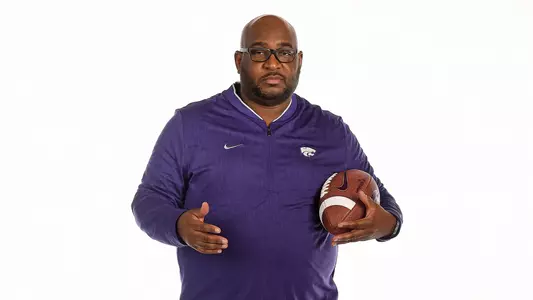
SE: Brian Anderson Plans to Use Positive Examples to Develop K-State Running Backs
Mar 11, 2019 | Football, Sports Extra
By Corbin McGuire
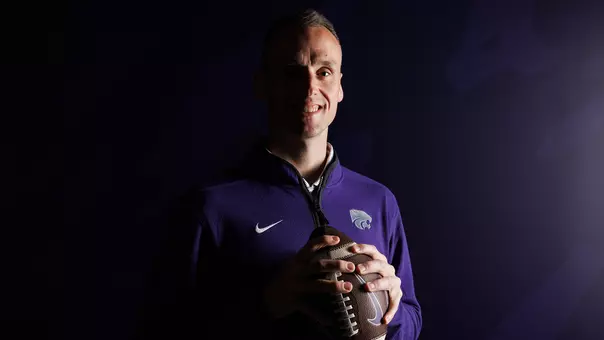
Brian Anderson is a big example guy. More specifically, he's a big positive example guy.
If K-State's first-year running backs coach wants to teach something or get a point across, more times than not he's going to refer to a video or a story to do so. They won't be negative examples, either. That's a mental space Anderson said he avoids.
"Everything that's done from here on out is all positive. There are no negatives," he said. "You have to breed that confidence in them that they can get this job done, no matter who it is, a walk-on or a guy that never played before."
As for the examples he uses, the 25-year coaching veteran said he typically begins with one player in particular. This player happens to be in both the Pro Football and College Football Hall of Fames, too.
"I'm always going to start with Marshall Faulk," Anderson said. "He's always going to be the first one because of the football IQ part."
Anderson recalled a video that came out close to Faulk's induction to the Pro Football Hall of Fame in 2011. Early in it, Faulk's cerebral understanding of the game is a focal point, much like Anderson said his focus will be in coaching up K-State's running backs.
"That's where I'm always going to start: 'Understand, guys, you have talent and that's why you're here, but your football IQ will take your game to another level,'" Anderson said of his message to K-State's backs. "If you understand how the defense lines up and what they're trying to do, you're going to be a better running back at the end of the day."
For the younger players not as familiar with Faulk, Anderson has more recent examples as well.
In 2017, he did short internships with the Minnesota Vikings and Tennessee Titans. What stood out in both experiences, he said, was how some of the best players prepared.
"The guys who are pros, you can tell are pros," he said, listing off names like Eric Decker, Adam Thielen, Latavius Murray and DeMarco Murray, the last of whom left the biggest impression. "DeMarco Murray, his notebook was full. It was unbelievable how detailed he was."
Again, Anderson expects his backs to approach the game similarly.
"That's what I try to tell the college kids. You have to learn how to take notes. It's no different than being in a classroom on campus. Why change because it's football? It should stay the same," he said. "You're sitting in a desk, taking notes and you're getting yourself prepared. That's the biggest thing. The preparation part of it is the thing I can preach more and more and more about on how to become a better football player."
Anderson also plans to preach a leadership philosophy he picked up throughout his time in football. It goes, "Don't be a bobblehead." In a nutshell, it means Anderson does not want players to agree for the sake of agreement. If something is being done wrong, call it out.
As a wide receiver at Western Illinois, Anderson picked this up from Brian Cox, who played 12 years in the NFL. When Western Illinois lost its 1990 season opener to Arkansas-Monticello, Anderson said he remembers Cox making the coaches leave the locker room so he could address the players.
As a wide receivers/returners coach at Southern Illinois, Anderson said he saw it again from another future NFL veteran in Bart Scott.
The more Brian Cox- and Bart Scott-like leaders Anderson can find and develop at K-State, he said the better off their group will be.
"I want all those guys to be leaders. Police each other. It's not negative. It's OK to disagree," he said. "With war there's peace."
Unexpectedly, Anderson found his peace in coaching.
He did not plan it as a profession but was looking for anything after he did not get a job he wanted in his hometown of Rockford, Illinois. Afterward, the only person Anderson thought he could call for advice was his former head coach at Western Illinois, Randy Ball.
"He just said, 'Can you get back here on Monday?' I got back there, and he said, 'You're going to start coaching,'" Anderson recalled. "From there, it just took off."
Anderson spent three years at Western Illinois before coaching for five more between stops at Highland Community College and Coffeyville Community College in Kansas. In 2001, he joined one of the best examples he has learned from in Jerry Kill at Southern Illinois. Ironically, it was also the place he was introduced to his wife, Kerri, by current K-State men's basketball associate head coach Chris Lowery.
Kill, who spent about a year as K-State's associate athletic director of administration, gave Anderson confidence that K-State would be a great place to work.
"(Kill) just said, 'It's a great place, good people there, and the one thing you don't have to worry about is toughness. The kids are going to be tough,'" Anderson said. "That's what we've always preached is having tough kids and kids that want to compete. He couldn't say enough about the kids and their toughness and the way they compete."
Anderson trusted his former boss. Plus, his relationship with Klieman goes back to when the K-State head coach, along with offensive coordinator Courtney Messingham, played with his older brother at Northern Iowa. Anderson also said Kill and Klieman share some core similarities that made him believe this opportunity would be a great fit.
"(Coach Kill) taught me a lot about the way things are done and doing things the right way. I see a lot of similarities with Coach Klieman," Anderson said. "My deal, Coach Klieman's deal and all of these coaches is it's about relationships.
"I'm still close to guys I coached back in 1994, '95. I talk to kids I coached at Southern Illinois all the time. Those are the things that are important to me, and that's why I do what I do. I think building those relationships is important because when a kid can connect to you off the field, they're going to play hard for you on the field. That's the way I always look at it."
Brian Anderson is a big example guy. More specifically, he's a big positive example guy.
If K-State's first-year running backs coach wants to teach something or get a point across, more times than not he's going to refer to a video or a story to do so. They won't be negative examples, either. That's a mental space Anderson said he avoids.
"Everything that's done from here on out is all positive. There are no negatives," he said. "You have to breed that confidence in them that they can get this job done, no matter who it is, a walk-on or a guy that never played before."
As for the examples he uses, the 25-year coaching veteran said he typically begins with one player in particular. This player happens to be in both the Pro Football and College Football Hall of Fames, too.
"I'm always going to start with Marshall Faulk," Anderson said. "He's always going to be the first one because of the football IQ part."
Anderson recalled a video that came out close to Faulk's induction to the Pro Football Hall of Fame in 2011. Early in it, Faulk's cerebral understanding of the game is a focal point, much like Anderson said his focus will be in coaching up K-State's running backs.
"That's where I'm always going to start: 'Understand, guys, you have talent and that's why you're here, but your football IQ will take your game to another level,'" Anderson said of his message to K-State's backs. "If you understand how the defense lines up and what they're trying to do, you're going to be a better running back at the end of the day."
For the younger players not as familiar with Faulk, Anderson has more recent examples as well.
In 2017, he did short internships with the Minnesota Vikings and Tennessee Titans. What stood out in both experiences, he said, was how some of the best players prepared.
"The guys who are pros, you can tell are pros," he said, listing off names like Eric Decker, Adam Thielen, Latavius Murray and DeMarco Murray, the last of whom left the biggest impression. "DeMarco Murray, his notebook was full. It was unbelievable how detailed he was."
Again, Anderson expects his backs to approach the game similarly.
"That's what I try to tell the college kids. You have to learn how to take notes. It's no different than being in a classroom on campus. Why change because it's football? It should stay the same," he said. "You're sitting in a desk, taking notes and you're getting yourself prepared. That's the biggest thing. The preparation part of it is the thing I can preach more and more and more about on how to become a better football player."
Anderson also plans to preach a leadership philosophy he picked up throughout his time in football. It goes, "Don't be a bobblehead." In a nutshell, it means Anderson does not want players to agree for the sake of agreement. If something is being done wrong, call it out.
As a wide receiver at Western Illinois, Anderson picked this up from Brian Cox, who played 12 years in the NFL. When Western Illinois lost its 1990 season opener to Arkansas-Monticello, Anderson said he remembers Cox making the coaches leave the locker room so he could address the players.
As a wide receivers/returners coach at Southern Illinois, Anderson said he saw it again from another future NFL veteran in Bart Scott.
The more Brian Cox- and Bart Scott-like leaders Anderson can find and develop at K-State, he said the better off their group will be.
"I want all those guys to be leaders. Police each other. It's not negative. It's OK to disagree," he said. "With war there's peace."
Unexpectedly, Anderson found his peace in coaching.
He did not plan it as a profession but was looking for anything after he did not get a job he wanted in his hometown of Rockford, Illinois. Afterward, the only person Anderson thought he could call for advice was his former head coach at Western Illinois, Randy Ball.
"He just said, 'Can you get back here on Monday?' I got back there, and he said, 'You're going to start coaching,'" Anderson recalled. "From there, it just took off."
Anderson spent three years at Western Illinois before coaching for five more between stops at Highland Community College and Coffeyville Community College in Kansas. In 2001, he joined one of the best examples he has learned from in Jerry Kill at Southern Illinois. Ironically, it was also the place he was introduced to his wife, Kerri, by current K-State men's basketball associate head coach Chris Lowery.
Kill, who spent about a year as K-State's associate athletic director of administration, gave Anderson confidence that K-State would be a great place to work.
"(Kill) just said, 'It's a great place, good people there, and the one thing you don't have to worry about is toughness. The kids are going to be tough,'" Anderson said. "That's what we've always preached is having tough kids and kids that want to compete. He couldn't say enough about the kids and their toughness and the way they compete."
Anderson trusted his former boss. Plus, his relationship with Klieman goes back to when the K-State head coach, along with offensive coordinator Courtney Messingham, played with his older brother at Northern Iowa. Anderson also said Kill and Klieman share some core similarities that made him believe this opportunity would be a great fit.
"(Coach Kill) taught me a lot about the way things are done and doing things the right way. I see a lot of similarities with Coach Klieman," Anderson said. "My deal, Coach Klieman's deal and all of these coaches is it's about relationships.
"I'm still close to guys I coached back in 1994, '95. I talk to kids I coached at Southern Illinois all the time. Those are the things that are important to me, and that's why I do what I do. I think building those relationships is important because when a kid can connect to you off the field, they're going to play hard for you on the field. That's the way I always look at it."
K-State FB | Welcome back Collin Klein
Monday, December 08
K-State FB | Head Coach Collin Klein Radio Interview
Friday, December 05
K-State FB | Head Coach Collin Klein Official Introductory Event
Friday, December 05
K-State FB | Thank You Coach Klieman
Wednesday, December 03