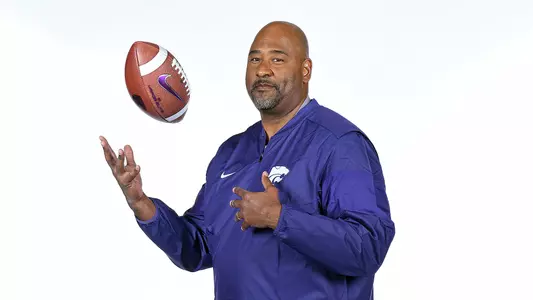
SE: Wyatt Using Large Coaching Portfolio to Better K-State’s Defensive Ends
Mar 27, 2019 | Football, Sports Extra
By Corbin McGuire
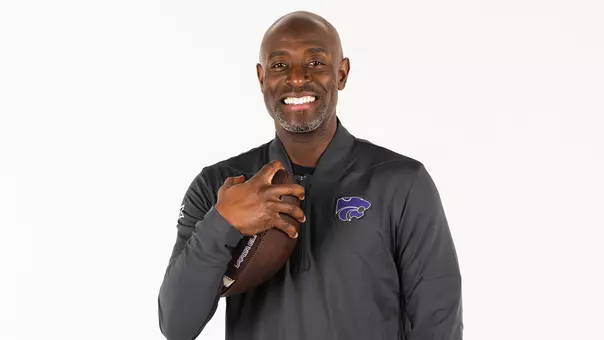
There are coaching portfolios, and then there is Buddy Wyatt's. If a bingo card was made for coaching stops, Wyatt would have a good shot at completing a few lines. He may even be near a blackout.
K-State's first-year defensive ends coach has spent time in three of the Power Five conferences (Big 12, SEC and Big Ten), along with the American Athletic Conference. He's worked at seven different Big 12 schools — some more than once (Texas A&M and Kansas), some before conference realignment took the schools elsewhere (Nebraska, Texas A&M, Colorado), some still part of the conference (Oklahoma State, Kansas and K-State) and one that joined after his time there (TCU).
Every stop, every move, Wyatt said, has been positive in his growth as a coach. He's picked up something different from each place, whether it was a defensive scheme, an individual technique or a player he could use as an example down the road.
"Then, it's just putting what you believe into action and making your own portfolio. That's the toughest part of it," Wyatt said. "You see a lot of good coaches, a lot of successful guys, but he does it this way, you do it that way…what are you comfortable with?"
Wyatt said his biggest comfort has always been in recruiting because "recruiting is about building relationships." It's what clicked for him after his dream of an NFL career did not pan out, his backup plan to be an accountant was a non-starter, and his college coaches suggested he change majors to education and to join them on the sidelines.
"I took a couple of education classes, liked them. More than that, my grades got better," Wyatt said, with a laugh, "so I went into coaching."
Wyatt, who got his first full-time job at Minnesota in 1992, connected with the relationship side of coaching right away. He's always had a way of convincing people to aspire for more. He still uses a motto to reinforce this mission: "Be better today than we were yesterday in all aspects — academics, weight training, nutrition and football. Be better today than we were yesterday."
K-State cornerbacks coach Van Malone can attest to Wyatt's persuasive nature. Wyatt is the man who convinced him to make the jump from high school to college coaching. Wyatt, at Texas A&M at the time, asked Malone, a Texas graduate, to come to a coaching clinic in College Station.
"I played at Texas. The last place I'm going to be caught is a Texas A&M clinic," Malone recalled thinking, with a smile. "But he convinced me to come to that clinic."
Malone left the clinic knowing he would take the next college coaching opportunity that came his way. It's no surprise Malone went to bat for Wyatt when the job became available on K-State head coach Chris Klieman's staff.
"My wife said to me the other day, 'Why don't you leave Buddy alone and stop dragging him around the country with you?'" Malone said, laughing, as he also worked with Wyatt at Texas A&M and SMU. "He's just a family man. He cares about his players. He's a good coach. He's coached many guys who have gone on and had great, productive NFL careers. I've learned so much from him, off the field and on the field."
Wyatt has coached more than a handful of players who went to the NFL. Von Miller, Ndamukong Suh, Michael Bennett, Jamal Williams, Adam Carriker and Ty Warren, are a few of the more notable names.
There are two other players he uses more often as examples, however, because their roads to the NFL were paved with traits anyone can develop.
The first player Wyatt named was Justin Lawler at SMU, picked up by the Los Angeles Rams in the seventh round of the 2018 NFL Draft. He made the team's roster and the trip to the Super Bowl.
The second was Wallace Gilberry, a defensive end out of Alabama. He was signed by the New York Giants as an undrafted free agent in 2008, released and signed shortly after by the Kansas City Chiefs to start a nine-year NFL career.
Neither player was the biggest, fastest or most talented player on his college team, but each showed work habits that made up for it. Gilberry, for instance, would come into Wyatt's office before a position meeting to get the same information twice.
"Those two were guys that I thought of as professionals when they were in college," Wyatt said.
As for Wyatt's particular coaching style, he said he's a "hands-on coach." While after nearly three decades in the business that means a little less demonstration than it used to — for fear of "pulling muscles," he laughed — it still boils down to one major focus: Technique.
"Technique is really important to me because the closer you are to the football the faster you have to be able to react, the faster things happen," he said. "The closer you move to the ball, there's less chance for you to be able take a false step or make a misread and be able to get your job done. I think that's really important that I make my guys technicians, make them students of the game so they can anticipate what's going to happen to them, react to things in a split second."
Only a few practices into K-State's spring period, K-State sophomore defensive end Wyatt Hubert said he's learned a variety of technical adjustments, mental and physical, to better his game.
"That's the main thing right now is just showing us little tiny tips or things he'll point out that you never knew about," Hubert said, "stuff that makes the game easier and slows it down for you."
"We're super fortunate that Coach Klieman brought in a guy like him with such a phenomenal resume and so many years of coaching experience underneath his belt," Hubert added. "He's making me a lot smarter football player and showing me a lot of things that I never knew in the past."
There are coaching portfolios, and then there is Buddy Wyatt's. If a bingo card was made for coaching stops, Wyatt would have a good shot at completing a few lines. He may even be near a blackout.
K-State's first-year defensive ends coach has spent time in three of the Power Five conferences (Big 12, SEC and Big Ten), along with the American Athletic Conference. He's worked at seven different Big 12 schools — some more than once (Texas A&M and Kansas), some before conference realignment took the schools elsewhere (Nebraska, Texas A&M, Colorado), some still part of the conference (Oklahoma State, Kansas and K-State) and one that joined after his time there (TCU).
Every stop, every move, Wyatt said, has been positive in his growth as a coach. He's picked up something different from each place, whether it was a defensive scheme, an individual technique or a player he could use as an example down the road.
"Then, it's just putting what you believe into action and making your own portfolio. That's the toughest part of it," Wyatt said. "You see a lot of good coaches, a lot of successful guys, but he does it this way, you do it that way…what are you comfortable with?"
Wyatt said his biggest comfort has always been in recruiting because "recruiting is about building relationships." It's what clicked for him after his dream of an NFL career did not pan out, his backup plan to be an accountant was a non-starter, and his college coaches suggested he change majors to education and to join them on the sidelines.
"I took a couple of education classes, liked them. More than that, my grades got better," Wyatt said, with a laugh, "so I went into coaching."
Wyatt, who got his first full-time job at Minnesota in 1992, connected with the relationship side of coaching right away. He's always had a way of convincing people to aspire for more. He still uses a motto to reinforce this mission: "Be better today than we were yesterday in all aspects — academics, weight training, nutrition and football. Be better today than we were yesterday."
K-State cornerbacks coach Van Malone can attest to Wyatt's persuasive nature. Wyatt is the man who convinced him to make the jump from high school to college coaching. Wyatt, at Texas A&M at the time, asked Malone, a Texas graduate, to come to a coaching clinic in College Station.
"I played at Texas. The last place I'm going to be caught is a Texas A&M clinic," Malone recalled thinking, with a smile. "But he convinced me to come to that clinic."
Malone left the clinic knowing he would take the next college coaching opportunity that came his way. It's no surprise Malone went to bat for Wyatt when the job became available on K-State head coach Chris Klieman's staff.
"My wife said to me the other day, 'Why don't you leave Buddy alone and stop dragging him around the country with you?'" Malone said, laughing, as he also worked with Wyatt at Texas A&M and SMU. "He's just a family man. He cares about his players. He's a good coach. He's coached many guys who have gone on and had great, productive NFL careers. I've learned so much from him, off the field and on the field."
Wyatt has coached more than a handful of players who went to the NFL. Von Miller, Ndamukong Suh, Michael Bennett, Jamal Williams, Adam Carriker and Ty Warren, are a few of the more notable names.
There are two other players he uses more often as examples, however, because their roads to the NFL were paved with traits anyone can develop.
The first player Wyatt named was Justin Lawler at SMU, picked up by the Los Angeles Rams in the seventh round of the 2018 NFL Draft. He made the team's roster and the trip to the Super Bowl.
The second was Wallace Gilberry, a defensive end out of Alabama. He was signed by the New York Giants as an undrafted free agent in 2008, released and signed shortly after by the Kansas City Chiefs to start a nine-year NFL career.
Neither player was the biggest, fastest or most talented player on his college team, but each showed work habits that made up for it. Gilberry, for instance, would come into Wyatt's office before a position meeting to get the same information twice.
"Those two were guys that I thought of as professionals when they were in college," Wyatt said.
As for Wyatt's particular coaching style, he said he's a "hands-on coach." While after nearly three decades in the business that means a little less demonstration than it used to — for fear of "pulling muscles," he laughed — it still boils down to one major focus: Technique.
"Technique is really important to me because the closer you are to the football the faster you have to be able to react, the faster things happen," he said. "The closer you move to the ball, there's less chance for you to be able take a false step or make a misread and be able to get your job done. I think that's really important that I make my guys technicians, make them students of the game so they can anticipate what's going to happen to them, react to things in a split second."
Only a few practices into K-State's spring period, K-State sophomore defensive end Wyatt Hubert said he's learned a variety of technical adjustments, mental and physical, to better his game.
"That's the main thing right now is just showing us little tiny tips or things he'll point out that you never knew about," Hubert said, "stuff that makes the game easier and slows it down for you."
"We're super fortunate that Coach Klieman brought in a guy like him with such a phenomenal resume and so many years of coaching experience underneath his belt," Hubert added. "He's making me a lot smarter football player and showing me a lot of things that I never knew in the past."
Players Mentioned
DE
/ FootballK-State FB | Welcome back Collin Klein
Monday, December 08
K-State FB | Head Coach Collin Klein Radio Interview
Friday, December 05
K-State FB | Head Coach Collin Klein Official Introductory Event
Friday, December 05
K-State FB | Thank You Coach Klieman
Wednesday, December 03