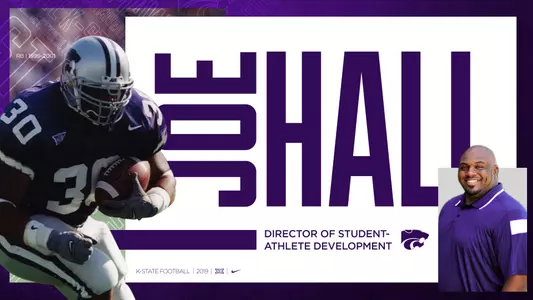
SE: How Joe Hall Changed His Aim in Order to Do the Same for Others
Jun 21, 2019 | Football, Sports Extra
By Corbin McGuire
Joe Hall was sitting in his office in Junction City High School this spring when his cell phone buzzed. It was Sean Snyder. A behavior interventionist, Hall was working with a student at the time and could not answer it.
But his brain naturally wandered.
"I wonder what he wants?" he thought.
Hall found out quickly. Snyder text him right after, informing of a new position being created on K-State's football staff. He asked Hall if he might be interested in it.
"I'm reading it while talking to this student, and I just lose everything. I can't function. So, I put it down and try to reinvest in this kid," Hall, who played two seasons at K-State (1999, 2001), said. "Once the meeting is over, I tell Sean, 'Of course.' Still, at the time, I had no inclination where it would go. I didn't really know what it was."
So, Hall asked Snyder to send him the job description. When Hall got the email detailing the position, he was floored. It mirrored something he wrote more than 10 years ago while running a speed and agility training company for young athletes in Arizona.
"I just fell in love with being able to help the kids. I wrote this program called, 'Change Your Aim Program,'" Hall said, adding the program was lost when his computer crashed years ago. "When he emailed it, I read it…and it was that form that I had in my computer.
"I was, like, 'This is the Change Your Aim Program.'"
As K-State football's first Director of Student-Athlete Development, Hall looks to do exactly that for more than 100 Wildcat student-athletes a year. In so many ways, he said he feels like the position was made for him, or he was made for the position, depending on how one looks at it.
To get to this point, however, he had to first change his aim.
When Hall addressed K-State's players earlier this summer, he did not spend much time talking about his time as a player, which included leading K-State in rushing yards as a junior transfer from Palomar Community College. Instead, he focused on what hindered his ability to play long-term.
Namely, two arrests.
The first was a minor in possession of alcohol. The second was a gun charge.
While Hall said he could rationalize both instances as more of bad luck than bad character, the reality of them became what was printed in the newspaper.
When he brings up his arrests, Hall does not want to justify his actions in either case. Instead he said he wants to "help the student-athletes understand" that mistakes, even ones as small as who you surround yourself with and the situations you put yourself in, can follow you for life.
"I just try to enlighten them from that perspective," he said. "Those are things that I've benefitted from greatly. A lot of my ability to be in my position is because I've made those mistakes but even beyond that, a lot of benefits I've taken from that have been because I learned. I was forced to grow up, to think, 'What if it was something more serious? What if you continue this path? How's that going to affect you long term?'
"The fact that, as a 19 year old, I made those mistakes and have to explain that to my now-15 year old (son) kind of gives me a passion to make sure these young men understand that one day, even if you don't get caught doing things that you're not supposed do, there's consequences regardless," he continued. "You're going to have to stand on those actions. If you do them long enough, that becomes your character. That becomes who you are."
All his life, Hall considered himself as someone meant to be "exceptional." He ran fast without having to work out. He was strong without having to lift. He picked up information, on a football field or in a classroom, quickly.
A native of Compton, California, this combination of gifts opened up opportunities for Hall that others in his neighborhood, where the ways out of poverty were commonly thought to be limited to sports, music or the streets, never had or thought of.
"In my environment, outside of my house, that was tough to imagine," he said. "There's other opportunities, and I had all of those things. I had real belief that I should be exceptional, and I wasn't. I was floating around."
Hall said he continued to float after he left K-State and bounced around the NFL from 2002-06.
Shortly after Hall stopped playing, he had no idea what he wanted to do. When Jean Boyd, a friend of Hall's and currently an executive senior associate AD at Arizona State, asked him to really think about it and draw up an ideal career, Hall imagined a job that looks much like his role now.
"I said I don't want to coach, necessarily," Hall said, "but I do want to be close to the athletes."
Boyd then asked what Hall majored in. Hall told him he never finished his degree at K-State.
"He was, like, 'There's nothing we can do then,'" Hall recalled. "It kind of got the ball moving."
The ball moved slowly at first, but it laid the groundwork for the future.
Hall opened his training company in Arizona, where he competed with several more notable former athletes. Among them, Barry Bonds. Without the name recognition, Hall gained traction in the area through his story. Through his experiences, he tried to steer athletes toward positive decisions as much as he was trying to increase their speed and agility.
One day, it clicked. This is what Hall wanted to do. He wanted to get into schools, to use his story to help youth get and stay on the right path. It became less about sports and more about everything else.
"At the time, it was, just, like, 'Man, I just want to show them that they have somebody that they can reach out to that will be there for them,'" Hall said. "I didn't know what that meant."
Hall figured out, at the very least, it meant he had to return to school if he wanted to make a career of it.
So, he finished his bachelor's degree in social science in 2012 at K-State. Then, he completed his master's in business in administration in 2015 at MidAmerica Nazarene, where he also coached and, as a result, became a much different student.
"I got that competitive urge but then I got competitive urge to be excellent and exceptional in the classroom, which I never had," Hall, who has four children with his wife, Hollie, said. "I never really took that as a challenge, to be the best student I could be."
In the fall of 2015, Hall returned again to K-State to pursue a master's degree in school counseling. Near the end of his curriculum, he worked with students who were dealing with their own mistakes, including a few, like himself, who were dismissed from the university and trying to reinstate.
The work seemed natural.
"It was everything I wanted it to be," Hall said. "Once I was making mistakes and once I came out of the other side, the only thing that could make me feel good about it, or get over it, was to be able to help somebody else go through what I went through and avoid it."
Which is what Hall had been doing since 2017. He worked for Topeka West High School for the 2017-18 school year and for Junction City High School last year.
When the opportunity at K-State arose, it seemed perfect. Admittedly, Hall said he could not imagine anyone being better fit for the position.
Between his experience in the program and in the NFL; his educational background, which now includes the pursuit of a doctoral degree in organizational leadership; and his past mistakes that he can use to connect with student-athletes in almost all circumstances, Hall has a lot to lean on in his new role.
"I think that personal experience from Day One, from my background back home all the way to today is pretty fitting for this position, and it makes it easier for the players," he said. "They usually respond differently because they know that I've been there."
While Hall obviously wants K-State to succeed on the field, his job goes beyond anything displayed on a scoreboard on Saturdays. He said he wants student-athletes, from starters to walk-ons, to walk away from K-State with a degree, a positive experience and a maturity to take on the real world from the get-go.
"When you're talking about the development of the student-athlete, that's the one thing I feel like I can put my mark on 100 percent every single day I get an opportunity to do that. It's not about wins and losses. It's about where you started and where you ended," he said. "If you start at one and the goal is to get to two, with the big picture being to finish at 10…if we do that with every single one of the kids — and that looks different for every individual — then we're increasing our opportunities.
"We're increasing our opportunities for society to be a better place for people that are willing to take chances, do what's right and stand out for being exceptional."
Editor's Note: K-State Sports Extra will be off next week for vacation and will return to its summer schedule on Monday, July 1.
Joe Hall was sitting in his office in Junction City High School this spring when his cell phone buzzed. It was Sean Snyder. A behavior interventionist, Hall was working with a student at the time and could not answer it.
But his brain naturally wandered.
"I wonder what he wants?" he thought.
Hall found out quickly. Snyder text him right after, informing of a new position being created on K-State's football staff. He asked Hall if he might be interested in it.
"I'm reading it while talking to this student, and I just lose everything. I can't function. So, I put it down and try to reinvest in this kid," Hall, who played two seasons at K-State (1999, 2001), said. "Once the meeting is over, I tell Sean, 'Of course.' Still, at the time, I had no inclination where it would go. I didn't really know what it was."
So, Hall asked Snyder to send him the job description. When Hall got the email detailing the position, he was floored. It mirrored something he wrote more than 10 years ago while running a speed and agility training company for young athletes in Arizona.
"I just fell in love with being able to help the kids. I wrote this program called, 'Change Your Aim Program,'" Hall said, adding the program was lost when his computer crashed years ago. "When he emailed it, I read it…and it was that form that I had in my computer.
"I was, like, 'This is the Change Your Aim Program.'"
As K-State football's first Director of Student-Athlete Development, Hall looks to do exactly that for more than 100 Wildcat student-athletes a year. In so many ways, he said he feels like the position was made for him, or he was made for the position, depending on how one looks at it.
To get to this point, however, he had to first change his aim.
When Hall addressed K-State's players earlier this summer, he did not spend much time talking about his time as a player, which included leading K-State in rushing yards as a junior transfer from Palomar Community College. Instead, he focused on what hindered his ability to play long-term.
Namely, two arrests.
The first was a minor in possession of alcohol. The second was a gun charge.
While Hall said he could rationalize both instances as more of bad luck than bad character, the reality of them became what was printed in the newspaper.
When he brings up his arrests, Hall does not want to justify his actions in either case. Instead he said he wants to "help the student-athletes understand" that mistakes, even ones as small as who you surround yourself with and the situations you put yourself in, can follow you for life.
"I just try to enlighten them from that perspective," he said. "Those are things that I've benefitted from greatly. A lot of my ability to be in my position is because I've made those mistakes but even beyond that, a lot of benefits I've taken from that have been because I learned. I was forced to grow up, to think, 'What if it was something more serious? What if you continue this path? How's that going to affect you long term?'
"The fact that, as a 19 year old, I made those mistakes and have to explain that to my now-15 year old (son) kind of gives me a passion to make sure these young men understand that one day, even if you don't get caught doing things that you're not supposed do, there's consequences regardless," he continued. "You're going to have to stand on those actions. If you do them long enough, that becomes your character. That becomes who you are."
All his life, Hall considered himself as someone meant to be "exceptional." He ran fast without having to work out. He was strong without having to lift. He picked up information, on a football field or in a classroom, quickly.
A native of Compton, California, this combination of gifts opened up opportunities for Hall that others in his neighborhood, where the ways out of poverty were commonly thought to be limited to sports, music or the streets, never had or thought of.
"In my environment, outside of my house, that was tough to imagine," he said. "There's other opportunities, and I had all of those things. I had real belief that I should be exceptional, and I wasn't. I was floating around."
Hall said he continued to float after he left K-State and bounced around the NFL from 2002-06.
Shortly after Hall stopped playing, he had no idea what he wanted to do. When Jean Boyd, a friend of Hall's and currently an executive senior associate AD at Arizona State, asked him to really think about it and draw up an ideal career, Hall imagined a job that looks much like his role now.
"I said I don't want to coach, necessarily," Hall said, "but I do want to be close to the athletes."
Boyd then asked what Hall majored in. Hall told him he never finished his degree at K-State.
"He was, like, 'There's nothing we can do then,'" Hall recalled. "It kind of got the ball moving."
The ball moved slowly at first, but it laid the groundwork for the future.
Hall opened his training company in Arizona, where he competed with several more notable former athletes. Among them, Barry Bonds. Without the name recognition, Hall gained traction in the area through his story. Through his experiences, he tried to steer athletes toward positive decisions as much as he was trying to increase their speed and agility.
One day, it clicked. This is what Hall wanted to do. He wanted to get into schools, to use his story to help youth get and stay on the right path. It became less about sports and more about everything else.
"At the time, it was, just, like, 'Man, I just want to show them that they have somebody that they can reach out to that will be there for them,'" Hall said. "I didn't know what that meant."
Hall figured out, at the very least, it meant he had to return to school if he wanted to make a career of it.
So, he finished his bachelor's degree in social science in 2012 at K-State. Then, he completed his master's in business in administration in 2015 at MidAmerica Nazarene, where he also coached and, as a result, became a much different student.
"I got that competitive urge but then I got competitive urge to be excellent and exceptional in the classroom, which I never had," Hall, who has four children with his wife, Hollie, said. "I never really took that as a challenge, to be the best student I could be."
In the fall of 2015, Hall returned again to K-State to pursue a master's degree in school counseling. Near the end of his curriculum, he worked with students who were dealing with their own mistakes, including a few, like himself, who were dismissed from the university and trying to reinstate.
The work seemed natural.
"It was everything I wanted it to be," Hall said. "Once I was making mistakes and once I came out of the other side, the only thing that could make me feel good about it, or get over it, was to be able to help somebody else go through what I went through and avoid it."
Which is what Hall had been doing since 2017. He worked for Topeka West High School for the 2017-18 school year and for Junction City High School last year.
When the opportunity at K-State arose, it seemed perfect. Admittedly, Hall said he could not imagine anyone being better fit for the position.
Between his experience in the program and in the NFL; his educational background, which now includes the pursuit of a doctoral degree in organizational leadership; and his past mistakes that he can use to connect with student-athletes in almost all circumstances, Hall has a lot to lean on in his new role.
"I think that personal experience from Day One, from my background back home all the way to today is pretty fitting for this position, and it makes it easier for the players," he said. "They usually respond differently because they know that I've been there."
While Hall obviously wants K-State to succeed on the field, his job goes beyond anything displayed on a scoreboard on Saturdays. He said he wants student-athletes, from starters to walk-ons, to walk away from K-State with a degree, a positive experience and a maturity to take on the real world from the get-go.
"When you're talking about the development of the student-athlete, that's the one thing I feel like I can put my mark on 100 percent every single day I get an opportunity to do that. It's not about wins and losses. It's about where you started and where you ended," he said. "If you start at one and the goal is to get to two, with the big picture being to finish at 10…if we do that with every single one of the kids — and that looks different for every individual — then we're increasing our opportunities.
"We're increasing our opportunities for society to be a better place for people that are willing to take chances, do what's right and stand out for being exceptional."
Editor's Note: K-State Sports Extra will be off next week for vacation and will return to its summer schedule on Monday, July 1.

Monday, June 22
Monday, June 22
Monday, June 22
Monday, June 01