SE: Isaac, Weber Relish Opportunity to have Voices Heard at Big 12 SAAC Meetings
Jul 24, 2019 | Sports Extra, Evans Student-Athlete Success Program
By Corbin McGuire
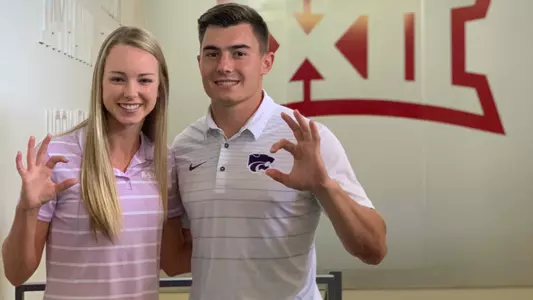
K-State women's golf's Reid Isaac, for the most part, knew what to expect from the annual Big 12 Student-Athlete Advisory Committee (SAAC) meeting last weekend in Irving, Texas. It was her second time going.
Landry Weber, a sophomore receiver for K-State football, had no idea what he was getting into. He was a first timer.
Still, both of K-State's Big 12 SAAC representatives left prouder of the conference they compete in. The source of this increased pride was simple: Their voices are being heard.
Within the three days of meetings at the Big 12 headquarters were hours of discussion between all 20 SAAC reps — two for each school — on potential rule proposals and changes. These discussions ranged from how to handle student-athletes transferring within the conference; allowing benefits from the United States Olympic Committee; and giving student-athletes in team sports the ability to set up an individual workout with a coach during the offseason, like those in individual sports can now.
On Sunday, each pair of school representatives came together to cast a vote for their school. While the final vote did not determine whether any legislation would pass or move forward, it will be passed up the chain for consideration when those issues are voted on by athletic directors across the Big 12.
"I think it's really cool how three years ago it was men in suits making decisions for student-athletes who are in uniforms, who didn't have any say and there wasn't much being asked of the student-athletes, in terms of opinions and how we feel about certain rules," Isaac said. "It's really cool to be in a room full of people who are having actual influence on the Big 12 rules and the direction the conference is headed. I think it's awesome they're really incorporating student-athletes into the process so that, on things they think we want, they actually know whether we want them or not.
"That's really important for us to have a voice. I think it's really showed how important it is that every student-athlete is not afraid to use their voice because these people actually care. They want to know what we think, how we could improve the conference as a whole."
Weber agreed.
"It definitely made me more prideful about being part of the Big 12," he said. "It's kind of cool that they're trying to listen to our voice, give us a say and they care about us. It makes you want to improve the conference as much as you can and do whatever you can for it. It was definitely a very cool experience."
The experience also included almost an entire day focused on diversity and inclusion education. The Big 12 SAAC representatives worked with and learned from RISE, a national nonprofit, on ways to enhance diversity and inclusion practices on their campus.
"One big thing was learning how there's surface diversity and then there's deep diversity. Surface is what we see, our skin color and stuff (like that), and that's a lot of times how society sees it, but it goes a lot deeper into who you are," Weber said. "That was a really cool experience. We learned a lot that we could bring back and help our university continue to grow in that area."
"We talked a lot about how nobody should have to leave a piece of themselves out of a room when they walk in, just to feel welcome," Isaac added. "So, loving each other despite differences and celebrating everything about each other."
Big 12 administrators also spent part of the weekend talking about its new digital network, Big 12 Now on ESPN+, with its SAAC members.
Weber and Isaac said their main takeaway from this was it should lead to more opportunity for everyone. For fans without cable or those looking to shift toward the digital-only route, it will provide more chances to watch their teams. As it grows, it may even lead to more opportunities for student-athletes to work for their school's in-house networks, like K-StateHD.TV, that broadcast events.
"They explained to us that they'll be looking to hire student-athletes to be involved with Big 12 Now," Isaac said. "So, we need to make our fellow student-athletes aware of that opportunity."
Outside of the business-type items, the Big 12 SAAC reps did get to have some fun.
The first night, they got fed by a national-award winning barbecue expert. Then, each school competed in a steak cookoff — K-State got third. They went to a bowling alley and arcade the next day. There was also a hospitality lounge open each night, where the student-athletes could interact and build relationships.
"All the other athletes were amazing people. It was super cool meeting them. We all clicked and became very tightknit very fast," Weber said. "It was really cool making those connections and building those relationships with people from all the universities in the Big 12."
K-State women's golf's Reid Isaac, for the most part, knew what to expect from the annual Big 12 Student-Athlete Advisory Committee (SAAC) meeting last weekend in Irving, Texas. It was her second time going.
Landry Weber, a sophomore receiver for K-State football, had no idea what he was getting into. He was a first timer.
Still, both of K-State's Big 12 SAAC representatives left prouder of the conference they compete in. The source of this increased pride was simple: Their voices are being heard.
Within the three days of meetings at the Big 12 headquarters were hours of discussion between all 20 SAAC reps — two for each school — on potential rule proposals and changes. These discussions ranged from how to handle student-athletes transferring within the conference; allowing benefits from the United States Olympic Committee; and giving student-athletes in team sports the ability to set up an individual workout with a coach during the offseason, like those in individual sports can now.
On Sunday, each pair of school representatives came together to cast a vote for their school. While the final vote did not determine whether any legislation would pass or move forward, it will be passed up the chain for consideration when those issues are voted on by athletic directors across the Big 12.
"I think it's really cool how three years ago it was men in suits making decisions for student-athletes who are in uniforms, who didn't have any say and there wasn't much being asked of the student-athletes, in terms of opinions and how we feel about certain rules," Isaac said. "It's really cool to be in a room full of people who are having actual influence on the Big 12 rules and the direction the conference is headed. I think it's awesome they're really incorporating student-athletes into the process so that, on things they think we want, they actually know whether we want them or not.
"That's really important for us to have a voice. I think it's really showed how important it is that every student-athlete is not afraid to use their voice because these people actually care. They want to know what we think, how we could improve the conference as a whole."
Weber agreed.
"It definitely made me more prideful about being part of the Big 12," he said. "It's kind of cool that they're trying to listen to our voice, give us a say and they care about us. It makes you want to improve the conference as much as you can and do whatever you can for it. It was definitely a very cool experience."
The experience also included almost an entire day focused on diversity and inclusion education. The Big 12 SAAC representatives worked with and learned from RISE, a national nonprofit, on ways to enhance diversity and inclusion practices on their campus.
"One big thing was learning how there's surface diversity and then there's deep diversity. Surface is what we see, our skin color and stuff (like that), and that's a lot of times how society sees it, but it goes a lot deeper into who you are," Weber said. "That was a really cool experience. We learned a lot that we could bring back and help our university continue to grow in that area."
"We talked a lot about how nobody should have to leave a piece of themselves out of a room when they walk in, just to feel welcome," Isaac added. "So, loving each other despite differences and celebrating everything about each other."
Big 12 administrators also spent part of the weekend talking about its new digital network, Big 12 Now on ESPN+, with its SAAC members.
Weber and Isaac said their main takeaway from this was it should lead to more opportunity for everyone. For fans without cable or those looking to shift toward the digital-only route, it will provide more chances to watch their teams. As it grows, it may even lead to more opportunities for student-athletes to work for their school's in-house networks, like K-StateHD.TV, that broadcast events.
"They explained to us that they'll be looking to hire student-athletes to be involved with Big 12 Now," Isaac said. "So, we need to make our fellow student-athletes aware of that opportunity."
Outside of the business-type items, the Big 12 SAAC reps did get to have some fun.
The first night, they got fed by a national-award winning barbecue expert. Then, each school competed in a steak cookoff — K-State got third. They went to a bowling alley and arcade the next day. There was also a hospitality lounge open each night, where the student-athletes could interact and build relationships.
"All the other athletes were amazing people. It was super cool meeting them. We all clicked and became very tightknit very fast," Weber said. "It was really cool making those connections and building those relationships with people from all the universities in the Big 12."

K-State Women's Basketball | Coach Mittie Press Conference vs BYU
Sunday, February 08
K-State Women's Basketball | Press Conference vs BYU
Sunday, February 08
K-State Women's Basketball | Game Highlights vs BYU
Sunday, February 08
K-State Men's Basketball | Postgame Press Conference at TCU
Saturday, February 07