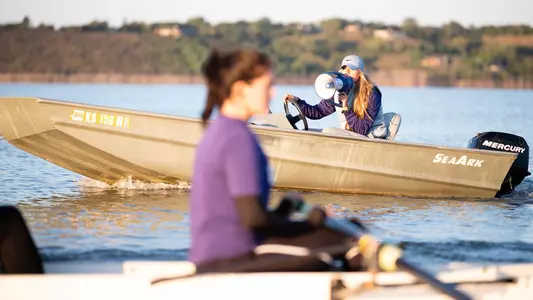
SE: Catching up with Noelle Dykmann of K-State Rowing
Nov 20, 2020 | Rowing, Sports Extra
Without a spring season or any competitions this fall, K-State Rowing will go almost a full year without racing.
And yet, the team has been hard at work the past few months and signed 15 rowers last week who will arrive on campus in 2021. Even in a pandemic, the Wildcats have found a way.
Noelle Dykmann is a former K-State captain and in her third season as an Assistant Coach.
She chatted with Austin Siegel of K-State Sports Extra about making adjustments throughout 2020, how the Wildcats recruit the state of Kansas and what it takes to be a K-State rower.
What's been the biggest challenge for K-State Rowing without a traditional fall season?
I would say it's been the people coming in and out of quarantine, with close contacts and that kind of thing. Rowing is pretty different from other sports in that we can't just put in a sub. You need to have eight people in the boat, otherwise it's not going to go straight. So, whenever we're making lineups, you have to be prepared for that phone call that we actually lost three of them, so we've got to create a new lineup and switch things around to adjust on the fly. I think the team has done a phenomenal job of hanging in there and doing the best they can.
When you build a workout schedule, how do you structure that between time in the gym and then getting out on the water?
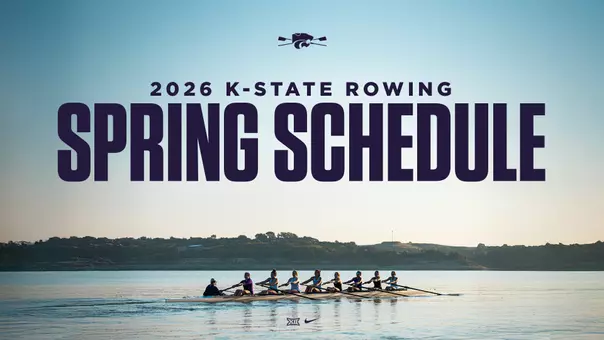
Ideally, we would be on the water every morning from 7 a.m. to 8:30 a.m. - the only thing that would prevent us from doing that is the weather. The wind at Tuttle Creek has been pretty crazy and when it gets too cold in the morning, we can't go out there. Ideal rowing conditions are flat, glassy water so that the racing shell can just glide across the top of the water.
What's too cold to be out at Tuttle Creek?
Generally, below freezing is a no-go.
Coming off National Signing Day and the work that you put in to identify the next generation of K-State rowers, what are some of the things you look for on the recruiting trail?
First? Height. Always height. Length is leverage, so the longer you are, the more water you can move per stroke. That's the first thing. Then, just basic athleticism. Grit, teamwork and a desire to achieve is one thing that you can't tell by looking at someone. But the more we get to know our recruits, the more we can see if they have that desire to push themselves and work hard. In the middle of a race you can't just be like "Uh cramp, pull me." You have to finish the freaking race. It takes really tough kids to do this thing.

The recruiting challenges in rowing already seem so different from any other sport at K-State, but with everything that 2020 has thrown at your program, how have you had to modify your approach?
Oh, I don't know [laughs]. We can't do campus visits and we can't go to basketball and volleyball tournaments, which is where we find height. We go find Kansas kids who aren't getting D1 looks in volleyball and basketball, track, swimming, soccer or softball. It's all homegrown, Kansas kids who want a D1 opportunity. Without watching them play a sport, we can't get new names in our database. Without having new kids come here, we can't meet them, show them the facility and show them the sport. Remember, they don't know how to do the sport.
So, at these volleyball and basketball tournaments, are you guys like waiting in the parking lot? How do you get the attention of these kids?
In a non-COVID year, we would go to a basketball tournament and get the roster, highlight everyone who is 5-foot-10 or taller, so big tournaments are the best, and then they're going to get a letter from us saying "Hey, we saw you at a tournament and we think you might have what it takes to be a D1 rower, fill out this questionnaire and we'll get back to you and talk from there." That's kind of where it starts. We were nervous coming into this year, because not a lot of high schools are having in-person classes, so if we send a letter, are they even going to get it?
When you're having that first conversation, even if it's just over Zoom, what kind of questions do you ask to figure out if they have the right mindset for the sport?
Are you competitive? That's a big one, because the team is really competitive within itself, but that's because it takes a team to build a team. We ask about sports backgrounds, but honestly, they aren't always athletes. Sometimes, it's just people who have an achievement complex. Maybe they're a really great pianist and they're tall and they want to try a new sport. Sometimes, those kids just try hard and find a way to be successful. It's about a desire to be better.
That's what motivated me when I was going through the program; I was seeing myself improve. You peak and valley, peak and valley. But the valleys come and go, and the peaks are worth it.
How much of your own story and your experience as a K-State rower comes into play on the recruiting trail?
I played basketball in high school and I got a couple letters sent to my school, but I threw those away. I was laughing at them like "No, I'm not doing this. This is embarrassing. Leave me alone." But as I know now, we are relentless, and we send letter after letter until they send one back.
I ignored them my junior year and then in my senior year, I had a couple friends who were getting looks for D1 volleyball at some big schools. I was like "Cool, I'm definitely not going D1 for basketball." But one of my friends was like "Isn't K-State a D1 school? You're getting an athletic opportunity. What's your problem?" Plus, my Dad was a K-State alum, so he made me come on the visit. They advertise that if you come on a visit the weekend of a football game, you get free tickets. He was like "I don't know what you're doing but I'm going to the game."
I couldn't envision myself not being an athlete. That's part of my identity and I wanted to see what I could do. My two favorite things are making friends and working out, so I thought well, why not do both at practice every morning? And then obviously I sucked my whole freshman year. I was not good. But honestly, that made me want to try harder. I didn't race my first year, but I raced my second year and I thought "OK, racing is the actual sport." Once I got to that point, I fell in love with it.
It seems like in rowing you could almost take away the sport itself without losing everything that training does for athletes emotionally and spiritually, or am I wrong?
No - It's crazy when you're out there on the rowing machines. There have been times where I get emotional on the erg because it's just you and the machine. You're pushing yourself so hard, but you do not stop because the people next to you aren't stopping either. When it becomes a selfless thing and you're doing it for your friends and you're doing it for the people around you, the way that you can see yourself grow is unreal.
So, when your team doesn't have those races this fall and the promise of that finish line, what sort of qualities does that bring to the surface in your rowers?
Resiliency and adaptability. I don't know how much you know about our team and what we've been through the past couple of years, but two years ago, we lost an athlete. It seems like our team is just resilient, because anything that we get thrown, we rise above it. We're adaptable. I think at the core of it, although a lot of the girls love to race and they love to win, earn a medal and all those external motivators, I think at the core of it our team is about the bonds and relationships that they get to build through the process.
And yet, the team has been hard at work the past few months and signed 15 rowers last week who will arrive on campus in 2021. Even in a pandemic, the Wildcats have found a way.
Noelle Dykmann is a former K-State captain and in her third season as an Assistant Coach.
She chatted with Austin Siegel of K-State Sports Extra about making adjustments throughout 2020, how the Wildcats recruit the state of Kansas and what it takes to be a K-State rower.
What's been the biggest challenge for K-State Rowing without a traditional fall season?
I would say it's been the people coming in and out of quarantine, with close contacts and that kind of thing. Rowing is pretty different from other sports in that we can't just put in a sub. You need to have eight people in the boat, otherwise it's not going to go straight. So, whenever we're making lineups, you have to be prepared for that phone call that we actually lost three of them, so we've got to create a new lineup and switch things around to adjust on the fly. I think the team has done a phenomenal job of hanging in there and doing the best they can.
When you build a workout schedule, how do you structure that between time in the gym and then getting out on the water?
Ideally, we would be on the water every morning from 7 a.m. to 8:30 a.m. - the only thing that would prevent us from doing that is the weather. The wind at Tuttle Creek has been pretty crazy and when it gets too cold in the morning, we can't go out there. Ideal rowing conditions are flat, glassy water so that the racing shell can just glide across the top of the water.
What's too cold to be out at Tuttle Creek?
Generally, below freezing is a no-go.
With one of the biggest rosters of any team at K-State, how much work goes in to planning workouts when everyone can't be in the same space at the same time?
Our roster is 65 and obviously we can't have all of them in one building because of COVID. So, we spread out the ergs, which are the rowing machines, but that limits who we can put in there even more. So, we have divided practice time in the morning with two shifts, one from 6:30 a.m. to 7:30 a.m. and one starting at 7:45 a.m. It's about sharing the erg room, getting creative and going outside to do circuits. Creativity has been a really big part of this semester.Coming off National Signing Day and the work that you put in to identify the next generation of K-State rowers, what are some of the things you look for on the recruiting trail?
First? Height. Always height. Length is leverage, so the longer you are, the more water you can move per stroke. That's the first thing. Then, just basic athleticism. Grit, teamwork and a desire to achieve is one thing that you can't tell by looking at someone. But the more we get to know our recruits, the more we can see if they have that desire to push themselves and work hard. In the middle of a race you can't just be like "Uh cramp, pull me." You have to finish the freaking race. It takes really tough kids to do this thing.
The recruiting challenges in rowing already seem so different from any other sport at K-State, but with everything that 2020 has thrown at your program, how have you had to modify your approach?
Oh, I don't know [laughs]. We can't do campus visits and we can't go to basketball and volleyball tournaments, which is where we find height. We go find Kansas kids who aren't getting D1 looks in volleyball and basketball, track, swimming, soccer or softball. It's all homegrown, Kansas kids who want a D1 opportunity. Without watching them play a sport, we can't get new names in our database. Without having new kids come here, we can't meet them, show them the facility and show them the sport. Remember, they don't know how to do the sport.
So, at these volleyball and basketball tournaments, are you guys like waiting in the parking lot? How do you get the attention of these kids?
In a non-COVID year, we would go to a basketball tournament and get the roster, highlight everyone who is 5-foot-10 or taller, so big tournaments are the best, and then they're going to get a letter from us saying "Hey, we saw you at a tournament and we think you might have what it takes to be a D1 rower, fill out this questionnaire and we'll get back to you and talk from there." That's kind of where it starts. We were nervous coming into this year, because not a lot of high schools are having in-person classes, so if we send a letter, are they even going to get it?
When you're having that first conversation, even if it's just over Zoom, what kind of questions do you ask to figure out if they have the right mindset for the sport?
Are you competitive? That's a big one, because the team is really competitive within itself, but that's because it takes a team to build a team. We ask about sports backgrounds, but honestly, they aren't always athletes. Sometimes, it's just people who have an achievement complex. Maybe they're a really great pianist and they're tall and they want to try a new sport. Sometimes, those kids just try hard and find a way to be successful. It's about a desire to be better.
That's what motivated me when I was going through the program; I was seeing myself improve. You peak and valley, peak and valley. But the valleys come and go, and the peaks are worth it.
How much of your own story and your experience as a K-State rower comes into play on the recruiting trail?
I played basketball in high school and I got a couple letters sent to my school, but I threw those away. I was laughing at them like "No, I'm not doing this. This is embarrassing. Leave me alone." But as I know now, we are relentless, and we send letter after letter until they send one back.
I ignored them my junior year and then in my senior year, I had a couple friends who were getting looks for D1 volleyball at some big schools. I was like "Cool, I'm definitely not going D1 for basketball." But one of my friends was like "Isn't K-State a D1 school? You're getting an athletic opportunity. What's your problem?" Plus, my Dad was a K-State alum, so he made me come on the visit. They advertise that if you come on a visit the weekend of a football game, you get free tickets. He was like "I don't know what you're doing but I'm going to the game."
I couldn't envision myself not being an athlete. That's part of my identity and I wanted to see what I could do. My two favorite things are making friends and working out, so I thought well, why not do both at practice every morning? And then obviously I sucked my whole freshman year. I was not good. But honestly, that made me want to try harder. I didn't race my first year, but I raced my second year and I thought "OK, racing is the actual sport." Once I got to that point, I fell in love with it.
It seems like in rowing you could almost take away the sport itself without losing everything that training does for athletes emotionally and spiritually, or am I wrong?
No - It's crazy when you're out there on the rowing machines. There have been times where I get emotional on the erg because it's just you and the machine. You're pushing yourself so hard, but you do not stop because the people next to you aren't stopping either. When it becomes a selfless thing and you're doing it for your friends and you're doing it for the people around you, the way that you can see yourself grow is unreal.
So, when your team doesn't have those races this fall and the promise of that finish line, what sort of qualities does that bring to the surface in your rowers?
Resiliency and adaptability. I don't know how much you know about our team and what we've been through the past couple of years, but two years ago, we lost an athlete. It seems like our team is just resilient, because anything that we get thrown, we rise above it. We're adaptable. I think at the core of it, although a lot of the girls love to race and they love to win, earn a medal and all those external motivators, I think at the core of it our team is about the bonds and relationships that they get to build through the process.
K-State Rowing | Media Day
Tuesday, February 24
K-State Rowing | Weights Practice
Tuesday, February 24
K-State Tennis | Weekend Recap vs Old Dominion & Minnesota
Tuesday, February 24
K-State Track and Field | Sights & Sounds Steve Miller Invitational
Monday, February 23