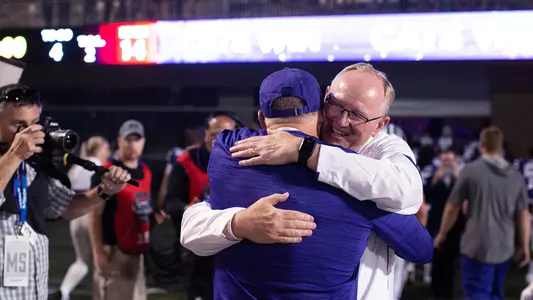
SE: Q&A with Gene Taylor on Football, NILs and the Culture of K-State Athletics
May 04, 2020 | Sports Extra
K-State Director of Athletics Gene Taylor spoke with Austin Siegel of K-State Sports Extra this week for an update on how K-State Athletics is navigating the college sports landscape during COVID-19. The conversation has been condensed and edited for clarity.
AS: Every athletic department is different, but with furloughs at schools across the country, what factors allowed K-State to avoid those measures in this week's salary reduction?
GT: This fiscal year we were in pretty good shape. As we look to next year, assuming we have some kind of football, we wanted to keep this at the senior level as much as possible. The impact of those salary reductions is a little easier to deal with, and we felt that if we could reach a number of savings by not going below that level, then that's where we would start.
I hope we can keep it there. If we don't have football obviously it's a totally different deal, but right now we just wanted to keep it at the senior staff level and coaches that are making those bigger salaries. That's where we did our math.
AS: Have you seen any scenarios for playing football in 2020 that seem crazy, such as playing a winter season in domed stadiums across the country, or is everything still on the table?
GT: Everything is on the table, but there are some crazy ideas that are on the table. I hadn't seen the domed stadium one, but the idea that I think is crazy is starting the season in January and playing until March.
There are very few places in the country where you can do that comfortably, including Kansas, and we're towards the southern end of that range. I certainly wouldn't want to go up to Iowa or Michigan. That's where I'm like, 'I don't know if you can make that work.' The one that makes a little more sense if you're going to play in the Spring - from a weather perspective - is starting in March and ending in May. From a facility perspective, most of these stadiums are football-only so you're not going to have conflicts and very few of these teams play in professional stadiums.
The problem with that one is the NFL Draft. How many guys who are draft eligible are not going to play in a season like that? And then all of a sudden, you end in May and you're back in late July or early August? I don't know how that works from a safety perspective.
AS: If most Big 12 schools are ready to play football this season, is there a consensus on what the plan would be if two or three schools in the conference aren't ready to start on time?
GT: We're mostly in it together. One AD did mention how can we stop schools in Texas or Oklahoma if they can play their first two games and schools in Kansas or Iowa can't for some reason, how can we deny them that opportunity? It's a fair question. Again, I think everybody agrees we need to be as competitively equitable as we can.
Where we're going to start to see cracks is with the moratorium on schools using their athletic facilities before May 31. All of a sudden, if we've still got a shutdown in Kansas and Oklahoma is wide open, then schools in Oklahoma are bringing their kids back to start working out in their facilities. That's where I think we won't be on the same page.
AS: You've expressed support for name, image and likeness rules that "work for everyone." With this week's proposed rule changes, how far apart do you think ADs across the country are on NILs?
GT: As I hear more and more on individual conversations, I think we are further apart than a lot of people think. There's one AD at a pretty prominent school who said, 'This is more permissible than in the professional ranks' the way these latest rules changes are presented. That's going to cause us major issues within the world of the collegiate model.
Everyone is moving away from amateurism and amateur athletics. We're focused on creating a collegiate model and this AD said, 'We need to make sure we're college athletics and we aren't professional.' There are more and more ADs getting on that bandwagon. As we continue to have these discussions, it will be interesting to see where it goes.
AS: With Governor Kelly's plan to re-open Kansas beginning on May 4, how important will having the athletic department staff back in the office be for K-State?
GT: I think it's huge. People have been very patient and understanding, but it's been almost seven weeks and I think people want to get back to some level of normal, whatever that is. Coming into their office and interacting, even if they're wearing a mask, with another staff member and seeing their friends, it's big. We need to make sure we do it the right way. If somebody is uncomfortable, they should have the option to work from home.
AS: What do you think makes the culture at an athletic department like K-State unique during a time like this, as coaches and athletic staffers prepare to return to the office in Manhattan?
GT: It's just the camaraderie of being a K-Stater. You love what you're doing because you are working with college athletes, and whether you're in the ticket office or team operations, you're having an impact on our young men and women. There's kind of a team effort to say, 'We're all in this together.' And it feels good, it feels good to wear the Powercat and know that you're helping these teams win games.
AS: Every athletic department is different, but with furloughs at schools across the country, what factors allowed K-State to avoid those measures in this week's salary reduction?
GT: This fiscal year we were in pretty good shape. As we look to next year, assuming we have some kind of football, we wanted to keep this at the senior level as much as possible. The impact of those salary reductions is a little easier to deal with, and we felt that if we could reach a number of savings by not going below that level, then that's where we would start.
I hope we can keep it there. If we don't have football obviously it's a totally different deal, but right now we just wanted to keep it at the senior staff level and coaches that are making those bigger salaries. That's where we did our math.
AS: Have you seen any scenarios for playing football in 2020 that seem crazy, such as playing a winter season in domed stadiums across the country, or is everything still on the table?
GT: Everything is on the table, but there are some crazy ideas that are on the table. I hadn't seen the domed stadium one, but the idea that I think is crazy is starting the season in January and playing until March.
There are very few places in the country where you can do that comfortably, including Kansas, and we're towards the southern end of that range. I certainly wouldn't want to go up to Iowa or Michigan. That's where I'm like, 'I don't know if you can make that work.' The one that makes a little more sense if you're going to play in the Spring - from a weather perspective - is starting in March and ending in May. From a facility perspective, most of these stadiums are football-only so you're not going to have conflicts and very few of these teams play in professional stadiums.
The problem with that one is the NFL Draft. How many guys who are draft eligible are not going to play in a season like that? And then all of a sudden, you end in May and you're back in late July or early August? I don't know how that works from a safety perspective.
AS: If most Big 12 schools are ready to play football this season, is there a consensus on what the plan would be if two or three schools in the conference aren't ready to start on time?
GT: We're mostly in it together. One AD did mention how can we stop schools in Texas or Oklahoma if they can play their first two games and schools in Kansas or Iowa can't for some reason, how can we deny them that opportunity? It's a fair question. Again, I think everybody agrees we need to be as competitively equitable as we can.
Where we're going to start to see cracks is with the moratorium on schools using their athletic facilities before May 31. All of a sudden, if we've still got a shutdown in Kansas and Oklahoma is wide open, then schools in Oklahoma are bringing their kids back to start working out in their facilities. That's where I think we won't be on the same page.
AS: You've expressed support for name, image and likeness rules that "work for everyone." With this week's proposed rule changes, how far apart do you think ADs across the country are on NILs?
GT: As I hear more and more on individual conversations, I think we are further apart than a lot of people think. There's one AD at a pretty prominent school who said, 'This is more permissible than in the professional ranks' the way these latest rules changes are presented. That's going to cause us major issues within the world of the collegiate model.
Everyone is moving away from amateurism and amateur athletics. We're focused on creating a collegiate model and this AD said, 'We need to make sure we're college athletics and we aren't professional.' There are more and more ADs getting on that bandwagon. As we continue to have these discussions, it will be interesting to see where it goes.
AS: With Governor Kelly's plan to re-open Kansas beginning on May 4, how important will having the athletic department staff back in the office be for K-State?
GT: I think it's huge. People have been very patient and understanding, but it's been almost seven weeks and I think people want to get back to some level of normal, whatever that is. Coming into their office and interacting, even if they're wearing a mask, with another staff member and seeing their friends, it's big. We need to make sure we do it the right way. If somebody is uncomfortable, they should have the option to work from home.
AS: What do you think makes the culture at an athletic department like K-State unique during a time like this, as coaches and athletic staffers prepare to return to the office in Manhattan?
GT: It's just the camaraderie of being a K-Stater. You love what you're doing because you are working with college athletes, and whether you're in the ticket office or team operations, you're having an impact on our young men and women. There's kind of a team effort to say, 'We're all in this together.' And it feels good, it feels good to wear the Powercat and know that you're helping these teams win games.
K-State Tennis | Weekend Recap
Tuesday, February 24
K-State Track and Field | Sights & Sounds Steve Miller Invitational
Monday, February 23
K-State Baseball | Highlights vs Michigan - Feb. 22, 2026
Monday, February 23
K-State Men's Basketball | Postgame Press Conference at Texas Tech
Sunday, February 22