SE: Why K-State Student-Athletes and Athletics Staff Joined Protests in Manhattan
Jun 08, 2020 | Football, Women's Basketball, Sports Extra
By: Austin Siegel
At this week's protests in Manhattan, a pastor shared text messages from his mother.
She was worried, Tyler Burns remembers, that her grandchildren were going to grow up without a father.
"That's a real fear for black people," Burns said. "George Floyd was somebody's brother, husband and father. When you see that, it starts to run through your mind, that could have easily been me."
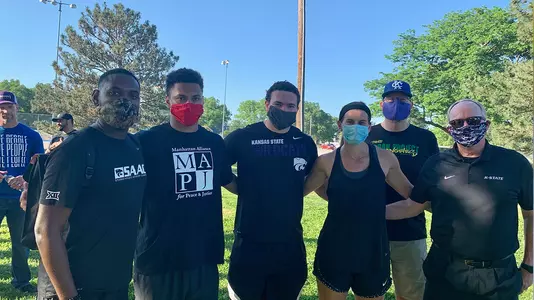
The K-State running back joined over 2,000 members of the Manhattan community this week in solidarity with nationwide protests that began in Minneapolis, after a white police officer killed George Floyd by kneeling on his neck for almost nine minutes.
Burns marched alongside K-State student-athletes and staff, including Director of Athletics Gene Taylor and Assistant Athletics Director of Student-Athlete Development Julian Jones.
Jones said that same theme – "it could have easily been me" – was first discussed in a meeting between Taylor and black student-athletes the week Floyd was killed.
"That dialogue is important so that our student-athletes feel supported, cared for and know that if they stand up about these things, they won't be shunned," Jones said.
Taylor said that his participation in local protests was about acknowledging his own privilege and staying visible in his support of black student-athletes at K-State.
"I can't imagine what they deal with on a daily basis," he said. "But for me to walk out with them and let them know I support them, we're listening to them and we need to stand up against racism, I thought it was critical for me to be there."
Manhattan's protests included a march down Bluemont Avenue on Tuesday night followed by a gathering in City Park on Wednesday evening.
Burns said that even those who might not fully understand the cause made a difference through their anger, desire to understand and a shared knowledge that "this is unjust."
He offered religion as a source of common ground, especially among student-athletes who come from different backgrounds and don't share a personal history of dealing with racism.
Peyton Williams, who participated in protests in Topeka with K-State women's basketball teammate Christianna Carr, is someone Burns said he has shared meaningful conversations with over the last few weeks.
"There are verses throughout the Bible that say when people are being treated unjustly, we should be there to carry each other's burden," Burns said. "As a white woman, Peyton recognizes that, 'OK, even if this doesn't affect me directly, I'm going to carry your burden and hopefully feel what you feel.' I think seeing how athletes responded has affected me the most."
Jones said that even among athletic programs at K-State that don't have a large number of black student-athletes, there is still a responsibility to support each other.
"For the members of those teams that are black, they want their brothers and their sisters to know how they're feeling and how important it is when they reach out," he said. "People have to understand that you need to have those uncomfortable conversations."
After a meeting between Taylor and black student-athletes the week that protests began in Minneapolis, K-State partnered with Oklahoma to host a talk on Zoom between black student-athletes, athletic staff and allies at different schools throughout the country.
While K-State and Oklahoma sponsored the event, the Humanity Talk was met with nationwide interest and every Power 5 conference was represented.
Taylor said that white members of the K-State Athletics community can no longer afford to remain silent during these protests - just last week, K-State displayed the message #BlackLivesMatter outside Bill Snyder Family Stadium.
He said his goal for K-State moving forward is to focus on continued education for those looking to support black student-athletes and a community where those conversations can take place.
"We talk about the melting pots of locker rooms and how there are differences in that room, but they put on a uniform and go out there together," Taylor said. "For them to start having those conversations like, 'Let me hear what you're thinking. Let me hear what gets you frustrated,' those are the kind of things where we need to focus on our ability to listen."
Burns said student-athletes can face pressure not to share their opinions on social issues, the same "shut up and dribble" mentality that has been used to pressure a generation of athletes from speaking out on everything from police brutality to systemic racism.
Burns is also aware of the perception that student-athletes aren't focused on studying or thinking about the same social issues as other K-State students.
"Sometimes, because of that stereotype, I go out of my way to not always wear K-State stuff, so I'm not pinned down as what a student-athlete should be," Burns said. "One of the reasons I play football is because of the platform. People worship football in the United States, and I don't necessarily agree with that, but because of that, I can share my thoughts and beliefs."
His focus moving forward is on the people who aren't protesting or are just there because it's a trending topic on social media. Burns said that protesting can be a "small steppingstone" towards the kind of interactions that can help move the K-State community forward.
"The issue isn't with the people who are at the protest, the issue is with the people who aren't at the protest," he said. "Those are the ones whose hearts need to be changed. It's hard to buy that it's a dialogue about race when the people who don't want to deal with these issues or don't even think that we have an issue probably aren't going to show up."
For Burns, that means listening to young black voices and continuing to fight against indifference.
"These are conversations that need to be had. I would hope and pray that people listen to the experiences of young black people that have experienced racism," Burns said. "Indifference is the issue. Jesus Christ hated indifference. During the Civil Rights movement, pastors told MLK he needed to be patient. Indifference is worse than hatred. Don't just sit there and do nothing."
At this week's protests in Manhattan, a pastor shared text messages from his mother.
She was worried, Tyler Burns remembers, that her grandchildren were going to grow up without a father.
"That's a real fear for black people," Burns said. "George Floyd was somebody's brother, husband and father. When you see that, it starts to run through your mind, that could have easily been me."
The K-State running back joined over 2,000 members of the Manhattan community this week in solidarity with nationwide protests that began in Minneapolis, after a white police officer killed George Floyd by kneeling on his neck for almost nine minutes.
Burns marched alongside K-State student-athletes and staff, including Director of Athletics Gene Taylor and Assistant Athletics Director of Student-Athlete Development Julian Jones.
Jones said that same theme – "it could have easily been me" – was first discussed in a meeting between Taylor and black student-athletes the week Floyd was killed.
"That dialogue is important so that our student-athletes feel supported, cared for and know that if they stand up about these things, they won't be shunned," Jones said.
This has been a long week! However I do want to thank our Athletic Director @KSTATEADGT for the support he has showed so far. We know we have a lot more work to do, but we are moving in the right direction. #PeacefulProtest #BlackLivesMatter pic.twitter.com/OCIjvnk2gR
— Julian Jones (@Julian__Jones) June 5, 2020
Taylor said that his participation in local protests was about acknowledging his own privilege and staying visible in his support of black student-athletes at K-State.
"I can't imagine what they deal with on a daily basis," he said. "But for me to walk out with them and let them know I support them, we're listening to them and we need to stand up against racism, I thought it was critical for me to be there."
Manhattan's protests included a march down Bluemont Avenue on Tuesday night followed by a gathering in City Park on Wednesday evening.
Thank you Manhattan Ks!! https://t.co/H08dpuGB4H
— Tyler Lockett (@TDLockett12) June 3, 2020
Burns said that even those who might not fully understand the cause made a difference through their anger, desire to understand and a shared knowledge that "this is unjust."
He offered religion as a source of common ground, especially among student-athletes who come from different backgrounds and don't share a personal history of dealing with racism.
Peyton Williams, who participated in protests in Topeka with K-State women's basketball teammate Christianna Carr, is someone Burns said he has shared meaningful conversations with over the last few weeks.
"There are verses throughout the Bible that say when people are being treated unjustly, we should be there to carry each other's burden," Burns said. "As a white woman, Peyton recognizes that, 'OK, even if this doesn't affect me directly, I'm going to carry your burden and hopefully feel what you feel.' I think seeing how athletes responded has affected me the most."
🖤 when silence is betrayal 🖤 pic.twitter.com/SICEELpNT9
— Peyton Williams (@pqwill11) June 4, 2020
Jones said that even among athletic programs at K-State that don't have a large number of black student-athletes, there is still a responsibility to support each other.
"For the members of those teams that are black, they want their brothers and their sisters to know how they're feeling and how important it is when they reach out," he said. "People have to understand that you need to have those uncomfortable conversations."
After a meeting between Taylor and black student-athletes the week that protests began in Minneapolis, K-State partnered with Oklahoma to host a talk on Zoom between black student-athletes, athletic staff and allies at different schools throughout the country.
While K-State and Oklahoma sponsored the event, the Humanity Talk was met with nationwide interest and every Power 5 conference was represented.
Taylor said that white members of the K-State Athletics community can no longer afford to remain silent during these protests - just last week, K-State displayed the message #BlackLivesMatter outside Bill Snyder Family Stadium.
He said his goal for K-State moving forward is to focus on continued education for those looking to support black student-athletes and a community where those conversations can take place.
"We talk about the melting pots of locker rooms and how there are differences in that room, but they put on a uniform and go out there together," Taylor said. "For them to start having those conversations like, 'Let me hear what you're thinking. Let me hear what gets you frustrated,' those are the kind of things where we need to focus on our ability to listen."
I stand with my brothers 🖤#BlackLivesMatter pic.twitter.com/5IX2jAEHyn
— Harry Trotter (@HTrotter_2) June 3, 2020
Burns said student-athletes can face pressure not to share their opinions on social issues, the same "shut up and dribble" mentality that has been used to pressure a generation of athletes from speaking out on everything from police brutality to systemic racism.
Burns is also aware of the perception that student-athletes aren't focused on studying or thinking about the same social issues as other K-State students.
"Sometimes, because of that stereotype, I go out of my way to not always wear K-State stuff, so I'm not pinned down as what a student-athlete should be," Burns said. "One of the reasons I play football is because of the platform. People worship football in the United States, and I don't necessarily agree with that, but because of that, I can share my thoughts and beliefs."
If you don't support me with this... then don't support me with that...
— christianna mae (@chrissycarr4) June 4, 2020
Simple. pic.twitter.com/lFtucmvjIJ
His focus moving forward is on the people who aren't protesting or are just there because it's a trending topic on social media. Burns said that protesting can be a "small steppingstone" towards the kind of interactions that can help move the K-State community forward.
"The issue isn't with the people who are at the protest, the issue is with the people who aren't at the protest," he said. "Those are the ones whose hearts need to be changed. It's hard to buy that it's a dialogue about race when the people who don't want to deal with these issues or don't even think that we have an issue probably aren't going to show up."
For Burns, that means listening to young black voices and continuing to fight against indifference.
"These are conversations that need to be had. I would hope and pray that people listen to the experiences of young black people that have experienced racism," Burns said. "Indifference is the issue. Jesus Christ hated indifference. During the Civil Rights movement, pastors told MLK he needed to be patient. Indifference is worse than hatred. Don't just sit there and do nothing."

Players Mentioned

RB
/ Football
G
/ Women's Basketball
RB
/ Football
F
/ Women's BasketballK-State Men's Basketball | Postgame Press Conference at Colorado
Thursday, February 26
K-State Rowing | Media Day
Tuesday, February 24
K-State Rowing | Weights Practice
Tuesday, February 24
K-State Tennis | Weekend Recap vs Old Dominion & Minnesota
Tuesday, February 24