
SE: Sunflower State Supremacy – Inside a K-State Win at the KU-KSU-WSU Triangular
Jan 19, 2021 | Track & Field, Sports Extra
By: Austin Siegel
The KU-KSU-WSU Triangular is the definition of collegiate track and field.
"I'm including Olympic Games, World Championships and all that," Cliff Rovelto said. "Some of the neatest memories for me are our women beating BYU when they were the best team in the country, beating LSU and USC on the road. These kinds of meets are important for our sport and help better define programs."
This weekend, Kansas State spelled out exactly who they are as a program, taking down Kansas and Wichita State by 58 points on Saturday for their second-straight victory in the Triangular.
After a year when times, heights and distances were unofficial, recorded on empty high school tracks and in parking lots during the COVID-19 pandemic, the Wildcats finally had a chance to compete in their first team event.
That meant K-State athletes weren't just chasing PRs but balancing hectic event schedules and trying to rack up some wins for the team.
Tejaswin Shankar swept the long jump, triple jump and high jump, while also scoring in the 60-meter hurdles and shot-put. His 25 points won him the event's "High Point Scorer" award.
But the scoring system meant that once Shankar won the high jump, he didn't stick around to see how high he could go - it was on to the next event and the next opportunity.
"That was my first event of the day," he said. "It's hard on the body, but I feel like I've gotten to the point where I can handle that without getting hurt…the goal was to get in some really good training this weekend and score points for the team."
And for the first, and quite possibly last time this season, the team was actually in the building to cheer him on.
Due to COVID-19 precautions this season, athletes usually arrive at Ahearn Field House for their event and leave when it's over, competing in a mostly empty gym.
Before every jump, Shankar starts a clap among his teammates and the crowd to help with the timing on his approach - that's difficult when there are only about 15 people in the gym.
"And 10 of those are officials," he said.
That all changed on Saturday, as the Wildcats found an extra spark competing in front of their teammates, something that would have been taken for granted in any other season.
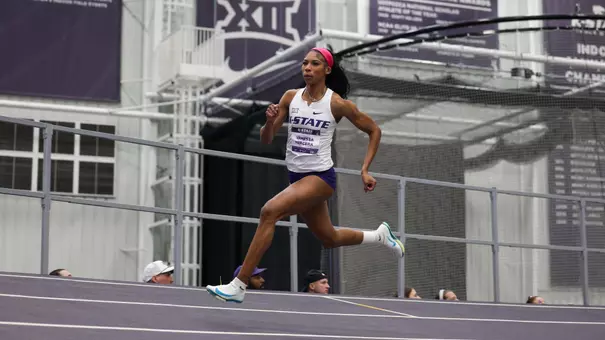
In the jumps, Shankar's sweep on the men's side was matched with a trio of victories from Madeline Righter (high jump), Chantoba Bright (triple jump) and Rhianna Phipps (long jump).
"There's good depth and a lot of versatility," Rovelto said. "You've got heptathletes like Maddie Righter who have some individual events that are pretty good and a lot of the horizontal girls, in terms of pure natural speed, who are probably our fastest athletes."
That versatility was on display at the Triangular, as K-State athletes filled up their meet schedules in a competition where the Wildcats didn't leave many points on the board.
Someone like Kassidy Johnson was invaluable. The Kansas native won the mile run with a time of 4:57.63.
A versatile distance runner, Johnson has now grabbed victories in three different events throughout the indoor season, including both the 800 meters and 1,000 meters.
For Shankar, an athlete with Olympic ambitions in the high jump, Saturday was an opportunity to mix things up.
When he was first learning the finer points of his signature event, Shankar went from getting off the ground to clearing 2.26m (7.41 feet) in about three years of practice.
If he kept improving at that pace, the senior would currently be able to jump over a pole vault without a pole.
Instead, he's gone from 2.26m to 2.29m (7.51 feet).
At the 2016 Olympics in Rio, that 0.03m was the difference between qualifying for the Olympic final and heading home after the qualifying round.
The KU-KSU-WSU Triangular was an opportunity for Shankar to focus less on chasing centimeters and more on getting the win for his team.
"The more you become a student of the sport, the more you start learning and looking at the technical intricacies, the more you start analyzing your jumps and your performance. A lot of the time you start overthinking," Shankar said. "That's where I think doing multiple events really helps me come out of that bubble of over-analyzing. With seven or eight things to do, you don't have time analyze everything before practice the next day. You would be really tired."
It's why an event like the Triangular, that has less to do with PRs than any other meet, just might be the best place for athletes like Shankar to sharpen the mental edge they need.
Shankar said it came up in a conversation with K-State alum and Olympic silver medalist Erik Kynard Jr., who's back in Manhattan this month to train with his former college coach.
"He told me to do the best I can do today. Then tomorrow, what do I have? Running drills, do that to the best of my ability. Mini-jump session? Do that to the best of my ability," Shankar said. "I don't have to worry about the end of July. It's in the back of my mind, but he told me not to worry about that and the weight of my own expectations."
The expectation on Saturday was a simple one: win as a team.
Thanks to Shankar's 25-point performance and the versatility of his teammates, the Wildcats did just that.
"TJ is training at such a high level right now," Rovelto said. "The workload he's going through is very high, so we looked at the meet as a high-quality training day. He's training so hard right now and that makes what he's able to do at these meets even more impressive."
The KU-KSU-WSU Triangular is the definition of collegiate track and field.
"I'm including Olympic Games, World Championships and all that," Cliff Rovelto said. "Some of the neatest memories for me are our women beating BYU when they were the best team in the country, beating LSU and USC on the road. These kinds of meets are important for our sport and help better define programs."
This weekend, Kansas State spelled out exactly who they are as a program, taking down Kansas and Wichita State by 58 points on Saturday for their second-straight victory in the Triangular.
After a year when times, heights and distances were unofficial, recorded on empty high school tracks and in parking lots during the COVID-19 pandemic, the Wildcats finally had a chance to compete in their first team event.
🏆 Champions 🏆
— K-State Track (@KStateTFXC) January 16, 2021
The Wildcats score 261 pts to claim another Triangular Showdown title #KStateTF pic.twitter.com/yIi1Pyg3MR
That meant K-State athletes weren't just chasing PRs but balancing hectic event schedules and trying to rack up some wins for the team.
Tejaswin Shankar swept the long jump, triple jump and high jump, while also scoring in the 60-meter hurdles and shot-put. His 25 points won him the event's "High Point Scorer" award.
But the scoring system meant that once Shankar won the high jump, he didn't stick around to see how high he could go - it was on to the next event and the next opportunity.
"That was my first event of the day," he said. "It's hard on the body, but I feel like I've gotten to the point where I can handle that without getting hurt…the goal was to get in some really good training this weekend and score points for the team."
And for the first, and quite possibly last time this season, the team was actually in the building to cheer him on.
Due to COVID-19 precautions this season, athletes usually arrive at Ahearn Field House for their event and leave when it's over, competing in a mostly empty gym.
Before every jump, Shankar starts a clap among his teammates and the crowd to help with the timing on his approach - that's difficult when there are only about 15 people in the gym.
"And 10 of those are officials," he said.
That all changed on Saturday, as the Wildcats found an extra spark competing in front of their teammates, something that would have been taken for granted in any other season.
In the jumps, Shankar's sweep on the men's side was matched with a trio of victories from Madeline Righter (high jump), Chantoba Bright (triple jump) and Rhianna Phipps (long jump).
"There's good depth and a lot of versatility," Rovelto said. "You've got heptathletes like Maddie Righter who have some individual events that are pretty good and a lot of the horizontal girls, in terms of pure natural speed, who are probably our fastest athletes."
That versatility was on display at the Triangular, as K-State athletes filled up their meet schedules in a competition where the Wildcats didn't leave many points on the board.
Put in the work, like champions #KStateTF pic.twitter.com/S2rb6o5ibW
— K-State Track (@KStateTFXC) January 17, 2021
Someone like Kassidy Johnson was invaluable. The Kansas native won the mile run with a time of 4:57.63.
A versatile distance runner, Johnson has now grabbed victories in three different events throughout the indoor season, including both the 800 meters and 1,000 meters.
For Shankar, an athlete with Olympic ambitions in the high jump, Saturday was an opportunity to mix things up.
When he was first learning the finer points of his signature event, Shankar went from getting off the ground to clearing 2.26m (7.41 feet) in about three years of practice.
If he kept improving at that pace, the senior would currently be able to jump over a pole vault without a pole.
Instead, he's gone from 2.26m to 2.29m (7.51 feet).
At the 2016 Olympics in Rio, that 0.03m was the difference between qualifying for the Olympic final and heading home after the qualifying round.
The KU-KSU-WSU Triangular was an opportunity for Shankar to focus less on chasing centimeters and more on getting the win for his team.
"The more you become a student of the sport, the more you start learning and looking at the technical intricacies, the more you start analyzing your jumps and your performance. A lot of the time you start overthinking," Shankar said. "That's where I think doing multiple events really helps me come out of that bubble of over-analyzing. With seven or eight things to do, you don't have time analyze everything before practice the next day. You would be really tired."
It's why an event like the Triangular, that has less to do with PRs than any other meet, just might be the best place for athletes like Shankar to sharpen the mental edge they need.
Shankar said it came up in a conversation with K-State alum and Olympic silver medalist Erik Kynard Jr., who's back in Manhattan this month to train with his former college coach.
"He told me to do the best I can do today. Then tomorrow, what do I have? Running drills, do that to the best of my ability. Mini-jump session? Do that to the best of my ability," Shankar said. "I don't have to worry about the end of July. It's in the back of my mind, but he told me not to worry about that and the weight of my own expectations."
The expectation on Saturday was a simple one: win as a team.
.@TejaswinShankar wins the Triangular Showdown High Point Award with 25 pts.
— K-State Track (@KStateTFXC) January 16, 2021
📈 https://t.co/oncwf6GRek#KStateTF pic.twitter.com/ZscjI7TZGP
Thanks to Shankar's 25-point performance and the versatility of his teammates, the Wildcats did just that.
"TJ is training at such a high level right now," Rovelto said. "The workload he's going through is very high, so we looked at the meet as a high-quality training day. He's training so hard right now and that makes what he's able to do at these meets even more impressive."

Players Mentioned

/ Track & Field

/ Track & Field

/ Track & Field

/ Track & Field

/ Track & Field
K-State Women's Basketball | Coach Mittie Press Conference vs Houston
Thursday, January 22
K-State Women's Basketball | Press Conference vs Houston
Thursday, January 22
K-State Women's Basketball | Game Highlights vs Houston
Thursday, January 22
2026 K-State Football Schedule Reveal at Marianna Kistler Beach Museum of Art
Wednesday, January 21