SE: Class of 2021 Turns Opportunity into Hall of Fame Careers
Oct 03, 2021 | Sports Extra, Athletics
By: D. Scott Fritchen
It was purple napkins and black tablecloths, frozen butter balls and dinner rolls, and a purple-rose centerpiece. It was beef filet with demi glaze, grilled shrimp skewers and roasted potatoes, clinking silverware, and the hum of dinner conversation. It was suits and dresses, smiles and handshakes, and finally hugs — because that's what family members do when they return home.
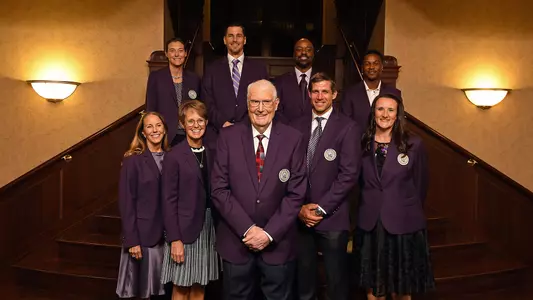
A couple hundred K-Staters, and many more watching on through the magic of the internet, gathered to witness the induction ceremony for the 2021 Kansas State Athletics Hall of Fame class in the K-State Alumni Center ballroom Friday night. It was David Allen; Laurie Koehn; AJ Morris; Jordy Nelson; Darren Sproles; Marty, John and Mary Vanier; Liz Wegner; Mike Wroblewski; and Attila Zsivoczky taking turns being celebrated, donning the esteemed Hall-of-Fame purple jacket, and sharing heartfelt, and sometimes emotional testimonies about what their alma mater, and their milestone moment, meant to them.
It was multiple All-Americans, multiple Academic All-Americans, multiple Big 12 Champions, a Big Eight Champion, Players of the Year, National Players of the Year, 32 years of NFL experience, years of WNBA experience, a major league baseball pitcher, and an international medalist all under one roof. Many were under-recruited athletes, or walk-ons — small-town Kansas kids who came to K-State just because they wanted a chance to compete at the Division I level.
Gallery: (10-2-2021) K-State Athletics Hall of Fame Reception
The night began with 102 members of the K-State Athletics Hall of Fame. In a span of two hours of humility, gratitude and speeches that stirred the purple soul, that number grew to 113.
"When we came to K-State, we wanted an opportunity and a chance," Nelson said at the podium. "As you know when you come here, nothing is given, and you earn everything that you do. It's an honor to have our footprint on this university and our programs that we were a part of."
K-State athletic director Gene Taylor, who has served at his position since April 2017, kicked off the night by recalling the specialness of this induction class.
"It's so fun to hear them share their stories and see their smiles — that's what makes tonight and this entire weekend special," Taylor said. "For us to be able to be a part of it is special. You're special and you're here not only because of what you've done as an athlete, but because of who you are as a person and because of the impact you've had beyond K-State.
"We can't thank you enough."
Soon after, the chant popular among K-Staters swept across the ballroom.
"DAAAA-VIIIID ALLLL-EENNN!"
Bill Snyder presented Allen with his purple jacket, and Allen, who starred on his own stage for several years in the 1990s, stood behind the ceremony's podium on a stage so few ever reach.
One of the greatest punt returners in the history of college football, Allen grinned in the face of those adoring chants, so familiar during his 1998 Consensus All-American season, and the chant that accompanied his presence on the field so many times at Bill Snyder Family Stadium. Allen, a native of Liberty, Missouri, said that his experience at K-State was special for so many reasons.
"What K-State means to me is more than the accomplishments on the field, it was always about the relationships off the field," Allen said. "One of the reasons I came to Manhattan was because it felt like home. We always talk about family and that was a very special thing for me to be a part of. Whenever we jogged onto the field, everyone held signs that said 'Family.' Coach Snyder was great in instilling that into us and in making sure we were comfortable and that we felt like we were wanted."
Koehn, one of the greatest 3-point shooters in the history of women's college basketball, thanked former K-State head coach Deb Patterson – who presented Koehn with her purple jacket – and associate head coach Kamie Ethridge for instilling values that she's carried throughout her life. Koehn, a Moundridge native, set the NCAA record with 392 made 3-pointers (a record that stood until 2020), but her time at K-State was about more than setting records.
"Coach Patterson and Coach Ethridge showed me what loyalty, selflessness, and a team-first mentality actually looked like," Koehn said. "I learned how I engaged with my teammates, how I treated waiters and waitresses, flight attendants and fans, and if I brought positive energy to kids in camps were far-more important than how quickly I could get my shot off. I learned to be grateful for everybody who did something for our program.
"After I graduated, I found out from playing professional basketball with athletes from other big programs that this was not normal. I found out these sorts of behaviors of valuable life lessons weren't taught or demanding everywhere, and that having someone in your life who cares enough about you to keep you from becoming entitled and to hold you accountable not only for your actions or your performance on the court, but also for your thoughts and motives in your heart was like pure gold.
"When I left KSU, I left with so much pride that I was a Kansas State Wildcat. I understood what that really meant. It meant so much more than just hating KU. It meant that your loyalty is unwavering, and you fight for your teammates, coaches, and program. It meant that you outwork everyone because you understand no one owes you anything. K-State teams in all sports were more gritty, more disciplined and had more passion, heart, and team chemistry. But I also understood that it wasn't all just about success, but about enjoying the process."
For Morris, that process began when the native of Humble, Texas, earned a scholarship offer from K-State. He left K-State as the first K-State pitcher to ever be named Consensus First Team All-American.
"My catcher Rob Vaughn was my high school catcher, my best friend, and he's the reason I came to K-State and I'm standing up here tonight," Morris said. "Rob was offered by K-State and he signed. K-State came down to watch Rob and saw me pitching, and two weeks later offered me a scholarship. I thought, 'If it's good enough for Rob, it's good enough for me.' I came to this place sight unseen, didn't take a visit, didn't see pictures, I didn't know much about K-State.
"I grew up and my dad was an Aggie, so I hated Texas. I came here and now I hate A&M and Texas. This university was one of the greatest decisions I ever made. It's the reason for the success I had in my career and for the person I am today."
For all of his on-field successes, Nelson remains one of the most humble people in K-State history as well. The Riley native, whose walk-on-to-NFL-star story has been told and retold over the years, has returned, and now lives 15 minutes from the football stadium where he created so many memories for K-State fans. Nelson, too, had been a lifelong K-State fan, and best put into perspective his spot in the lineage of K-State greats.
"When I walked-on at Coach Snyder's program, it was a chance," he said. "I knew if I came to K-State I'd have the best opportunity to maximize my potential, not knowing what that would be, and I try to give Jon McGraw as much credit as I can, because without him walking on here I don't think I ever would have thought it was possible.
"I know growing up everyone chanted David Allen's name. I did that in the south end zone. I was avoiding Darren Sproles in practice when I was the defensive player in the backfield. I watched Laurie shoot all those 3s in Bramlage. Everyone here, it's an honor to go into this class with you. It's special. The family thing everyone talks about continues to grow. It's that family and community that K-State and this Manhattan community provides. It's an honor to be a part of that and to be back 15 minutes from here so we can continue to be a part of it and make memories with my wife and kids of tailgating on Saturdays and going to K-State games."
Sproles, too, recalled a journey to K-State spurred by a fellow K-State Athletics Hall of Fame inductee. An Olathe native, Sproles' story continues to inspire many undersized players in college and NFL football today. Sproles' career rushing total of 4,979 yards ranked 11th all-time in college football history.
"I want to thank God because without Him none of this would've been possible," Sproles said. "It is so nice to come back to a place that I call my alma mater at Kansas State. Growing up in Olathe, I had a dream. I had a dream to play Division I football. My high school coach, Gene Wier told me, 'When you get a chance, make them forget about your size.' I chose K-State because when I came on my recruiting trip the team was like a family. Then I came to a game with my father, and David Allen went back for a punt, and the whole crowd stood up and started chanting "DAAAA-VIIIID ALLLL-EENNN!" I looked at my dad and said, 'I'm going to Kansas State.'
"I want to thank my running back coach, Michael Smith. I want to tell him thank you for pushing me each and every day. Thank you for always being there for me. We started off as you being my running back coach and we grew into family. To my teammates, my offensive line, Jon Doty, Ryan Lilja, Nick Leckey, Mike Johnson and Jeromey Clary; my tight ends Brian Casey and Thomas Hill; my fullbacks Victor Mann and Travis Wilson; my quarterback Ell Roberson — thank you for helping me to be the player that I was at K-State. Coach Snyder, thank you for always believing in me, thank you for everything that you've done for me and for this K-State family. Thank you for being more than a coach."
Sproles paused and collected himself. The night just wasn't complete without his mother, Annette, who died of cancer prior to his senior season.
"Lastly my parents, Annette and Larry Sproles, thank you for all of your sacrifice," he continued. "Thank you for always being there for me. To my dad, he's where I got my confidence from. The reason I wear 43 is because of my dad. I wanted to be just like him. My mom, she is no longer with us, but she passed away the spring of my junior year here at K-State, and she could care less about sports. The only thing she cared about was me and my schoolwork. I would've given anything to see the smile on her face when I received my degree. Thank you all and God bless. Go Wildcats."
The children of K-State legacy family Jack and Donna Vanier, Marty, John, and Mary Vanier continue the tradition of tremendous support of K-State. In addition to their many university, civic, and local honors, awards, and gifts, they have been a strong part of many critical K-State athletics projects. It's truly been a family tradition.
"Like thousands of others, we are a multi-generational K-State family," Marty Vanier said. "The family's first significant gift to K-State athletics was given by our grandfather, J.J. Vanier, who in 1968 gave the first gift for the first generation of our football stadium. This honor is especially meaningful for us as we join our parents, Jack and Donna Vanier, who were inducted in 1995. Congratulations to our inductees this evening. You have made us proud by your actions on and off the field."
Wegner, the first two-time All-American in K-State volleyball history, recalled a riveting personal analogy while expressing her gratitude for her honor.
"When I was trying to come up with what I wanted to express myself about what K-State meant to me, I was out on a run in a snowy day in Kansas, and I was toward the halfway point of my run before I turn around, and I'd been struggling on this run, and wanted it to be over," she said. "I got to the top of the hill, stopped and looked, and saw all of my footprints leading to this point. I paused and realized that was my journey and every step was super important in getting me to that point.
"I realized so often we can't wait until that big event, and I realized the journey — all the steps and events in between really meant everything to me. I couldn't be where I am without all those little things adding up and getting me here, and I'm so grateful. I'm honored to have played for K-State. Many of us were overlooked, and I'm just glad K-State gave me a chance. I'm so proud to bleed purple."
A First Team All-Big 8, Second Team All-American and school record holder, Mike Wroblewski played for Tex Winter from 1959-62, and his 46 points against Kansas remains the most point by a K-State player in a conference game.
"I'm incredibly honored," Wroblewski said. "My family is over there and I told them I played basketball, but this brings it home."
Attila Zsiovczky, a native of Hungary, was unable to attend the induction ceremony due to COVID international travel restrictions, but the two-time second-place decathlon finisher in the US Outdoor National Championships offered his gratitude in a video message.
"When I think of K-State, I have great memories," Zsivoczky said. "I have to thank Steve Fritz, who was a great predecessor in the decathlon. I always looked up to him. I cannot forget to thank Cliff Rovelto, our head coach. Without him, I could've never succeeded as a decathlete. He helped me in so many ways I couldn't even possibly tell you. I've always thought of myself as a Wildcat. This is a great honor to be recognized."
The idea for the K-State Athletics Hall of Fame was born in 1989, when then-athletic director Steve Miller conceived the notion of honoring those who participated in the program with special distinction.
The night that began with handshakes and hugs, ended with gratitude for the journey.
"When everyone came to K-State, they wanted an opportunity and a chance," Nelson said. "It's an honor to have our footprint on this university."
It was purple napkins and black tablecloths, frozen butter balls and dinner rolls, and a purple-rose centerpiece. It was beef filet with demi glaze, grilled shrimp skewers and roasted potatoes, clinking silverware, and the hum of dinner conversation. It was suits and dresses, smiles and handshakes, and finally hugs — because that's what family members do when they return home.
A couple hundred K-Staters, and many more watching on through the magic of the internet, gathered to witness the induction ceremony for the 2021 Kansas State Athletics Hall of Fame class in the K-State Alumni Center ballroom Friday night. It was David Allen; Laurie Koehn; AJ Morris; Jordy Nelson; Darren Sproles; Marty, John and Mary Vanier; Liz Wegner; Mike Wroblewski; and Attila Zsivoczky taking turns being celebrated, donning the esteemed Hall-of-Fame purple jacket, and sharing heartfelt, and sometimes emotional testimonies about what their alma mater, and their milestone moment, meant to them.
It was multiple All-Americans, multiple Academic All-Americans, multiple Big 12 Champions, a Big Eight Champion, Players of the Year, National Players of the Year, 32 years of NFL experience, years of WNBA experience, a major league baseball pitcher, and an international medalist all under one roof. Many were under-recruited athletes, or walk-ons — small-town Kansas kids who came to K-State just because they wanted a chance to compete at the Division I level.
The night began with 102 members of the K-State Athletics Hall of Fame. In a span of two hours of humility, gratitude and speeches that stirred the purple soul, that number grew to 113.
"When we came to K-State, we wanted an opportunity and a chance," Nelson said at the podium. "As you know when you come here, nothing is given, and you earn everything that you do. It's an honor to have our footprint on this university and our programs that we were a part of."
K-State athletic director Gene Taylor, who has served at his position since April 2017, kicked off the night by recalling the specialness of this induction class.
"It's so fun to hear them share their stories and see their smiles — that's what makes tonight and this entire weekend special," Taylor said. "For us to be able to be a part of it is special. You're special and you're here not only because of what you've done as an athlete, but because of who you are as a person and because of the impact you've had beyond K-State.
"We can't thank you enough."
Soon after, the chant popular among K-Staters swept across the ballroom.
"DAAAA-VIIIID ALLLL-EENNN!"
Bill Snyder presented Allen with his purple jacket, and Allen, who starred on his own stage for several years in the 1990s, stood behind the ceremony's podium on a stage so few ever reach.
Congratulations to the K-State Athletics Hall of Fame Class of 2021! pic.twitter.com/T8O5sf1v1Y
— K-State Athletics (@kstatesports) October 2, 2021
One of the greatest punt returners in the history of college football, Allen grinned in the face of those adoring chants, so familiar during his 1998 Consensus All-American season, and the chant that accompanied his presence on the field so many times at Bill Snyder Family Stadium. Allen, a native of Liberty, Missouri, said that his experience at K-State was special for so many reasons.
"What K-State means to me is more than the accomplishments on the field, it was always about the relationships off the field," Allen said. "One of the reasons I came to Manhattan was because it felt like home. We always talk about family and that was a very special thing for me to be a part of. Whenever we jogged onto the field, everyone held signs that said 'Family.' Coach Snyder was great in instilling that into us and in making sure we were comfortable and that we felt like we were wanted."
Koehn, one of the greatest 3-point shooters in the history of women's college basketball, thanked former K-State head coach Deb Patterson – who presented Koehn with her purple jacket – and associate head coach Kamie Ethridge for instilling values that she's carried throughout her life. Koehn, a Moundridge native, set the NCAA record with 392 made 3-pointers (a record that stood until 2020), but her time at K-State was about more than setting records.
"Coach Patterson and Coach Ethridge showed me what loyalty, selflessness, and a team-first mentality actually looked like," Koehn said. "I learned how I engaged with my teammates, how I treated waiters and waitresses, flight attendants and fans, and if I brought positive energy to kids in camps were far-more important than how quickly I could get my shot off. I learned to be grateful for everybody who did something for our program.
"After I graduated, I found out from playing professional basketball with athletes from other big programs that this was not normal. I found out these sorts of behaviors of valuable life lessons weren't taught or demanding everywhere, and that having someone in your life who cares enough about you to keep you from becoming entitled and to hold you accountable not only for your actions or your performance on the court, but also for your thoughts and motives in your heart was like pure gold.
"When I left KSU, I left with so much pride that I was a Kansas State Wildcat. I understood what that really meant. It meant so much more than just hating KU. It meant that your loyalty is unwavering, and you fight for your teammates, coaches, and program. It meant that you outwork everyone because you understand no one owes you anything. K-State teams in all sports were more gritty, more disciplined and had more passion, heart, and team chemistry. But I also understood that it wasn't all just about success, but about enjoying the process."
For Morris, that process began when the native of Humble, Texas, earned a scholarship offer from K-State. He left K-State as the first K-State pitcher to ever be named Consensus First Team All-American.
"My catcher Rob Vaughn was my high school catcher, my best friend, and he's the reason I came to K-State and I'm standing up here tonight," Morris said. "Rob was offered by K-State and he signed. K-State came down to watch Rob and saw me pitching, and two weeks later offered me a scholarship. I thought, 'If it's good enough for Rob, it's good enough for me.' I came to this place sight unseen, didn't take a visit, didn't see pictures, I didn't know much about K-State.
"I grew up and my dad was an Aggie, so I hated Texas. I came here and now I hate A&M and Texas. This university was one of the greatest decisions I ever made. It's the reason for the success I had in my career and for the person I am today."
For all of his on-field successes, Nelson remains one of the most humble people in K-State history as well. The Riley native, whose walk-on-to-NFL-star story has been told and retold over the years, has returned, and now lives 15 minutes from the football stadium where he created so many memories for K-State fans. Nelson, too, had been a lifelong K-State fan, and best put into perspective his spot in the lineage of K-State greats.
"When I walked-on at Coach Snyder's program, it was a chance," he said. "I knew if I came to K-State I'd have the best opportunity to maximize my potential, not knowing what that would be, and I try to give Jon McGraw as much credit as I can, because without him walking on here I don't think I ever would have thought it was possible.
"I know growing up everyone chanted David Allen's name. I did that in the south end zone. I was avoiding Darren Sproles in practice when I was the defensive player in the backfield. I watched Laurie shoot all those 3s in Bramlage. Everyone here, it's an honor to go into this class with you. It's special. The family thing everyone talks about continues to grow. It's that family and community that K-State and this Manhattan community provides. It's an honor to be a part of that and to be back 15 minutes from here so we can continue to be a part of it and make memories with my wife and kids of tailgating on Saturdays and going to K-State games."
Sproles, too, recalled a journey to K-State spurred by a fellow K-State Athletics Hall of Fame inductee. An Olathe native, Sproles' story continues to inspire many undersized players in college and NFL football today. Sproles' career rushing total of 4,979 yards ranked 11th all-time in college football history.
"I want to thank God because without Him none of this would've been possible," Sproles said. "It is so nice to come back to a place that I call my alma mater at Kansas State. Growing up in Olathe, I had a dream. I had a dream to play Division I football. My high school coach, Gene Wier told me, 'When you get a chance, make them forget about your size.' I chose K-State because when I came on my recruiting trip the team was like a family. Then I came to a game with my father, and David Allen went back for a punt, and the whole crowd stood up and started chanting "DAAAA-VIIIID ALLLL-EENNN!" I looked at my dad and said, 'I'm going to Kansas State.'
"I want to thank my running back coach, Michael Smith. I want to tell him thank you for pushing me each and every day. Thank you for always being there for me. We started off as you being my running back coach and we grew into family. To my teammates, my offensive line, Jon Doty, Ryan Lilja, Nick Leckey, Mike Johnson and Jeromey Clary; my tight ends Brian Casey and Thomas Hill; my fullbacks Victor Mann and Travis Wilson; my quarterback Ell Roberson — thank you for helping me to be the player that I was at K-State. Coach Snyder, thank you for always believing in me, thank you for everything that you've done for me and for this K-State family. Thank you for being more than a coach."
Sproles paused and collected himself. The night just wasn't complete without his mother, Annette, who died of cancer prior to his senior season.
"Lastly my parents, Annette and Larry Sproles, thank you for all of your sacrifice," he continued. "Thank you for always being there for me. To my dad, he's where I got my confidence from. The reason I wear 43 is because of my dad. I wanted to be just like him. My mom, she is no longer with us, but she passed away the spring of my junior year here at K-State, and she could care less about sports. The only thing she cared about was me and my schoolwork. I would've given anything to see the smile on her face when I received my degree. Thank you all and God bless. Go Wildcats."
The children of K-State legacy family Jack and Donna Vanier, Marty, John, and Mary Vanier continue the tradition of tremendous support of K-State. In addition to their many university, civic, and local honors, awards, and gifts, they have been a strong part of many critical K-State athletics projects. It's truly been a family tradition.
"Like thousands of others, we are a multi-generational K-State family," Marty Vanier said. "The family's first significant gift to K-State athletics was given by our grandfather, J.J. Vanier, who in 1968 gave the first gift for the first generation of our football stadium. This honor is especially meaningful for us as we join our parents, Jack and Donna Vanier, who were inducted in 1995. Congratulations to our inductees this evening. You have made us proud by your actions on and off the field."
Wegner, the first two-time All-American in K-State volleyball history, recalled a riveting personal analogy while expressing her gratitude for her honor.
"When I was trying to come up with what I wanted to express myself about what K-State meant to me, I was out on a run in a snowy day in Kansas, and I was toward the halfway point of my run before I turn around, and I'd been struggling on this run, and wanted it to be over," she said. "I got to the top of the hill, stopped and looked, and saw all of my footprints leading to this point. I paused and realized that was my journey and every step was super important in getting me to that point.
"I realized so often we can't wait until that big event, and I realized the journey — all the steps and events in between really meant everything to me. I couldn't be where I am without all those little things adding up and getting me here, and I'm so grateful. I'm honored to have played for K-State. Many of us were overlooked, and I'm just glad K-State gave me a chance. I'm so proud to bleed purple."
A First Team All-Big 8, Second Team All-American and school record holder, Mike Wroblewski played for Tex Winter from 1959-62, and his 46 points against Kansas remains the most point by a K-State player in a conference game.
"I'm incredibly honored," Wroblewski said. "My family is over there and I told them I played basketball, but this brings it home."
Attila Zsiovczky, a native of Hungary, was unable to attend the induction ceremony due to COVID international travel restrictions, but the two-time second-place decathlon finisher in the US Outdoor National Championships offered his gratitude in a video message.
"When I think of K-State, I have great memories," Zsivoczky said. "I have to thank Steve Fritz, who was a great predecessor in the decathlon. I always looked up to him. I cannot forget to thank Cliff Rovelto, our head coach. Without him, I could've never succeeded as a decathlete. He helped me in so many ways I couldn't even possibly tell you. I've always thought of myself as a Wildcat. This is a great honor to be recognized."
The idea for the K-State Athletics Hall of Fame was born in 1989, when then-athletic director Steve Miller conceived the notion of honoring those who participated in the program with special distinction.
The night that began with handshakes and hugs, ended with gratitude for the journey.
"When everyone came to K-State, they wanted an opportunity and a chance," Nelson said. "It's an honor to have our footprint on this university."
Wednesday, September 23
Wednesday, September 23
Monday, September 21
Saturday, September 19