SE: THE PROGRAM Helps MBB Drive for Greatness
Oct 05, 2021 | Men's Basketball, Sports Extra
By: D. Scott Fritchen
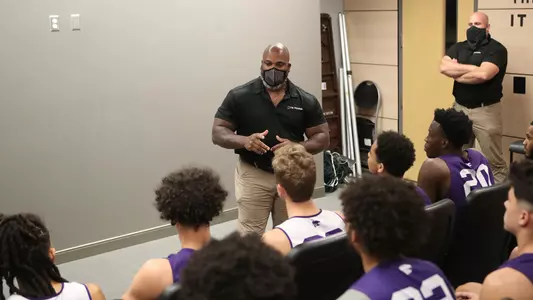
Patrick McNamara was assigned to the 101st Airborne Division. He served as Platoon leader during deployment to Iraq and Afghanistan, and he earned the distinguished Army Combat Action Badge. Now he is a SWAT Operator specialized as a sniper for the Massachusetts State Police. But today, he stands in a black polo shirt, and khaki slacks, and paces the floor while addressing the Kansas State men's basketball team in the team theater room at the Ice Family Basketball Center.
"Maximus Edwards, how do you set the example for your teammates?" McNamara asks.
"Giving 110%"
"Carlton Linguard, Jr., how else do you set the example for our brothers?"
"Being on time," Linguard replies, "and doing what you're supposed to do."
This is K-State's introduction to "THE PROGRAM," which was founded by Erik Kapitulik in 2008. Kapitulik spent eight years of active service in the Marine Corps as both an Infantry Officer and Special Operations Officer with 1st Force Reconnaissance Company, 1st Marine Division. In 1999, during a routine training mission to prepare for an upcoming deployment to the Persian Gulf, Kapitulik and his Force Recon platoon were in a helicopter crash that killed six of his Marines. Since then, he has competed in eight Ironman Triathlons, a Death Race Ultra Marathon, and has climbed to the highest peak in five of seven continents — all to help supply the children of his deceased soldiers with a college scholarship fund.
This year, THE PROGRAM, which is based in Connecticut, is utilized by 150 college and professional teams along with corporations across the nation.
Today at K-State is the start of what THE PROGRAM calls "Judgement Day."
"Judgement Day" is broken down into various periods over a span of 48 hours. It's likely the most grueling couple of days in the lives of current K-State basketball players.
"We define toughness as staying mission focused in the face of physical, mental and emotional adversity," McNamara says, pacing the floor in the team theater. "We're going to test all three of those. Physically, you're going to be tired. Are you going to start focusing on that pain and forget your mission? There's mental toughness, and over the course of the next two days, you're going to be confused because there will be a lot of things going on, but can you stay mission focused? There's emotional toughness, and a lot of times people think that guys who throw temper tantrums or have anger problems are great. That's not great. That's emotional weakness. If you allow your emotions to get the better of you and lose mission focus, that's being emotionally weak."
Fred Smith, a retired Sergeant Major with 25 years in the United States Marine Corps, served five combat missions in Iraq and Afghanistan, and once transformed 1,000 civilians into United States Marines at Parris Island, South Carolina. He joins McNamara on this trip to Manhattan. There's probably 600 pounds of weight between McNamara and Smith, which consists of mostly muscle.
"We do not rise to the occasion. We fall back on our training!" Smith says to the team.
The first period features a motto: One team, one heartbeat.
The leader is charged with organizing the team in perfect rows and columns on the football field. The team is charged with performing push-ups, flutter kicks, mountain climbing, jumping jacks, and holding a plank — in perfect synchronization over six repetitions — for a total of 16 minutes. There are very specific demands. The team must maintain perfect rows and columns. The players are charged with holding each other accountable. All flutter kicks must be precise — all left legs going up at the same, followed by the right legs, while the leader yells the tempo, and his teammates count the repetitions. If players fail to hold their teammates accountable — if they look at the ground or the sky instead of looking to their right and left to ensure their teammates are on sync — McNamara and Smith step in, and the clock resets to 0:00. The exercise can take 16 minutes, or 2 hours and 16 minutes. It's up to the leader and his teammates. It's one team, one heartbeat. Everything must be perfect.
"Our mission is developing better leaders and creating more cohesive teams. We do so through shared adversity," THE PROGRAM lead instructor Omri Rachmut tells K-State Sports Extra in a phone interview on Monday. "Based on our backgrounds, we know as a team and as individuals, leaders, teammates, coaches, we're only going to grow when we're placed outside our comfort zone. When we can discuss certain concepts, theories, and methodologies in a climate-controlled environment via conference room, classroom, reading a book, and there's very valuable information that can be attained.
"But until the first bead of sweat starts running down your forehead, we're not actually developing habits. By design, the athletes are placed outside of their comfort zone. In all honesty, they experience a certain amount of failure that enables us to identify a number of learning points that we can expose, which then allows us to work on those things specifically throughout the remainder of the season."
Second period of "Judgement Day"? Heavy log pulls and sandbags. Two players start out the exercise carrying the sandbags, and the rest of the players pull the logs. All players must cycle between the logs and the sandbags at the direction of their team leaders. The starting line for the logs and sandbags is the goal line and the ending point is at exactly the 41-yard line. Players run down and run back with the logs and sandbags as fast as possible. It's about delegation. It's about small details.
"The log pulls must be right on top of the yard marker," Rachmut says. "We must make sure everyone is on point and in sync. Leaders learn to delegate responsibility and ultimately understand that whether this operation is precise or not, it all becomes the responsibility of the leader."
Third period focuses on communication, how team members communicate under pressure, and the kinds of verbiage used in expressing orders — all as one player carries another player during suicides. This exercise, as the others, causes fatigue and pain, but THE PROGRAM challenges players mentally as well. Can they effectively communicate, and do so in a positive way? That means leaders inform players what they should do, not what they shouldn't do.
"Remember Chris Webber calling the timeout to lose the game?" Rachmut says. "Everybody screamed, 'Don't call timeout.' He heard, 'Timeout,' and that was the end of it. In the military, we don't say, 'Stop shooting,' we say, 'Seize fire,' or there could be dire consequences. There are psychological things at play. Our ability to effectively communicate is going to determine if we can execute properly under pressure. Details matter and we must use proper words.
"We're setting up Kansas State to succeed prior to the season because on the basketball court in the Big 12 Championships, you're not learning anything, you're falling back on habits that you've developed in preparation for the season. We must instill good habits to fall back on when the time comes. Again, it's allowing us to expose certain things that we can develop throughout the remainder of the season."
THE PROGRAM doesn't force any player to perform a task against his will. That's important to note, particularly for the next period, when players are asked to tread water while wearing heavy sweatshirts. They call this the "most powerful" period of "Judgement Day," because instructors work can appreciate the fear of athletes who lack strong swimming skills. Can players rise above that fear? The team needs its leaders and players when adversity strikes. Rachmut explains that it's easy to be a great leader when the team is 10-0, but it becomes paramount to be a great leaders and teammates under difficult circumstances — thus stepping out of that comfort zone by treading water in sweatshirts.
"You're faced with an obstacle that requires you to dig deep and face some fears with the team's best interest at heart, and as teammates you support your teammates when they walk through adversity," Rachmut says, "but the reality is KU doesn't care about your adversity. That's when you must have your team's best interest at heart. It sounds simple, but it's a challenge, especially when your personal comfort or fears can get into the way of that.
"That's when we get to prove how good of teammates we really are."
Throughout "Judgement Day," McNamara and Smith take notes, then hand their compiled list to Bruce Weber. McNamara and Smith identify who they believe to be the best leaders and teammates, and they also list actionable points and items that they believe will help to develop the team throughout the season. Usually, they'll return to attend a practice, and believe that regular engagement on a monthly basis, whether in person or via Zoom with individual leaders or the entire team, reinforces the lessons gained over a two-day span in the summer.
"Nothing makes us prouder than working with teams on a consistent basis," Rachmut says. "We've worked with many teams for 10 years and THE PROGRAM just becomes a part of their culture."
K-State head coach Bruce Weber appears to be a strong advocate of its teachings.
"They did an unbelievable job, and their evaluation of our guys was unbelievable," Weber says. "They spent two hours with us as a staff just helping us with some ideas to help the players. It was definitely worth it. Our big theme was grit, driving for greatness, representing K-State, intensity, toughness and togetherness, and we'll carry that theme into the fall.
"I couldn't be happier with what happened. Our big thing was the toughness, but also the detail and discipline of drills they put them through. Probably most importantly, I wanted to have them come together as a group and deal with tough times. When you're in the pool and must take off your sweatshirt and put it back on and help your teammate who doesn't know how to swim, that's really tough. I couldn't be happier with how our guys reacted to it while building some leadership and finding out who the leaders were and who stepped up to help their teammates.
"Now, it's real practice and starting to put concepts in your five-on-five and keep conditioning."
Weber indicated that a surprise candidate jumped out as one of the top leaders.
"They flat out asked our guys, 'Who likes holding people accountable?' It's not an easy thing to do, and there were a lot of guys that raised their hand and said, 'I do not like to do that and I'm not comfortable with it,'" Weber says. "Mark Smith jumped out. Their evaluation after it was over, they thought Mark Smith was the best leader from their two days. Who has been the biggest surprise? I think Mark has taken on a little bit of that role, not to diminish Mike McGuirl or Nijel Pack, or anyone else. They still are leaders in some way.
"They also talk about first row command, second row command, and you got to have your first row, and then who's going to be next, and that's where I think we can slowly and surely do that. Selton Miguel is one of the guys that does the verbal part. I think if you asked the coaches who is the best teammate on our team it's Davion Bradford. We've got a good mixture, but I think if you pick one guy right now, maybe Mark Smith, but we'll see more as practice goes on."
Rachmut reinforces the desire to expose, strengthen and develop various facets that can aid K-State during its basketball season.
"The purpose of the two days is exposing the things we can develop during the remainder of the engagement to where we're able to develop great habits," he says. Contrary to what's been said on sports TV three times a day for two decades, nobody is going to 'rise to the occasion.' Scientifically, it's not correct. No one actually rises to the occasion. If we're looking at statistics, Kobe, LeBron, MJ, Brady, under pressure their performance simply doesn't decline — but they don't actually do better.
"We don't rise to the occasion, what we do is fall back on our habits. Let's make sure we're instilling good habits to fall back on."
Patrick McNamara was assigned to the 101st Airborne Division. He served as Platoon leader during deployment to Iraq and Afghanistan, and he earned the distinguished Army Combat Action Badge. Now he is a SWAT Operator specialized as a sniper for the Massachusetts State Police. But today, he stands in a black polo shirt, and khaki slacks, and paces the floor while addressing the Kansas State men's basketball team in the team theater room at the Ice Family Basketball Center.
"Maximus Edwards, how do you set the example for your teammates?" McNamara asks.
"Giving 110%"
"Carlton Linguard, Jr., how else do you set the example for our brothers?"
"Being on time," Linguard replies, "and doing what you're supposed to do."
This is K-State's introduction to "THE PROGRAM," which was founded by Erik Kapitulik in 2008. Kapitulik spent eight years of active service in the Marine Corps as both an Infantry Officer and Special Operations Officer with 1st Force Reconnaissance Company, 1st Marine Division. In 1999, during a routine training mission to prepare for an upcoming deployment to the Persian Gulf, Kapitulik and his Force Recon platoon were in a helicopter crash that killed six of his Marines. Since then, he has competed in eight Ironman Triathlons, a Death Race Ultra Marathon, and has climbed to the highest peak in five of seven continents — all to help supply the children of his deceased soldiers with a college scholarship fund.
This year, THE PROGRAM, which is based in Connecticut, is utilized by 150 college and professional teams along with corporations across the nation.
Today at K-State is the start of what THE PROGRAM calls "Judgement Day."
"Judgement Day" is broken down into various periods over a span of 48 hours. It's likely the most grueling couple of days in the lives of current K-State basketball players.
"We define toughness as staying mission focused in the face of physical, mental and emotional adversity," McNamara says, pacing the floor in the team theater. "We're going to test all three of those. Physically, you're going to be tired. Are you going to start focusing on that pain and forget your mission? There's mental toughness, and over the course of the next two days, you're going to be confused because there will be a lot of things going on, but can you stay mission focused? There's emotional toughness, and a lot of times people think that guys who throw temper tantrums or have anger problems are great. That's not great. That's emotional weakness. If you allow your emotions to get the better of you and lose mission focus, that's being emotionally weak."
Fred Smith, a retired Sergeant Major with 25 years in the United States Marine Corps, served five combat missions in Iraq and Afghanistan, and once transformed 1,000 civilians into United States Marines at Parris Island, South Carolina. He joins McNamara on this trip to Manhattan. There's probably 600 pounds of weight between McNamara and Smith, which consists of mostly muscle.
"We do not rise to the occasion. We fall back on our training!" Smith says to the team.
The first period features a motto: One team, one heartbeat.
The leader is charged with organizing the team in perfect rows and columns on the football field. The team is charged with performing push-ups, flutter kicks, mountain climbing, jumping jacks, and holding a plank — in perfect synchronization over six repetitions — for a total of 16 minutes. There are very specific demands. The team must maintain perfect rows and columns. The players are charged with holding each other accountable. All flutter kicks must be precise — all left legs going up at the same, followed by the right legs, while the leader yells the tempo, and his teammates count the repetitions. If players fail to hold their teammates accountable — if they look at the ground or the sky instead of looking to their right and left to ensure their teammates are on sync — McNamara and Smith step in, and the clock resets to 0:00. The exercise can take 16 minutes, or 2 hours and 16 minutes. It's up to the leader and his teammates. It's one team, one heartbeat. Everything must be perfect.
"Our mission is developing better leaders and creating more cohesive teams. We do so through shared adversity," THE PROGRAM lead instructor Omri Rachmut tells K-State Sports Extra in a phone interview on Monday. "Based on our backgrounds, we know as a team and as individuals, leaders, teammates, coaches, we're only going to grow when we're placed outside our comfort zone. When we can discuss certain concepts, theories, and methodologies in a climate-controlled environment via conference room, classroom, reading a book, and there's very valuable information that can be attained.
"But until the first bead of sweat starts running down your forehead, we're not actually developing habits. By design, the athletes are placed outside of their comfort zone. In all honesty, they experience a certain amount of failure that enables us to identify a number of learning points that we can expose, which then allows us to work on those things specifically throughout the remainder of the season."
Second period of "Judgement Day"? Heavy log pulls and sandbags. Two players start out the exercise carrying the sandbags, and the rest of the players pull the logs. All players must cycle between the logs and the sandbags at the direction of their team leaders. The starting line for the logs and sandbags is the goal line and the ending point is at exactly the 41-yard line. Players run down and run back with the logs and sandbags as fast as possible. It's about delegation. It's about small details.
"The log pulls must be right on top of the yard marker," Rachmut says. "We must make sure everyone is on point and in sync. Leaders learn to delegate responsibility and ultimately understand that whether this operation is precise or not, it all becomes the responsibility of the leader."
Third period focuses on communication, how team members communicate under pressure, and the kinds of verbiage used in expressing orders — all as one player carries another player during suicides. This exercise, as the others, causes fatigue and pain, but THE PROGRAM challenges players mentally as well. Can they effectively communicate, and do so in a positive way? That means leaders inform players what they should do, not what they shouldn't do.
"Remember Chris Webber calling the timeout to lose the game?" Rachmut says. "Everybody screamed, 'Don't call timeout.' He heard, 'Timeout,' and that was the end of it. In the military, we don't say, 'Stop shooting,' we say, 'Seize fire,' or there could be dire consequences. There are psychological things at play. Our ability to effectively communicate is going to determine if we can execute properly under pressure. Details matter and we must use proper words.
"We're setting up Kansas State to succeed prior to the season because on the basketball court in the Big 12 Championships, you're not learning anything, you're falling back on habits that you've developed in preparation for the season. We must instill good habits to fall back on when the time comes. Again, it's allowing us to expose certain things that we can develop throughout the remainder of the season."
THE PROGRAM doesn't force any player to perform a task against his will. That's important to note, particularly for the next period, when players are asked to tread water while wearing heavy sweatshirts. They call this the "most powerful" period of "Judgement Day," because instructors work can appreciate the fear of athletes who lack strong swimming skills. Can players rise above that fear? The team needs its leaders and players when adversity strikes. Rachmut explains that it's easy to be a great leader when the team is 10-0, but it becomes paramount to be a great leaders and teammates under difficult circumstances — thus stepping out of that comfort zone by treading water in sweatshirts.
"You're faced with an obstacle that requires you to dig deep and face some fears with the team's best interest at heart, and as teammates you support your teammates when they walk through adversity," Rachmut says, "but the reality is KU doesn't care about your adversity. That's when you must have your team's best interest at heart. It sounds simple, but it's a challenge, especially when your personal comfort or fears can get into the way of that.
"That's when we get to prove how good of teammates we really are."
Throughout "Judgement Day," McNamara and Smith take notes, then hand their compiled list to Bruce Weber. McNamara and Smith identify who they believe to be the best leaders and teammates, and they also list actionable points and items that they believe will help to develop the team throughout the season. Usually, they'll return to attend a practice, and believe that regular engagement on a monthly basis, whether in person or via Zoom with individual leaders or the entire team, reinforces the lessons gained over a two-day span in the summer.
"Nothing makes us prouder than working with teams on a consistent basis," Rachmut says. "We've worked with many teams for 10 years and THE PROGRAM just becomes a part of their culture."
K-State head coach Bruce Weber appears to be a strong advocate of its teachings.
"They did an unbelievable job, and their evaluation of our guys was unbelievable," Weber says. "They spent two hours with us as a staff just helping us with some ideas to help the players. It was definitely worth it. Our big theme was grit, driving for greatness, representing K-State, intensity, toughness and togetherness, and we'll carry that theme into the fall.
"I couldn't be happier with what happened. Our big thing was the toughness, but also the detail and discipline of drills they put them through. Probably most importantly, I wanted to have them come together as a group and deal with tough times. When you're in the pool and must take off your sweatshirt and put it back on and help your teammate who doesn't know how to swim, that's really tough. I couldn't be happier with how our guys reacted to it while building some leadership and finding out who the leaders were and who stepped up to help their teammates.
"Now, it's real practice and starting to put concepts in your five-on-five and keep conditioning."
Weber indicated that a surprise candidate jumped out as one of the top leaders.
"They flat out asked our guys, 'Who likes holding people accountable?' It's not an easy thing to do, and there were a lot of guys that raised their hand and said, 'I do not like to do that and I'm not comfortable with it,'" Weber says. "Mark Smith jumped out. Their evaluation after it was over, they thought Mark Smith was the best leader from their two days. Who has been the biggest surprise? I think Mark has taken on a little bit of that role, not to diminish Mike McGuirl or Nijel Pack, or anyone else. They still are leaders in some way.
"They also talk about first row command, second row command, and you got to have your first row, and then who's going to be next, and that's where I think we can slowly and surely do that. Selton Miguel is one of the guys that does the verbal part. I think if you asked the coaches who is the best teammate on our team it's Davion Bradford. We've got a good mixture, but I think if you pick one guy right now, maybe Mark Smith, but we'll see more as practice goes on."
Rachmut reinforces the desire to expose, strengthen and develop various facets that can aid K-State during its basketball season.
"The purpose of the two days is exposing the things we can develop during the remainder of the engagement to where we're able to develop great habits," he says. Contrary to what's been said on sports TV three times a day for two decades, nobody is going to 'rise to the occasion.' Scientifically, it's not correct. No one actually rises to the occasion. If we're looking at statistics, Kobe, LeBron, MJ, Brady, under pressure their performance simply doesn't decline — but they don't actually do better.
"We don't rise to the occasion, what we do is fall back on our habits. Let's make sure we're instilling good habits to fall back on."
Players Mentioned

G
/ Men's BasketballK-State Rowing | Media Day
Tuesday, February 24
K-State Rowing | Weights Practice
Tuesday, February 24
K-State Tennis | Weekend Recap vs Old Dominion & Minnesota
Tuesday, February 24
K-State Track and Field | Sights & Sounds Steve Miller Invitational
Monday, February 23