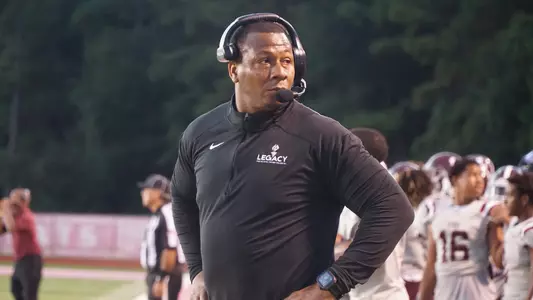
SE: Q&A with K-State Ring of Honor Member, Current High School Football Coach Michael Bishop
Nov 15, 2021 | Football, Sports Extra
Michael Bishop, the most dangerous signal-caller in college football in 1998, conquered a significant barrier while leading Kansas State to a No. 1 ranking, a win over Nebraska, and an 11-2 record during his senior season. He became the first quarterback in the history of the prestigious Davey O'Brien Award to earn the nation's top quarterback honor while passing for at least 1,500 yards and running for at least 500 yards in a season.
Bishop, the runner-up for the 1998 Heisman Trophy, threw for 2,844 yards with 23 touchdowns and just four interceptions, while he rushed for 748 yards and 14 touchdowns.
He pioneered a trend. After 1998, six of the next 13 O'Brien Award winners — Joe Hamilton (1999), Eric Crouch (2001), Vince Young (2005), Tim Tebow (2007), Cam Newton (2010) and Robert Griffin III (2011) — each passed for more than 1,500 yards and rushed for at least 500 yards during their own respective award-winning campaigns.
Today, Bishop is in the midst of completing his first season as head football coach at Legacy the School of Sport Sciences in Spring, Texas. For half a decade, Bishop has coached in numerous youth football organizations and has been actively involved in various aspects of recruiting, training, and player development on and off the field.
Bishop, who was inducted into the K-State Football Ring of Honor in 2015, spoke with D. Scott Fritchen of K-State Sports Extra about life after K-State, his first meeting with Bill Snyder, his advice to Skylar Thompson, and the evolution of the dual-threat quarterback.
DSF: What's been the most rewarding part about being a high school head football coach?
MB: I enjoy having an opportunity to be of service to young men and I have that opportunity as a head coach in Texas. The experience has been wonderful. As a former player, to see and have a great impact on young men has been the most rewarding thing for me as a coach. Some of the parents know of my playing days. I've had parents tell me, "Please groom my kids so they understand what's in front of them." To have a kid come back and tell me that they've enjoyed football and have learned more than just football has been rewarding to me as well. We won our district and being a first-year head coach to win district has been rewarding. I always tell our kids that we're the better team, but we have to play like we're the better team. We won our first playoff game 56-2. We have a great chance to win state.
A couple of the younger guys who didn't know about my playing days, they know now, and you can tell they do everything in their power not to let me down, so they put a lot of pressure on themselves. They know I've played well at different levels, so they try to make sure they're doing the right things. When a kid doesn't practice hard or takes plays off, that can lose a ballgame or a championship. I talk to the parents after practice. Kids in Texas seem to put so much pressure on themselves because they want to get a scholarship. We have players on our team that will receive Division I scholarships and players who will receive junior college scholarships. The talent level is very good. We also have players transferring into our school, which will make us even better.
DSF: What is the most important thing that you share with your quarterbacks at the high school level?
MB: I have two junior quarterbacks and one freshman quarterback. I tell them the most consistent part of their game must be developing that next-play mentality. If you throw a touchdown, you're supposed to do that — forget about it and focus on the next play and the next series. If you throw an interception, move on to the next play and the next series. I'm on them every day about having that next-play mentality. If you're too excited about what you just achieved, then you're not focused on the next series. Every day, I tell our quarterbacks, "Next-play mentality, let's go."

DSF: How have you seen the usage of dual-threat quarterbacks emerge and evolve at the high school level in recent years?
MB: The way it's going now and with the extra training many of these young players are receiving, it's evolved night and day. I sit back and watch some of the guys who receive the notoriety of being the top dual-threat quarterback, and at the same time I catch myself reflecting on the past, where the dual-threat quarterback came from, and who started it. Even when I watch the games now, the guys who are outstanding dual-threat quarterbacks lead one- and two-loss teams. If you have a quarterback who can do it all, you have a greater chance of success.
DSF: Of course, you were the first player in Big 12 Conference history to pass for 1,500 yards and rush for 500 yards in back-to-back seasons. You were also the first recipient in the 17-year history of the Davey O'Brien Award to earn the nation's top quarterback honor after passing for 1,500 yards and rushing for 500 yards in a season. Do you consider yourself to be a dual-threat pioneer?
MB: I've been asked that question a million times, and what it comes back to if I had to run it, I'd run it, and if I had to pass it, I'd pass it. If I had to run over somebody, I'd do that, and that's what I was doing at the time. To be labeled as a dual-threat, it says you can do whatever, whenever and wherever. For me, now that I look at it, I think I had a whole lot to do with the evolution in the college game, as far being a quarterback who could run and throw and put his team into position to have success. If it was third-and-forever, there was a 70% chance we were going to get a first down.
DSF: When it comes to dual-threat quarterbacks, it appeared you were ahead of your time in the NFL. How would Michael Bishop fare as an NFL quarterback in today's offensive systems?
MB: I honestly think the way things are going now I'd be among the top three quarterbacks in the league. A lot of quarterbacks in the league that run and throw it, they run it well, but they get a lot of flack for how they throw it. I truly believe in my talents and believe that I could do both at a high level. If I was thrown into an offense, knowing what I know now, the sky would be the limit. With my mentality of doing whatever it takes to win, if I was on a team now, everybody would be on the same page, and I could mold young guys to have the same energy, the same enthusiasm, and the same work ethic to be the best player possible. I believe I would thrive in it really well.
DSF: Tom Brady in 2007 told reporters that you possessed "the strongest arm I've ever seen." Yet Bill Belichick couldn't seem to find a home for your blend of talents in the New England Patriots' offense. Why?
MB: Number one, you need to be blessed to even be at that level. It takes a lot of hard work and determination to be a draft pick. When I look back on it now, there had been nobody in the New England organization that had brought those talents to the table, the things that I was doing. Now NFL teams understand and know that they can use guys like this. At the time, the Patriots had Drew Bledsoe as its starter, who was a straight drop-back passer. Their whole mojo was designed around a five-step or seven-step drop. There weren't any rollout passers or anything like that. Their mind just wasn't open to, "Let's find a way to use this guy to fit us in situations." Now a days, teams are open-minded. Their job is to win. It's not about playing a guy because he has a $100 million contract. If I could go back, I believe they could've found a way for me to contribute to the team.

DSF: Some K-State fans know the legend of the time you threw a football 93 yards after a K-State practice. Other fans perhaps have never heard the story. Can you revisit that day?
MB: We had just finished conditioning. We had guys who play wide receiver, linebacker, running back — everybody said that they could throw the farthest. I remember Damion McIntosh, a lineman, could throw it 85 yards. But Darnell McDonald and these guys thought they could let it go. When it was my turn, I went back to the back of the end zone, ran up and let it go, and 93 yards later I was king of the hill that day. But for me, I never really felt I had a strong arm. I just felt that I was blessed with the ability to let it go and let it fly.
DSF: Can you take K-Staters back to the first time you met Bill Snyder?
MB: Coach Snyder and Coach (Mo) Latimore came to visit me in Willis, Texas, and they talked about me possibly coming to Kansas State and play quarterback. When I met them, it was a genuine conversation. The first three hours there was not one thing about football. The conversation was all about my education and what I wanted to do in college. They instantly had my respect. Everybody else was telling me, "You're what we need to take us to the next level." Me and my parents felt so comfortable with Coach Snyder because it wasn't about me and football, it was about me as a person, and me becoming a young man. There were some coaches who you could tell were reading off notes, and they were feeding me generic information. With Coach Snyder and Coach Latimore, it was different. I felt comfortable. I felt like I was being told the truth. Some people didn't want me as a quarterback. They told me that they wanted me to play quarterback. They told me that they had quarterbacks on campus now, and Jonathan Beasley and Casey Vidricksen were the only quarterbacks who had playing experience. They were up front with me. They said it would be up to me how hard I wanted to work if I decided to come there. All I wanted was an opportunity, and once that opportunity was presented to me, I felt that it was the truth, and I knew that I had come in and work hard, and let the chips fall where they may.
DSF: Some people believed that Coach Snyder was ahead of his time in implementing the dual-threat quarterback. Urban Meyer even visited Coach in Manhattan to learn about dual-threat offenses. Did you consider Coach Snyder to be an offensive genius?
MB: I did. At the time, he realized the talents that we had, the talents that I brought to the table, and he was able to mold the offense around me and the guys that he had. He wasn't stuck on a certain offense even if he didn't have the guys to do it. He saw what he had and took that and put his twist on it, and he let us play free and be in our own element. It takes a great man to go away from what he knows to doing what he knows his players can do well. We had a lot of success because he was able to do that.

DSF: So much has been said and written about K-State/Nebraska in 1998. What do you remember about that week?
MB: You could really see the will to want to win against Nebraska in Manhattan. You could see it on Coach's face. You could see it on the players' faces. You could feel a different emotion walking into the facility that week. For me, I tell people all the time, I looked at it as another game, but I also looked at it as, "OK, you guys got us last year in Lincoln, but I'm going to do everything in the world to make sure things don't happen like they did last year." The week that we played Nebraska in Manhattan, everybody was relaxed and geared up. A lot of people don't realize this, but you can lose a game before you play a game if you let your mind wander. That week, everybody was focused and understood the task at hand. Big Red, Blackshirts, whatever you want to call them — we knew what we had to do, and we knew what we needed to do to stop them. During the course of the game, it was back and forth, and a lot of things transpired, a lot of emotions, a lot of great plays, some negative plays, but in the end, we were able to make more plays, which made us come out with the victory. It was not only a great feeling for Coach Snyder and the guys in the locker room, but for K-State fans, the best fans in America. Our fans were wonderful.
DSF: What if Michael Bishop had played four years at K-State?
MB: I will say this with pride, I would have won the Heisman Trophy two times, and maybe three. We would've won the national title twice or three times. I believe we would have set college football on fire. If I would've been there four years, I would've played all four years, and I wouldn't have left early for the NFL. I would've enjoyed my teammates and college life. Often, I think about if I'd been given four years, and I think about the excitement and joy in knowing that there would've been many more great times.
DSF: You had shared with me the story about speaking with Brad Thompson, Skylar Thompson's father, in the parking lot after a K-State game during Skylar's freshman year. Then you took the opportunity after the game to speak to Skylar and share some thoughts with him as he sought his opportunity to see the field. What are your thoughts on what Skylar Thompson has been able to accomplish in his K-State career?
MB: Number one, he's had a lot of time to play at K-State. In the beginning, things weren't going the way he wanted them to go, which can often happen with a young guy who comes in and isn't "the guy" on campus. He went on and has fulfilled his dream and his destiny for being the leader of K-State football. The opportunities that he's had to make plays and be that guy, he's done a great job. It's his gift, and he's thriving with his gift. He had a couple of injuries and has impressively been able to bounce back. The team believes in him as a leader out there on the field. He is doing a magnificent job. His will to want to get better and keep going has been impressive. The day I spoke with Skylar in the parking lot, I told him, "You never know when your chance is going to come. You always have to be ready. Don't miss out on your own party. Don't miss out on your opportunity to be the star of the show." That's what I told him. I'm glad he stuck with it. He took the opportunity and he's done some magnificent things for the university, and he's going to finish out strong, and I believe he'll have a great bowl experience. That's what it's all about.

DSF: How grateful are you for your time at K-State?
MB: I am really grateful because I met some wonderful people on and off the field, and I met some great people in the community. At the time, I was able to go to some of the elementary schools and speak with young kids, and I was able to do more than just play football. I was able to be a role model and speak about what K-State stands for. If you take away the football aspect, I still believe I did a great job. I was a student, but when you add football to it, that makes it even better. I was able to see people be happy on Saturdays. Some people might have a heck of a week, they work long hours, they're hard-working people, but when Saturday came, I was able to help them have something to smile about, and something to go home happy about. I was just glad that I was able to be a part of all that.
Bishop, the runner-up for the 1998 Heisman Trophy, threw for 2,844 yards with 23 touchdowns and just four interceptions, while he rushed for 748 yards and 14 touchdowns.
He pioneered a trend. After 1998, six of the next 13 O'Brien Award winners — Joe Hamilton (1999), Eric Crouch (2001), Vince Young (2005), Tim Tebow (2007), Cam Newton (2010) and Robert Griffin III (2011) — each passed for more than 1,500 yards and rushed for at least 500 yards during their own respective award-winning campaigns.
Today, Bishop is in the midst of completing his first season as head football coach at Legacy the School of Sport Sciences in Spring, Texas. For half a decade, Bishop has coached in numerous youth football organizations and has been actively involved in various aspects of recruiting, training, and player development on and off the field.
Bishop, who was inducted into the K-State Football Ring of Honor in 2015, spoke with D. Scott Fritchen of K-State Sports Extra about life after K-State, his first meeting with Bill Snyder, his advice to Skylar Thompson, and the evolution of the dual-threat quarterback.
DSF: What's been the most rewarding part about being a high school head football coach?
MB: I enjoy having an opportunity to be of service to young men and I have that opportunity as a head coach in Texas. The experience has been wonderful. As a former player, to see and have a great impact on young men has been the most rewarding thing for me as a coach. Some of the parents know of my playing days. I've had parents tell me, "Please groom my kids so they understand what's in front of them." To have a kid come back and tell me that they've enjoyed football and have learned more than just football has been rewarding to me as well. We won our district and being a first-year head coach to win district has been rewarding. I always tell our kids that we're the better team, but we have to play like we're the better team. We won our first playoff game 56-2. We have a great chance to win state.
A couple of the younger guys who didn't know about my playing days, they know now, and you can tell they do everything in their power not to let me down, so they put a lot of pressure on themselves. They know I've played well at different levels, so they try to make sure they're doing the right things. When a kid doesn't practice hard or takes plays off, that can lose a ballgame or a championship. I talk to the parents after practice. Kids in Texas seem to put so much pressure on themselves because they want to get a scholarship. We have players on our team that will receive Division I scholarships and players who will receive junior college scholarships. The talent level is very good. We also have players transferring into our school, which will make us even better.
DSF: What is the most important thing that you share with your quarterbacks at the high school level?
MB: I have two junior quarterbacks and one freshman quarterback. I tell them the most consistent part of their game must be developing that next-play mentality. If you throw a touchdown, you're supposed to do that — forget about it and focus on the next play and the next series. If you throw an interception, move on to the next play and the next series. I'm on them every day about having that next-play mentality. If you're too excited about what you just achieved, then you're not focused on the next series. Every day, I tell our quarterbacks, "Next-play mentality, let's go."
DSF: How have you seen the usage of dual-threat quarterbacks emerge and evolve at the high school level in recent years?
MB: The way it's going now and with the extra training many of these young players are receiving, it's evolved night and day. I sit back and watch some of the guys who receive the notoriety of being the top dual-threat quarterback, and at the same time I catch myself reflecting on the past, where the dual-threat quarterback came from, and who started it. Even when I watch the games now, the guys who are outstanding dual-threat quarterbacks lead one- and two-loss teams. If you have a quarterback who can do it all, you have a greater chance of success.
DSF: Of course, you were the first player in Big 12 Conference history to pass for 1,500 yards and rush for 500 yards in back-to-back seasons. You were also the first recipient in the 17-year history of the Davey O'Brien Award to earn the nation's top quarterback honor after passing for 1,500 yards and rushing for 500 yards in a season. Do you consider yourself to be a dual-threat pioneer?
MB: I've been asked that question a million times, and what it comes back to if I had to run it, I'd run it, and if I had to pass it, I'd pass it. If I had to run over somebody, I'd do that, and that's what I was doing at the time. To be labeled as a dual-threat, it says you can do whatever, whenever and wherever. For me, now that I look at it, I think I had a whole lot to do with the evolution in the college game, as far being a quarterback who could run and throw and put his team into position to have success. If it was third-and-forever, there was a 70% chance we were going to get a first down.
DSF: When it comes to dual-threat quarterbacks, it appeared you were ahead of your time in the NFL. How would Michael Bishop fare as an NFL quarterback in today's offensive systems?
MB: I honestly think the way things are going now I'd be among the top three quarterbacks in the league. A lot of quarterbacks in the league that run and throw it, they run it well, but they get a lot of flack for how they throw it. I truly believe in my talents and believe that I could do both at a high level. If I was thrown into an offense, knowing what I know now, the sky would be the limit. With my mentality of doing whatever it takes to win, if I was on a team now, everybody would be on the same page, and I could mold young guys to have the same energy, the same enthusiasm, and the same work ethic to be the best player possible. I believe I would thrive in it really well.
DSF: Tom Brady in 2007 told reporters that you possessed "the strongest arm I've ever seen." Yet Bill Belichick couldn't seem to find a home for your blend of talents in the New England Patriots' offense. Why?
MB: Number one, you need to be blessed to even be at that level. It takes a lot of hard work and determination to be a draft pick. When I look back on it now, there had been nobody in the New England organization that had brought those talents to the table, the things that I was doing. Now NFL teams understand and know that they can use guys like this. At the time, the Patriots had Drew Bledsoe as its starter, who was a straight drop-back passer. Their whole mojo was designed around a five-step or seven-step drop. There weren't any rollout passers or anything like that. Their mind just wasn't open to, "Let's find a way to use this guy to fit us in situations." Now a days, teams are open-minded. Their job is to win. It's not about playing a guy because he has a $100 million contract. If I could go back, I believe they could've found a way for me to contribute to the team.
DSF: Some K-State fans know the legend of the time you threw a football 93 yards after a K-State practice. Other fans perhaps have never heard the story. Can you revisit that day?
MB: We had just finished conditioning. We had guys who play wide receiver, linebacker, running back — everybody said that they could throw the farthest. I remember Damion McIntosh, a lineman, could throw it 85 yards. But Darnell McDonald and these guys thought they could let it go. When it was my turn, I went back to the back of the end zone, ran up and let it go, and 93 yards later I was king of the hill that day. But for me, I never really felt I had a strong arm. I just felt that I was blessed with the ability to let it go and let it fly.
DSF: Can you take K-Staters back to the first time you met Bill Snyder?
MB: Coach Snyder and Coach (Mo) Latimore came to visit me in Willis, Texas, and they talked about me possibly coming to Kansas State and play quarterback. When I met them, it was a genuine conversation. The first three hours there was not one thing about football. The conversation was all about my education and what I wanted to do in college. They instantly had my respect. Everybody else was telling me, "You're what we need to take us to the next level." Me and my parents felt so comfortable with Coach Snyder because it wasn't about me and football, it was about me as a person, and me becoming a young man. There were some coaches who you could tell were reading off notes, and they were feeding me generic information. With Coach Snyder and Coach Latimore, it was different. I felt comfortable. I felt like I was being told the truth. Some people didn't want me as a quarterback. They told me that they wanted me to play quarterback. They told me that they had quarterbacks on campus now, and Jonathan Beasley and Casey Vidricksen were the only quarterbacks who had playing experience. They were up front with me. They said it would be up to me how hard I wanted to work if I decided to come there. All I wanted was an opportunity, and once that opportunity was presented to me, I felt that it was the truth, and I knew that I had come in and work hard, and let the chips fall where they may.
DSF: Some people believed that Coach Snyder was ahead of his time in implementing the dual-threat quarterback. Urban Meyer even visited Coach in Manhattan to learn about dual-threat offenses. Did you consider Coach Snyder to be an offensive genius?
MB: I did. At the time, he realized the talents that we had, the talents that I brought to the table, and he was able to mold the offense around me and the guys that he had. He wasn't stuck on a certain offense even if he didn't have the guys to do it. He saw what he had and took that and put his twist on it, and he let us play free and be in our own element. It takes a great man to go away from what he knows to doing what he knows his players can do well. We had a lot of success because he was able to do that.
DSF: So much has been said and written about K-State/Nebraska in 1998. What do you remember about that week?
MB: You could really see the will to want to win against Nebraska in Manhattan. You could see it on Coach's face. You could see it on the players' faces. You could feel a different emotion walking into the facility that week. For me, I tell people all the time, I looked at it as another game, but I also looked at it as, "OK, you guys got us last year in Lincoln, but I'm going to do everything in the world to make sure things don't happen like they did last year." The week that we played Nebraska in Manhattan, everybody was relaxed and geared up. A lot of people don't realize this, but you can lose a game before you play a game if you let your mind wander. That week, everybody was focused and understood the task at hand. Big Red, Blackshirts, whatever you want to call them — we knew what we had to do, and we knew what we needed to do to stop them. During the course of the game, it was back and forth, and a lot of things transpired, a lot of emotions, a lot of great plays, some negative plays, but in the end, we were able to make more plays, which made us come out with the victory. It was not only a great feeling for Coach Snyder and the guys in the locker room, but for K-State fans, the best fans in America. Our fans were wonderful.
DSF: What if Michael Bishop had played four years at K-State?
MB: I will say this with pride, I would have won the Heisman Trophy two times, and maybe three. We would've won the national title twice or three times. I believe we would have set college football on fire. If I would've been there four years, I would've played all four years, and I wouldn't have left early for the NFL. I would've enjoyed my teammates and college life. Often, I think about if I'd been given four years, and I think about the excitement and joy in knowing that there would've been many more great times.
DSF: You had shared with me the story about speaking with Brad Thompson, Skylar Thompson's father, in the parking lot after a K-State game during Skylar's freshman year. Then you took the opportunity after the game to speak to Skylar and share some thoughts with him as he sought his opportunity to see the field. What are your thoughts on what Skylar Thompson has been able to accomplish in his K-State career?
MB: Number one, he's had a lot of time to play at K-State. In the beginning, things weren't going the way he wanted them to go, which can often happen with a young guy who comes in and isn't "the guy" on campus. He went on and has fulfilled his dream and his destiny for being the leader of K-State football. The opportunities that he's had to make plays and be that guy, he's done a great job. It's his gift, and he's thriving with his gift. He had a couple of injuries and has impressively been able to bounce back. The team believes in him as a leader out there on the field. He is doing a magnificent job. His will to want to get better and keep going has been impressive. The day I spoke with Skylar in the parking lot, I told him, "You never know when your chance is going to come. You always have to be ready. Don't miss out on your own party. Don't miss out on your opportunity to be the star of the show." That's what I told him. I'm glad he stuck with it. He took the opportunity and he's done some magnificent things for the university, and he's going to finish out strong, and I believe he'll have a great bowl experience. That's what it's all about.
DSF: How grateful are you for your time at K-State?
MB: I am really grateful because I met some wonderful people on and off the field, and I met some great people in the community. At the time, I was able to go to some of the elementary schools and speak with young kids, and I was able to do more than just play football. I was able to be a role model and speak about what K-State stands for. If you take away the football aspect, I still believe I did a great job. I was a student, but when you add football to it, that makes it even better. I was able to see people be happy on Saturdays. Some people might have a heck of a week, they work long hours, they're hard-working people, but when Saturday came, I was able to help them have something to smile about, and something to go home happy about. I was just glad that I was able to be a part of all that.
Players Mentioned

QB
/ FootballWednesday, August 05
Wednesday, August 05
Tuesday, August 04
Tuesday, August 04