SE: Shankar, Jones Learn to Lead at NCAA Forum
Dec 15, 2021 | Sports Extra, Athletics
By: D. Scott Fritchen
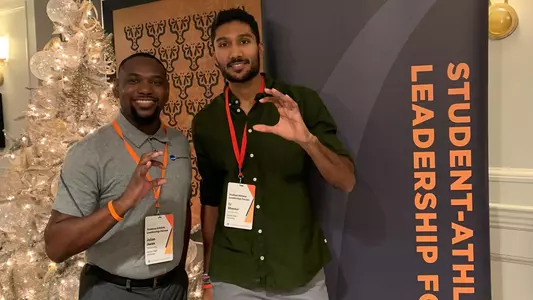
What began with a 1,000-word essay a few months ago culminated in a life-changing experience for Kansas State track and field star Tejaswin Shankar, who recently participated as the Big 12 Conference's male representative in the 2021 NCAA Student-Athlete Leadership Forum in Houston, Texas.
Created in 1997, the NCAA Student-Athlete Leadership Forum is geared toward enhancing the growth of student-athletes, administrators and coaches from all three NCAA divisions personally and professionally. More than 5,000 student-athletes have participated in the four-day affair to learn invaluable leadership skills, a refined understanding of the relationship among personal values, core beliefs and behavioral styles, while gaining the support of a close personal network of like-minded peers — many of whom become lifelong friends.
"I found that regardless if people were at a Division III, or Division II or Division I school, they were all going through similar experiences," Shankar said. "We had never seen each other face-to-face in our lives, and we came together and were vulnerable. People discussed things they might be going through at their institutions or at a conference level. To see them come together and share and learn from each other, and to take tools to move forward, was amazing to see. Everybody was there to grow."
Shankar is a 3.5 GPA student who earned his bachelor's degree in accounting and finance and is currently working toward earning his master's degree in accounting in May. Shankar, a six-time All-American who has won one NCAA Championship and five Big 12 Championships, is also one of the most highly decorated collegiate track and field athletes in the legendary career of Cliff Rovelto, who has coached 17 Olympians in his 34 years at K-State.

Shankar explained his personal, academic and athletic path to success in a 1,000-word essay, which he attached to his application and academic transcripts to be considered for selection to the leadership forum. He learned that he was accepted in October, thus opening a new world of opportunity to soft-spoken star and vice president of the K-State Student-Athlete Advisory Committee, whose heart is entwined in leadership on and off the track.
Attendance featured 150 student-athletes, coaches and administrators, and included group facilitators and NCAA facilitators at the J.W. Marriott in Houston from November 18-21. Upon his acceptance, Shankar, along with the rest of the attendees, was assigned to a group signified by a color with between 20 and 25 members. He learned more about each member through video introductions prior to the event. Once face-to-face at the forum, the group worked in an open environment with trained facilitators to engage in discussions regarding leadership.
Julian Jones, K-State's assistant athletic director for student-athlete development and chief diversity officer, was selected to the prestigious role as a facilitator at the leadership forum. As an NCAA intern in the office of inclusion in 2016-17, Jones had previously participated in the forum as a group leader, or "color team" leader, who aided the group's facilitator.

"It was so impactful to be around individuals who want to be leaders and to be able to teach what I'm passionate about," Jones said. "It helped me to understand my 'why' and the importance of it. It's hard to put into words how impactful it was but just being around like-minded people who want to learn and grow. At the end, for them to tell us how well we did as facilitators it helped me to understand my 'why' and my purpose. Sometimes you might question if you're doing your purpose, but it helped me to understand that I'm doing what I love, and that's helping to develop people.
"Having the experience to go down and learn the curriculum of the student-athlete leadership forum helped me to understand what an expanded curriculum could look like at K-State in the future. That's a goal."
The hours were long with sessions beginning at 7 a.m. and wrapping up at around 9 p.m. One of the initial exercises involved identifying individual core values, narrowing a list of 30 core values to a top 5, and eventually a top 3.
"That was tough, but my top three core values were 'self-control,' 'integrity' and 'tolerance,'" Shankar said. "Those really resonated with me."
Here's why it was a life-changing forum for Shankar: He learned about himself.
"The reason is it's a life-changer for me is because a lot of times you know what you're doing but you don't have words to express those emotions," he said. "While we were there, I learned to identify those emotions and my thoughts became clearer. You have to know who you are before you can lead others. We learned who we are. That workshop was very much geared toward first discovering yourself as a person, being able to apply and change things within yourself, then understanding others' emotions, and then applying change to their emotions. That was the structure of the workshop over the course of three days. That transitions well into life."
Shankar enjoyed hearing about various leadership styles among his peers.
"Everyone talks about leading from the front when it comes to leadership philosophies," he said. "Somebody in the conference, I remember very distinctly, he said that he wanted to lead from the back. I thought that was very interesting. The philosophy is that people who lead from the front don't need anybody to lead them because they're already goal-oriented, whereas those people in the back are the ones who need to be led. So, if I can push them from the back, we can move forward as a group. You don't need to lead from the front all the time. I thought, 'That's a great way of looking at things.' Sometimes it just depends on the scenario. Things like that came out. That's why it was a life-changer."

Added Jones, "It was impactful to see people's gears turning and to see them grasp their core values and philosophy and to have ideas of areas where they could improve."
Three aspects in particular grabbed Shankar's attention: The emotional quotient, self-examination, and listening.
"The emotional quotient (EQ) discusses how EQ is greater than IQ," Shankar said. "You can be smart, but if you don't have people skills and don't understand somebody's emotions, as leader or as a human being, if you aren't able to understand what a person is going through, it's difficult to help them. You have to be able to hear. That really struck me. We talked about understanding yourself and knowing everything about yourself. If there was something you wanted to change, you must be able to look at yourself objectively and be able to facilitate change. Only after you do those two steps can you have the ability to lead others. If you don't understand yourself, you can't understand anybody else. Those topics really impacted us in the leadership forum.
"Finally, the one thing I'll take away from this is just being able to listen to everybody's opinion, and that's where the tolerance part of my core values, is being able to listen to anybody. I want to be tolerant enough to be able to give them a fair shot and hear what they say before I cloud my judgement with what I believe is right. That's where I'll change myself. That's what I'm working on going forward."
What began with a 1,000-word essay a few months ago culminated in a life-changing experience for Kansas State track and field star Tejaswin Shankar, who recently participated as the Big 12 Conference's male representative in the 2021 NCAA Student-Athlete Leadership Forum in Houston, Texas.
Created in 1997, the NCAA Student-Athlete Leadership Forum is geared toward enhancing the growth of student-athletes, administrators and coaches from all three NCAA divisions personally and professionally. More than 5,000 student-athletes have participated in the four-day affair to learn invaluable leadership skills, a refined understanding of the relationship among personal values, core beliefs and behavioral styles, while gaining the support of a close personal network of like-minded peers — many of whom become lifelong friends.
"I found that regardless if people were at a Division III, or Division II or Division I school, they were all going through similar experiences," Shankar said. "We had never seen each other face-to-face in our lives, and we came together and were vulnerable. People discussed things they might be going through at their institutions or at a conference level. To see them come together and share and learn from each other, and to take tools to move forward, was amazing to see. Everybody was there to grow."
Shankar is a 3.5 GPA student who earned his bachelor's degree in accounting and finance and is currently working toward earning his master's degree in accounting in May. Shankar, a six-time All-American who has won one NCAA Championship and five Big 12 Championships, is also one of the most highly decorated collegiate track and field athletes in the legendary career of Cliff Rovelto, who has coached 17 Olympians in his 34 years at K-State.
Shankar explained his personal, academic and athletic path to success in a 1,000-word essay, which he attached to his application and academic transcripts to be considered for selection to the leadership forum. He learned that he was accepted in October, thus opening a new world of opportunity to soft-spoken star and vice president of the K-State Student-Athlete Advisory Committee, whose heart is entwined in leadership on and off the track.
Attendance featured 150 student-athletes, coaches and administrators, and included group facilitators and NCAA facilitators at the J.W. Marriott in Houston from November 18-21. Upon his acceptance, Shankar, along with the rest of the attendees, was assigned to a group signified by a color with between 20 and 25 members. He learned more about each member through video introductions prior to the event. Once face-to-face at the forum, the group worked in an open environment with trained facilitators to engage in discussions regarding leadership.
Julian Jones, K-State's assistant athletic director for student-athlete development and chief diversity officer, was selected to the prestigious role as a facilitator at the leadership forum. As an NCAA intern in the office of inclusion in 2016-17, Jones had previously participated in the forum as a group leader, or "color team" leader, who aided the group's facilitator.
"It was so impactful to be around individuals who want to be leaders and to be able to teach what I'm passionate about," Jones said. "It helped me to understand my 'why' and the importance of it. It's hard to put into words how impactful it was but just being around like-minded people who want to learn and grow. At the end, for them to tell us how well we did as facilitators it helped me to understand my 'why' and my purpose. Sometimes you might question if you're doing your purpose, but it helped me to understand that I'm doing what I love, and that's helping to develop people.
"Having the experience to go down and learn the curriculum of the student-athlete leadership forum helped me to understand what an expanded curriculum could look like at K-State in the future. That's a goal."
The hours were long with sessions beginning at 7 a.m. and wrapping up at around 9 p.m. One of the initial exercises involved identifying individual core values, narrowing a list of 30 core values to a top 5, and eventually a top 3.
"That was tough, but my top three core values were 'self-control,' 'integrity' and 'tolerance,'" Shankar said. "Those really resonated with me."
Here's why it was a life-changing forum for Shankar: He learned about himself.
"The reason is it's a life-changer for me is because a lot of times you know what you're doing but you don't have words to express those emotions," he said. "While we were there, I learned to identify those emotions and my thoughts became clearer. You have to know who you are before you can lead others. We learned who we are. That workshop was very much geared toward first discovering yourself as a person, being able to apply and change things within yourself, then understanding others' emotions, and then applying change to their emotions. That was the structure of the workshop over the course of three days. That transitions well into life."
Shankar enjoyed hearing about various leadership styles among his peers.
"Everyone talks about leading from the front when it comes to leadership philosophies," he said. "Somebody in the conference, I remember very distinctly, he said that he wanted to lead from the back. I thought that was very interesting. The philosophy is that people who lead from the front don't need anybody to lead them because they're already goal-oriented, whereas those people in the back are the ones who need to be led. So, if I can push them from the back, we can move forward as a group. You don't need to lead from the front all the time. I thought, 'That's a great way of looking at things.' Sometimes it just depends on the scenario. Things like that came out. That's why it was a life-changer."
Added Jones, "It was impactful to see people's gears turning and to see them grasp their core values and philosophy and to have ideas of areas where they could improve."
Three aspects in particular grabbed Shankar's attention: The emotional quotient, self-examination, and listening.
"The emotional quotient (EQ) discusses how EQ is greater than IQ," Shankar said. "You can be smart, but if you don't have people skills and don't understand somebody's emotions, as leader or as a human being, if you aren't able to understand what a person is going through, it's difficult to help them. You have to be able to hear. That really struck me. We talked about understanding yourself and knowing everything about yourself. If there was something you wanted to change, you must be able to look at yourself objectively and be able to facilitate change. Only after you do those two steps can you have the ability to lead others. If you don't understand yourself, you can't understand anybody else. Those topics really impacted us in the leadership forum.
"Finally, the one thing I'll take away from this is just being able to listen to everybody's opinion, and that's where the tolerance part of my core values, is being able to listen to anybody. I want to be tolerant enough to be able to give them a fair shot and hear what they say before I cloud my judgement with what I believe is right. That's where I'll change myself. That's what I'm working on going forward."


K-State Men's Basketball | Postgame Press Conference at Colorado
Thursday, February 26
K-State Rowing | Media Day
Tuesday, February 24
K-State Rowing | Weights Practice
Tuesday, February 24
K-State Tennis | Weekend Recap vs Old Dominion & Minnesota
Tuesday, February 24