SE: 64 Teams Are Searching for One Shining Moment - Meet the K-Stater Who Picked Them
Mar 19, 2021 | Women's Basketball, Sports Extra
By: Austin Siegel
About a year ago, K-State Deputy Athletics Director Jill Shields touched down in Indianapolis and headed straight to the hotel where the NCAA Women's Basketball Committee would select the 64 teams for the 2020 tournament.
She took an elevator up to the conference room, walked in and saw the chair of the selection committee shaking her head.
"They canceled it didn't they?" Shields asked.
"Yep."
"She said, 'You can go in and someone will help you book your flight home,'" Shields remembers.
That's how her first season as a member of the NCAA Women's Basketball Tournament selection committee came to an end.
This year, Shields is in San Antonio, preparing for a unique one-site tournament played entirely in Texas. But the important thing is, when Iowa tips off against Central Michigan on Sunday, Shields will have helped pick the teams for a tournament that, you know, is actually happening.
"The number of games that we all watch, the hours you spend going through team sheets, all the data on teams," Shields said. "Until I got really immersed in the work, I had no idea what was ahead of me."
There are 354 women's college basketball teams that compete at the D1 level. Every single one, in theory, could qualify for the NCAA Tournament.
It's the most egalitarian competition in sports. There are 32 spots available for the champion of every conference tournament, from schools like Kansas State in the Big 12 to the liberal arts colleges that make up the Patriot League.
For one month, the Utah Valley Wolverines and the UConn Huskies are both six games away from a national title.
Here's where Shields comes in: 32 more teams receive "at-large bids" to the tournament, based on the opinion and the decision of a selection committee. All 64 teams are then ranked, 1 to 16, which determines each matchup as they move through the tournament bracket.
The 10-member committee features a cross section of schools both large and small. Shields has represented K-State and the Big 12 since 2019.
It's a five-year commitment, basically requiring Shields to be as knowledgeable about women's college hoops as anyone in the country. There's no other job like it.
"I've got four primary conferences that I'm responsible for and then I'm the secondary committee member on three additional conferences," she said. "I've watched over 200 games this year, and if you don't, you're really not prepared in the selection room."
That would be a lot of basketball if Shields had nothing else going on this season.
But as the Deputy AD at K-State, she's also been helping 16 varsity athletic programs in Manhattan navigate the pandemic and the day-to-day challenges that arise in big-time college sports.
Two keys to watching something like 400 hours of college hoops without losing your mind? The central time zone and TiVo.
Living in Kansas, games on either coast generally don't start too late or too early for Shields to get to her couch. But more often than not, she hit record every night and watched games on her own schedule.
"After my first year doing this, I figured out that if you plan ahead and tape the games, you can watch five games in five hours as opposed to five games in 10 hours," she said. "You can watch so many more games that way without watching the timeouts and halftime. But it can still be a lot of late nights."
Shields is a former college basketball player at Central Florida and an assistant coach at Wichita State, the kind of experience that serves her well as the sports administrator for K-State Women's Basketball.
But when she wasn't working with the Wildcats this season, Shields was doing what college basketball fans across the country do every year, just for dozens of teams, with higher stakes.

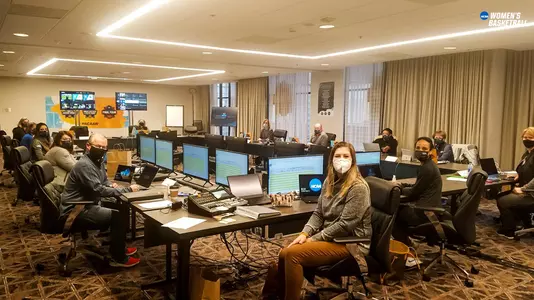
When she arrived in San Antonio before the 64-team bracket was finalized, Shields found a makeshift "situation room" with monitors ready for the committee to pull up info on any team in the nation.
"Everyone has a different perspective, and everyone has a different background. I feel like our committee was strong in that many of us were student-athletes or coaches," Shields said. "It's fun to be in a room with people who have similar interests and want to see women's basketball on the big stage. It's fun to banter back and forth."
Committee members leave the room if their own school comes up in the conversation, while other members do their best to rank schools that might have never played each other before.
With fewer common opponents than ever this season due to COVID-19, those discussions made watching games even more important.
"If we wanted to compare BYU and DePaul for instance, we would pull those team sheets up. Box 1 has all of their wins over teams ranked 1 through 25 and then Box 2 is their wins over teams ranked 26 through 50," Shields said. "So, you can see teams and separate teams by their number of top 50 wins."
That data is essential in making decisions across conferences, with a voting system to help committee members like Shields break ties.
When it comes to the first four teams left out of the tournament, a designation reserved for teams on the "bubble" that came just short of an at-large bid, the decision was critical.
Had any of the 64 teams not been able to make the trip to San Antonio due to COVID, those four teams would have been next in line for an invite. Now that everybody has arrived in Texas, any team whose opponent has to cancel a game due to COVID-19 will simply advance.
Even with the bracket set, Shields can still roll off a quick scouting report on just about any team in the tournament, like say, her alma mater at Central Florida. The Golden Knights are a 10-seed and will face seventh-seed Northwestern in the first round of the tournament.
"I watched them about three times," she said. "They're a really athletic team and a strong defensive team. They don't quite have the star power of a Northwestern, but that should be a really good game. I'm looking forward to it."
Shields will shift into a representative role once the tournament begins, helping organize each practice at her designated game site in San Antonio. A tour of the Alamodome on Tuesday helped Shields get a feel for the building where she will spend the first three rounds.
A normal responsibility like helping out at practice will be just as important this year as making sure no two teams ever cross paths outside game day and keep contact at a minimum.
400 hours of watching basketball for two weeks in March might seem crazy in any other context. But for Shields, and college hoops fans across the country, this is what it's all about.
"We've prepped teams to be patient. We're excited that we get to have a tournament, but we're telling teams it's not going to be the same experience that you've had before," Shields said. "We've got to celebrate that and know that we're fortunate to be here."
About a year ago, K-State Deputy Athletics Director Jill Shields touched down in Indianapolis and headed straight to the hotel where the NCAA Women's Basketball Committee would select the 64 teams for the 2020 tournament.
She took an elevator up to the conference room, walked in and saw the chair of the selection committee shaking her head.
"They canceled it didn't they?" Shields asked.
"Yep."
"She said, 'You can go in and someone will help you book your flight home,'" Shields remembers.
That's how her first season as a member of the NCAA Women's Basketball Tournament selection committee came to an end.
This year, Shields is in San Antonio, preparing for a unique one-site tournament played entirely in Texas. But the important thing is, when Iowa tips off against Central Michigan on Sunday, Shields will have helped pick the teams for a tournament that, you know, is actually happening.
"The number of games that we all watch, the hours you spend going through team sheets, all the data on teams," Shields said. "Until I got really immersed in the work, I had no idea what was ahead of me."
There are 354 women's college basketball teams that compete at the D1 level. Every single one, in theory, could qualify for the NCAA Tournament.
It's the most egalitarian competition in sports. There are 32 spots available for the champion of every conference tournament, from schools like Kansas State in the Big 12 to the liberal arts colleges that make up the Patriot League.
For one month, the Utah Valley Wolverines and the UConn Huskies are both six games away from a national title.
Here's where Shields comes in: 32 more teams receive "at-large bids" to the tournament, based on the opinion and the decision of a selection committee. All 64 teams are then ranked, 1 to 16, which determines each matchup as they move through the tournament bracket.
The 10-member committee features a cross section of schools both large and small. Shields has represented K-State and the Big 12 since 2019.
It's a five-year commitment, basically requiring Shields to be as knowledgeable about women's college hoops as anyone in the country. There's no other job like it.
"I've got four primary conferences that I'm responsible for and then I'm the secondary committee member on three additional conferences," she said. "I've watched over 200 games this year, and if you don't, you're really not prepared in the selection room."
That would be a lot of basketball if Shields had nothing else going on this season.
But as the Deputy AD at K-State, she's also been helping 16 varsity athletic programs in Manhattan navigate the pandemic and the day-to-day challenges that arise in big-time college sports.
Two keys to watching something like 400 hours of college hoops without losing your mind? The central time zone and TiVo.
Living in Kansas, games on either coast generally don't start too late or too early for Shields to get to her couch. But more often than not, she hit record every night and watched games on her own schedule.
"After my first year doing this, I figured out that if you plan ahead and tape the games, you can watch five games in five hours as opposed to five games in 10 hours," she said. "You can watch so many more games that way without watching the timeouts and halftime. But it can still be a lot of late nights."
Shields is a former college basketball player at Central Florida and an assistant coach at Wichita State, the kind of experience that serves her well as the sports administrator for K-State Women's Basketball.
But when she wasn't working with the Wildcats this season, Shields was doing what college basketball fans across the country do every year, just for dozens of teams, with higher stakes.
When she arrived in San Antonio before the 64-team bracket was finalized, Shields found a makeshift "situation room" with monitors ready for the committee to pull up info on any team in the nation.
"Everyone has a different perspective, and everyone has a different background. I feel like our committee was strong in that many of us were student-athletes or coaches," Shields said. "It's fun to be in a room with people who have similar interests and want to see women's basketball on the big stage. It's fun to banter back and forth."
Committee members leave the room if their own school comes up in the conversation, while other members do their best to rank schools that might have never played each other before.
With fewer common opponents than ever this season due to COVID-19, those discussions made watching games even more important.
"If we wanted to compare BYU and DePaul for instance, we would pull those team sheets up. Box 1 has all of their wins over teams ranked 1 through 25 and then Box 2 is their wins over teams ranked 26 through 50," Shields said. "So, you can see teams and separate teams by their number of top 50 wins."
That data is essential in making decisions across conferences, with a voting system to help committee members like Shields break ties.
When it comes to the first four teams left out of the tournament, a designation reserved for teams on the "bubble" that came just short of an at-large bid, the decision was critical.
Had any of the 64 teams not been able to make the trip to San Antonio due to COVID, those four teams would have been next in line for an invite. Now that everybody has arrived in Texas, any team whose opponent has to cancel a game due to COVID-19 will simply advance.
Even with the bracket set, Shields can still roll off a quick scouting report on just about any team in the tournament, like say, her alma mater at Central Florida. The Golden Knights are a 10-seed and will face seventh-seed Northwestern in the first round of the tournament.
"I watched them about three times," she said. "They're a really athletic team and a strong defensive team. They don't quite have the star power of a Northwestern, but that should be a really good game. I'm looking forward to it."
Shields will shift into a representative role once the tournament begins, helping organize each practice at her designated game site in San Antonio. A tour of the Alamodome on Tuesday helped Shields get a feel for the building where she will spend the first three rounds.
A normal responsibility like helping out at practice will be just as important this year as making sure no two teams ever cross paths outside game day and keep contact at a minimum.
400 hours of watching basketball for two weeks in March might seem crazy in any other context. But for Shields, and college hoops fans across the country, this is what it's all about.
"We've prepped teams to be patient. We're excited that we get to have a tournament, but we're telling teams it's not going to be the same experience that you've had before," Shields said. "We've got to celebrate that and know that we're fortunate to be here."
K-State Men's Basketball | Postgame Press Conference at Texas Tech
Sunday, February 22
K-State Women's Basketball | Tess Heal Senior Video
Sunday, February 22
K-State Women's Basketball | Mikayla Parks Senior Video
Sunday, February 22
K-State Women's Basketball | Senior Night Ceremony 2025 - 2026 Season
Sunday, February 22