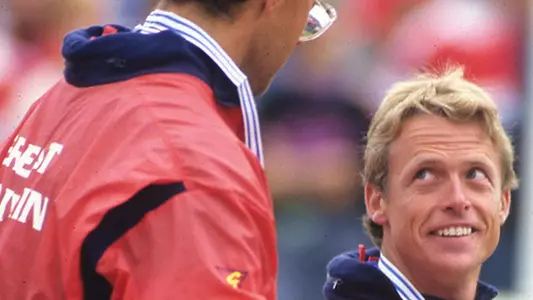
SE: Sweeney Reflects on Olympic Rowing Experience
Jul 30, 2021 | Rowing, Sports Extra
By: Austin Siegel
The Summer Olympics are on TV at the Intercollegiate Rowing Center.
K-State head coach Patrick Sweeney has caught some of the rowing competition, enough to have an opinion about Great Britain's performance - not so great - and to recognize a few coaches at Sea Forest Waterway in Tokyo.
The last time the greatest sporting event on earth came to Japan, Sweeney was a 12-year-old kid growing up in England and watching the first Olympics beamed onto television screens across the world.
He was also, to phrase it more gently than Sweeney did, on the shorter side.
"I was like, 'Man, I want to do that.' There were these people from all around the world and it was very exotic," he said. "They were competing together, and I had always liked competing. But I found a sport that I could do well at."
There have been 14 Summer Olympics since those Tokyo Games. Sweeney has been at six of them.
He won a silver medal at Montreal in 1976 and a bronze at Seoul in 1988, alongside coaching stints with Great Britain and Belgium at three more Olympics.
On rowing's biggest stage, it's a remarkable resume for the K-State head coach.
Sweeney's debut came, a few days after he turned 20, at the Munich Olympics in 1972. At that point, after breaking into the British rowing scene as a teenage coxswain, he felt ready to represent his country.
Moving into the Olympic village, everything was just as exotic as it had been on his television screen. With most races beginning at dawn, Sweeney didn't have much time to enjoy the atmosphere until the rowing competition wrapped up after the first week of the Olympics.
"Then it's party time," he said. "You really get to soak everything in."
It would also be his last time competing at the Olympics as an amateur - Great Britain would bring semi-professional rowers to the next Summer Olympics in Montreal.
Before the Munich Games, Sweeney was working full-time as a mechanical engineer.
"Rowing was still fun, but it was a job now," he said. "It became different and more cut-throat in some ways. This was how you had to do it and if not, you had to get out."

Watching rowing at the Olympics this summer, Sweeney said that going professional has introduced better equipment, new training methods, and a focus on nutrition and psychology to the sport.
These changes were just beginning when Sweeney returned to the Olympic stage in 1976. He said the British knew they were a medal contender as soon as they arrived in Montreal.
"You build up over the three World Championships to the Olympics. You know how you're progressing, so there are no surprises," Sweeney said. "The team has been put together over a number of years."
Sweeney coxed the British Eight to a silver medal, returning 12 years later to Seoul in 1988 where he won a bronze medal with the coxed pair of Steve Redgrave and Andy Holmes.
"In those Disney movies, you turn up and then suddenly you win out of nowhere," Sweeney said. "In real life, it takes a long time, you start at the age of 12 or 13 and maybe make it to the podium in your 20s. It doesn't happen like it does in the movies."
As a head coach, Sweeney spent six years leading Belgium, a team that had at least one Hollywood element to their story.
"The goal we had wasn't to medal," he said. "The main goal was to bring a country that was so divided together… you've got Dutch, French and German speakers."
Under Sweeney, a country that had previously focused on boats with athletes who spoke the same language created a combined boat with rowers across the linguistic divide.
At the 2000 Sydney Olympics, Belgium recorded their best finish in rowing since 1924.
"Before, they would always stick to the smaller boats," he said. "The aim was to bring them together and they did pretty well. They needed some good races to get there."
At K-State, Sweeney is watching the Tokyo Games as a fan – a self-described "old fart" – and someone who's reached the Olympics while building a life and career outside their orbit.
He's still in contact with former teammates – a recent birthday card included a photo of the British Olympic team – and Sweeney said he still thinks about certain moments from past races.
But that was never the point of reaching the Olympics in the first place.
"In 1964, I saw all of these exotic people laughing, joking and having fun together," he said. "That, to me, is what the biggest thing is. If you end up with a medal, great. If it's gold, great. But at the end of the day, so what? Hopefully, the experience makes you a better person."
The Summer Olympics are on TV at the Intercollegiate Rowing Center.
K-State head coach Patrick Sweeney has caught some of the rowing competition, enough to have an opinion about Great Britain's performance - not so great - and to recognize a few coaches at Sea Forest Waterway in Tokyo.
The last time the greatest sporting event on earth came to Japan, Sweeney was a 12-year-old kid growing up in England and watching the first Olympics beamed onto television screens across the world.
He was also, to phrase it more gently than Sweeney did, on the shorter side.
"I was like, 'Man, I want to do that.' There were these people from all around the world and it was very exotic," he said. "They were competing together, and I had always liked competing. But I found a sport that I could do well at."
There have been 14 Summer Olympics since those Tokyo Games. Sweeney has been at six of them.
He won a silver medal at Montreal in 1976 and a bronze at Seoul in 1988, alongside coaching stints with Great Britain and Belgium at three more Olympics.
On rowing's biggest stage, it's a remarkable resume for the K-State head coach.
Sweeney's debut came, a few days after he turned 20, at the Munich Olympics in 1972. At that point, after breaking into the British rowing scene as a teenage coxswain, he felt ready to represent his country.
Moving into the Olympic village, everything was just as exotic as it had been on his television screen. With most races beginning at dawn, Sweeney didn't have much time to enjoy the atmosphere until the rowing competition wrapped up after the first week of the Olympics.
"Then it's party time," he said. "You really get to soak everything in."
It would also be his last time competing at the Olympics as an amateur - Great Britain would bring semi-professional rowers to the next Summer Olympics in Montreal.
Before the Munich Games, Sweeney was working full-time as a mechanical engineer.
"Rowing was still fun, but it was a job now," he said. "It became different and more cut-throat in some ways. This was how you had to do it and if not, you had to get out."
Watching rowing at the Olympics this summer, Sweeney said that going professional has introduced better equipment, new training methods, and a focus on nutrition and psychology to the sport.
These changes were just beginning when Sweeney returned to the Olympic stage in 1976. He said the British knew they were a medal contender as soon as they arrived in Montreal.
"You build up over the three World Championships to the Olympics. You know how you're progressing, so there are no surprises," Sweeney said. "The team has been put together over a number of years."
Sweeney coxed the British Eight to a silver medal, returning 12 years later to Seoul in 1988 where he won a bronze medal with the coxed pair of Steve Redgrave and Andy Holmes.
"In those Disney movies, you turn up and then suddenly you win out of nowhere," Sweeney said. "In real life, it takes a long time, you start at the age of 12 or 13 and maybe make it to the podium in your 20s. It doesn't happen like it does in the movies."
As a head coach, Sweeney spent six years leading Belgium, a team that had at least one Hollywood element to their story.
"The goal we had wasn't to medal," he said. "The main goal was to bring a country that was so divided together… you've got Dutch, French and German speakers."
Under Sweeney, a country that had previously focused on boats with athletes who spoke the same language created a combined boat with rowers across the linguistic divide.
At the 2000 Sydney Olympics, Belgium recorded their best finish in rowing since 1924.
"Before, they would always stick to the smaller boats," he said. "The aim was to bring them together and they did pretty well. They needed some good races to get there."
At K-State, Sweeney is watching the Tokyo Games as a fan – a self-described "old fart" – and someone who's reached the Olympics while building a life and career outside their orbit.
He's still in contact with former teammates – a recent birthday card included a photo of the British Olympic team – and Sweeney said he still thinks about certain moments from past races.
But that was never the point of reaching the Olympics in the first place.
"In 1964, I saw all of these exotic people laughing, joking and having fun together," he said. "That, to me, is what the biggest thing is. If you end up with a medal, great. If it's gold, great. But at the end of the day, so what? Hopefully, the experience makes you a better person."

K-State Baseball | Game Highlights vs TCU
Saturday, April 04
K-State Volleyball | March Madness Tournament
Friday, April 03
K-State Football | 2026-2027 Student Athletic Passes ON SALE NOW 🔥
Friday, April 03
K-State Tennis | Timing is everything 🎤
Friday, April 03