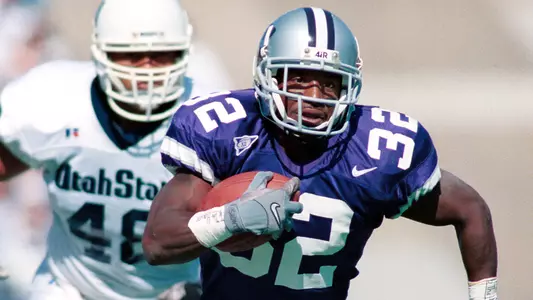
Q&A With K-State HOF Inductee David Allen
Sep 27, 2021 | Football, Sports Extra
David Allen, one of the greatest punt-return specialists in the history of college football, will return to Manhattan this weekend when he is inducted into the Kansas State Athletics Hall of Fame. A 1998 Consensus All-American and 1999 first-team All-American, Allen left K-State as the all-time leader in career punt-return average, total yards, attempts and touchdowns, while his seven career punt-return touchdowns tied the NCAA record.
A three-time All-Big 12 honoree, Allen burst into the national spotlight as a sophomore in 1998, becoming the first and only player to return a punt for a touchdown in three consecutive weeks while setting an NCAA record with four punt-return touchdowns in a single season. Sadly, Allen suffered a season-ending injury during the first game of his senior season in 2000, but he went on to play six years of professional football.
As for his biggest honor? He is a loving father to Jaidin, his five-year-old son.
D. Scott Fritchen of K-State Sports Extra spoke with Allen ahead of his return to K-State for his Hall of Fame induction:
DSF: What has David Allen been up to since leaving K-State?
Honestly, I'm just living life. I live in Kansas City, Missouri, and work for a pharmaceutical company, and I have a five-year-old son, Jaidin, who is my main priority when it comes to my day. Life is good. I have no complaints. Obviously, I was with the San Francisco 49ers (2001), Minnesota Vikings (2002), Jacksonville Jaguars (2003-04), St. Louis Rams (2005) and Calgary Stampeders (2006-07), then a K-State football graduate assistant (2009-12) while earning a Master's degree in Counseling and College Student Development. Then I was a scout for the Jaguars (2012-13). Now I'm in the medical industry.
DSF: When you arrived at K-State from Liberty, Missouri, what were the goals you mapped out for yourself during your college football career?
DA: Honestly, my goal when I came to K-State was to be the best football player I could be. I wanted to have an opportunity to play. The first thing was to come in and learn. I wanted to redshirt my freshman year so I had an opportunity to learn because my goal was to play for four years after that. I wanted to do me, just be the best football player I could be, and see where it could take me.
DSF: What was the biggest challenge you faced during your K-State career?
DA: The biggest challenge? My injury late in my career. For any athlete, injuries are usually the biggest obstacles because you're out there working your tail off, then get injured, and then you're working hard to get back to play. I don't think there were a whole lot of obstacles other than injuries. I enjoyed my time at K-State, playing with the guys that I played with, being on the great teams that I was on, and just wanted to work hard every day to be able to play. You've got to earn the right to play. It's not just going to be given to you. The biggest thing every day was to go out there and prove to the coaches and to myself that I deserved to be one of the guys playing.
DSF: Of course, you tied the NCAA record with seven punt-return touchdowns, and it could've been eight if not for the phantom holding call against Iowa during the season-opener at Arrowhead Stadium in 2000. What comes to mind when you think about your achievements?
DA: At the end of the day, records are records, and they're made to be broken. At the time, would it have been nice to get eight and break the record? Of course. Anytime you have an opportunity to break a record you want to achieve that, but things happen for a reason. For me, the things that we were able to accomplish, I give credit to all of the other guys that were a part of the punt-return units, because if not for them, there wouldn't have been anything. They made my job easy. Yeah, I got all of the glory and accolades because I got to score the touchdowns, but it was all of the other guys that made it all possible. For me, it's always about giving those guys the credit because my job was easy. I just had to catch it and run.
My time at K-State, I wouldn't change anything. Injuries? I think everything happens for a reason. There's always going to be adversity at times. It's just how you deal with those adversities and move forward through them. That makes you the person that you become. The teammates that I had and the guys that I played with, at the end of the day, if it isn't for them, there's no us, there's no me, there's none of the guys going into the K-State Athletics Hall of Fame. There is no Jordy Nelson or Darren Sproles without the whole team. More credit needs to be given to the guys behind the scenes. I truly believe that. Without those walk-ons and guys who come out and are a part of the team, who don't get the praises, the accolades, and some of them don't even get to play on Saturdays, without those guys, there is none of this. They have to be given just as much credit as we do because without them, we aren't successful. They have to be committed to work every day and to work hard because not only are we getting better but they're getting better. Everybody needs the credit.
DSF: What is an individual accomplishment you'll always remember?
DA: My most memorable highlight was my first punt-return touchdown against KU. That was the one that got the ball rolling and got things started and put me on the map a little bit. Everything after that just became routine, I guess. It just became easy, and it became fun. I think I had one early in my freshman season against Oklahoma that got called back, once we got the first one against KU and it counted, it became fun. That one, for me, stands out a little bit more, because that's the one that actually stood, the first one of my career, and it sprung the platform for what was to come later down the road.
DSF: How do you want to be remembered at K-State?
DA: I don't even think it has anything to do with football. For me, it's about being a guy who was everybody's friend, a likeable guy in the community, always willing to do whatever it took to help people. Everybody saw and knew what I was able to do on the football field, but there were people in the community, even today, that if you mentioned my name to them or the relationship that I had with them, it was more than just about football. There are people that aren't with us today who I appreciated the opportunity to meet, and it was about more than what was on the field that sprung forth those relationships — Bob Krause and John Fairman. Those were people that I was very, very close to that had nothing to do with football. They were just relationships off the field that I was able to be a part of. To me, being remembered as a great football player isn't the most important thing to me. Being remembered as a great person first, and as a great football player second, is what's important to me.
DSF: What was the impact of Bill Snyder on your life?
DA: There's so much you can say as far as his impact and what he was able to do for me and for all the players. You have to give Coach Snyder credit for what he was able to do, and I appreciate Coach Snyder the most because of the little things that he instilled in us, as far as continuing to be respectful on and off the field, working hard every day, being the best you can be, being accountable for everything. That's what he preached. I remember when I was in Jacksonville as a scout, one of the scouts from another team said, "We love getting those K-State players because we know exactly what we're getting because those guys work harder than anybody." That's a tribute to Coach Snyder and the types of players that he brought in — guys who were willing to work hard. At the end of the day, some of us might not have been the most talented, and we might not have been the five-star guys, but when we played, we worked harder than anybody we played against. That's why we were successful. That's why we won.
DSF: What does it mean to you to be inducted into the K-State Athletics Hall of Fame?
DA: For me, any award that you receive is an honor and a big accomplishment. I greatly appreciate to receive an award of that magnitude. Any Hall of Fame you go into is a big deal. It's one of those things where you're in there forever. To be in the Ring of Honor, the Kansas Sports Hall of Fame, and K-State Athletics Hall of Fame, I'm very honored to be a part of that. I'm excited. I'm excited to get back to Manhattan. I always look forward to going to Manhattan. The stadium is crazy. Everything that they've been able to do in the athletic department, whether it's the soccer stadium, baseball stadium, the rowing facility, the south end zone, it's crazy to think where we were 20 years ago to where we are today. I remember when they put the upper eastside seats in after the 1998 season. We thought, "That's so awesome." Then we got new jumbotrons and we thought we were on cloud nine. It's nothing compared to what it looks like now. It's great to see K-State sports being able to do those things with the facilities. Hopefully, that'll help continue to grow the programs. I'm very appreciative of the award and honor.
A three-time All-Big 12 honoree, Allen burst into the national spotlight as a sophomore in 1998, becoming the first and only player to return a punt for a touchdown in three consecutive weeks while setting an NCAA record with four punt-return touchdowns in a single season. Sadly, Allen suffered a season-ending injury during the first game of his senior season in 2000, but he went on to play six years of professional football.
As for his biggest honor? He is a loving father to Jaidin, his five-year-old son.
D. Scott Fritchen of K-State Sports Extra spoke with Allen ahead of his return to K-State for his Hall of Fame induction:
DSF: What has David Allen been up to since leaving K-State?
Honestly, I'm just living life. I live in Kansas City, Missouri, and work for a pharmaceutical company, and I have a five-year-old son, Jaidin, who is my main priority when it comes to my day. Life is good. I have no complaints. Obviously, I was with the San Francisco 49ers (2001), Minnesota Vikings (2002), Jacksonville Jaguars (2003-04), St. Louis Rams (2005) and Calgary Stampeders (2006-07), then a K-State football graduate assistant (2009-12) while earning a Master's degree in Counseling and College Student Development. Then I was a scout for the Jaguars (2012-13). Now I'm in the medical industry.
DSF: When you arrived at K-State from Liberty, Missouri, what were the goals you mapped out for yourself during your college football career?
DA: Honestly, my goal when I came to K-State was to be the best football player I could be. I wanted to have an opportunity to play. The first thing was to come in and learn. I wanted to redshirt my freshman year so I had an opportunity to learn because my goal was to play for four years after that. I wanted to do me, just be the best football player I could be, and see where it could take me.
DSF: What was the biggest challenge you faced during your K-State career?
DA: The biggest challenge? My injury late in my career. For any athlete, injuries are usually the biggest obstacles because you're out there working your tail off, then get injured, and then you're working hard to get back to play. I don't think there were a whole lot of obstacles other than injuries. I enjoyed my time at K-State, playing with the guys that I played with, being on the great teams that I was on, and just wanted to work hard every day to be able to play. You've got to earn the right to play. It's not just going to be given to you. The biggest thing every day was to go out there and prove to the coaches and to myself that I deserved to be one of the guys playing.
DSF: Of course, you tied the NCAA record with seven punt-return touchdowns, and it could've been eight if not for the phantom holding call against Iowa during the season-opener at Arrowhead Stadium in 2000. What comes to mind when you think about your achievements?
DA: At the end of the day, records are records, and they're made to be broken. At the time, would it have been nice to get eight and break the record? Of course. Anytime you have an opportunity to break a record you want to achieve that, but things happen for a reason. For me, the things that we were able to accomplish, I give credit to all of the other guys that were a part of the punt-return units, because if not for them, there wouldn't have been anything. They made my job easy. Yeah, I got all of the glory and accolades because I got to score the touchdowns, but it was all of the other guys that made it all possible. For me, it's always about giving those guys the credit because my job was easy. I just had to catch it and run.
My time at K-State, I wouldn't change anything. Injuries? I think everything happens for a reason. There's always going to be adversity at times. It's just how you deal with those adversities and move forward through them. That makes you the person that you become. The teammates that I had and the guys that I played with, at the end of the day, if it isn't for them, there's no us, there's no me, there's none of the guys going into the K-State Athletics Hall of Fame. There is no Jordy Nelson or Darren Sproles without the whole team. More credit needs to be given to the guys behind the scenes. I truly believe that. Without those walk-ons and guys who come out and are a part of the team, who don't get the praises, the accolades, and some of them don't even get to play on Saturdays, without those guys, there is none of this. They have to be given just as much credit as we do because without them, we aren't successful. They have to be committed to work every day and to work hard because not only are we getting better but they're getting better. Everybody needs the credit.
DSF: What is an individual accomplishment you'll always remember?
DA: My most memorable highlight was my first punt-return touchdown against KU. That was the one that got the ball rolling and got things started and put me on the map a little bit. Everything after that just became routine, I guess. It just became easy, and it became fun. I think I had one early in my freshman season against Oklahoma that got called back, once we got the first one against KU and it counted, it became fun. That one, for me, stands out a little bit more, because that's the one that actually stood, the first one of my career, and it sprung the platform for what was to come later down the road.
DSF: How do you want to be remembered at K-State?
DA: I don't even think it has anything to do with football. For me, it's about being a guy who was everybody's friend, a likeable guy in the community, always willing to do whatever it took to help people. Everybody saw and knew what I was able to do on the football field, but there were people in the community, even today, that if you mentioned my name to them or the relationship that I had with them, it was more than just about football. There are people that aren't with us today who I appreciated the opportunity to meet, and it was about more than what was on the field that sprung forth those relationships — Bob Krause and John Fairman. Those were people that I was very, very close to that had nothing to do with football. They were just relationships off the field that I was able to be a part of. To me, being remembered as a great football player isn't the most important thing to me. Being remembered as a great person first, and as a great football player second, is what's important to me.
DSF: What was the impact of Bill Snyder on your life?
DA: There's so much you can say as far as his impact and what he was able to do for me and for all the players. You have to give Coach Snyder credit for what he was able to do, and I appreciate Coach Snyder the most because of the little things that he instilled in us, as far as continuing to be respectful on and off the field, working hard every day, being the best you can be, being accountable for everything. That's what he preached. I remember when I was in Jacksonville as a scout, one of the scouts from another team said, "We love getting those K-State players because we know exactly what we're getting because those guys work harder than anybody." That's a tribute to Coach Snyder and the types of players that he brought in — guys who were willing to work hard. At the end of the day, some of us might not have been the most talented, and we might not have been the five-star guys, but when we played, we worked harder than anybody we played against. That's why we were successful. That's why we won.
DSF: What does it mean to you to be inducted into the K-State Athletics Hall of Fame?
DA: For me, any award that you receive is an honor and a big accomplishment. I greatly appreciate to receive an award of that magnitude. Any Hall of Fame you go into is a big deal. It's one of those things where you're in there forever. To be in the Ring of Honor, the Kansas Sports Hall of Fame, and K-State Athletics Hall of Fame, I'm very honored to be a part of that. I'm excited. I'm excited to get back to Manhattan. I always look forward to going to Manhattan. The stadium is crazy. Everything that they've been able to do in the athletic department, whether it's the soccer stadium, baseball stadium, the rowing facility, the south end zone, it's crazy to think where we were 20 years ago to where we are today. I remember when they put the upper eastside seats in after the 1998 season. We thought, "That's so awesome." Then we got new jumbotrons and we thought we were on cloud nine. It's nothing compared to what it looks like now. It's great to see K-State sports being able to do those things with the facilities. Hopefully, that'll help continue to grow the programs. I'm very appreciative of the award and honor.
Friday, October 02
Friday, October 02
Thursday, October 01
Wednesday, September 30