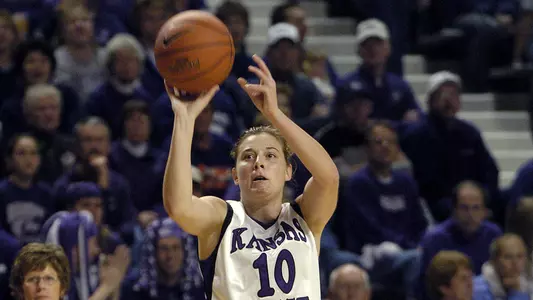
Q&A With K-State HOF Inductee Laurie Koehn
Sep 28, 2021 | Women's Basketball, Sports Extra
Laurie Koehn, one of the greatest 3-point shooters in the history of women's college basketball, will return to Manhattan this weekend when she is inducted into the Kansas State Athletics Hall of Fame. Over the course of Koehn's career between 2002-05, she set the NCAA record with 392 made 3-pointers (a record that stood until 2020) and holds the Big 12 Conference all-time record with an 87.7 percentage in free throws.
Koehn was named 2002 ESPN Rookie of the Year as a freshman and helped the Wildcats to one of their most impressive periods in history. The Wildcats made four NCAA Tournament appearances, including the 2002 Sweet Sixteen, the winningest season in history with a 29-5 record in 2003, and a 2004 Big 12 Championship. Koehn signed a free-agent contract with the Washington Mystics in 2005 and enjoyed an eight-year professional basketball career. She is currently associate head coach at Washington State.
D. Scott Fritchen of K-State Sports Extra spoke with Koehn ahead of her return to K-State for her Hall of Fame induction:
DSF: What has life been like for Laurie Koehn since graduating from K-State?
LK: First off, K-State was the best four years of my career and the best five years of my life, and I had a blast there, and I learned so much and grew so much. That happens in college for most players. But I never imagined that I would've been able to play professionally for as long as I did with five years on a WNBA team. To play with some of the best players in the world was a dream come true. I loved the overseas experience and having the opportunity to live in different countries and getting to know people from all different cultures for five years. That alters your perspective and it helps a person from a small town in Kansas understand what's out there in the world. I loved every bit of it. Throughout my professional career, whenever I had time off, I always came back to Kansas State, where Coach (Deb) Patterson and Kamie Ethridge were, and worked out there and played pickup ball with the team or had a chance to shoot in my off time. I was always so grateful to have that option and to have great resources.
During that time I also started to shadow what was going on in the coaches' office. It helped me to understand what all goes in to preparing an individual. From a really young age, I knew that I loved the game enough that I wanted to be involved with basketball in some capacity when I couldn't play anymore. I wanted to work at a high level and work with players who wanted to be good. When Kamie got the head coaching job at Northern Colorado, I had just returned from a season overseas in Australia, and she put me in charge of her massive team camp. I spent the summer working out, then went back overseas for one more season. Then I had an offer for a contract to play for another year. That's when Kamie had a job open up on her staff at Northern Colorado. She said, "Take it or leave it, but if you play another year, I have to fill this spot, and there are no promises that there'll be something open." I knew I'd love to be on her staff. I hung it up and jumped in there at Northern Colorado. We were able to turn around the program a little bit and had our feet on the ground. Then Washington State called. It ended up being something we couldn't turn down. We're starting year four here now.
I absolutely love working with players because I was once in their shoes. I like the challenge of helping kids to be successful and learn how to be better individuals and competitors. There's so much in the relationship building and watching players grow and improve. It's really satisfying. It's a long answer, but that's my story.
DSF: Do you see some Laurie Koehn in some of these kids you coach today, perhaps kids who might come from a small town, who are overlooked, and who flourish at their craft?
LK: I do, I do. It's so funny, because obviously, in recruiting you're looking for players who have a lot of talent and a lot of upside and very often those are the players like a Nicole Ohlde, who didn't have to put much into their game because they were so talented, and they were so good in high school. Then there are those other kids who wouldn't even have a chance at a scholarship if they didn't work their tail off from the time they're 10 years old. We have a good mix of both. You love the kids who had to work really hard to get to where they're at, because you know they've got some strong character traits, and know how to be disciplined and work hard. They know they have to earn everything. I have a soft spot for those kids because they're maxing out every single day. They're the first ones to the gym and the hardest workers in the gym. I like helping them to understand that you have to work hard to have a chance here, but that also doesn't guarantee you anything and you can't be mad at the players who are just more talented than you.
It's a lot more rare, really, to find kids who are willing to work so hard to have a chance to get to the Division I level when they might be 5-foot-7 and are not very athletic, but I love those stories, and they're the best stories, too, because it just shows you if you work hard you can make it happen.
DSF: How do you use your story to inspire others?
LK: Obviously, I wasn't the most talented or gifted player athletically. I had to be great at something to have a chance. For me, that was shooting the ball. The most fulfilling thing is to show up every day and work as hard as you can, and give as much as you can to your teammates, your program, and to the people around you, and then you have to live with whatever happens. What I like to help kids understand is if you show up and control what you can control, which is your attitude and what kind of teammate you are, and you never get to step on the court all season, you should still look at yourself after the season and say, "I'm proud of what I did. I gave it everything I had." I went to the WNBA and the only way I could make a team was if I didn't miss a shot the entire training camp. I knew I had to show up every day and be by far the best shooter in the gym. Because I was so limited athletically, I was never going to be more than a specialist, and that's OK, and I might get 10 minutes or 4 minutes in a game, or I might not play, but I still knew I had to be the hardest worker and the best teammate every single day. That's the stuff that ultimately you can control, and that's fulfilling because I gave it everything I had. That's what I share with our players.
DSF: You'll forever be regarded as one of the finest 3-point shooters in the history of NCAA women's basketball. Your 392 made 3-pointers stood as the NCAA record for 15 years, and remains the most in Big 12 history. What was the sense of pride in being able to achieve that feat while playing for K-State?
LK: I hated some of the injuries that I had and hate that I missed so many games in my career with some nagging injuries. I feel like I became a better shooter even after I left K-State and got to learn my shot more, and I continued to grow. But the opportunity that I had to play at Kansas State and the good fortune I had to go to K-State with Nicole Ohlde, Kendra Wecker and Megan Mahoney and everyone else on those teams, we knew we had the opportunity to be successful as a team. I'm proud of the 3-point record because I worked so hard growing up, and it wasn't with the intent of becoming a great shooter but because I wanted to be a great basketball player. I spent so much time in the gym shooting, so there's a sense of pride in being able to have those sorts of records. But by far I'm most proud of our success as a team. I wouldn't trade that for the world. That's what I remember more than anything about my time at Kansas State — our success, our chemistry, our culture and team dynamic, and our willingness to fight for each other and our desire to see everyone succeed. That's what made that so special for me, and so much more so than any record or individual accolade.
DSF: As you reflect, what did it feel like when K-State women's basketball sparked such a love affair with its fans, and Bramlage Coliseum sold out regularly, and the team, which consisted of several talented Kansas natives, was one of the top women's basketball stories in America?
LK: After I played in the Jordy Nelson Legends Softball Classic earlier this month, I ran into some friends from my hometown, and we shared memories. They told me a story that I had never heard before. The night of our first sellout, Nebraska had sent two busses of fans to Bramlage Coliseum — Nebraska fans were just used to showing up places and buying tickets — but the busses of Nebraska fans were turned away because Bramlage was already sold out. I had never heard that story. It reminded me of driving up to Bramlage three hours before a game in freezing January and having to slow down when I reached the parking lot because people were walking to join a line of fans that stretched all the way to the football stadium parking lot. I remember being on the court before games and the doors busting open and the sound of rumbling of people running down the stairs to secure their seats. I remember stopping and watching that and making sure that I held onto that moment, because I knew that moment would always mean so much to me. And it does. The love and the support and the unconditional win-lose-or-draw adoration that we felt from our fans was really incredible. Sometimes we laughed that we'd go to Walmart, Dillions or to the movies, and we couldn't do those things without being approached by people, simply because all the K-State fans were great fans, and they were all very caring and appreciative. What a blessing that was. Looking back, you think, "Man, that's a once-in-a-lifetime experience."
K-State fans are genuine people who really, really wanted to support us, and that says everything. How fun is that? There was nothing like running out of the tunnel to the fight song and seeing a sold-out Bramlage. How many teams in women's college basketball ever get to experience that? Another great memory is the time we went to play in Lawrence and K-State fans sold out Allen Field House. It was all purple people. We came out to shoot and the place erupted. It was something else. K-State fans are something special. I feel so fortunate to have been a part of something like that and to experience endless support and love from people all over the state of Kansas.
DSF: What does it mean to be inducted into the K-State Athletics Hall of Fame?
LK: It's really difficult to put that into words because, obviously, there was so much to my experience and time at K-State and there are so many people who poured into me and poured into us. K-State to me is the best thing that ever happened to me, having a chance to play there, and to be a part of a university that has so much tradition, and that feels like a family. I've been to other universities now and there's nothing like K-State. You see people for the first time in 20 years and it still feels like family.
There's no better honor I can think of than to be inducted into the K-State Athletics Hall of Fame because it was the best four years of my life. Think of any other honor you can attain over a career and it pales in comparison to this one because this place means so much to me. Putting it into words is difficult, but the things I learned and the culture created impacted my life in so many ways. It's really the greatest honor I could ever ask for when I look back on my career. I'm not sure that I deserve it, but I'm very, very appreciative, and I just cannot say thank everybody enough at Kansas State. This little orange ball took me farther than I ever could've imagined.
Koehn was named 2002 ESPN Rookie of the Year as a freshman and helped the Wildcats to one of their most impressive periods in history. The Wildcats made four NCAA Tournament appearances, including the 2002 Sweet Sixteen, the winningest season in history with a 29-5 record in 2003, and a 2004 Big 12 Championship. Koehn signed a free-agent contract with the Washington Mystics in 2005 and enjoyed an eight-year professional basketball career. She is currently associate head coach at Washington State.
D. Scott Fritchen of K-State Sports Extra spoke with Koehn ahead of her return to K-State for her Hall of Fame induction:
DSF: What has life been like for Laurie Koehn since graduating from K-State?
LK: First off, K-State was the best four years of my career and the best five years of my life, and I had a blast there, and I learned so much and grew so much. That happens in college for most players. But I never imagined that I would've been able to play professionally for as long as I did with five years on a WNBA team. To play with some of the best players in the world was a dream come true. I loved the overseas experience and having the opportunity to live in different countries and getting to know people from all different cultures for five years. That alters your perspective and it helps a person from a small town in Kansas understand what's out there in the world. I loved every bit of it. Throughout my professional career, whenever I had time off, I always came back to Kansas State, where Coach (Deb) Patterson and Kamie Ethridge were, and worked out there and played pickup ball with the team or had a chance to shoot in my off time. I was always so grateful to have that option and to have great resources.
During that time I also started to shadow what was going on in the coaches' office. It helped me to understand what all goes in to preparing an individual. From a really young age, I knew that I loved the game enough that I wanted to be involved with basketball in some capacity when I couldn't play anymore. I wanted to work at a high level and work with players who wanted to be good. When Kamie got the head coaching job at Northern Colorado, I had just returned from a season overseas in Australia, and she put me in charge of her massive team camp. I spent the summer working out, then went back overseas for one more season. Then I had an offer for a contract to play for another year. That's when Kamie had a job open up on her staff at Northern Colorado. She said, "Take it or leave it, but if you play another year, I have to fill this spot, and there are no promises that there'll be something open." I knew I'd love to be on her staff. I hung it up and jumped in there at Northern Colorado. We were able to turn around the program a little bit and had our feet on the ground. Then Washington State called. It ended up being something we couldn't turn down. We're starting year four here now.
I absolutely love working with players because I was once in their shoes. I like the challenge of helping kids to be successful and learn how to be better individuals and competitors. There's so much in the relationship building and watching players grow and improve. It's really satisfying. It's a long answer, but that's my story.
DSF: Do you see some Laurie Koehn in some of these kids you coach today, perhaps kids who might come from a small town, who are overlooked, and who flourish at their craft?
LK: I do, I do. It's so funny, because obviously, in recruiting you're looking for players who have a lot of talent and a lot of upside and very often those are the players like a Nicole Ohlde, who didn't have to put much into their game because they were so talented, and they were so good in high school. Then there are those other kids who wouldn't even have a chance at a scholarship if they didn't work their tail off from the time they're 10 years old. We have a good mix of both. You love the kids who had to work really hard to get to where they're at, because you know they've got some strong character traits, and know how to be disciplined and work hard. They know they have to earn everything. I have a soft spot for those kids because they're maxing out every single day. They're the first ones to the gym and the hardest workers in the gym. I like helping them to understand that you have to work hard to have a chance here, but that also doesn't guarantee you anything and you can't be mad at the players who are just more talented than you.
It's a lot more rare, really, to find kids who are willing to work so hard to have a chance to get to the Division I level when they might be 5-foot-7 and are not very athletic, but I love those stories, and they're the best stories, too, because it just shows you if you work hard you can make it happen.
DSF: How do you use your story to inspire others?
LK: Obviously, I wasn't the most talented or gifted player athletically. I had to be great at something to have a chance. For me, that was shooting the ball. The most fulfilling thing is to show up every day and work as hard as you can, and give as much as you can to your teammates, your program, and to the people around you, and then you have to live with whatever happens. What I like to help kids understand is if you show up and control what you can control, which is your attitude and what kind of teammate you are, and you never get to step on the court all season, you should still look at yourself after the season and say, "I'm proud of what I did. I gave it everything I had." I went to the WNBA and the only way I could make a team was if I didn't miss a shot the entire training camp. I knew I had to show up every day and be by far the best shooter in the gym. Because I was so limited athletically, I was never going to be more than a specialist, and that's OK, and I might get 10 minutes or 4 minutes in a game, or I might not play, but I still knew I had to be the hardest worker and the best teammate every single day. That's the stuff that ultimately you can control, and that's fulfilling because I gave it everything I had. That's what I share with our players.
DSF: You'll forever be regarded as one of the finest 3-point shooters in the history of NCAA women's basketball. Your 392 made 3-pointers stood as the NCAA record for 15 years, and remains the most in Big 12 history. What was the sense of pride in being able to achieve that feat while playing for K-State?
LK: I hated some of the injuries that I had and hate that I missed so many games in my career with some nagging injuries. I feel like I became a better shooter even after I left K-State and got to learn my shot more, and I continued to grow. But the opportunity that I had to play at Kansas State and the good fortune I had to go to K-State with Nicole Ohlde, Kendra Wecker and Megan Mahoney and everyone else on those teams, we knew we had the opportunity to be successful as a team. I'm proud of the 3-point record because I worked so hard growing up, and it wasn't with the intent of becoming a great shooter but because I wanted to be a great basketball player. I spent so much time in the gym shooting, so there's a sense of pride in being able to have those sorts of records. But by far I'm most proud of our success as a team. I wouldn't trade that for the world. That's what I remember more than anything about my time at Kansas State — our success, our chemistry, our culture and team dynamic, and our willingness to fight for each other and our desire to see everyone succeed. That's what made that so special for me, and so much more so than any record or individual accolade.
DSF: As you reflect, what did it feel like when K-State women's basketball sparked such a love affair with its fans, and Bramlage Coliseum sold out regularly, and the team, which consisted of several talented Kansas natives, was one of the top women's basketball stories in America?
LK: After I played in the Jordy Nelson Legends Softball Classic earlier this month, I ran into some friends from my hometown, and we shared memories. They told me a story that I had never heard before. The night of our first sellout, Nebraska had sent two busses of fans to Bramlage Coliseum — Nebraska fans were just used to showing up places and buying tickets — but the busses of Nebraska fans were turned away because Bramlage was already sold out. I had never heard that story. It reminded me of driving up to Bramlage three hours before a game in freezing January and having to slow down when I reached the parking lot because people were walking to join a line of fans that stretched all the way to the football stadium parking lot. I remember being on the court before games and the doors busting open and the sound of rumbling of people running down the stairs to secure their seats. I remember stopping and watching that and making sure that I held onto that moment, because I knew that moment would always mean so much to me. And it does. The love and the support and the unconditional win-lose-or-draw adoration that we felt from our fans was really incredible. Sometimes we laughed that we'd go to Walmart, Dillions or to the movies, and we couldn't do those things without being approached by people, simply because all the K-State fans were great fans, and they were all very caring and appreciative. What a blessing that was. Looking back, you think, "Man, that's a once-in-a-lifetime experience."
K-State fans are genuine people who really, really wanted to support us, and that says everything. How fun is that? There was nothing like running out of the tunnel to the fight song and seeing a sold-out Bramlage. How many teams in women's college basketball ever get to experience that? Another great memory is the time we went to play in Lawrence and K-State fans sold out Allen Field House. It was all purple people. We came out to shoot and the place erupted. It was something else. K-State fans are something special. I feel so fortunate to have been a part of something like that and to experience endless support and love from people all over the state of Kansas.
DSF: What does it mean to be inducted into the K-State Athletics Hall of Fame?
LK: It's really difficult to put that into words because, obviously, there was so much to my experience and time at K-State and there are so many people who poured into me and poured into us. K-State to me is the best thing that ever happened to me, having a chance to play there, and to be a part of a university that has so much tradition, and that feels like a family. I've been to other universities now and there's nothing like K-State. You see people for the first time in 20 years and it still feels like family.
There's no better honor I can think of than to be inducted into the K-State Athletics Hall of Fame because it was the best four years of my life. Think of any other honor you can attain over a career and it pales in comparison to this one because this place means so much to me. Putting it into words is difficult, but the things I learned and the culture created impacted my life in so many ways. It's really the greatest honor I could ever ask for when I look back on my career. I'm not sure that I deserve it, but I'm very, very appreciative, and I just cannot say thank everybody enough at Kansas State. This little orange ball took me farther than I ever could've imagined.
K-State Men's Basketball | Postgame Press Conference at Colorado
Thursday, February 26
K-State Rowing | Media Day
Tuesday, February 24
K-State Rowing | Weights Practice
Tuesday, February 24
K-State Tennis | Weekend Recap vs Old Dominion & Minnesota
Tuesday, February 24