Title IX Changed Things for Women Everywhere, Including K-State
Jun 23, 2022 | Women's Basketball, Sports Extra
By: D. Scott Fritchen
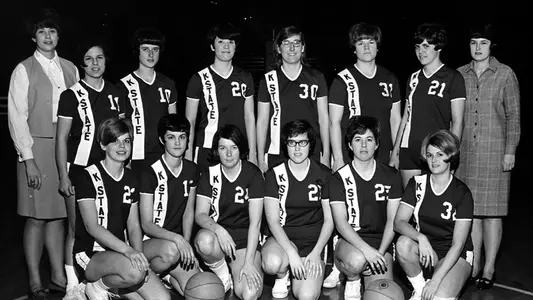
Ginny Honomichl sits in her home office in Baldwin City, Kansas, and the memories begin to flow, as she looks at the "K" varsity letter proudly displayed upon the wall along with various other purple artifacts. On Thursday, we celebrate the 50th anniversary of the passing of Title IX of the Higher Education Act. Honomichl played on the K-State women's basketball teams between 1966 and 1970. The yellowed memories flood back.
"I think there are some of us out there that were just designed to be pioneers at that time," she says. "To me, that's an honor."
Pam (Backhaus) Leptich, who played K-State women's basketball in the late 1960s, remembers it, too, how the players fueled their own cars, packed them with teammates, and caravanned to play in cities and towns such as Topeka, Newton and Fort Scott, and other destinations, when they weren't playing their home games at Nichols Gymnasium, and how players wore old black Converse high tops and dribbled worn basketballs. Sandy Hick was a professor in the physical education department and served as the women's intramural director. However, as the women's basketball head coach, she didn't receive a salary.
"We were making history," Leptich says, "before there was history."
Adds Honomichl: "We weren't able to secure any transportation through K-State, so it wasn't unusual for seniors to drive. We didn't have any allowance for meals or anything like that. That was some of the pioneering — load up the covered wagons and take off."
In just a matter of years, things changed.
Title IX of the Educational Amendments of 1972 is a Federal civil rights law that prohibits sexual discrimination at educational institutions that receive federal funding. The Title IX regulation states that "except for provided elsewhere in this part, no person shall, on the basis of sex, be excluded from participation in, be denied benefits of, or be subjected to discrimination under any academic, extracurricular, research, occupational training, or other education program or activity operated by a recipient which receives…Federal financial assistance."
That was 50 years ago.
"It doesn't feel like 50 years have passed at all," Honomichl says, "but I wouldn't change anything."

LeAnn Wilcox, the first women's basketball scholarship player
Back then, many K-State women found out about the women's basketball program through advertisements. LeAnn Wilcox earned the first women's basketball scholarship in 1976, four years after Title IX became law.
There's a sense of pride in starting on the ground floor.
"I'm sitting here in my office looking at an honor we received on February 11, 1996, which recognized all of those who came before they awarded any "K" varsity letter," Honomichl says. "I'm proud of being a part of that and proud of the care and pride that the K-State women's basketball program continues to have."
Leptich completed her basketball career in 1967-1968 to focus on student teaching. Honomichl continued playing. Judy Akers, a former teammate, became head coach in 1968-69, and the Wild Kittens competed in the Association of Kansas Women's Intercollegiate Sports. The 1968-69 team was the first intercollegiate squad in K-State women's basketball history and finished with an 11-3 record.

"She did a lot more at the time than I was ever aware of. I was pretty naive to everything."
K-State women's basketball didn't come without extraordinary hardship, as Nichols Gym burned to the ground on December 13, 1968, destroying the team's uniforms. The Wild Kittens began practicing at Ahearn Field House (normally reserved for the men's basketball team) at 6 a.m. or at 8 p.m., and they played their games there as well without use of a locker room. Players taped each other's ankles.
One thrill came when K-State players and parents drove to Amarillo, Texas, for the program's first postseason appearance, the NWIT. Another time, K-State players were able to make a trip to participate in a 16-team tournament in Boston, Massachusetts.
"We knew to have something was better than nothing at all," Honomichl says. "We weren't first class, but we played with class and competed with class. We were with our friends, and we made other friends through that. We never stopped because we didn't start at the top."
K-State intercollegiate athletics for women began before the finalization of Title IX, as the Wildcats offered a women's track and field program in 1905 prior to the start of the women's basketball program. By the time Title IX was signed into law, K-State women's basketball had won more than 50 games in intercollegiate competition. Of K-State's other current existing women's programs, tennis began in 1973, volleyball began in 1974, cross country began in 1975, golf began in 1981, rowing began in 1996, and soccer began in 2014.
"I don't necessarily count myself as a feminist, but I do believe in equality," Leptich says. "Everything was brand new. Title IX was a whole mindset that took over the country and I think it was because of the little seeds that were dropped, that girls decided that they wanted to do the same thing boys were doing, and they wanted to compete in sports, and that's when the inequities reared their ugly head. The only way was for them to have their activities equally funded. It just seemed like such a radical idea at the time. Now it just seems fair."

Honomichl believes there's still room to grow in Title IX.
"We're not there at all with where Title IX should be," she says. "We still don't get equal coverage. I live in Baldwin, right south of Lawrence, and we're not there yet. The NCAA two years ago had inferior training facilities for postseason basketball. How could the NCAA not make that equal? That's just not right."
Honomichl started the girls track and field and basketball programs at Russell High School, then created the softball team at Baldwin High School. Potts taught and coached basketball at Chase County High School in Cottonwood Falls and was honored in the 2022 with the inaugural K-State Girls and Women in Sports IMPACT Award. Leptich eventually earned her master's degree at South Carolina and went on to serve as South Carolina women's basketball head coach between 1973 and 1975. She was instrumental in the "Carolina Chicks" playing games at the storied Carolina Coliseum — "the holy grail of Southeastern Conference basketball back then," Leptich says.
"We played two games in there the first year and three games the second year," Leptich says. "I knew it'd be a thrill for our girls. It was big."
Leptich also recalls an important day in 1972 when she was a physical education teacher in Topeka.
The game was about to change.
"I remember I was teaching junior high PE when Title IX was first passed," Leptich says. "The men's PE teacher, Phil, came up to me and gave me the very first basketball that came off the truck that day. He wanted to give me the first basketball for the new shipment. He was sincere. That's a memory of Title IX.
"Things changed for women everywhere."
Ginny Honomichl sits in her home office in Baldwin City, Kansas, and the memories begin to flow, as she looks at the "K" varsity letter proudly displayed upon the wall along with various other purple artifacts. On Thursday, we celebrate the 50th anniversary of the passing of Title IX of the Higher Education Act. Honomichl played on the K-State women's basketball teams between 1966 and 1970. The yellowed memories flood back.
"I think there are some of us out there that were just designed to be pioneers at that time," she says. "To me, that's an honor."
Pam (Backhaus) Leptich, who played K-State women's basketball in the late 1960s, remembers it, too, how the players fueled their own cars, packed them with teammates, and caravanned to play in cities and towns such as Topeka, Newton and Fort Scott, and other destinations, when they weren't playing their home games at Nichols Gymnasium, and how players wore old black Converse high tops and dribbled worn basketballs. Sandy Hick was a professor in the physical education department and served as the women's intramural director. However, as the women's basketball head coach, she didn't receive a salary.
"We were making history," Leptich says, "before there was history."
Adds Honomichl: "We weren't able to secure any transportation through K-State, so it wasn't unusual for seniors to drive. We didn't have any allowance for meals or anything like that. That was some of the pioneering — load up the covered wagons and take off."
In just a matter of years, things changed.
Title IX of the Educational Amendments of 1972 is a Federal civil rights law that prohibits sexual discrimination at educational institutions that receive federal funding. The Title IX regulation states that "except for provided elsewhere in this part, no person shall, on the basis of sex, be excluded from participation in, be denied benefits of, or be subjected to discrimination under any academic, extracurricular, research, occupational training, or other education program or activity operated by a recipient which receives…Federal financial assistance."
That was 50 years ago.
"It doesn't feel like 50 years have passed at all," Honomichl says, "but I wouldn't change anything."
LeAnn Wilcox, the first women's basketball scholarship player
There's a sense of pride in starting on the ground floor.
"I'm sitting here in my office looking at an honor we received on February 11, 1996, which recognized all of those who came before they awarded any "K" varsity letter," Honomichl says. "I'm proud of being a part of that and proud of the care and pride that the K-State women's basketball program continues to have."
Leptich completed her basketball career in 1967-1968 to focus on student teaching. Honomichl continued playing. Judy Akers, a former teammate, became head coach in 1968-69, and the Wild Kittens competed in the Association of Kansas Women's Intercollegiate Sports. The 1968-69 team was the first intercollegiate squad in K-State women's basketball history and finished with an 11-3 record.
Judy Akers
"We just evolved," says Pat Potts, who was a part of that first official team. "It was initiated by Sandy Hick and Judy Akers. We were kids that liked to play basketball. They were instrumental because there hadn't been women's basketball at K-State. Judy was very determined. I knew she had run into some difficulties for us to be able to practice and play but she was really determined and a real leader for us."She did a lot more at the time than I was ever aware of. I was pretty naive to everything."
K-State women's basketball didn't come without extraordinary hardship, as Nichols Gym burned to the ground on December 13, 1968, destroying the team's uniforms. The Wild Kittens began practicing at Ahearn Field House (normally reserved for the men's basketball team) at 6 a.m. or at 8 p.m., and they played their games there as well without use of a locker room. Players taped each other's ankles.
One thrill came when K-State players and parents drove to Amarillo, Texas, for the program's first postseason appearance, the NWIT. Another time, K-State players were able to make a trip to participate in a 16-team tournament in Boston, Massachusetts.
"We knew to have something was better than nothing at all," Honomichl says. "We weren't first class, but we played with class and competed with class. We were with our friends, and we made other friends through that. We never stopped because we didn't start at the top."
K-State intercollegiate athletics for women began before the finalization of Title IX, as the Wildcats offered a women's track and field program in 1905 prior to the start of the women's basketball program. By the time Title IX was signed into law, K-State women's basketball had won more than 50 games in intercollegiate competition. Of K-State's other current existing women's programs, tennis began in 1973, volleyball began in 1974, cross country began in 1975, golf began in 1981, rowing began in 1996, and soccer began in 2014.
"I don't necessarily count myself as a feminist, but I do believe in equality," Leptich says. "Everything was brand new. Title IX was a whole mindset that took over the country and I think it was because of the little seeds that were dropped, that girls decided that they wanted to do the same thing boys were doing, and they wanted to compete in sports, and that's when the inequities reared their ugly head. The only way was for them to have their activities equally funded. It just seemed like such a radical idea at the time. Now it just seems fair."
The 1968-69 team - the first intercollegiate squad in K-State women's basketball history - honored prior to the K-State vs. KU game in 2018
Adds Potts: "Title IX was encouraging for women's sports. It gave us the opportunity to have women's programs. I'd like to think it hasn't been 50 years. I'm older than I feel sometimes."Honomichl believes there's still room to grow in Title IX.
"We're not there at all with where Title IX should be," she says. "We still don't get equal coverage. I live in Baldwin, right south of Lawrence, and we're not there yet. The NCAA two years ago had inferior training facilities for postseason basketball. How could the NCAA not make that equal? That's just not right."
Honomichl started the girls track and field and basketball programs at Russell High School, then created the softball team at Baldwin High School. Potts taught and coached basketball at Chase County High School in Cottonwood Falls and was honored in the 2022 with the inaugural K-State Girls and Women in Sports IMPACT Award. Leptich eventually earned her master's degree at South Carolina and went on to serve as South Carolina women's basketball head coach between 1973 and 1975. She was instrumental in the "Carolina Chicks" playing games at the storied Carolina Coliseum — "the holy grail of Southeastern Conference basketball back then," Leptich says.
"We played two games in there the first year and three games the second year," Leptich says. "I knew it'd be a thrill for our girls. It was big."
Leptich also recalls an important day in 1972 when she was a physical education teacher in Topeka.
The game was about to change.
"I remember I was teaching junior high PE when Title IX was first passed," Leptich says. "The men's PE teacher, Phil, came up to me and gave me the very first basketball that came off the truck that day. He wanted to give me the first basketball for the new shipment. He was sincere. That's a memory of Title IX.
"Things changed for women everywhere."
K-State Tennis | Weekend Recap
Tuesday, February 24
K-State Track and Field | Sights & Sounds Steve Miller Invitational
Monday, February 23
K-State Baseball | Highlights vs Michigan - Feb. 22, 2026
Monday, February 23
K-State Men's Basketball | Postgame Press Conference at Texas Tech
Sunday, February 22