Time Heals Dibbini Following Medical Scare
Jun 29, 2022 | Soccer, Sports Extra
By: D. Scott Fritchen
The right eye grew blurry. That's what Mike Dibbini noticed first. Then the right side of the face began to tingle. Then the right arm. Then the leg. He finished brushing his teeth and walked out of the bathroom in his parents' spacious home in Palmdale, California. It was December 23. Gorgeous day in Southern California. Some Christmas gifts were wrapped. Other gifts were still on the list. "Hey, something's wrong," Mike said to his wife, Trina. "I'm blurry. Something's wrong."
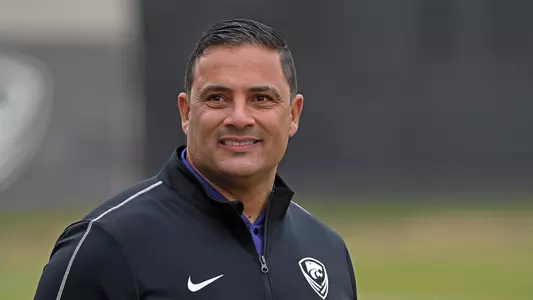
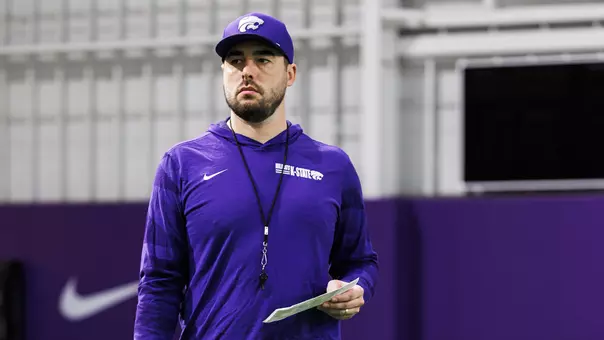
Mike is an active 45-year-old who lives a healthy lifestyle and works out four times a week while also serving as head women's soccer coach at Kansas State — a position that he's held since his hiring as K-State's first intercollegiate women's soccer coach in December 2014. He's a native of Palmdale, a former four-time soccer All-American at Kansas Wesleyan University and Bethany (Minn.) Lutheran, and he has had no prior major medical history.
Mike and Trina have two amazing children. Jada is a 15-year-old all-state soccer player at Manhattan High School and Kadin is a 13-year-old starting quarterback at Eisenhower Middle School. But what would he tell them, what with the blurred vision and tingling sensations across the right side of his body? Guys, dad doesn't feel good and is going to the hospital. Hope to be back by Christmas.
All that Mike knew was that something didn't feel right.
Trina phoned her sister, Angie Bogart, a nurse practitioner in Salina, and gave her the rundown on Mike's symptoms.
"Take him to the emergency room," Angie said. "I think he's having a stroke."
Mike passed all the initial stroke tests at Palmdale Regional Medical Center. During Mike's eight-hour wait for an observation room, medical staff drew his blood, performed a CAT scan, and took a chest x-ray. Doctors saw nothing. They diagnosed Mike with "stress and anxiety." Go home and get some rest. Mike believed it was something more.
Mike and Trina awakened early on Christmas Eve. Their body clocks were still on Kansas time. So, they had their morning coffee and hit the road to beat the Southern California traffic and finish their last-minute Christmas shopping. When they returned to his parents' home, Mike was dumbfounded again. He told Trina, "I'm not feeling well," and lay down for a nap. That's when the vertigo set in. The room spun. Then the left side of his body tingled. The nightmare had returned. I'm not feeling right. Now it's the left side of my body? Something is off again.
This time, to avoid another possible eight-hour line at the hospital, Angie urged Trina to call an ambulance, so Mike might be immediately seen by doctors.
Four hours later, doctors determined that Mike had actually suffered a transient ischaemic attack (TIA) or "mini stroke" on December 23. An MRI scan concluded that he had suddenly suffered a stroke on his right occipital lobe, the visual processing center of the brain, on Christmas Eve. OK, I had a stroke. Why did I have a stroke? More bloodwork. Ultrasounds. Hospital gown. Hospital food. Mike was discharged on December 28.
"I had a lot of anxiety built up," he said, "because the cause of the stroke was still unknown."
The Dibbini family decided to go to church in Palmdale on January 2. The Dibbini's were scheduled to fly to Manhattan that night. But first, prayer, kneeling, standing, sitting, and Mike suddenly thought it's hot in here. Next thing he knew, he awoke laying on a pew. Not enough blood was going to his brain. It shut him down. Boom. Another trip to Palmdale Regional Medical Center. The next day, doctors performed a cerebral angiogram, a procedure that uses a special dye and x-rays to observe how blood flows through the brain.
"That's when they found a dissected artery in the back of my neck," Mike said.
In medical terms, Mike had suffered a dissected vertebral artery.
What was the cause? Had Mike been in an accident? No. Had Mike visited a chiropractor? No. The doctor's check-off list to determine possible reasons for a stroke was expansive. Then Trina saw rollercoaster on the list. Yes, rollercoaster. Had Mike been on a rollercoaster? Orlando. Mike took Jada to a major soccer showcase in Orlando, Florida. In between soccer games, the parents took their children to Universal Studios. Some daddy-daughter time. And they rode rollercoasters. That had been three weeks ago.
"He did ride a rollercoaster," Trina told the doctor.

Doctors wanted Mike back in Kansas as soon as possible. Mike and Trina had already begun forming their medical team back home. Mike had an ophthalmologist, radiologist, cardiologist, and neurologist lined up, and they were eager to help — he had coached all their kids in soccer in Salina — along with his family physician. Trina sent their team of doctors Mike's scans. "He rode a rollercoaster," Trina told them. Mike and Trina sent Jada and Kadin to stay with family in Manhattan. The kids had school. Days later, Mike was discharged from the hospital. He and Trina caught a direct flight from Los Angeles International Airport to Kansas City International Airport on January 9.
"Google 'dissected vertebral artery and rollercoasters,'" Mike said. "That's what they came up with. It's not 100% the cause, but that's what they came up with. It's a blessing because you're trying to find out, 'Is it my blood or is something wrong with my vessels?' So, then the next step when I finally got back home was scheduling my visits to see the doctors in Salina. That's when they checked my eyes out, they performed a transesophageal echocardiogram to check my heart. How did I have two strokes — one on my right and one on my left? They checked if anything came out of the heart. There were no holes in my heart, so they ruled out my heart. They ruled out my blood. They ruled everything out. Everything stood on this one artery in the back of my neck and that's the story.
"But then there's the anxiety and paranoia. You don't know if it's going to happen again."
His six-month benchmark since the stroke was June 23.
"I just had my five-and-a-half-month checkup on June 1," Mike said. "They saw the vessels were very good and I was getting enough blood to the brain. They said everything was going well."

Mike sat at his L-shaped desk in his office at Buser Family Park last Monday. Diplomas hung on the wall along with two purple ceremonial shovels, including one from the groundbreaking of Buser Family Park. Two framed K-State soccer jerseys also hung on the wall. One jersey is dated January 7, 2014 — the day K-State introduced Mike as its first-ever women's soccer coach at a news conference. The office was quiet aside from the occasional purr of a car driving along nearby College Avenue. A hutch featured his most prized possession — a big, long frame containing one photo of Kaiden, one photo of the entire Dibbini family, and one photo of Jada.
"This all put life into perspective," Mike said. "You don't expect this freak accident to happen at 45 years old. It all goes back to family and how important they are. I consider our program and my players and staff and athletic department a part of my family, too. I've always treated people really well, and I think I'm really genuine, but maybe I'm over the top now. I treat people sometimes like it's the last time I'll see them. That's the thing that's changed. Unless you've been through it, you don't know.
"Any given day."
Mike's doctor recommended a mini vacation. So, Mike took Trina to Florida for a few days to help with his mental healing. Mike began driving a little bit more on the women's soccer recruiting trail — he didn't trust himself quite yet on a plane; after all, what would happen if the nightmare happened in mid-flight? — but in the last couple of weeks, Mike has mentally progressed to the point that he has flown to Dallas, Los Angeles, Seattle, and Indiana.
Mike feels confident about the women's soccer program. It is dear to his heart. Last season, he led a squad that established new school records for goals (20), goals per game (1.11), assists (20), total points (60) and total points per game (3.33). The Wildcats tied the school record for wins in a season (six), tied No. 9 West Virginia (1-1) and No. 23 Baylor (0-0) in a pair of Top 25 matchups, and were in the hunt for a first-ever berth in the Big 12 Tournament until the very last game of the season — a 1-0 loss to Iowa State.

In just six seasons, Mike has had one MAC Hermann Trophy candidate, one Senior CLASS Award All-American, a CoSIDA Academic All-American, a United Soccer Coaches All-Region selection, four All-Big 12 selections and 69 Academic All-Big 12 honorees.
The Wildcats will return an abundance of experience in 2022 with nine seniors, by far the most in program history.
"I'm very, very proud of the trajectory of the program," he said. "We started from scratch and that's a major challenge. Your first five years is Phase I, and I think we're now leaving Phase I of trying to build infrastructure and we're now starting Phase II, where we should eventually take off. There are two phases to building this program. It's a 10-year model.
"First phase is you have to build an infrastructure. Now Phase II starts where we have it in place and we're in that phase of our program where the next couple years we should take off to compete in the Big 12 and compete more consistently. We just need to continue to focus on the process."
He continued.
"It's tough and challenging but I'm proud of the process," he said. "It's hard work and a lot of time and for the players and staff and everybody involved it's been a grind, but I'm proud of everybody who's put all the time and effort into it. Hopefully now we can be rewarded."
For Mike, the healing process continues. Medication and deep breathing typically ward off the minor post-traumatic stress attacks. But small things become amplified. And understandably so. My arm is feeling numb — what does this mean?...This muscle is twitching…What does this little muscle spasm mean? Things are magnified. The subconscious at work.

Mike relies on Trina. That's his safe place. That's his comfort zone. Or he'll pick up the phone and call Rani Dibbini, his first cousin, a former ER doctor; or he'll call Angie, Trina's sister, just to be sure. Let's talk it out. Here's what's going on... "That has nothing to do with your stroke," Rani tells him. The brain continues to rewire after its disturbance six months ago.
"They're my comfort zone along with the other doctors involved as well," Mike said. "The more you go back to your normal lifestyle, it's going to heal you. And I'm feeling a lot better. Of course, I wake up every day thanking God and thanking God again before I go to bed.
"When I leave now, I make sure to say 'bye.' It turns life upside down in a way. I love my family, but when this happened, I thought about it even more. Time is the healer.
"And I'm just getting better every day."
The right eye grew blurry. That's what Mike Dibbini noticed first. Then the right side of the face began to tingle. Then the right arm. Then the leg. He finished brushing his teeth and walked out of the bathroom in his parents' spacious home in Palmdale, California. It was December 23. Gorgeous day in Southern California. Some Christmas gifts were wrapped. Other gifts were still on the list. "Hey, something's wrong," Mike said to his wife, Trina. "I'm blurry. Something's wrong."
Mike is an active 45-year-old who lives a healthy lifestyle and works out four times a week while also serving as head women's soccer coach at Kansas State — a position that he's held since his hiring as K-State's first intercollegiate women's soccer coach in December 2014. He's a native of Palmdale, a former four-time soccer All-American at Kansas Wesleyan University and Bethany (Minn.) Lutheran, and he has had no prior major medical history.
Mike and Trina have two amazing children. Jada is a 15-year-old all-state soccer player at Manhattan High School and Kadin is a 13-year-old starting quarterback at Eisenhower Middle School. But what would he tell them, what with the blurred vision and tingling sensations across the right side of his body? Guys, dad doesn't feel good and is going to the hospital. Hope to be back by Christmas.
All that Mike knew was that something didn't feel right.
Trina phoned her sister, Angie Bogart, a nurse practitioner in Salina, and gave her the rundown on Mike's symptoms.
"Take him to the emergency room," Angie said. "I think he's having a stroke."
Mike passed all the initial stroke tests at Palmdale Regional Medical Center. During Mike's eight-hour wait for an observation room, medical staff drew his blood, performed a CAT scan, and took a chest x-ray. Doctors saw nothing. They diagnosed Mike with "stress and anxiety." Go home and get some rest. Mike believed it was something more.
Mike and Trina awakened early on Christmas Eve. Their body clocks were still on Kansas time. So, they had their morning coffee and hit the road to beat the Southern California traffic and finish their last-minute Christmas shopping. When they returned to his parents' home, Mike was dumbfounded again. He told Trina, "I'm not feeling well," and lay down for a nap. That's when the vertigo set in. The room spun. Then the left side of his body tingled. The nightmare had returned. I'm not feeling right. Now it's the left side of my body? Something is off again.
This time, to avoid another possible eight-hour line at the hospital, Angie urged Trina to call an ambulance, so Mike might be immediately seen by doctors.
Four hours later, doctors determined that Mike had actually suffered a transient ischaemic attack (TIA) or "mini stroke" on December 23. An MRI scan concluded that he had suddenly suffered a stroke on his right occipital lobe, the visual processing center of the brain, on Christmas Eve. OK, I had a stroke. Why did I have a stroke? More bloodwork. Ultrasounds. Hospital gown. Hospital food. Mike was discharged on December 28.
"I had a lot of anxiety built up," he said, "because the cause of the stroke was still unknown."
The Dibbini family decided to go to church in Palmdale on January 2. The Dibbini's were scheduled to fly to Manhattan that night. But first, prayer, kneeling, standing, sitting, and Mike suddenly thought it's hot in here. Next thing he knew, he awoke laying on a pew. Not enough blood was going to his brain. It shut him down. Boom. Another trip to Palmdale Regional Medical Center. The next day, doctors performed a cerebral angiogram, a procedure that uses a special dye and x-rays to observe how blood flows through the brain.
"That's when they found a dissected artery in the back of my neck," Mike said.
In medical terms, Mike had suffered a dissected vertebral artery.
What was the cause? Had Mike been in an accident? No. Had Mike visited a chiropractor? No. The doctor's check-off list to determine possible reasons for a stroke was expansive. Then Trina saw rollercoaster on the list. Yes, rollercoaster. Had Mike been on a rollercoaster? Orlando. Mike took Jada to a major soccer showcase in Orlando, Florida. In between soccer games, the parents took their children to Universal Studios. Some daddy-daughter time. And they rode rollercoasters. That had been three weeks ago.
"He did ride a rollercoaster," Trina told the doctor.
Doctors wanted Mike back in Kansas as soon as possible. Mike and Trina had already begun forming their medical team back home. Mike had an ophthalmologist, radiologist, cardiologist, and neurologist lined up, and they were eager to help — he had coached all their kids in soccer in Salina — along with his family physician. Trina sent their team of doctors Mike's scans. "He rode a rollercoaster," Trina told them. Mike and Trina sent Jada and Kadin to stay with family in Manhattan. The kids had school. Days later, Mike was discharged from the hospital. He and Trina caught a direct flight from Los Angeles International Airport to Kansas City International Airport on January 9.
"Google 'dissected vertebral artery and rollercoasters,'" Mike said. "That's what they came up with. It's not 100% the cause, but that's what they came up with. It's a blessing because you're trying to find out, 'Is it my blood or is something wrong with my vessels?' So, then the next step when I finally got back home was scheduling my visits to see the doctors in Salina. That's when they checked my eyes out, they performed a transesophageal echocardiogram to check my heart. How did I have two strokes — one on my right and one on my left? They checked if anything came out of the heart. There were no holes in my heart, so they ruled out my heart. They ruled out my blood. They ruled everything out. Everything stood on this one artery in the back of my neck and that's the story.
"But then there's the anxiety and paranoia. You don't know if it's going to happen again."
His six-month benchmark since the stroke was June 23.
"I just had my five-and-a-half-month checkup on June 1," Mike said. "They saw the vessels were very good and I was getting enough blood to the brain. They said everything was going well."
Mike sat at his L-shaped desk in his office at Buser Family Park last Monday. Diplomas hung on the wall along with two purple ceremonial shovels, including one from the groundbreaking of Buser Family Park. Two framed K-State soccer jerseys also hung on the wall. One jersey is dated January 7, 2014 — the day K-State introduced Mike as its first-ever women's soccer coach at a news conference. The office was quiet aside from the occasional purr of a car driving along nearby College Avenue. A hutch featured his most prized possession — a big, long frame containing one photo of Kaiden, one photo of the entire Dibbini family, and one photo of Jada.
"This all put life into perspective," Mike said. "You don't expect this freak accident to happen at 45 years old. It all goes back to family and how important they are. I consider our program and my players and staff and athletic department a part of my family, too. I've always treated people really well, and I think I'm really genuine, but maybe I'm over the top now. I treat people sometimes like it's the last time I'll see them. That's the thing that's changed. Unless you've been through it, you don't know.
"Any given day."
Mike's doctor recommended a mini vacation. So, Mike took Trina to Florida for a few days to help with his mental healing. Mike began driving a little bit more on the women's soccer recruiting trail — he didn't trust himself quite yet on a plane; after all, what would happen if the nightmare happened in mid-flight? — but in the last couple of weeks, Mike has mentally progressed to the point that he has flown to Dallas, Los Angeles, Seattle, and Indiana.
Mike feels confident about the women's soccer program. It is dear to his heart. Last season, he led a squad that established new school records for goals (20), goals per game (1.11), assists (20), total points (60) and total points per game (3.33). The Wildcats tied the school record for wins in a season (six), tied No. 9 West Virginia (1-1) and No. 23 Baylor (0-0) in a pair of Top 25 matchups, and were in the hunt for a first-ever berth in the Big 12 Tournament until the very last game of the season — a 1-0 loss to Iowa State.
In just six seasons, Mike has had one MAC Hermann Trophy candidate, one Senior CLASS Award All-American, a CoSIDA Academic All-American, a United Soccer Coaches All-Region selection, four All-Big 12 selections and 69 Academic All-Big 12 honorees.
The Wildcats will return an abundance of experience in 2022 with nine seniors, by far the most in program history.
"I'm very, very proud of the trajectory of the program," he said. "We started from scratch and that's a major challenge. Your first five years is Phase I, and I think we're now leaving Phase I of trying to build infrastructure and we're now starting Phase II, where we should eventually take off. There are two phases to building this program. It's a 10-year model.
"First phase is you have to build an infrastructure. Now Phase II starts where we have it in place and we're in that phase of our program where the next couple years we should take off to compete in the Big 12 and compete more consistently. We just need to continue to focus on the process."
He continued.
"It's tough and challenging but I'm proud of the process," he said. "It's hard work and a lot of time and for the players and staff and everybody involved it's been a grind, but I'm proud of everybody who's put all the time and effort into it. Hopefully now we can be rewarded."
For Mike, the healing process continues. Medication and deep breathing typically ward off the minor post-traumatic stress attacks. But small things become amplified. And understandably so. My arm is feeling numb — what does this mean?...This muscle is twitching…What does this little muscle spasm mean? Things are magnified. The subconscious at work.
Mike relies on Trina. That's his safe place. That's his comfort zone. Or he'll pick up the phone and call Rani Dibbini, his first cousin, a former ER doctor; or he'll call Angie, Trina's sister, just to be sure. Let's talk it out. Here's what's going on... "That has nothing to do with your stroke," Rani tells him. The brain continues to rewire after its disturbance six months ago.
"They're my comfort zone along with the other doctors involved as well," Mike said. "The more you go back to your normal lifestyle, it's going to heal you. And I'm feeling a lot better. Of course, I wake up every day thanking God and thanking God again before I go to bed.
"When I leave now, I make sure to say 'bye.' It turns life upside down in a way. I love my family, but when this happened, I thought about it even more. Time is the healer.
"And I'm just getting better every day."
K-State Men's Basketball | Postgame Press Conference at Texas Tech
Sunday, February 22
K-State Women's Basketball | Tess Heal Senior Video
Sunday, February 22
K-State Women's Basketball | Mikayla Parks Senior Video
Sunday, February 22
K-State Women's Basketball | Senior Night Ceremony 2025 - 2026 Season
Sunday, February 22