Clark an Integral Part of Making K-State Better
Jun 06, 2022 | Sports Extra, Athletics
By: D. Scott Fritchen
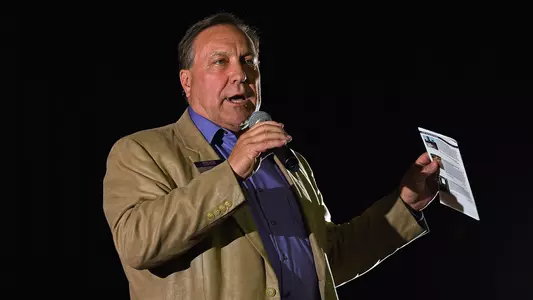
Mike Clark, Senior Director of Development for Kansas State Athletics, is always on the move. Today, Friday, June 3, finds him on the third hole at Spring Creek Golf Course at a Catbacker Golf Tournament in Seneca, Kansas. His golf game aside — "I'm not very good," he says — the 69-year-old Clark buzzes with excitement on the other end of the cellphone.
"I missed a birdie putt on No. 3, so I'm just getting back to the cart with a par," he says. "I've pulled over in the shade. Now we can talk. We had 54 foursomes, 216 total golfers enter the tournament, and I love the enthusiasm and excitement that K-State fans have right now. This is the best time because you get to know so many great people."
Clark will play one hole with a foursome, another hole with another foursome, and before he knows it, he will have played one hole with 14 or 15 different foursomes during the nine-hour event. Everyone has a gift. For nearly two decades, Clark has utilized his gift while meeting thousands of K-Staters across the country. Clark's gift is building relationships.
"I love being out here with these people," he says. "A lot of people think it's great because you get to play golf, but really, this has nothing to do with my golf game. I like hitting the golf ball but I'm not very good. Basically, it's just getting to know our people and understand what makes them tick and what we can do to make their experience better at K-State and what we can do to make things better for our players and coaches and everybody.
"This is the grassroots part of it."
Clark pulled his golf cart under the shade at Spring Creek Golf Course to speak with K-State Sports Extra's D. Scott Fritchen about life, K-State, and living the dream.
D. SCOTT FRITCHEN: Can you remember your very first Catbacker event?
MIKE CLARK: I was hired as head baseball coach on the sixth of August and Topeka held its Catbacker event that next weekend outside at the Knights of Columbus campground. It had to have been 100 degrees out there, but we had probably 300 people in attendance, and everybody was excited. The speakers were Lon Kruger and Stan Parrish. Lon was going into his first year as head coach and there was a lot of excitement for basketball. Stan was just going into his first year as well, so there was that forever hope that football would turn around and be respectable. At the time, we didn't think about bowl games. We just thought about respectability. It was a great turnout at the Catbackers and it was a really fun time.
FRITCHEN: Tell me about your path to K-State.
CLARK: I graduated from Missouri Western and then served as graduate assistant baseball coach at Northwest Missouri. I was going to earn my master's degree that spring. The old football coach at Missouri Western, who had been let go, served as athletic director at a high school in Oklahoma. Northwest Missouri was playing Tulsa at the time. He came over to the game and said that he had an opening at a 2A high school in a suburb of Tulsa. So, I went on with him to coach and it was a great experience with great kids. I earned the region's Coach of the Year my second year as baseball coach. The Northeast Oklahoma A&M Junior College job opened, and I applied for it. I became assistant basketball coach and baseball coach and taught four classes. It was a great job.
We took over a baseball program that was similar to K-State in a lot of ways. The assistant football coach had been the baseball coach and he was a great guy and head of the physical education department, but they hadn't won since the 1960s, really. And this was 1979. I think they won six games the year before and three the year before that. We took over the program and got them to the Region 2 Tournament for the first time since the 1960s. We had great success. Every year we got a little bit better. We went 50-12 my last year and were one pitch from going to the Junior College World Series.
I was also assistant basketball coach for three years and then they wanted to have a full-time assistant, so I just coached baseball. I also taught Swimming, American History, Government, Anatomy and Physiology. We had great kids and formed great relationships that continue to this day. Of course, they're 50 years old now. I was just so lucky to get that job.
Then the K-State job opened in 1986 and I was told by most of the scouts not to go after it because they were going to drop baseball. So, I don't know how many people applied or anything along those lines, but I talked with K-State assistant athletic director Lee Moon. I came over and talked and the facilities were a little bit shocking. The facility was not very good. When they told me I'd have to take a $4,000 pay cut from what I had made at Northeast Oklahoma A&M Junior College, I had some explaining to do to Julie, my wife. It just didn't make a lot of sense. But this was a Big Eight school. I was assured that K-State wasn't going to drop baseball because we already were at the Division I minimum of 15 sports. That was reassuring. I took the leap.
I'm so thankful and so glad that I took the leap. Thirty-six years later. Man. It's been a phenomenal experience.

FRITCHEN: You retired as K-State head baseball coach in 2003 as the winningest head coach in K-State history. Does it seem like you coaching just yesterday, or does it seem like it's been a small lifetime ago since you were in the dugout?
CLARK: There are times when it feels like it hasn't been that long and other times — I had to get out of coaching. I weighed 285 pounds and was on a heart monitor the last year I served as head coach. It just wore me down. Back in those days, many baseball programs didn't have the facilities and budget. Oklahoma, Texas and Texas A&M had groundskeepers and coaches didn't have to worry about dragging the field, or mowing the infield, or chalking the lines, and the coach didn't have to worry about whether or not the public-address system worked inside the stadium.
Everything — you had to worry about everything on top of putting a competitive team out there on the field. Recruiting? You had to explain to recruits why we didn't have a locker room. We just emphasized the great things we did have such as education and people and the opportunity to make yourself better at a great school in a great conference.
I wouldn't trade the coaching, but I was just done. People ask me, "Do you miss coaching?" I miss not being around the guys but in another way for many, many years I've been around more people because I'm connected with all the programs. I've been able to establish great relationships with football, basketball and baseball coaches and players. I still have those relationships, but as far as being a head coach, I don't think I would be alive today. I really don't think so.
FRITCHEN: How gratifying was it to see Tointon Family Stadium constructed?
CLARK: It's amazing. I tear up just thinking about stuff like that and going to the Regionals and Super Regionals. I mean, that was the dream. Do I wish I could've been the head coach to do that? You bet. But I was proud as hell with what Brad Hill did and with what Pete Hughes is doing, and I'm proud as hell of the facility and the fans. Back in the day, Julie ran the concession stand, and me and my assistant coaches managed all field preparations. Today you can just coach and that's what it's all about.
When I retired, that's all I wanted, was for us to have the same thing everybody else did, and for us to have the same chance. When Coach Snyder came, football was the same way, and they didn't have a chance. It took improved facilities, improved salaries, and we needed to do better for our fans to keep attracting them to purchase tickets and support the Ahearn Fund.
The evolution of the Kansas State athletic department as a whole is mind blowing and it's been really rewarding. That's the neat part about staying in Manhattan. When I retired from baseball, I didn't know what I wanted to do. I was kind of a free agent, and to be truthful, serving as Director of Development for Manhattan Catholic Schools after my retirement saved me. The job rejuvenated me and allowed me to understand that there are other things out there besides coaching baseball. I used a lot of skills, particularly with recruiting, to do my job. Then Kansas State Bank in Manhattan called me. They saw what I had done as Director of Development for the Manhattan Catholic Schools. Next thing I knew, I was Vice President of Marketing, Public Relations and Business Development for Kansas State Bank for a few of years.
Tim Weiser always told me, "When the right thing opens up, Coach I want you back." When Ernie Barrett retired as Director of Development in 2007, Tim came to me and said, "I want you to do this." And I wanted to do this. And to do what I've done for the past 17 years isn't work. I love every moment of it. It's like coaching. I loved every moment of coaching but physically and mentally I had to do something else. I'm so blessed to be able to do this.

FRITCHEN: There's no question you wear many hats. Just how enjoyable is it to sit in the TV booth at Tointon Family Stadium and serve as color analyst on Big 12 Now with Brian Smoller and Matt Walters for K-State baseball games?
CLARK: It's awesome. The whole experience with baseball is just phenomenal. Fans turn around and wave while we're doing our telecast. Brian and Matt do such a great job. Those guys were there in the days when things weren't quite as nice. I sit back and watch and see what's going on and see the fans' reaction and the kids' reaction during the game. The game to me is not secondary but the enjoyment of the fans, I love it. We all want the kids to win and for Pete to have a regional team and to win conference championships, but after the game is over, win or lose, I walk out of the stadium, look up and say, "Unbelievable. This is a piece of heaven right here." This stadium is what we needed to be competitive. It makes the 17 years as head baseball coach worth it.
When we start our pregame in football, I get tears in my eyes and the hair on the back of my neck stands up. When I hear, "Bring on the 'Cats" at basketball games, it's the same thing. The first time I heard "Bring on the 'Cats" was when Lon was coaching, and we were at Ahearn Field House and the students rushed in for their seats. It's what Kansas State is, and what we've become, and what we have an opportunity to be.
Those stadiums, facilities, those traditions — hopefully they live on forever. We could've never dreamt this. It's a credit to our fans and our donors and our administration. I've worked with super stars in development. Our development staff in the last 17 years has been phenomenal. I just try to stay out of their way most of the time. Just tell me what I need to do, and we'll go get it done. It's just very, very, very rewarding. When they play, "I'm Proud of This House We Built," at the football stadium, I just look around the athletic facilities and I look at all the fans tailgating. We did this, we did this all together against big odds. It's amazing.

FRITCHEN: People see the title "Senior Director or Development." What all does that entail?
CLARK: Whatever they tell me to do. It's a little bit of everything. I've mentored coaches, I've dedicated my time to the Ahearn Fund, I've dedicated my time to building projects, and I work with a lot of people. My first two contracts at K-State were "head baseball coach/football parking lot supervisor." I knew nothing about parking and didn't really need to know anything about parking because nobody showed up the first two years except for the KU and Nebraska games.
At first, we didn't have the facilities and didn't have the amenities for fans or our student-athletes, but boy, now we do, and man, I'm proud as hell of everybody who's been involved in making that happen, from the donors to the fans to the players to the successes that we've had and the coaches who've come through here. What an honor to be associated with them. It's been fun.
FRITCHEN: How have you seen K-State change the most over the last 36 years?
CLARK: Of course, the thing that jumps out are the facilities. But how have I seen K-State change the most? Expectation. We expect as fans, coaches and players to compete for conference championships. Other than basketball and track and field there really weren't any expectations on other sports to compete for championships when I arrived in 1986-87. We simply didn't have the money or facilities to make that a realistic goal.
But going back to facilities for a moment, the facilities are off the charts. The big thing is that the people have pretty much stayed the same. I tell people from other schools that we've got the best fans and best donors I know of. I won't mention any schools, but there are places where somebody will say, "We need to fire this guy, and I have a hotwire to the athletic director, and if he doesn't fire this guy, we're going to fire him." We don't have that at Kansas State. Our donors want to win and be competitive, but there's no demanding. They quietly demand when they don't buy tickets or if they cut back on the Ahearn Fund. They don't demand this or that. It goes back to the fact that we're a people university and it's about the people. For the most part, we've given our fans pretty competitive athletics, with a few exceptions, which are going to happen sometimes in sports.
FRITCHEN: Four years ago, you battled cancer. What did you learn most about yourself during that journey?
CLARK: It was…the first time in my life…that I had an expiration date. I never thought about that before. It made priorities different. A part of me — I'd been kind of selfish. Julie and the kids loved me and let me coach and take pay cuts on jobs. There were times we were buying baseballs out of our personal budget. Julie ran the concession stand. Scouts told her that it was the best concession stand in the league.
Cancer probably woke me up to the fact that it'll probably be time to do something else at some point. Ernie retired when he was 76 and I thought, "I can do 76 years old in this job." You think it's easy, it's great, and you're working with great people, and it's perfect, but then cancer happens. Cancer told me, "Hey, you'd better enjoy the grandkids and do some traveling with Julie." I'll be 70 in October. Family is important. I just got back from Disney World with the grandkids. It was a great experience.
I'm lucky. They caught the cancer so early that I should be fine. I have great doctors who did miracle things. I think the cancer just made me think that these last 15 years or 10 years or five years, or whatever I have left, it's time to make the most of it. I'll never miss the Seneca Catbacker Golf Tournament. I've been to 28 of them. I've missed Marysville once. Colby I've been at a lot. So many great memories — the nut fry, Coaches Vs. Cancer. At some point, there will be a time that it's time to do something else, maybe fundraising to help the community and to help younger kids.

FRITCHEN: What do you want the Mike Clark legacy to be at K-State?
CLARK: There's a prayer I say every day — every day when I get up, I try to make things better and try to make a positive difference in the lives of everybody I'm around…Baseball players, players I've coached against, coaches I've coached with and coaches I've coached against, donors, fans, people at K-State — hopefully I made things better for them and hopefully I make a difference. Hopefully, we've had a little fun while we're doing it.
FRITCHEN: Such as playing golf?
CLARK: Exactly, such as playing golf. It's amazing. Over half my life has been at Kansas State. You go to these golf tournaments, and people come up to you, and it's 25 or 30 years we've been doing this, and the stories — we talk different things that have happened. It's been a pleasure and people have no idea how lucky I've been to be able to do this, and I'm not talking about golf, but just sitting back and talking to these people, and their kids, who were once 5 years old, are now going to K-State. This has been amazing. Truly amazing.
Mike Clark, Senior Director of Development for Kansas State Athletics, is always on the move. Today, Friday, June 3, finds him on the third hole at Spring Creek Golf Course at a Catbacker Golf Tournament in Seneca, Kansas. His golf game aside — "I'm not very good," he says — the 69-year-old Clark buzzes with excitement on the other end of the cellphone.
"I missed a birdie putt on No. 3, so I'm just getting back to the cart with a par," he says. "I've pulled over in the shade. Now we can talk. We had 54 foursomes, 216 total golfers enter the tournament, and I love the enthusiasm and excitement that K-State fans have right now. This is the best time because you get to know so many great people."
Clark will play one hole with a foursome, another hole with another foursome, and before he knows it, he will have played one hole with 14 or 15 different foursomes during the nine-hour event. Everyone has a gift. For nearly two decades, Clark has utilized his gift while meeting thousands of K-Staters across the country. Clark's gift is building relationships.
"I love being out here with these people," he says. "A lot of people think it's great because you get to play golf, but really, this has nothing to do with my golf game. I like hitting the golf ball but I'm not very good. Basically, it's just getting to know our people and understand what makes them tick and what we can do to make their experience better at K-State and what we can do to make things better for our players and coaches and everybody.
"This is the grassroots part of it."
Clark pulled his golf cart under the shade at Spring Creek Golf Course to speak with K-State Sports Extra's D. Scott Fritchen about life, K-State, and living the dream.
D. SCOTT FRITCHEN: Can you remember your very first Catbacker event?
MIKE CLARK: I was hired as head baseball coach on the sixth of August and Topeka held its Catbacker event that next weekend outside at the Knights of Columbus campground. It had to have been 100 degrees out there, but we had probably 300 people in attendance, and everybody was excited. The speakers were Lon Kruger and Stan Parrish. Lon was going into his first year as head coach and there was a lot of excitement for basketball. Stan was just going into his first year as well, so there was that forever hope that football would turn around and be respectable. At the time, we didn't think about bowl games. We just thought about respectability. It was a great turnout at the Catbackers and it was a really fun time.
FRITCHEN: Tell me about your path to K-State.
CLARK: I graduated from Missouri Western and then served as graduate assistant baseball coach at Northwest Missouri. I was going to earn my master's degree that spring. The old football coach at Missouri Western, who had been let go, served as athletic director at a high school in Oklahoma. Northwest Missouri was playing Tulsa at the time. He came over to the game and said that he had an opening at a 2A high school in a suburb of Tulsa. So, I went on with him to coach and it was a great experience with great kids. I earned the region's Coach of the Year my second year as baseball coach. The Northeast Oklahoma A&M Junior College job opened, and I applied for it. I became assistant basketball coach and baseball coach and taught four classes. It was a great job.
We took over a baseball program that was similar to K-State in a lot of ways. The assistant football coach had been the baseball coach and he was a great guy and head of the physical education department, but they hadn't won since the 1960s, really. And this was 1979. I think they won six games the year before and three the year before that. We took over the program and got them to the Region 2 Tournament for the first time since the 1960s. We had great success. Every year we got a little bit better. We went 50-12 my last year and were one pitch from going to the Junior College World Series.
I was also assistant basketball coach for three years and then they wanted to have a full-time assistant, so I just coached baseball. I also taught Swimming, American History, Government, Anatomy and Physiology. We had great kids and formed great relationships that continue to this day. Of course, they're 50 years old now. I was just so lucky to get that job.
Then the K-State job opened in 1986 and I was told by most of the scouts not to go after it because they were going to drop baseball. So, I don't know how many people applied or anything along those lines, but I talked with K-State assistant athletic director Lee Moon. I came over and talked and the facilities were a little bit shocking. The facility was not very good. When they told me I'd have to take a $4,000 pay cut from what I had made at Northeast Oklahoma A&M Junior College, I had some explaining to do to Julie, my wife. It just didn't make a lot of sense. But this was a Big Eight school. I was assured that K-State wasn't going to drop baseball because we already were at the Division I minimum of 15 sports. That was reassuring. I took the leap.
I'm so thankful and so glad that I took the leap. Thirty-six years later. Man. It's been a phenomenal experience.
FRITCHEN: You retired as K-State head baseball coach in 2003 as the winningest head coach in K-State history. Does it seem like you coaching just yesterday, or does it seem like it's been a small lifetime ago since you were in the dugout?
CLARK: There are times when it feels like it hasn't been that long and other times — I had to get out of coaching. I weighed 285 pounds and was on a heart monitor the last year I served as head coach. It just wore me down. Back in those days, many baseball programs didn't have the facilities and budget. Oklahoma, Texas and Texas A&M had groundskeepers and coaches didn't have to worry about dragging the field, or mowing the infield, or chalking the lines, and the coach didn't have to worry about whether or not the public-address system worked inside the stadium.
Everything — you had to worry about everything on top of putting a competitive team out there on the field. Recruiting? You had to explain to recruits why we didn't have a locker room. We just emphasized the great things we did have such as education and people and the opportunity to make yourself better at a great school in a great conference.
I wouldn't trade the coaching, but I was just done. People ask me, "Do you miss coaching?" I miss not being around the guys but in another way for many, many years I've been around more people because I'm connected with all the programs. I've been able to establish great relationships with football, basketball and baseball coaches and players. I still have those relationships, but as far as being a head coach, I don't think I would be alive today. I really don't think so.
FRITCHEN: How gratifying was it to see Tointon Family Stadium constructed?
CLARK: It's amazing. I tear up just thinking about stuff like that and going to the Regionals and Super Regionals. I mean, that was the dream. Do I wish I could've been the head coach to do that? You bet. But I was proud as hell with what Brad Hill did and with what Pete Hughes is doing, and I'm proud as hell of the facility and the fans. Back in the day, Julie ran the concession stand, and me and my assistant coaches managed all field preparations. Today you can just coach and that's what it's all about.
When I retired, that's all I wanted, was for us to have the same thing everybody else did, and for us to have the same chance. When Coach Snyder came, football was the same way, and they didn't have a chance. It took improved facilities, improved salaries, and we needed to do better for our fans to keep attracting them to purchase tickets and support the Ahearn Fund.
The evolution of the Kansas State athletic department as a whole is mind blowing and it's been really rewarding. That's the neat part about staying in Manhattan. When I retired from baseball, I didn't know what I wanted to do. I was kind of a free agent, and to be truthful, serving as Director of Development for Manhattan Catholic Schools after my retirement saved me. The job rejuvenated me and allowed me to understand that there are other things out there besides coaching baseball. I used a lot of skills, particularly with recruiting, to do my job. Then Kansas State Bank in Manhattan called me. They saw what I had done as Director of Development for the Manhattan Catholic Schools. Next thing I knew, I was Vice President of Marketing, Public Relations and Business Development for Kansas State Bank for a few of years.
Tim Weiser always told me, "When the right thing opens up, Coach I want you back." When Ernie Barrett retired as Director of Development in 2007, Tim came to me and said, "I want you to do this." And I wanted to do this. And to do what I've done for the past 17 years isn't work. I love every moment of it. It's like coaching. I loved every moment of coaching but physically and mentally I had to do something else. I'm so blessed to be able to do this.
FRITCHEN: There's no question you wear many hats. Just how enjoyable is it to sit in the TV booth at Tointon Family Stadium and serve as color analyst on Big 12 Now with Brian Smoller and Matt Walters for K-State baseball games?
CLARK: It's awesome. The whole experience with baseball is just phenomenal. Fans turn around and wave while we're doing our telecast. Brian and Matt do such a great job. Those guys were there in the days when things weren't quite as nice. I sit back and watch and see what's going on and see the fans' reaction and the kids' reaction during the game. The game to me is not secondary but the enjoyment of the fans, I love it. We all want the kids to win and for Pete to have a regional team and to win conference championships, but after the game is over, win or lose, I walk out of the stadium, look up and say, "Unbelievable. This is a piece of heaven right here." This stadium is what we needed to be competitive. It makes the 17 years as head baseball coach worth it.
When we start our pregame in football, I get tears in my eyes and the hair on the back of my neck stands up. When I hear, "Bring on the 'Cats" at basketball games, it's the same thing. The first time I heard "Bring on the 'Cats" was when Lon was coaching, and we were at Ahearn Field House and the students rushed in for their seats. It's what Kansas State is, and what we've become, and what we have an opportunity to be.
Those stadiums, facilities, those traditions — hopefully they live on forever. We could've never dreamt this. It's a credit to our fans and our donors and our administration. I've worked with super stars in development. Our development staff in the last 17 years has been phenomenal. I just try to stay out of their way most of the time. Just tell me what I need to do, and we'll go get it done. It's just very, very, very rewarding. When they play, "I'm Proud of This House We Built," at the football stadium, I just look around the athletic facilities and I look at all the fans tailgating. We did this, we did this all together against big odds. It's amazing.
FRITCHEN: People see the title "Senior Director or Development." What all does that entail?
CLARK: Whatever they tell me to do. It's a little bit of everything. I've mentored coaches, I've dedicated my time to the Ahearn Fund, I've dedicated my time to building projects, and I work with a lot of people. My first two contracts at K-State were "head baseball coach/football parking lot supervisor." I knew nothing about parking and didn't really need to know anything about parking because nobody showed up the first two years except for the KU and Nebraska games.
At first, we didn't have the facilities and didn't have the amenities for fans or our student-athletes, but boy, now we do, and man, I'm proud as hell of everybody who's been involved in making that happen, from the donors to the fans to the players to the successes that we've had and the coaches who've come through here. What an honor to be associated with them. It's been fun.
FRITCHEN: How have you seen K-State change the most over the last 36 years?
CLARK: Of course, the thing that jumps out are the facilities. But how have I seen K-State change the most? Expectation. We expect as fans, coaches and players to compete for conference championships. Other than basketball and track and field there really weren't any expectations on other sports to compete for championships when I arrived in 1986-87. We simply didn't have the money or facilities to make that a realistic goal.
But going back to facilities for a moment, the facilities are off the charts. The big thing is that the people have pretty much stayed the same. I tell people from other schools that we've got the best fans and best donors I know of. I won't mention any schools, but there are places where somebody will say, "We need to fire this guy, and I have a hotwire to the athletic director, and if he doesn't fire this guy, we're going to fire him." We don't have that at Kansas State. Our donors want to win and be competitive, but there's no demanding. They quietly demand when they don't buy tickets or if they cut back on the Ahearn Fund. They don't demand this or that. It goes back to the fact that we're a people university and it's about the people. For the most part, we've given our fans pretty competitive athletics, with a few exceptions, which are going to happen sometimes in sports.
FRITCHEN: Four years ago, you battled cancer. What did you learn most about yourself during that journey?
CLARK: It was…the first time in my life…that I had an expiration date. I never thought about that before. It made priorities different. A part of me — I'd been kind of selfish. Julie and the kids loved me and let me coach and take pay cuts on jobs. There were times we were buying baseballs out of our personal budget. Julie ran the concession stand. Scouts told her that it was the best concession stand in the league.
Cancer probably woke me up to the fact that it'll probably be time to do something else at some point. Ernie retired when he was 76 and I thought, "I can do 76 years old in this job." You think it's easy, it's great, and you're working with great people, and it's perfect, but then cancer happens. Cancer told me, "Hey, you'd better enjoy the grandkids and do some traveling with Julie." I'll be 70 in October. Family is important. I just got back from Disney World with the grandkids. It was a great experience.
I'm lucky. They caught the cancer so early that I should be fine. I have great doctors who did miracle things. I think the cancer just made me think that these last 15 years or 10 years or five years, or whatever I have left, it's time to make the most of it. I'll never miss the Seneca Catbacker Golf Tournament. I've been to 28 of them. I've missed Marysville once. Colby I've been at a lot. So many great memories — the nut fry, Coaches Vs. Cancer. At some point, there will be a time that it's time to do something else, maybe fundraising to help the community and to help younger kids.
FRITCHEN: What do you want the Mike Clark legacy to be at K-State?
CLARK: There's a prayer I say every day — every day when I get up, I try to make things better and try to make a positive difference in the lives of everybody I'm around…Baseball players, players I've coached against, coaches I've coached with and coaches I've coached against, donors, fans, people at K-State — hopefully I made things better for them and hopefully I make a difference. Hopefully, we've had a little fun while we're doing it.
FRITCHEN: Such as playing golf?
CLARK: Exactly, such as playing golf. It's amazing. Over half my life has been at Kansas State. You go to these golf tournaments, and people come up to you, and it's 25 or 30 years we've been doing this, and the stories — we talk different things that have happened. It's been a pleasure and people have no idea how lucky I've been to be able to do this, and I'm not talking about golf, but just sitting back and talking to these people, and their kids, who were once 5 years old, are now going to K-State. This has been amazing. Truly amazing.

K-State Men's Basketball | Postgame Press Conference at Colorado
Thursday, February 26
K-State Rowing | Media Day
Tuesday, February 24
K-State Rowing | Weights Practice
Tuesday, February 24
K-State Tennis | Weekend Recap vs Old Dominion & Minnesota
Tuesday, February 24