Inspiring Other Women Like Those That Inspired Her
Aug 30, 2022 | Cross Country, Sports Extra
By: D. Scott Fritchen
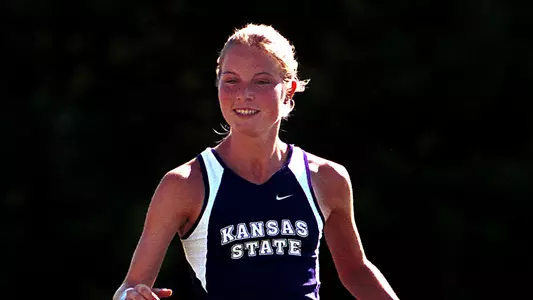
Amy (Mortimer) Garman was 12 years old when she began running with the truck. Her father, Bob, owned a Toyota with rust on the edges and hung a speaker outside the window, as the headlights beamed, and dusk began to crawl on country roads just outside Riley, Kansas. Two miles? Three? All Amy knew for sure was that if she kept a steady pace, one foot in front of the other, she could last until darkness made faraway trees disappear, leaving behind only the headlights, as music danced in the air.
Amy knew she could run. She couldn't hit a double, drain a 3-pointer, or spike a volleyball, nor did it matter, because she always had running, that familiar rush and an unflappable competitiveness, her dominant domain that began at age 10, when she ran a 7:35 mile and beat all but one boy in her class, and which would grow into three state championships in a single day, and which would grow into 12 All-America recognitions by the time she finished her final race in a Kansas State jersey. Yes, even then, she chased the sun, a 10-year professional career — she finished ninth at the 2004 U.S. Olympic Trials — that took her across the world, before darkness fell, and it was time to return home.
"From the time I started running," Amy begins, "I felt like this was kind of my purpose, not my only purpose, but it was a big purpose for me."
Fresh off her PhD in accounting, Amy is now a professor at K-State. She received her master's degree at Boston College, lived on the east coast for four years, returned to Manhattan in 2008, tried to make the Olympics until 2012, and has a husband and two children. Gunnar is 9 and Sailor is 7. They both carry a competitiveness that she knows all too well, and she loves watching them play summer baseball and t-ball. Gunnar is now playing football. She chuckles at her happy memories and those that her children might make during their lives.
"My competitiveness, I was just super serious from the moment I started running," she says. "I can be kind of an intense person. It was a burning desire inside of me to be the best. I used to think it was weird, but now I can see it in my kids."

Sometime, Amy might settle in and tell them more fully of her conquests and travels many moons ago, while Amy remains mindful of path, upon tracks and country hills in college, and across foreign lands as a professional, which truly were out of reach for women not too long ago. Fifty years is but a short climb in the realm of competitive racing, which has been a staple seemingly for eons, and yet 50 years is when this race across women's athletics officially began with the introduction of Title IX.
Title IX of the Educational Amendments of 1972 is a Federal civil rights law that prohibits sexual discrimination at educational institutions that receive federal funding. The Title IX regulation states that "except for provided elsewhere in this part, no person shall, on the basis of sex, be excluded from participation in, be denied benefits of, or be subjected to discrimination under any academic, extracurricular, research, occupational training, or other education program or activity operated by a recipient which receives… federal financial assistance."
That was 50 years ago.
"It's hard to even put into words," Amy says. "I got to know Teri Anderson (a 1976 K-Stater and 2003 Kansas Sports Hall of Fame inductee) as she went to my high school. She told me stories about when she was running track and they didn't have a track team and she was training on her own. I feel like I reaped the benefits of what all those women before me did where they broke through these barriers.
"Because of them, I never had to think about whether sports were an option for me. It's really hard to put into words how much running has changed my life, but through running I was able to pay for school, and was able to travel all over the world, and had all these experiences, and made these great friends. I'm so excited for my own daughter to do those kinds of things."

Amy insists that she doesn't live in the past, and she does so somewhat reluctantly, drawing it out like the string on a ball of yarn that suddenly could go on and on. There are the 13 state titles while she was at Riley County High School, the Kansas high school record with a time of 4:44.09 in the mile, and the 1998 Foot Locker Cross Country All-American honor. There are the 12 All-America designations, and this: She remains the only female in the history of K-State cross country to be named All-American four times. And on and on.
"I want to be known for being a good person, someone who cared about other people, and helped other people along," she says. "I've had a lot of accomplishments athletically and those are really valuable to me, but I hope through that I've been able to inspire other women or bring other people along.
"That's what makes my successes and failures more meaningful to me, is when they can help out other people."
Amy (Mortimer) Garman was 12 years old when she began running with the truck. Her father, Bob, owned a Toyota with rust on the edges and hung a speaker outside the window, as the headlights beamed, and dusk began to crawl on country roads just outside Riley, Kansas. Two miles? Three? All Amy knew for sure was that if she kept a steady pace, one foot in front of the other, she could last until darkness made faraway trees disappear, leaving behind only the headlights, as music danced in the air.
Amy knew she could run. She couldn't hit a double, drain a 3-pointer, or spike a volleyball, nor did it matter, because she always had running, that familiar rush and an unflappable competitiveness, her dominant domain that began at age 10, when she ran a 7:35 mile and beat all but one boy in her class, and which would grow into three state championships in a single day, and which would grow into 12 All-America recognitions by the time she finished her final race in a Kansas State jersey. Yes, even then, she chased the sun, a 10-year professional career — she finished ninth at the 2004 U.S. Olympic Trials — that took her across the world, before darkness fell, and it was time to return home.
"From the time I started running," Amy begins, "I felt like this was kind of my purpose, not my only purpose, but it was a big purpose for me."
Fresh off her PhD in accounting, Amy is now a professor at K-State. She received her master's degree at Boston College, lived on the east coast for four years, returned to Manhattan in 2008, tried to make the Olympics until 2012, and has a husband and two children. Gunnar is 9 and Sailor is 7. They both carry a competitiveness that she knows all too well, and she loves watching them play summer baseball and t-ball. Gunnar is now playing football. She chuckles at her happy memories and those that her children might make during their lives.
"My competitiveness, I was just super serious from the moment I started running," she says. "I can be kind of an intense person. It was a burning desire inside of me to be the best. I used to think it was weird, but now I can see it in my kids."
Sometime, Amy might settle in and tell them more fully of her conquests and travels many moons ago, while Amy remains mindful of path, upon tracks and country hills in college, and across foreign lands as a professional, which truly were out of reach for women not too long ago. Fifty years is but a short climb in the realm of competitive racing, which has been a staple seemingly for eons, and yet 50 years is when this race across women's athletics officially began with the introduction of Title IX.
Title IX of the Educational Amendments of 1972 is a Federal civil rights law that prohibits sexual discrimination at educational institutions that receive federal funding. The Title IX regulation states that "except for provided elsewhere in this part, no person shall, on the basis of sex, be excluded from participation in, be denied benefits of, or be subjected to discrimination under any academic, extracurricular, research, occupational training, or other education program or activity operated by a recipient which receives… federal financial assistance."
That was 50 years ago.
"It's hard to even put into words," Amy says. "I got to know Teri Anderson (a 1976 K-Stater and 2003 Kansas Sports Hall of Fame inductee) as she went to my high school. She told me stories about when she was running track and they didn't have a track team and she was training on her own. I feel like I reaped the benefits of what all those women before me did where they broke through these barriers.
"Because of them, I never had to think about whether sports were an option for me. It's really hard to put into words how much running has changed my life, but through running I was able to pay for school, and was able to travel all over the world, and had all these experiences, and made these great friends. I'm so excited for my own daughter to do those kinds of things."
Amy insists that she doesn't live in the past, and she does so somewhat reluctantly, drawing it out like the string on a ball of yarn that suddenly could go on and on. There are the 13 state titles while she was at Riley County High School, the Kansas high school record with a time of 4:44.09 in the mile, and the 1998 Foot Locker Cross Country All-American honor. There are the 12 All-America designations, and this: She remains the only female in the history of K-State cross country to be named All-American four times. And on and on.
"I want to be known for being a good person, someone who cared about other people, and helped other people along," she says. "I've had a lot of accomplishments athletically and those are really valuable to me, but I hope through that I've been able to inspire other women or bring other people along.
"That's what makes my successes and failures more meaningful to me, is when they can help out other people."



K-State Men's Basketball | Postgame Press Conference at Colorado
Thursday, February 26
K-State Rowing | Media Day
Tuesday, February 24
K-State Rowing | Weights Practice
Tuesday, February 24
K-State Tennis | Weekend Recap vs Old Dominion & Minnesota
Tuesday, February 24