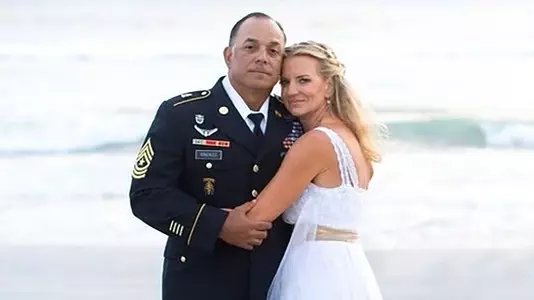
Lessons Learned at K-State Take Gonzalez to a Decorated Military Career
Sep 16, 2022 | Football, Sports Extra
By: D. Scott Fritchen
When Antonio Gonzalez pushed open the doors to the Vanier Family Football Complex in 1990, he simply hoped to help the Kansas State football program under head coach Bill Snyder.
Gonzalez was a native of East Los Angeles. He was a junior college transfer from Rancho Santiago Community College in Santa Ana, California. He was 5-foot-9, 170-pound cornerback. He was also tough.
In his first K-State game, he intercepted a pass and returned it for a touchdown. It was called back due to a penalty. No matter. Message sent. K-State players voted Gonzalez as special teams captain. Gonzalez starred at the "gunner" position on kickoffs and punts. He was one of the guys who ran as fast as he could down the football field to tackle the return specialist after he fielded the ball. It was a very physical position. It often ended with high-speed impact.
Sometimes, four or five of the special teams opponent players would form a wall — a line of defense created to keep K-State players running down the field to make a tackle away from its returner. Gonzalez told Jaime Mendez, his roommate and close friend, that he had devised a new strategy that he planned to carry out on the next kickoff.
"Jaime," Gonzalez said, "I'm going to jump the wall."
"What do you mean you're going to jump the wall?"
"I'm going to jump the wall," Gonzalez said, "and make the tackle."
Gonzalez ran down the field. He jumped the wall and made the tackle.
"Everybody went nuts," Mendez recalls. "He had no fear."
Gonzalez chuckles at the memory.
"I was kind of a special teams pioneer," he says.

Ever since Gonzalez was a child, he wanted to serve in the U.S. Army. After his playing days at K-State ended and he earned his college degree, he walked into an Army recruiter's office in 1996. He told the recruiter, "Hey, sign me up." The recruiter asked Gonzalez if he was running from the law. Gonzalez replied, "I just want to serve." Gonzalez figures if it wasn't for K-State football, he would've scratched getting a college degree and enlisted in the service earlier.
But Gonzalez also knew that he picked up some valuable character traits under K-State head coach Bill Snyder that could serve him well in life. Life — that was the big picture for Gonzalez. He loved America. He wanted to serve. He wanted to help his country.
"Being a football player under Coach Snyder with the discipline that he instilled into me, and the organization, and always thinking ahead," Gonzalez says. "that's helped me greatly during my career."
Today, Antonio Gonzalez is known as Sergeant Major Antonio Gonzalez, United States Army. He received the Silver Star for gallantry in action while serving as a Senior Weapons Sergeant for Special Forces Operational Detachment Alpha 732 in Kandahr, Afghanistan. The Silver Star is the nation's third highest award for gallantry in action. The citation reads: "He distinguished himself by inspiring those around him to extraordinary collective valor on June 11, 2007, which led to an overwhelming battlefield victory and contributed to the success of Operation Enduring Freedom X."
Gonzalez, now Strategic Effects Group Sergeant Major for Mission Command Training Program at Fort Leavenworth, Kansas, will return to Manhattan on Saturday, as K-State observes Fort Riley Day. He will ceremoniously open the K-State locker room door prior to kickoff, as the Wildcats face Tulane at Bill Snyder Family Stadium.
On the football field, K-State President Richard Linton will honor Gonzalez with the University Medal for Military Excellence, which is awarded for the highest levels of military achievement among the K-State family.
Snyder remembers Gonzalez's impact upon the K-State football team. He was a hard worker. He was team oriented. He was a young guy who stepped up and provided quality and caring leadership within the program. He led with his actions. He executed his thoughts and ideas through his leadership. Players followed him.
"I've been most proud of what Tony has done since leaving Kansas State University and getting invested in the service, and it just goes along with his nature and wanting to do what is right and provide guidance for his fellow teammates, and his country," Snyder says. "Our military and national government have recognized him in being truly special in that regard.
"I'm just so extremely proud of him and so pleased he's being honored at Kansas State."
Gonzalez, his monotone voice as solid as granite during an hour-long conversation, takes a long pause for the first time on the other end of the phone when he listens to Snyder's praise.
He maybe even sniffles.
"I'm humbled Coach said such nice words about me," Gonzalez says. "I'm just a regular guy who just loves being an American."
• • •
A young Gonzalez arrived at Ft. Campbell, Kentucky, for his first duty station in 1997. He received orders to Korea in 1999. He wanted something more. He wanted to challenge himself. He didn't want to sit at home one day and say, "Man, could I have done that?" He volunteered to try out for Special Forces in 2001. He was selected as a weapon's specialist. He had to know how to break down and put together virtually every weapon system available in the U.S. Army. He had to learn how to break down and put together enemy weapon systems as well.
Gonzalez joined the 7th Special Forces Group, Charlie Company, which was stationed in Fort Bragg, North Carolina. Now a member of the Green Beret, Gonzalez trained, advised, and assisted numerous times in South and Central America. He also deployed to Afghanistan numerous times. They were always training. Always preparing.
"We were always doing something to prepare for the next phase," Gonzalez says. "The training is what really got us through the day and through those hard times. To equate it to K-State football, we had all those practices in the summer and during two-a-days, and Coach would say, 'Run the play again.' At the time, you wondered if it all made sense, but Coach knew what he was doing. We were developing muscle memory. We knew what to expect because of the constant repetition. Eventually, you can do it with your eyes closed. In the marksmanship course, we might shoot from 10 meters away for two hours, and wonder, 'Why are we doing this from 10 meters away?' You just never know.
"The muscle memory is with the mind, and the mind is a powerful tool. If you train your mind right, you're unstoppable."
From Fort Bragg, the 7th Special Forces Group moved to Eglin, Florida. From Eglin, Gonzalez went to Fort Polk in Louisiana to serve as an instructor. Then he was selected to the Sergeant Major's Academy at Fort Bliss, Texas. Upon graduation, Gonzalez rejoined 7th Special Forces at Eglin as Sergeant Major. In all, Sergeant Major Gonzalez took four tours to Afghanistan.
But the world seemingly stopped on June 11, 2007.
"We were in Afghanistan," Gonzalez says, "And an event happened."
• • •
All he wanted was to eat his MRE — Meal Ready to Eat. Just before Sergeant Major Gonzalez opened the brown wrapping, he heard gunfire in the distance. He was serving as Senior Weapons Sergeant for Special Forces Operational Detachment Alpha 732 somewhere in Uruzgan, Afghanistan. He had just finished a routine patrol. More gunfire. In Afghanistan, everyone had a gun. Sometimes they used guns for celebratory events or to hunt. More gunfire. This gunfire grew more intense. It was an ambush.
Not long before, they had called for three supply trucks. Their Afghan security forces were in Toyota Hiluxes. There were two in the front, two in the back, and the supply trucks in the middle. The 12-man Special Forces team rolled out in their Humvees with small arms, rocket-propelled grenades, and mortars, and headed toward the gunfire. They would later learn there were about 80 insurgents. Not that it mattered.
"That's where the training comes in," Gonzalez says. "We know exactly what each other is thinking, how we're going to defend, attack, or deal with a situation. It's all because of the training. It's the same thing with football. We practiced every day so we knew what the offense was going to do, we knew what holes to hit, whether we should be in man-to-man or zone. In this event, we knew exactly what we were going to do without talking about it. The left hand knew what the right hand was doing. What's so wonderful about the Special Forces is we have very intelligent individuals who can solve some dynamic problems on the go.
"We make quick answers to those deadly questions."
Gonzalez's detachment didn't go into the Taliban's trap that had set up for them. Instead, they did a bold flanking maneuver to the left, and the surprise was on the Taliban. The detachment was going to save its Afghan partner force. Gonzalez fired and eliminated a Taliban fighter who harbored a belt-fed weapon and radio. Gonzalez directed his Humvee into the center of the enemy kill zone, placing it within 30 meters of the enemy's ambush line, and directly within the crossfire of the enemy snipers and machine gunners.
They were now also enveloped in the same ambush. The enemy had machine guns. They had rocket-propelled grenades. They had recoilless rifle fire from distances as close as 10 meters. The Taliban had chewed up the Toyota trucks with gunfire. The Afghan security forces fled into a building in a nearby cemetery. Gonzalez signaled them to come over to him. They refused.
"At that point, the attachment commander asked for a head count — 'Do we have everybody?'" Gonzalez says. "I said, 'Sir, we don't.'"
Gonzalez had to act fast. There were dozens of insurgents. There were snipers. The enemy was firing at the Humvees from three sides from an 800-meter-wide enemy ambush line. It appeared time, too, was the enemy. It was not on the side of the Americans. In the absence of orders, Gonzalez dug deep in his gut.
It was then that Gonzalez made a decision.
He was going to jump the wall and make the tackle.

The big question was whether he believed that he could make it to the Afghan Soldiers. The building in the cemetery still had to have been 30 meters away. It was called the kill zone for a reason. Sergeant Major Gonzalez did not care. He refused to be at home someday wondering, "What if?" He likened it to playing K-State football.
"The linebackers relied on us cornerbacks to cover the wide receivers, and the defensive linemen relied on the linebackers to make those tackles," Gonzalez says. "Everybody was a role. We all had a role on that team. I was with my brothers, and we depended upon each other. The risk comes with the territory."
He looked back at members of his detachment.
"I'll be back," he said. "Cover me."
He ran in a zig-zag motion. Because that's what you're taught when you're running under enemy fire. And the gunfire was intense. And it was wide open terrain. And he kept running. And he kept zigzagging. And he finally reached the building.
"I got them, brought them back to the truck, and then came back and counted, and realized, 'Man, this isn't everybody,'" Gonzalez says. "I looked back and there were more of our partner forces there."
He ran the 30 meters again.
And then he ran the 30 meters a third time.
"So, I'd grabbed our people on two trips and returned them to the vehicle, and on my third time back, something told me to stop, so I stopped," Gonzalez says. "I felt a bullet go right by my head. Of course, they had snipers out there, and sooner or later they're going to home in on you. But something told me to stop. I thank God for that. It was a very intense time. The man upstairs is always looking out for you."
While leading a split team in a six-hour enemy contact, Gonzalez risked his life three times and rescued four Afghan Soldiers, who were unable to maneuver on their own, one of which was fatally wounded.
Then Gonzalez drove out of the center of the kill zone. Close Air Support swept in and destroyed the enemy positions. It resulted in 60 enemy killed, including two Taliban Commanders.
His decision turned the momentum of the fight.
"I didn't do it for the ribbon. I did it because lives were at stake," Gonzalez says. "God has a plan for everybody and if His plan was for me to go places around the world and make a difference, then that's my calling, and I'll do it to the best that I possibly can through being a good steward, being a good ambassador, and being a good person.
"We have a lot of friends who were killed in combat. It's a tough one to swallow, but you learn from that and build from there. Just like when you lose a game, you learn from that and build from it."
• • •
Now serving as Strategic Effects Group Sergeant Major for Mission Command Training Program at Fort Leavenworth, Kansas, Gonzalez marvels that his path has nearly run full circle after nearly three decades. He ended his K-State career serving an internship at Fort Leavenworth Penitentiary.
"I'm an LA guy," Gonzalez says. "My parents, Racquel and Manuel, their sacrifices, their commitments, it's amazing what they did coming from a Mexican-American family. They gave me an amazing opportunity and they believed in me, and they allowed me to do what I needed to do, even though they didn't want me to leave the state of California. My wife, Alyson, puts me in my place. She's the real Sergeant Major. She graduated from K-State's College of Education in 1995 and earned her master's in 1996 and is now a school counselor at Edgerton Elementary School.

"My stepson Owen, is in the K-State ROTC program. He's following in my footsteps. My son Tyler was wounded in action in Afghanistan in 2013. I have two standard poodles — Sergeant Winchester, and Major Chancellor. My wife and I had to come to an agreement on their names. We settled on them 50-50."
On Saturday, Gonzalez will pull open the locker room door to the K-State football team before it goes out in performs on the football field that he knew so well many years ago.
So much time has passed. The lessons live on.
"Coming into the complex on Sundays after a Saturday football game, at the time, we might've thought, 'Why are we doing this?' but I understand where Coach Snyder was coming from. He was teaching us personal accountability. As you're given positions of responsibility, that's accountability, and not only accountability for yourself, but for your family on your left and your right. The practices, whether it was hot, cold, windy or whatever, we were practicing, and we were building that foundation."
And once in a while it required a game-changing decision.
Jump the wall and make the tackle.
When Antonio Gonzalez pushed open the doors to the Vanier Family Football Complex in 1990, he simply hoped to help the Kansas State football program under head coach Bill Snyder.
Gonzalez was a native of East Los Angeles. He was a junior college transfer from Rancho Santiago Community College in Santa Ana, California. He was 5-foot-9, 170-pound cornerback. He was also tough.
In his first K-State game, he intercepted a pass and returned it for a touchdown. It was called back due to a penalty. No matter. Message sent. K-State players voted Gonzalez as special teams captain. Gonzalez starred at the "gunner" position on kickoffs and punts. He was one of the guys who ran as fast as he could down the football field to tackle the return specialist after he fielded the ball. It was a very physical position. It often ended with high-speed impact.
Sometimes, four or five of the special teams opponent players would form a wall — a line of defense created to keep K-State players running down the field to make a tackle away from its returner. Gonzalez told Jaime Mendez, his roommate and close friend, that he had devised a new strategy that he planned to carry out on the next kickoff.
"Jaime," Gonzalez said, "I'm going to jump the wall."
"What do you mean you're going to jump the wall?"
"I'm going to jump the wall," Gonzalez said, "and make the tackle."
Gonzalez ran down the field. He jumped the wall and made the tackle.
"Everybody went nuts," Mendez recalls. "He had no fear."
Gonzalez chuckles at the memory.
"I was kind of a special teams pioneer," he says.
Ever since Gonzalez was a child, he wanted to serve in the U.S. Army. After his playing days at K-State ended and he earned his college degree, he walked into an Army recruiter's office in 1996. He told the recruiter, "Hey, sign me up." The recruiter asked Gonzalez if he was running from the law. Gonzalez replied, "I just want to serve." Gonzalez figures if it wasn't for K-State football, he would've scratched getting a college degree and enlisted in the service earlier.
But Gonzalez also knew that he picked up some valuable character traits under K-State head coach Bill Snyder that could serve him well in life. Life — that was the big picture for Gonzalez. He loved America. He wanted to serve. He wanted to help his country.
"Being a football player under Coach Snyder with the discipline that he instilled into me, and the organization, and always thinking ahead," Gonzalez says. "that's helped me greatly during my career."
Today, Antonio Gonzalez is known as Sergeant Major Antonio Gonzalez, United States Army. He received the Silver Star for gallantry in action while serving as a Senior Weapons Sergeant for Special Forces Operational Detachment Alpha 732 in Kandahr, Afghanistan. The Silver Star is the nation's third highest award for gallantry in action. The citation reads: "He distinguished himself by inspiring those around him to extraordinary collective valor on June 11, 2007, which led to an overwhelming battlefield victory and contributed to the success of Operation Enduring Freedom X."
Gonzalez, now Strategic Effects Group Sergeant Major for Mission Command Training Program at Fort Leavenworth, Kansas, will return to Manhattan on Saturday, as K-State observes Fort Riley Day. He will ceremoniously open the K-State locker room door prior to kickoff, as the Wildcats face Tulane at Bill Snyder Family Stadium.
On the football field, K-State President Richard Linton will honor Gonzalez with the University Medal for Military Excellence, which is awarded for the highest levels of military achievement among the K-State family.
Snyder remembers Gonzalez's impact upon the K-State football team. He was a hard worker. He was team oriented. He was a young guy who stepped up and provided quality and caring leadership within the program. He led with his actions. He executed his thoughts and ideas through his leadership. Players followed him.
"I've been most proud of what Tony has done since leaving Kansas State University and getting invested in the service, and it just goes along with his nature and wanting to do what is right and provide guidance for his fellow teammates, and his country," Snyder says. "Our military and national government have recognized him in being truly special in that regard.
"I'm just so extremely proud of him and so pleased he's being honored at Kansas State."
Gonzalez, his monotone voice as solid as granite during an hour-long conversation, takes a long pause for the first time on the other end of the phone when he listens to Snyder's praise.
He maybe even sniffles.
"I'm humbled Coach said such nice words about me," Gonzalez says. "I'm just a regular guy who just loves being an American."
• • •
A young Gonzalez arrived at Ft. Campbell, Kentucky, for his first duty station in 1997. He received orders to Korea in 1999. He wanted something more. He wanted to challenge himself. He didn't want to sit at home one day and say, "Man, could I have done that?" He volunteered to try out for Special Forces in 2001. He was selected as a weapon's specialist. He had to know how to break down and put together virtually every weapon system available in the U.S. Army. He had to learn how to break down and put together enemy weapon systems as well.
Gonzalez joined the 7th Special Forces Group, Charlie Company, which was stationed in Fort Bragg, North Carolina. Now a member of the Green Beret, Gonzalez trained, advised, and assisted numerous times in South and Central America. He also deployed to Afghanistan numerous times. They were always training. Always preparing.
"We were always doing something to prepare for the next phase," Gonzalez says. "The training is what really got us through the day and through those hard times. To equate it to K-State football, we had all those practices in the summer and during two-a-days, and Coach would say, 'Run the play again.' At the time, you wondered if it all made sense, but Coach knew what he was doing. We were developing muscle memory. We knew what to expect because of the constant repetition. Eventually, you can do it with your eyes closed. In the marksmanship course, we might shoot from 10 meters away for two hours, and wonder, 'Why are we doing this from 10 meters away?' You just never know.
"The muscle memory is with the mind, and the mind is a powerful tool. If you train your mind right, you're unstoppable."
From Fort Bragg, the 7th Special Forces Group moved to Eglin, Florida. From Eglin, Gonzalez went to Fort Polk in Louisiana to serve as an instructor. Then he was selected to the Sergeant Major's Academy at Fort Bliss, Texas. Upon graduation, Gonzalez rejoined 7th Special Forces at Eglin as Sergeant Major. In all, Sergeant Major Gonzalez took four tours to Afghanistan.
But the world seemingly stopped on June 11, 2007.
"We were in Afghanistan," Gonzalez says, "And an event happened."
• • •
All he wanted was to eat his MRE — Meal Ready to Eat. Just before Sergeant Major Gonzalez opened the brown wrapping, he heard gunfire in the distance. He was serving as Senior Weapons Sergeant for Special Forces Operational Detachment Alpha 732 somewhere in Uruzgan, Afghanistan. He had just finished a routine patrol. More gunfire. In Afghanistan, everyone had a gun. Sometimes they used guns for celebratory events or to hunt. More gunfire. This gunfire grew more intense. It was an ambush.
Not long before, they had called for three supply trucks. Their Afghan security forces were in Toyota Hiluxes. There were two in the front, two in the back, and the supply trucks in the middle. The 12-man Special Forces team rolled out in their Humvees with small arms, rocket-propelled grenades, and mortars, and headed toward the gunfire. They would later learn there were about 80 insurgents. Not that it mattered.
"That's where the training comes in," Gonzalez says. "We know exactly what each other is thinking, how we're going to defend, attack, or deal with a situation. It's all because of the training. It's the same thing with football. We practiced every day so we knew what the offense was going to do, we knew what holes to hit, whether we should be in man-to-man or zone. In this event, we knew exactly what we were going to do without talking about it. The left hand knew what the right hand was doing. What's so wonderful about the Special Forces is we have very intelligent individuals who can solve some dynamic problems on the go.
"We make quick answers to those deadly questions."
Gonzalez's detachment didn't go into the Taliban's trap that had set up for them. Instead, they did a bold flanking maneuver to the left, and the surprise was on the Taliban. The detachment was going to save its Afghan partner force. Gonzalez fired and eliminated a Taliban fighter who harbored a belt-fed weapon and radio. Gonzalez directed his Humvee into the center of the enemy kill zone, placing it within 30 meters of the enemy's ambush line, and directly within the crossfire of the enemy snipers and machine gunners.
They were now also enveloped in the same ambush. The enemy had machine guns. They had rocket-propelled grenades. They had recoilless rifle fire from distances as close as 10 meters. The Taliban had chewed up the Toyota trucks with gunfire. The Afghan security forces fled into a building in a nearby cemetery. Gonzalez signaled them to come over to him. They refused.
"At that point, the attachment commander asked for a head count — 'Do we have everybody?'" Gonzalez says. "I said, 'Sir, we don't.'"
Gonzalez had to act fast. There were dozens of insurgents. There were snipers. The enemy was firing at the Humvees from three sides from an 800-meter-wide enemy ambush line. It appeared time, too, was the enemy. It was not on the side of the Americans. In the absence of orders, Gonzalez dug deep in his gut.
It was then that Gonzalez made a decision.
He was going to jump the wall and make the tackle.
The big question was whether he believed that he could make it to the Afghan Soldiers. The building in the cemetery still had to have been 30 meters away. It was called the kill zone for a reason. Sergeant Major Gonzalez did not care. He refused to be at home someday wondering, "What if?" He likened it to playing K-State football.
"The linebackers relied on us cornerbacks to cover the wide receivers, and the defensive linemen relied on the linebackers to make those tackles," Gonzalez says. "Everybody was a role. We all had a role on that team. I was with my brothers, and we depended upon each other. The risk comes with the territory."
He looked back at members of his detachment.
"I'll be back," he said. "Cover me."
He ran in a zig-zag motion. Because that's what you're taught when you're running under enemy fire. And the gunfire was intense. And it was wide open terrain. And he kept running. And he kept zigzagging. And he finally reached the building.
"I got them, brought them back to the truck, and then came back and counted, and realized, 'Man, this isn't everybody,'" Gonzalez says. "I looked back and there were more of our partner forces there."
He ran the 30 meters again.
And then he ran the 30 meters a third time.
"So, I'd grabbed our people on two trips and returned them to the vehicle, and on my third time back, something told me to stop, so I stopped," Gonzalez says. "I felt a bullet go right by my head. Of course, they had snipers out there, and sooner or later they're going to home in on you. But something told me to stop. I thank God for that. It was a very intense time. The man upstairs is always looking out for you."
While leading a split team in a six-hour enemy contact, Gonzalez risked his life three times and rescued four Afghan Soldiers, who were unable to maneuver on their own, one of which was fatally wounded.
Then Gonzalez drove out of the center of the kill zone. Close Air Support swept in and destroyed the enemy positions. It resulted in 60 enemy killed, including two Taliban Commanders.
His decision turned the momentum of the fight.
"I didn't do it for the ribbon. I did it because lives were at stake," Gonzalez says. "God has a plan for everybody and if His plan was for me to go places around the world and make a difference, then that's my calling, and I'll do it to the best that I possibly can through being a good steward, being a good ambassador, and being a good person.
"We have a lot of friends who were killed in combat. It's a tough one to swallow, but you learn from that and build from there. Just like when you lose a game, you learn from that and build from it."
• • •
Now serving as Strategic Effects Group Sergeant Major for Mission Command Training Program at Fort Leavenworth, Kansas, Gonzalez marvels that his path has nearly run full circle after nearly three decades. He ended his K-State career serving an internship at Fort Leavenworth Penitentiary.
"I'm an LA guy," Gonzalez says. "My parents, Racquel and Manuel, their sacrifices, their commitments, it's amazing what they did coming from a Mexican-American family. They gave me an amazing opportunity and they believed in me, and they allowed me to do what I needed to do, even though they didn't want me to leave the state of California. My wife, Alyson, puts me in my place. She's the real Sergeant Major. She graduated from K-State's College of Education in 1995 and earned her master's in 1996 and is now a school counselor at Edgerton Elementary School.
"My stepson Owen, is in the K-State ROTC program. He's following in my footsteps. My son Tyler was wounded in action in Afghanistan in 2013. I have two standard poodles — Sergeant Winchester, and Major Chancellor. My wife and I had to come to an agreement on their names. We settled on them 50-50."
On Saturday, Gonzalez will pull open the locker room door to the K-State football team before it goes out in performs on the football field that he knew so well many years ago.
So much time has passed. The lessons live on.
"Coming into the complex on Sundays after a Saturday football game, at the time, we might've thought, 'Why are we doing this?' but I understand where Coach Snyder was coming from. He was teaching us personal accountability. As you're given positions of responsibility, that's accountability, and not only accountability for yourself, but for your family on your left and your right. The practices, whether it was hot, cold, windy or whatever, we were practicing, and we were building that foundation."
And once in a while it required a game-changing decision.
Jump the wall and make the tackle.
K-State Baseball | Highlights vs Michigan - Feb. 22, 2026
Monday, February 23
K-State Men's Basketball | Postgame Press Conference at Texas Tech
Sunday, February 22
K-State Women's Basketball | Tess Heal Senior Video
Sunday, February 22
K-State Women's Basketball | Mikayla Parks Senior Video
Sunday, February 22