Mansfield Ready to Lead K-State into New Era
Jan 05, 2023 | Volleyball, Sports Extra
By: D. Scott Fritchen
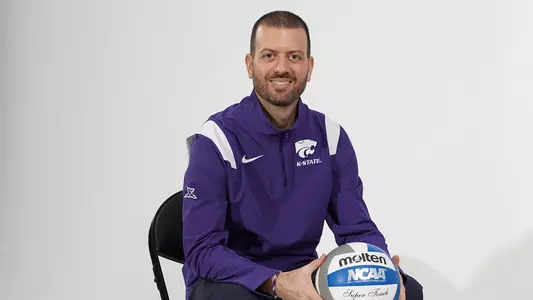
New Kansas State women's volleyball coach Jason Mansfield arrives at Kansas State with a championship pedigree. He has helped guide NCAA Division I women's volleyball teams to seven Final Fours and one national championship during stints at Stanford and then Washington, where he has spent the past five seasons. Mansfield, the ninth head coach in the history of the K-State women's volleyball program, brings energy and passion, and he is excited to be a part of the team, the student-athletes and the Manhattan community.
In his five seasons at Washington, Mansfield helped the Huskies advance to the Sweet 16 four times, the 2019 Elite Eight, and to the 2021 Final Four. At Stanford, he helped capture a 2004 National Championship while working under his mentor, Hall-of-Famer John Dunning. At Illinois, he helped the Illini to the NCAA Round of 16.
It's been quite a journey for Mansfield, who began coaching jay-vee teams at a young age and realized his dream of teaching young people. His championship path through the college ranks is proven — he has mentored 25 individual players that have earned 65 All-America honors during his 20 years of coaching and has coached five athletes that have gone on to compete in the Olympic Games for Team USA.
Jason Mansfield spoke with D. Scott Fritchen of K-State Sports Extra about his family, his passions, values and goals for K-State women's volleyball program.

D. Scott Fritchen: K-State is big on family. The athletic department is big about family. How excited are you to join the K-State family?
Jason Mansfield: I'm really excited. One of the best things during the hiring process was hearing about the community and everybody that I met during the interview process just really, really felt that there was a strong community here. People come here and they stay, and that's something that I was looking forward to with my family. I was looking forward to the next opportunity and the community of Manhattan and university is a special place.
DSF: Tell me about your family and what is the importance of family?
JM: I grew up with four brothers, three older and one younger, and we're a very close unit. Family has always been incredibly important. I'm very fortunate to have had a strong family around me growing up. I've been married to Kim for 10 years and I have a daughter, Rylee, who is 8, and a son, Dylan, who is 6, and they're my everything. Being a good husband and being a dad is the most important job that I have. Family means everything. I wouldn't be here if they weren't excited about this opportunity as well.

DSF: Who are some people who've poured into your life and have made you the man you are today?
JM: A big part of it is my parents. The morals they instilled into me and the work ethic starts with them. My brother is my best friend, and he's the new coach at Oklahoma now, so we'll be playing against each other a couple times, at least this year. He's been an incredible mentor to me, even though he's six years younger. He's the reason I got started in volleyball. I started coaching in the seventh grade and we went on this journey together. My biggest mentor is John Dunning, who I coached with for 15 years at Stanford. He's a Hall of Fame coach and in my opinion the best ever to do it and the best teacher that this game has ever had. Getting an opportunity to learn from him for 15 years was unbelievable.
DSF: What did you most learn from Coach Dunning at Stanford and how did he impact you as you assume your own spot as a head coach?
JM: First and foremost, he's a teacher. He was a high school teacher before he got into college volleyball. He coached at high school and was a teacher as well. That's who he is at his core. When I first started coaching with him, he just did a phenomenal job of figuring out what the individual needed, and really tried to break down their game and see where they needed to really grow and improve. That process was different for every player, and it was different every year. It was exciting to see him really spend time on the individual player to improve them. I think the culture was really strong and it was strong because he had really good values. He cared about the student-athletes not just as players but as people. He's very competitive. He just tried to find a way to balance everything out about caring about them but also finding a way to maximize what we had every year and compete at the highest level. Those are the things that I've taken away. There are so many values that I'll have for this program. He'll have his fingerprints all over it.

DSF: What are the top three values you have and why are they so important?
JM: The first one is having a strong character. It's about recruiting strong character, and that's really important to me. That's the individual piece that will be our main value because it's individual to them and I'll help them grow as athletes and student-athletes and people. The second one is having a really strong connection with each other. The connection piece is really strong right now. The student-athletes are very connected to each other and to the school and they love K-State. That connection is strong with them, and I want that connection to be good amongst our staff, our support staff, and the community. That connection is really important. I have a passion for competing and really understand what it means to compete and doing it with community and passion. I want us to understand what that looks like, and we're going to practice that every day and understand what part of their character will help make that happen individually. Character, connection and competing are my top three.
DSF: Take me back to Foothill Community College in 1997. Could you have envisioned at that time that you'd one day be in the spot you're at now?
JM: No. Before that and at around that time I was coaching junior high boys and jay-vee boys for a year and jay-vee girls for a year, and I was the head varsity coach for girls for five years and head varsity coach for boys for five years. I spent this time working my way up and enjoyed every single step along the way. The junior-college experience was the first time that it was like, 'These are good athletes, and these are athletes that are in a very important part of their life in their development as a person,' and I really wanted to help them navigate through that, not only as a volleyball coach but to mentor them and help them grow. There was never, 'I want to be a college coach one day.' It was never about that. I wanted to be a teacher since I was 16 years old and ever since I began coaching, it was an unbelievable experience teaching the game that I love and teaching life through the game. When John Dunning called me to be the volunteer coach at Stanford, I was unsure if I could afford that living on my own, but it started from there. I knew I had to give this a try and see if it was something I wanted to do, and it grew from there.

DSF: What sparked your interest in pursuing this job at K-State?
JM: Jill Shields and Gene Taylor had a huge part in that. When the position first opened up, again, I don't have a lot of connections here, but this was an interesting opportunity, and the more I looked into it, the more I saw a really good foundation. The academics of the school speak for itself, and the community of Manhattan speaks for itself. Those are very unique things. The Big 12 is a great conference that I've coached against a lot, and I have a lot of respect for those programs, and it's probably the fastest-growing conference in the country as far as quality of programs. The more I watched film of the players the more excited I got for this opportunity. The individual talent on this team really excites me. It wasn't going to be a complete rebuild. I was unsure if the players were going to stay. You never know if they're going to stay or go, but nobody was in the transfer portal, so I knew they were waiting to see who the next head coach was going to be, and the more I looked into it, the more excited I became, and the more excited my family became about the community, and the sleeping giant that I think it is.
DSF: You've been highly successful, a part of seven Final Fours and have captured one national championship. What's the thrill like in being in a NCAA Tournament and then also helping guide a team all the way to the Final Four and beyond?
JM: The goal is always to make the NCAA Tournament. It's a special thing to hear your name called that you're a part of the 64 teams. That's always the goal. Then once you're in the tournament anything can happen. If you're healthy and playing well at the right time, you get the best opportunity to make a run. There's nothing more exciting than the NCAA Tournament. I've been fortunate to have been to seven Final Fours and every single one of the Final Fours is unique and special. They were unbelievable experiences for the student-athletes. I want to duplicate that here. It's going to start with giving us a chance to make the tournament and then grow from there. It's something I think is possible, and I wouldn't be here if I didn't think it was possible. I'm a competitive guy and I want that experience for the student-athletes for sure.

DSF: In 20 years of coaching, you've had 25 players who've earned a combined 65 All-America honors. What are the common intrinsic characteristics of an All-American player and secondly from your experience what have been the keys to helping a player reach her potential?
JM: The biggest thing that stands out is their commitment to improving. They all started as freshmen and some of them were very talented, but they didn't have a deep understanding of the game and of how they were great. It's about developing athletes and maximizing what they can do. That's the No. 1 goal for me. Their passion for the game, their passion and love for the game is very similar with all those players. That's important as is their competitive edge, and when they get out there they're really wanting to win at a high level. Thinking about all of them, they're all so different and unique and their stories are unique about how they started and how they finished. Some of them were very highly touted and some others were not. They found a way to improve, and we found a way to maximize what they have. My favorite stories, honestly, are the ones who came out from nowhere and really had a chance to break out. There's nothing better than seeing these athletes grow and develop over four or five years.
DSF: What are you looking for in student-athletes and which areas of the country would you most like to reach for these student-athletes?
JM: There's talent all over the country. That's the biggest change in the last 10 years is there are so many pockets of great volleyball around the country and the surrounding states of Kansas. The state of Kansas has a lot of talent, so that was another really intriguing part about K-State — just the amount of talent that we can drive to in order to watch them compete. Having connections in different parts of the country is something that's important, and I'm fortunate to have that. I just want people to be interested in what we're trying to do. The school and academics and the conference speak for themselves. I'm looking for people who are passionate about the game and learning and definitely want to compete at a very high level. They'll see that when we play in the new facility, which is going to be incredible for recruiting, so I'm really excited about that. I really want to find the best fit, and I'm not going to cut corners to do that. I'm going to make sure we find the best players for K-State.
DSF: K-State fans are very passionate. What would be your message to K-State fans?
JM: We're going to be a lot of fun to watch. We're going to have a team that they'll be proud of on and off the court. They'll see our passion on the court, and they'll see that connection that we have with each other. It's going to be a lot of fun. I appreciate their support, and I'm excited to do it with them. I'm really excited about this opportunity. Go Cats.
New Kansas State women's volleyball coach Jason Mansfield arrives at Kansas State with a championship pedigree. He has helped guide NCAA Division I women's volleyball teams to seven Final Fours and one national championship during stints at Stanford and then Washington, where he has spent the past five seasons. Mansfield, the ninth head coach in the history of the K-State women's volleyball program, brings energy and passion, and he is excited to be a part of the team, the student-athletes and the Manhattan community.
In his five seasons at Washington, Mansfield helped the Huskies advance to the Sweet 16 four times, the 2019 Elite Eight, and to the 2021 Final Four. At Stanford, he helped capture a 2004 National Championship while working under his mentor, Hall-of-Famer John Dunning. At Illinois, he helped the Illini to the NCAA Round of 16.
It's been quite a journey for Mansfield, who began coaching jay-vee teams at a young age and realized his dream of teaching young people. His championship path through the college ranks is proven — he has mentored 25 individual players that have earned 65 All-America honors during his 20 years of coaching and has coached five athletes that have gone on to compete in the Olympic Games for Team USA.
Jason Mansfield spoke with D. Scott Fritchen of K-State Sports Extra about his family, his passions, values and goals for K-State women's volleyball program.
D. Scott Fritchen: K-State is big on family. The athletic department is big about family. How excited are you to join the K-State family?
Jason Mansfield: I'm really excited. One of the best things during the hiring process was hearing about the community and everybody that I met during the interview process just really, really felt that there was a strong community here. People come here and they stay, and that's something that I was looking forward to with my family. I was looking forward to the next opportunity and the community of Manhattan and university is a special place.
DSF: Tell me about your family and what is the importance of family?
JM: I grew up with four brothers, three older and one younger, and we're a very close unit. Family has always been incredibly important. I'm very fortunate to have had a strong family around me growing up. I've been married to Kim for 10 years and I have a daughter, Rylee, who is 8, and a son, Dylan, who is 6, and they're my everything. Being a good husband and being a dad is the most important job that I have. Family means everything. I wouldn't be here if they weren't excited about this opportunity as well.
DSF: Who are some people who've poured into your life and have made you the man you are today?
JM: A big part of it is my parents. The morals they instilled into me and the work ethic starts with them. My brother is my best friend, and he's the new coach at Oklahoma now, so we'll be playing against each other a couple times, at least this year. He's been an incredible mentor to me, even though he's six years younger. He's the reason I got started in volleyball. I started coaching in the seventh grade and we went on this journey together. My biggest mentor is John Dunning, who I coached with for 15 years at Stanford. He's a Hall of Fame coach and in my opinion the best ever to do it and the best teacher that this game has ever had. Getting an opportunity to learn from him for 15 years was unbelievable.
DSF: What did you most learn from Coach Dunning at Stanford and how did he impact you as you assume your own spot as a head coach?
JM: First and foremost, he's a teacher. He was a high school teacher before he got into college volleyball. He coached at high school and was a teacher as well. That's who he is at his core. When I first started coaching with him, he just did a phenomenal job of figuring out what the individual needed, and really tried to break down their game and see where they needed to really grow and improve. That process was different for every player, and it was different every year. It was exciting to see him really spend time on the individual player to improve them. I think the culture was really strong and it was strong because he had really good values. He cared about the student-athletes not just as players but as people. He's very competitive. He just tried to find a way to balance everything out about caring about them but also finding a way to maximize what we had every year and compete at the highest level. Those are the things that I've taken away. There are so many values that I'll have for this program. He'll have his fingerprints all over it.
DSF: What are the top three values you have and why are they so important?
JM: The first one is having a strong character. It's about recruiting strong character, and that's really important to me. That's the individual piece that will be our main value because it's individual to them and I'll help them grow as athletes and student-athletes and people. The second one is having a really strong connection with each other. The connection piece is really strong right now. The student-athletes are very connected to each other and to the school and they love K-State. That connection is strong with them, and I want that connection to be good amongst our staff, our support staff, and the community. That connection is really important. I have a passion for competing and really understand what it means to compete and doing it with community and passion. I want us to understand what that looks like, and we're going to practice that every day and understand what part of their character will help make that happen individually. Character, connection and competing are my top three.
DSF: Take me back to Foothill Community College in 1997. Could you have envisioned at that time that you'd one day be in the spot you're at now?
JM: No. Before that and at around that time I was coaching junior high boys and jay-vee boys for a year and jay-vee girls for a year, and I was the head varsity coach for girls for five years and head varsity coach for boys for five years. I spent this time working my way up and enjoyed every single step along the way. The junior-college experience was the first time that it was like, 'These are good athletes, and these are athletes that are in a very important part of their life in their development as a person,' and I really wanted to help them navigate through that, not only as a volleyball coach but to mentor them and help them grow. There was never, 'I want to be a college coach one day.' It was never about that. I wanted to be a teacher since I was 16 years old and ever since I began coaching, it was an unbelievable experience teaching the game that I love and teaching life through the game. When John Dunning called me to be the volunteer coach at Stanford, I was unsure if I could afford that living on my own, but it started from there. I knew I had to give this a try and see if it was something I wanted to do, and it grew from there.
DSF: What sparked your interest in pursuing this job at K-State?
JM: Jill Shields and Gene Taylor had a huge part in that. When the position first opened up, again, I don't have a lot of connections here, but this was an interesting opportunity, and the more I looked into it, the more I saw a really good foundation. The academics of the school speak for itself, and the community of Manhattan speaks for itself. Those are very unique things. The Big 12 is a great conference that I've coached against a lot, and I have a lot of respect for those programs, and it's probably the fastest-growing conference in the country as far as quality of programs. The more I watched film of the players the more excited I got for this opportunity. The individual talent on this team really excites me. It wasn't going to be a complete rebuild. I was unsure if the players were going to stay. You never know if they're going to stay or go, but nobody was in the transfer portal, so I knew they were waiting to see who the next head coach was going to be, and the more I looked into it, the more excited I became, and the more excited my family became about the community, and the sleeping giant that I think it is.
DSF: You've been highly successful, a part of seven Final Fours and have captured one national championship. What's the thrill like in being in a NCAA Tournament and then also helping guide a team all the way to the Final Four and beyond?
JM: The goal is always to make the NCAA Tournament. It's a special thing to hear your name called that you're a part of the 64 teams. That's always the goal. Then once you're in the tournament anything can happen. If you're healthy and playing well at the right time, you get the best opportunity to make a run. There's nothing more exciting than the NCAA Tournament. I've been fortunate to have been to seven Final Fours and every single one of the Final Fours is unique and special. They were unbelievable experiences for the student-athletes. I want to duplicate that here. It's going to start with giving us a chance to make the tournament and then grow from there. It's something I think is possible, and I wouldn't be here if I didn't think it was possible. I'm a competitive guy and I want that experience for the student-athletes for sure.
DSF: In 20 years of coaching, you've had 25 players who've earned a combined 65 All-America honors. What are the common intrinsic characteristics of an All-American player and secondly from your experience what have been the keys to helping a player reach her potential?
JM: The biggest thing that stands out is their commitment to improving. They all started as freshmen and some of them were very talented, but they didn't have a deep understanding of the game and of how they were great. It's about developing athletes and maximizing what they can do. That's the No. 1 goal for me. Their passion for the game, their passion and love for the game is very similar with all those players. That's important as is their competitive edge, and when they get out there they're really wanting to win at a high level. Thinking about all of them, they're all so different and unique and their stories are unique about how they started and how they finished. Some of them were very highly touted and some others were not. They found a way to improve, and we found a way to maximize what they have. My favorite stories, honestly, are the ones who came out from nowhere and really had a chance to break out. There's nothing better than seeing these athletes grow and develop over four or five years.
DSF: What are you looking for in student-athletes and which areas of the country would you most like to reach for these student-athletes?
JM: There's talent all over the country. That's the biggest change in the last 10 years is there are so many pockets of great volleyball around the country and the surrounding states of Kansas. The state of Kansas has a lot of talent, so that was another really intriguing part about K-State — just the amount of talent that we can drive to in order to watch them compete. Having connections in different parts of the country is something that's important, and I'm fortunate to have that. I just want people to be interested in what we're trying to do. The school and academics and the conference speak for themselves. I'm looking for people who are passionate about the game and learning and definitely want to compete at a very high level. They'll see that when we play in the new facility, which is going to be incredible for recruiting, so I'm really excited about that. I really want to find the best fit, and I'm not going to cut corners to do that. I'm going to make sure we find the best players for K-State.
DSF: K-State fans are very passionate. What would be your message to K-State fans?
JM: We're going to be a lot of fun to watch. We're going to have a team that they'll be proud of on and off the court. They'll see our passion on the court, and they'll see that connection that we have with each other. It's going to be a lot of fun. I appreciate their support, and I'm excited to do it with them. I'm really excited about this opportunity. Go Cats.
K-State Men's Basketball | Postgame Press Conference at Colorado
Thursday, February 26
K-State Rowing | Media Day
Tuesday, February 24
K-State Rowing | Weights Practice
Tuesday, February 24
K-State Tennis | Weekend Recap vs Old Dominion & Minnesota
Tuesday, February 24