Involvement Outside of Sport
Mar 07, 2023 | Sports Extra, Athletics, Evans Student-Athlete Success Program
By: D. Scott Fritchen
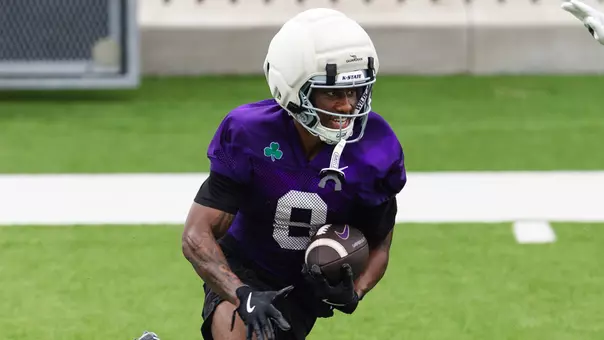
Phillip Brooks has always had an interest in the Black community outside of athletics at Kansas State. The sixth-year senior wide receiver and one of the nation's most dangerous punt returners heavily invests in his craft, but Brooks also seeks to expand upon his college experience. Today, he's one of several Black K-State student-athletes involved in events with the ever-thriving Black Student Union, which recently received the Clarence Wine Award for Outstanding Big XII Council of the Year.
"I'm a member of Kappa Alpha Psi Fraternity on campus and we're really involved with the Black Student Union events," Brooks says. "Sometimes when you're an athlete, you get so wrapped up in just being an athlete. Being involved is a time where it's something outside of football. It's something that shows that athletes can be more than just their sport. That piques my interest."
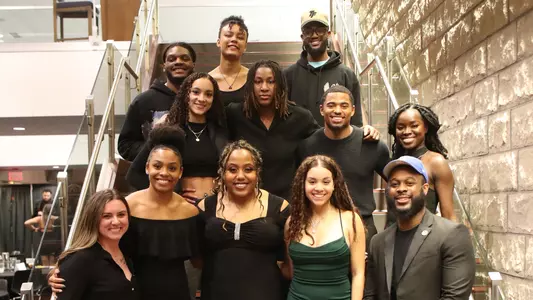
Brooks joined several other Black K-State student-athletes at the 46th annual Big XII Council on Black Student Government — a four-day, three-night event that features hundreds of attendees and annually rotates across Big 12 campuses. K-State hosted the event in February 16-19. K-State last hosted the conference in 2013.
The Big XII Council on Black Student Government is a regional Black Student Governing Body which consists of the Black Student Governments from institutions in the Big 12. This body of student leaders assembles each academic year to continue to promote Black culture, leadership, positive self-efficacy, political power and awareness, and goodwill of the student body and Black community on the campus of each member institution.
The conference featured various keynote speakers, a career fair, and breakout sessions. It featured an all-black-attire formal dinner. And it features awards. The K-State Black Student Union (BSU) has now won best in the Big 12 in 14 of the last 17 years.
K-State was the only Big 12 school with any student-athletes in attendance.

"It's about having more Black student-athletes coming together and getting to know more people around K-State and not just student-athletes," says senior sprinter Vitoria Sena Batista Alves. "That sparked my interest. We get so used to being around just student-athletes. Of course, we have a schedule busier than normal students, but they're students as we all are. It's really important just to know them as well. We have a student committee as well. That's important. You can make more friends on the student side."
BSU is drawing more and more interest from Black student-athletes at K-State behind the efforts of Andre Bean, director of the Evans Competitive Advantage Program at K-State, which among its array of far-reaching positive impacts oversees student-athlete groups such as PAALS (Positioning African-American and Black Athletes for Lifelong Success) within its department.
"It's everything," Bean says. "It's so fulfilling. It makes me feel like our team from the Competitive Advantage program is doing what it's supposed to in providing that message, comfort and empowering our student-athletes that this is a good space you can be in and they take advantage of it. A big focus of our department is try to empower them to maximize their potential not only on the playing field but in the community and in life in general.
"You're here for four-to-six years and that goes by quickly, and this is just a stage in your life, so if we can get them to maximize seeing themselves as being more than just athletes, that's everything to me."

BSU President Christopher Burrell, a senior in mechanical engineering who won the Martin Luther King Jr. Award, calls the relationship between Competitive Advantage and BSU "crucial."
"There's a gap between Black student-athletes and Black students for whatever reason," Burrell says. "The Black student-athletes are busy with travel, practice, and games, and the BSU is busy with programming and meetings. However, with this partnership we began with them — Andre is fantastic — we've been able to bring more athletes into the Black community at large and then allow people in the general body in BSU to venture to the athletics complex a little bit more to see what the realm of athletics looks like.
"The most beautiful part of this is we're getting more student-athletes coming to BSU on a regular basis. I have about six or seven, which is more than we had in the past. We had just one."
It doesn't only impact Black student-athletes, either.
"The conference was really important," says Regina Bolin, K-State Athletics Director of Digital Media. "First of all, it strengthens the relationship between athletics and the campus side of K-State and shows that there are things we can work on together and it shows K-State as a whole is willing to bring events like this to help other groups basically get better. It shows that commitment that our universities have with diversity and inclusion. That kind of sets the floor for more conferences in the future or other groups or events to come on campus and get other people involved."
This year's theme of the Big XII Council on Black Student Government was "Health, Wealth, and Knowledge of Self."
"Health" focused on physical and mental health among the Black community. "Wealth" emphasized creating more generational Black wealth. "Knowledge of Self" was a multi-pronged topic.
"This 'Knowledge of Self' component was extremely important because it delved deep into being your most unapologetic, Black and excellent self, whether that be in corporate America, whether that be in school, whether that be in majority-white environments, and most importantly in your day-to-day life," Burrell says. "My biggest takeaway was never forgetting to give back to your people and pouring back into the Black community."
Brooks earned a degree in Business/Finance in Spring 2020 with a minor in leadership studies, and is currently working on his master's degree with a concentration in finance. He plans on pursing a professional football career, then later serve as a financial advisor or obtain a position at a financial company or accounting firm.
"As an older college student thinking about life, the workshop that stood out to me was called FOCUS and the speaker was a very big guy who you'd think had to have played football, but that was just how he was built, and he explained that being at a predominately white school, when you see a minority, they're not just there to play a sport," Brooks says.
"He spoke to us about jobs and internships and setting goals and achieving things in your daily life, which was helpful, because you're not always going to be an athlete, and your schedule isn't always going to be set up for you, and you have to figure things out, and that's real-life stuff. I really enjoyed him talking about that. We talked about finances, weekly savings, spending plans, and living life."
Alves, who will graduate in Psychology this summer and plans to attend graduate school while training for a shot at the 2024 Olympic Games, particularly appreciated a workshop that emphasized leadership.
"If you're a good leader, you express your ideas and are honest with yourself and the people you're trying to lead," she says. "That made my drive myself and woke myself up. I never thought my voice would be heard anywhere. When I found out I have the opportunity to make myself heard, it makes me want to talk more, and share my ideas, and listen to ideas, and make it something bigger."

The Big XII Council on Black Student Government was the first major event that involved Black K-State student-athletes this spring semester. The second event arrived February 26 when Competitive Advantage and K-State Athletics partnered with the K-State Black Student Union to present Soul Café — an evening event on campus that showcases Black talent at K-State — "It creates a jazz-club vibe," Burrell says — and features a soul food dinner.
K-State head football coach Chris Klieman and head men's basketball coach Jerome Tang attended the event along with several K-State student-athletes.
"We allow for some of our students who excel in the arts to come up and show their talent. It's a talent showcase," Burrell says. The various talents included violin, spoken word, songs and raps, capped by a performance by award-winning saxophonist JahVelle Rhone.

"It's about showcasing talent and bringing students together to bond and to be in their element," Bean says. "They're advancing and elevating and they're together for one cause and that's to have a good time and we're representing K-State in a positive light.
"Some are displaying their talents and others are supporting their talents. It's super, super impactful."
This is the third year of Soul Café. Brooks says that he has attended the event all three years.
"There was a lot of singing, some instrument playing, some poems, and it was all very intimate in how they worked hard on their pieces," Brooks says. "The saxophonist blew the roof off. We also wore all black to that event, which was cool.
"I don't have too many crazy talents. I enjoyed watching the other students perform. People come to our games, and this is their time to showcase their ability. Coach Klieman tried to send me up there. I said, 'I can't do too much. They can't kick me punts in here.'"
Brooks plans to attempt to get more Black student-athletes involved in BSU events.
"Absolutely," he says. "Once you go, you'll enjoy it. This is one of those things where all you have to do is go and you'll understand why everybody is excited about it. It's definitely very important in making our Black student-athletes comfortable a predominately-white schools. I'm definitely going to be an advocate to invite people to attend more events like this.
"This is a very important thing to me."
Phillip Brooks has always had an interest in the Black community outside of athletics at Kansas State. The sixth-year senior wide receiver and one of the nation's most dangerous punt returners heavily invests in his craft, but Brooks also seeks to expand upon his college experience. Today, he's one of several Black K-State student-athletes involved in events with the ever-thriving Black Student Union, which recently received the Clarence Wine Award for Outstanding Big XII Council of the Year.
"I'm a member of Kappa Alpha Psi Fraternity on campus and we're really involved with the Black Student Union events," Brooks says. "Sometimes when you're an athlete, you get so wrapped up in just being an athlete. Being involved is a time where it's something outside of football. It's something that shows that athletes can be more than just their sport. That piques my interest."
Brooks joined several other Black K-State student-athletes at the 46th annual Big XII Council on Black Student Government — a four-day, three-night event that features hundreds of attendees and annually rotates across Big 12 campuses. K-State hosted the event in February 16-19. K-State last hosted the conference in 2013.
The Big XII Council on Black Student Government is a regional Black Student Governing Body which consists of the Black Student Governments from institutions in the Big 12. This body of student leaders assembles each academic year to continue to promote Black culture, leadership, positive self-efficacy, political power and awareness, and goodwill of the student body and Black community on the campus of each member institution.
The conference featured various keynote speakers, a career fair, and breakout sessions. It featured an all-black-attire formal dinner. And it features awards. The K-State Black Student Union (BSU) has now won best in the Big 12 in 14 of the last 17 years.
K-State was the only Big 12 school with any student-athletes in attendance.
"It's about having more Black student-athletes coming together and getting to know more people around K-State and not just student-athletes," says senior sprinter Vitoria Sena Batista Alves. "That sparked my interest. We get so used to being around just student-athletes. Of course, we have a schedule busier than normal students, but they're students as we all are. It's really important just to know them as well. We have a student committee as well. That's important. You can make more friends on the student side."
BSU is drawing more and more interest from Black student-athletes at K-State behind the efforts of Andre Bean, director of the Evans Competitive Advantage Program at K-State, which among its array of far-reaching positive impacts oversees student-athlete groups such as PAALS (Positioning African-American and Black Athletes for Lifelong Success) within its department.
"It's everything," Bean says. "It's so fulfilling. It makes me feel like our team from the Competitive Advantage program is doing what it's supposed to in providing that message, comfort and empowering our student-athletes that this is a good space you can be in and they take advantage of it. A big focus of our department is try to empower them to maximize their potential not only on the playing field but in the community and in life in general.
"You're here for four-to-six years and that goes by quickly, and this is just a stage in your life, so if we can get them to maximize seeing themselves as being more than just athletes, that's everything to me."
BSU President Christopher Burrell, a senior in mechanical engineering who won the Martin Luther King Jr. Award, calls the relationship between Competitive Advantage and BSU "crucial."
"There's a gap between Black student-athletes and Black students for whatever reason," Burrell says. "The Black student-athletes are busy with travel, practice, and games, and the BSU is busy with programming and meetings. However, with this partnership we began with them — Andre is fantastic — we've been able to bring more athletes into the Black community at large and then allow people in the general body in BSU to venture to the athletics complex a little bit more to see what the realm of athletics looks like.
"The most beautiful part of this is we're getting more student-athletes coming to BSU on a regular basis. I have about six or seven, which is more than we had in the past. We had just one."
It doesn't only impact Black student-athletes, either.
"The conference was really important," says Regina Bolin, K-State Athletics Director of Digital Media. "First of all, it strengthens the relationship between athletics and the campus side of K-State and shows that there are things we can work on together and it shows K-State as a whole is willing to bring events like this to help other groups basically get better. It shows that commitment that our universities have with diversity and inclusion. That kind of sets the floor for more conferences in the future or other groups or events to come on campus and get other people involved."
This year's theme of the Big XII Council on Black Student Government was "Health, Wealth, and Knowledge of Self."
"Health" focused on physical and mental health among the Black community. "Wealth" emphasized creating more generational Black wealth. "Knowledge of Self" was a multi-pronged topic.
"This 'Knowledge of Self' component was extremely important because it delved deep into being your most unapologetic, Black and excellent self, whether that be in corporate America, whether that be in school, whether that be in majority-white environments, and most importantly in your day-to-day life," Burrell says. "My biggest takeaway was never forgetting to give back to your people and pouring back into the Black community."
Brooks earned a degree in Business/Finance in Spring 2020 with a minor in leadership studies, and is currently working on his master's degree with a concentration in finance. He plans on pursing a professional football career, then later serve as a financial advisor or obtain a position at a financial company or accounting firm.
"As an older college student thinking about life, the workshop that stood out to me was called FOCUS and the speaker was a very big guy who you'd think had to have played football, but that was just how he was built, and he explained that being at a predominately white school, when you see a minority, they're not just there to play a sport," Brooks says.
"He spoke to us about jobs and internships and setting goals and achieving things in your daily life, which was helpful, because you're not always going to be an athlete, and your schedule isn't always going to be set up for you, and you have to figure things out, and that's real-life stuff. I really enjoyed him talking about that. We talked about finances, weekly savings, spending plans, and living life."
Alves, who will graduate in Psychology this summer and plans to attend graduate school while training for a shot at the 2024 Olympic Games, particularly appreciated a workshop that emphasized leadership.
"If you're a good leader, you express your ideas and are honest with yourself and the people you're trying to lead," she says. "That made my drive myself and woke myself up. I never thought my voice would be heard anywhere. When I found out I have the opportunity to make myself heard, it makes me want to talk more, and share my ideas, and listen to ideas, and make it something bigger."
The Big XII Council on Black Student Government was the first major event that involved Black K-State student-athletes this spring semester. The second event arrived February 26 when Competitive Advantage and K-State Athletics partnered with the K-State Black Student Union to present Soul Café — an evening event on campus that showcases Black talent at K-State — "It creates a jazz-club vibe," Burrell says — and features a soul food dinner.
K-State head football coach Chris Klieman and head men's basketball coach Jerome Tang attended the event along with several K-State student-athletes.
"We allow for some of our students who excel in the arts to come up and show their talent. It's a talent showcase," Burrell says. The various talents included violin, spoken word, songs and raps, capped by a performance by award-winning saxophonist JahVelle Rhone.
"It's about showcasing talent and bringing students together to bond and to be in their element," Bean says. "They're advancing and elevating and they're together for one cause and that's to have a good time and we're representing K-State in a positive light.
"Some are displaying their talents and others are supporting their talents. It's super, super impactful."
This is the third year of Soul Café. Brooks says that he has attended the event all three years.
"There was a lot of singing, some instrument playing, some poems, and it was all very intimate in how they worked hard on their pieces," Brooks says. "The saxophonist blew the roof off. We also wore all black to that event, which was cool.
"I don't have too many crazy talents. I enjoyed watching the other students perform. People come to our games, and this is their time to showcase their ability. Coach Klieman tried to send me up there. I said, 'I can't do too much. They can't kick me punts in here.'"
Brooks plans to attempt to get more Black student-athletes involved in BSU events.
"Absolutely," he says. "Once you go, you'll enjoy it. This is one of those things where all you have to do is go and you'll understand why everybody is excited about it. It's definitely very important in making our Black student-athletes comfortable a predominately-white schools. I'm definitely going to be an advocate to invite people to attend more events like this.
"This is a very important thing to me."
Thursday, August 27
Thursday, August 27
Thursday, August 27
Thursday, August 27