More Than Ever, We Thank You
Apr 28, 2023 | Men's Basketball, Sports Extra, Athletics
By: D. Scott Fritchen
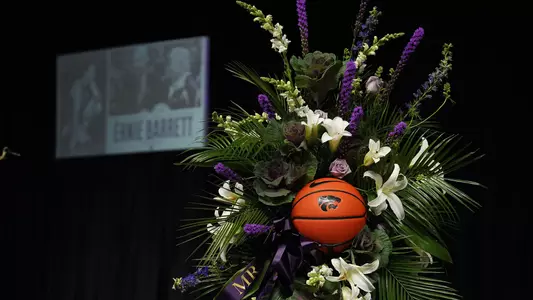
Nine flower arrangements, including one with a basketball, neatly lined a dark stage upon midcourt of the hardwood floor at Bramlage Coliseum, a black wall curtain and purple floor lamps accentuating the basketball goal on each end of the court. Eighty people sat upon purple chairs. Hundreds more filled the bleachers. The arena videoboard featured a photo slideshow. A digital display at the top of the videoboard read: "MR. K-STATE / HALL OF FAME / ERNIE BARRETT / 1929-2023." Directly below in front of the black pulpit rested a large purple wall of flowers with white roses forming the letter "K."
Frank Sinatra sang "When you're smiling, the whole world smiles with you." Then the K-State pep band played. And the photos, there were so many photos: Ernie and Bonnie walking down the aisle in their wedding attire, Ernie digging into earth at a groundbreaking, Ernie and Bonnie wearing nametags and an event, Ernie wrapping his arm around Jim Colbert, Ernie holding a large-mouth bass, Ernie smiling and holding a silver "9" and "0" balloons, Ernie standing with Jack Vanier, Ernie wearing a Boston Celtics jersey, Ernie holding grandson Ryan, and Ernie draping his right arm upon the shoulder of a seated Tex Winter. Oh, there were more, far more, a trail of days and years and memories and laughs leading to today, a Celebration of Life, for a wonderful man.
"My grandfather will forever be known as 'Mr. K-State,'" grandson Ryan Barrett said during the service. "But I don't want the Mr. K-State perspective to be the only one shared today. I want to lift that veil and offer a new one. He was a willful mentor, ferocious advocate, loyal friend, fervent father, tender husband, and so much more.
"To me, he was my Papa."

Ernie Barrett passed away April 21 surrounded by his family in Manhattan. He was 93. The man, the legend, the king of the crushing handshake, the 1951 Second Team All-American, Boston Celtic, and K-State assistant coach, administrator, athletic director and No. 1 fundraiser who dedicated more than 70 years to K-State athletics, will be laid to rest in Sunset Cemetery.
Barrett was known for so much.
To Ryan, he was the one who taught him to cast a line and clean a fish. He helped him with his golf swing and basketball footwork. He traded him $20 for every 'A' on his report card. He showed off his ability to domesticate wild rabbits, which he fed out of his hand. Ryan and Papa watched westerns. Rawhide was their favorite TV show. Wine was Papa's favorite. Every Christmas, Brad Barrett bought his father a wrapped bottle of wine. Papa wore the bow on his head.
"We didn't need to see the bow on your head to know you were a gift, Papa," Ryan said.
Ernie Barrett was a gift to so many.
"His lifelong career at Kansas State University as an athlete, coach, administrator, fundraiser, advocate and promoter will never be forgotten," Bill Snyder said, standing behind the pulpit. "Ernie Barrett will not be forgotten. His legacy will live on forever."

There's a story Mike Clark likes to tell, so let him tell it. Clark, who remains the all-time winningest coach in K-State history, is the Senior Director of Development for K-State Athletics, and learned quite a few stories from Barrett over Clark's 37-year residence in Manhattan.
Clark shared how Barrett was roommates with Bob Cousey on the road when he played for the Celtics. The players called Barrett "Rook." Clark said this was Barrett's favorite story, how Cousey returned to the hotel late, slept on the bus, and then scored 45 points in Madison Square Garden that night. Clark said that Barrett told the story hundreds of times and would laugh and laugh. Clark said that K-State beating Kentucky in the 2018 Sweet 16 in Atlanta was "one of the most special things in his life," given that K-State suffered a loss to Kentucky in the 1951 national championship game.
"We hugged and we hugged," Clark said, "and my back still has never been the same after he lifted me off the ground."
Every other Sunday for the past 3 ½ years, the Barretts and Clarks dined at Old Chicago. Barrett always ordered two personal thin mini pizzas, one personal thin veggie pizza, one child's order of macaroni and cheese, and yogurt and strawberries. Clark brought the food to the Barretts' home, and they ate while watching K-State play in the Elite Eight this March.
"We're going to miss Ernie. We're all going to miss him. Thank you for allowing us to have the time with such an amazing man. We loved him, and we love you," Clark said, pointing to Bonnie, who was seated near the middle of the front row.
Another story. As the final three minutes rolled off the clock, Barrett, hardened by the atrocity of the infamous streak, stood in Section 5 at Bramlage Coliseum, wearing a collared shirt that matched K-State's old-school lavender jerseys, and attempted to put it all into words. Little by little, the Wildcats' icon with broad shoulders and an iron-clad handshake slowly melted into butter until his eyes, the ones that thought they had seen it all, finally became watery near the end of the Wildcats' 84-75 win over No. 2 Kansas on January 30, 2008.
"We did it tonight, buddy," Barrett said.
A friend turned around. "Still two minutes left."
"Oh, bull," Barrett replied. "We're going to win it."
Barrett raised his granite fists into the air as the deafening crowd of 12,528 reached ear-popping levels and time dwindled on the Wildcats' first victory over the Jayhawks in Bramlage history.
"Everybody told me long ago that the noise in Bramlage wasn't like Ahearn," Barrett said. "I said, 'Listen, you fill this damn thing, and it will be.'"
Mr. K-State headed out into the cold nighttime air, head held high and burning with the same competitive fire that stewed inside for more than half a century.
"Ernie was competitive," Clark said. "Who's known a more competitive individual than Ernie Barrett? He always expressed his enthusiasm for anything that was important to him.
"Kansas State was certainly important to him."

The bone-jarring handshake is the first thing we'll remember. It was unlike anything anyone would experience in life. You always remembered that first handshake. You braced yourself for it every time after. It was the handshake of friendship, the handshake of trust, the handshake of acceptance, the handshake of love. There was simply nothing quite like it and there will never be anything quite like it. There's a reason why when they erected a statue of Barrett in 1999, his hand was extended. That was Barrett.
Did Barrett begin his signature handshake when he led Wellington High School to its lone state championship in 1947? Did he begin it when he led K-State to the national championship game in 1951? Did he begin it at the Sigma Alpha Epsilon house? Or when he was drafted No. 7 overall by the Boston Celtics? Did he crush the hands of Cousey and Red Auerbach? There's really no telling. But when he shook your hand, he meant it. In the business world, it was a deal maker.
Barrett returned to K-State as an assistant coach under Tex Winter and was a part of two Final Fours in 1959 and 1964.
"I remember when I was an assistant coach under Tex, I wanted to be a head coach," Barrett once said. "People said, 'Well, you don't have any coaching experience.' I never got to be a head coach, so I got into administration."
There was never a better fundraiser in K-State history.
In 1961, Barrett joined the athletics staff as assistant athletic director in charge of fundraising and promotions. Barrett spearheaded fundraising campaigns for KSU Stadium, the athletic dormitory, synthetic turf on the football field, and the R.V. Christian Track and Field Complex.
K-State President James McCain bestowed upon Barrett the title of "Mr. K-State" and Barrett was promoted from assistant athletic director in charge of fundraising and promotions to the school's fifth athletic director in May 1969, becoming the first Kansas-born athlete to lead K-State's athletic program.
"It was one of the most outstanding positions I had in the world of intercollegiate athletics," Barrett once said. "I enjoyed the opportunity to make decisions that needed to be made."
He led fundraising efforts for a number of projects including continued enhancements to KSU Stadium, the construction of the Vanier Football Complex, and K-State athletic dormitory. Barrett also began laying the fundraising foundation for what would eventually be Bramlage Coliseum.
The list of facilities that Barrett touched goes on and on — the Dev Nelson Press Box, the first indoor football facility, the Academic Learning Center, Tointon Family Stadium, Colbert Hills Golf Course and expanded Vanier Football Complex.
"Every time Ernie was with you, he'd always ask the same question: 'What can I do to help?'" Snyder said. "And he meant it with a passion. He loved this university and always felt that the university and people of this university had done so much for him. He wanted to repay it."

Kevin Ingram of Manhattan Christian College put it this way: "Ernie Barrett used his excitement and gifts and abilities to go through life and help others be their best. A position can be replaceable, but a person like that leaves an indelible mark that lasts on. Ernie was a champion on the court, but more important than that, he spent the rest of his life being a champion to other people. And that's why he earned the title, 'Mr. K-State.'"
To Ryan, he was Papa.
"He was and is a legend to so many, but to me he was something words cannot describe," Ryan said. "Even as I grew and he grew older, I always saw him as someone 10 feet tall. He was the full-bore intense force of nature in everything he did. He was that way just being a grandpa. Even something as simple as driving to Wichita to surprise me at a grade-school play and clapping louder than the rest of the crowd. He had a swag and demeanor and status that was just unattainable by us mortal men.
"Today, I feel that more than ever."
Ryan continued.
"'More than ever.' Those were the last words my grandfather spoke to me in response to telling him goodbye. Those who knew him in his later years knew he struggled to find the right words at times. I just smiled and translated that to mean, 'Goodbye, thanks for coming, and love you, too.' But I think maybe he meant exactly what he said that day — 'More than ever, goodbye; more than ever, thanks for coming; more than ever, I love you, too."
Ryan paused.
"Papa, more than ever, thank you for everything that you did for me. More than ever, I'm going to miss the hell out of you. More than ever, I will always love you."
In lieu of flowers, the family suggests donations be made to a memorial for Barrett that has been established at the Kansas State University Foundation with donations benefitting the Ernie and Bonnie Barrett Family Men's Basketball Scholarship. Contributions may be sent to: KSU Foundation, 1800 Kimball Ave., Ste 200, Manhattan, KS 66502, please indicate fund M47447. To make a gift online, click here.
Nine flower arrangements, including one with a basketball, neatly lined a dark stage upon midcourt of the hardwood floor at Bramlage Coliseum, a black wall curtain and purple floor lamps accentuating the basketball goal on each end of the court. Eighty people sat upon purple chairs. Hundreds more filled the bleachers. The arena videoboard featured a photo slideshow. A digital display at the top of the videoboard read: "MR. K-STATE / HALL OF FAME / ERNIE BARRETT / 1929-2023." Directly below in front of the black pulpit rested a large purple wall of flowers with white roses forming the letter "K."
Frank Sinatra sang "When you're smiling, the whole world smiles with you." Then the K-State pep band played. And the photos, there were so many photos: Ernie and Bonnie walking down the aisle in their wedding attire, Ernie digging into earth at a groundbreaking, Ernie and Bonnie wearing nametags and an event, Ernie wrapping his arm around Jim Colbert, Ernie holding a large-mouth bass, Ernie smiling and holding a silver "9" and "0" balloons, Ernie standing with Jack Vanier, Ernie wearing a Boston Celtics jersey, Ernie holding grandson Ryan, and Ernie draping his right arm upon the shoulder of a seated Tex Winter. Oh, there were more, far more, a trail of days and years and memories and laughs leading to today, a Celebration of Life, for a wonderful man.
"My grandfather will forever be known as 'Mr. K-State,'" grandson Ryan Barrett said during the service. "But I don't want the Mr. K-State perspective to be the only one shared today. I want to lift that veil and offer a new one. He was a willful mentor, ferocious advocate, loyal friend, fervent father, tender husband, and so much more.
"To me, he was my Papa."
Ernie Barrett passed away April 21 surrounded by his family in Manhattan. He was 93. The man, the legend, the king of the crushing handshake, the 1951 Second Team All-American, Boston Celtic, and K-State assistant coach, administrator, athletic director and No. 1 fundraiser who dedicated more than 70 years to K-State athletics, will be laid to rest in Sunset Cemetery.
Barrett was known for so much.
To Ryan, he was the one who taught him to cast a line and clean a fish. He helped him with his golf swing and basketball footwork. He traded him $20 for every 'A' on his report card. He showed off his ability to domesticate wild rabbits, which he fed out of his hand. Ryan and Papa watched westerns. Rawhide was their favorite TV show. Wine was Papa's favorite. Every Christmas, Brad Barrett bought his father a wrapped bottle of wine. Papa wore the bow on his head.
"We didn't need to see the bow on your head to know you were a gift, Papa," Ryan said.
Ernie Barrett was a gift to so many.
"His lifelong career at Kansas State University as an athlete, coach, administrator, fundraiser, advocate and promoter will never be forgotten," Bill Snyder said, standing behind the pulpit. "Ernie Barrett will not be forgotten. His legacy will live on forever."
There's a story Mike Clark likes to tell, so let him tell it. Clark, who remains the all-time winningest coach in K-State history, is the Senior Director of Development for K-State Athletics, and learned quite a few stories from Barrett over Clark's 37-year residence in Manhattan.
Clark shared how Barrett was roommates with Bob Cousey on the road when he played for the Celtics. The players called Barrett "Rook." Clark said this was Barrett's favorite story, how Cousey returned to the hotel late, slept on the bus, and then scored 45 points in Madison Square Garden that night. Clark said that Barrett told the story hundreds of times and would laugh and laugh. Clark said that K-State beating Kentucky in the 2018 Sweet 16 in Atlanta was "one of the most special things in his life," given that K-State suffered a loss to Kentucky in the 1951 national championship game.
"We hugged and we hugged," Clark said, "and my back still has never been the same after he lifted me off the ground."
Every other Sunday for the past 3 ½ years, the Barretts and Clarks dined at Old Chicago. Barrett always ordered two personal thin mini pizzas, one personal thin veggie pizza, one child's order of macaroni and cheese, and yogurt and strawberries. Clark brought the food to the Barretts' home, and they ate while watching K-State play in the Elite Eight this March.
"We're going to miss Ernie. We're all going to miss him. Thank you for allowing us to have the time with such an amazing man. We loved him, and we love you," Clark said, pointing to Bonnie, who was seated near the middle of the front row.
Another story. As the final three minutes rolled off the clock, Barrett, hardened by the atrocity of the infamous streak, stood in Section 5 at Bramlage Coliseum, wearing a collared shirt that matched K-State's old-school lavender jerseys, and attempted to put it all into words. Little by little, the Wildcats' icon with broad shoulders and an iron-clad handshake slowly melted into butter until his eyes, the ones that thought they had seen it all, finally became watery near the end of the Wildcats' 84-75 win over No. 2 Kansas on January 30, 2008.
"We did it tonight, buddy," Barrett said.
A friend turned around. "Still two minutes left."
"Oh, bull," Barrett replied. "We're going to win it."
Barrett raised his granite fists into the air as the deafening crowd of 12,528 reached ear-popping levels and time dwindled on the Wildcats' first victory over the Jayhawks in Bramlage history.
"Everybody told me long ago that the noise in Bramlage wasn't like Ahearn," Barrett said. "I said, 'Listen, you fill this damn thing, and it will be.'"
Mr. K-State headed out into the cold nighttime air, head held high and burning with the same competitive fire that stewed inside for more than half a century.
"Ernie was competitive," Clark said. "Who's known a more competitive individual than Ernie Barrett? He always expressed his enthusiasm for anything that was important to him.
"Kansas State was certainly important to him."
The bone-jarring handshake is the first thing we'll remember. It was unlike anything anyone would experience in life. You always remembered that first handshake. You braced yourself for it every time after. It was the handshake of friendship, the handshake of trust, the handshake of acceptance, the handshake of love. There was simply nothing quite like it and there will never be anything quite like it. There's a reason why when they erected a statue of Barrett in 1999, his hand was extended. That was Barrett.
Did Barrett begin his signature handshake when he led Wellington High School to its lone state championship in 1947? Did he begin it when he led K-State to the national championship game in 1951? Did he begin it at the Sigma Alpha Epsilon house? Or when he was drafted No. 7 overall by the Boston Celtics? Did he crush the hands of Cousey and Red Auerbach? There's really no telling. But when he shook your hand, he meant it. In the business world, it was a deal maker.
Barrett returned to K-State as an assistant coach under Tex Winter and was a part of two Final Fours in 1959 and 1964.
"I remember when I was an assistant coach under Tex, I wanted to be a head coach," Barrett once said. "People said, 'Well, you don't have any coaching experience.' I never got to be a head coach, so I got into administration."
There was never a better fundraiser in K-State history.
In 1961, Barrett joined the athletics staff as assistant athletic director in charge of fundraising and promotions. Barrett spearheaded fundraising campaigns for KSU Stadium, the athletic dormitory, synthetic turf on the football field, and the R.V. Christian Track and Field Complex.
K-State President James McCain bestowed upon Barrett the title of "Mr. K-State" and Barrett was promoted from assistant athletic director in charge of fundraising and promotions to the school's fifth athletic director in May 1969, becoming the first Kansas-born athlete to lead K-State's athletic program.
"It was one of the most outstanding positions I had in the world of intercollegiate athletics," Barrett once said. "I enjoyed the opportunity to make decisions that needed to be made."
He led fundraising efforts for a number of projects including continued enhancements to KSU Stadium, the construction of the Vanier Football Complex, and K-State athletic dormitory. Barrett also began laying the fundraising foundation for what would eventually be Bramlage Coliseum.
The list of facilities that Barrett touched goes on and on — the Dev Nelson Press Box, the first indoor football facility, the Academic Learning Center, Tointon Family Stadium, Colbert Hills Golf Course and expanded Vanier Football Complex.
"Every time Ernie was with you, he'd always ask the same question: 'What can I do to help?'" Snyder said. "And he meant it with a passion. He loved this university and always felt that the university and people of this university had done so much for him. He wanted to repay it."
Kevin Ingram of Manhattan Christian College put it this way: "Ernie Barrett used his excitement and gifts and abilities to go through life and help others be their best. A position can be replaceable, but a person like that leaves an indelible mark that lasts on. Ernie was a champion on the court, but more important than that, he spent the rest of his life being a champion to other people. And that's why he earned the title, 'Mr. K-State.'"
To Ryan, he was Papa.
"He was and is a legend to so many, but to me he was something words cannot describe," Ryan said. "Even as I grew and he grew older, I always saw him as someone 10 feet tall. He was the full-bore intense force of nature in everything he did. He was that way just being a grandpa. Even something as simple as driving to Wichita to surprise me at a grade-school play and clapping louder than the rest of the crowd. He had a swag and demeanor and status that was just unattainable by us mortal men.
"Today, I feel that more than ever."
Ryan continued.
"'More than ever.' Those were the last words my grandfather spoke to me in response to telling him goodbye. Those who knew him in his later years knew he struggled to find the right words at times. I just smiled and translated that to mean, 'Goodbye, thanks for coming, and love you, too.' But I think maybe he meant exactly what he said that day — 'More than ever, goodbye; more than ever, thanks for coming; more than ever, I love you, too."
Ryan paused.
"Papa, more than ever, thank you for everything that you did for me. More than ever, I'm going to miss the hell out of you. More than ever, I will always love you."
In lieu of flowers, the family suggests donations be made to a memorial for Barrett that has been established at the Kansas State University Foundation with donations benefitting the Ernie and Bonnie Barrett Family Men's Basketball Scholarship. Contributions may be sent to: KSU Foundation, 1800 Kimball Ave., Ste 200, Manhattan, KS 66502, please indicate fund M47447. To make a gift online, click here.

K-State Baseball | Highlights vs Michigan - Feb. 22, 2026
Monday, February 23
K-State Men's Basketball | Postgame Press Conference at Texas Tech
Sunday, February 22
K-State Women's Basketball | Tess Heal Senior Video
Sunday, February 22
K-State Women's Basketball | Mikayla Parks Senior Video
Sunday, February 22