Always Moving Forward
Jul 10, 2023 | Football, Sports Extra
By: D. Scott Fritchen
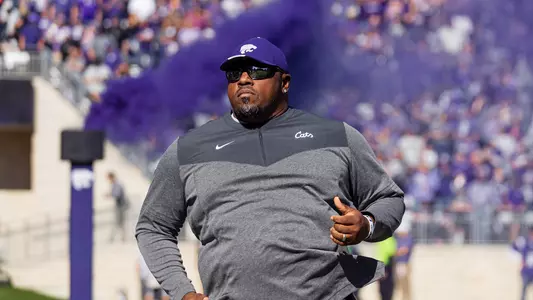
Once known for running over defenders as one of the most bruising running backs in Kansas State history, Joe Hall is making his impact felt within the football program in a different way these days.
Hall enters his fifth year as Director of Student-Athlete Development in 2023. Hall creates, develops and implements a student-athlete development program that fosters an environment of well-being and achievement. He serves as the program's liaison to various K-State Athletics support areas, including sport psychologist, athletic trainers, strength and conditioning coaches and student-athlete services, in addition to support services on campus.
Hall has developed various programs such as P.R.O. Cats and Cats' Culture. Hall published a book titled "Pay for Play: High Stake and Mental State" in July 2022, which details some of the challenges of young student-athletes years ago and how they intersect, mirror and alleviate from challenges faced by today's student-athlete.
A native of Compton, California, Hall lettered in 1999 and 2000 for the Wildcats. He went on to play parts of four seasons in the NFL. He obtained his bachelor's degree from K-State in 2012, a master's of science degree in management from MidAmerica Nazarene in 2015 and a master's in school counseling from K-State in 2019. He is currently working toward his doctorate degree in organizational leadership.
Hall and his wife, Hollie, have four children — Joe III, Jorryn, Joss and Jagger. Joe III is a safety for the Wildcats.
Hall spoke with K-State Sports Extra's D. Scott Fritchen about his career with the Wildcats:
D. SCOTT FRITCHEN: Just how busy was June for you?
JOE HALL: This was one of my busiest times as we are in the transition with getting incoming freshmen and newcomers onto campus and assisting with their housing and filling out the appropriate paperwork for their eligibility and just helping them through the first couple of weeks. Although I'm not traveling on the road like the assistant coaches on staff, I have 25 new guys who I cannot let slip through the cracks. It's a fulfilling time because I know the value of young players ultimately getting off to a fast start, making that first impression with the coaches, and staying in the good graces of their coaches.
My normal day consists of having conversations with players who are experiencing specific issues. We did pretty well as a team academically and everyone on staff played a role in that accomplishment. We want the new players to understand the expectations and the culture.

FRITCHEN: You have a beautiful family and a great job. What is the routine when it comes to balancing work and personal life?
HALL: That's probably the toughest balance, mainly because I'm much less understanding of my own kids making mistakes than I am with these young men making mistakes. I have 124 guys who are like children to me, but honestly, I have much more patience for them than I do for my own kids. I really care about my own family and this extended family. I try to fill that void that some of the players here might be missing. That can be a fulltime job in itself and it's something I continue to work on. My kids, not only my oldest son who's here now, but my three younger children, are entrenched in sports. I care about my children and these young guys. That's the theme of it all and that helps out a lot.
I tell the young guys coming in every year that I was put on this planet to be a star athlete. I'd never seen a person my size who could do the things I could do, and I say that as humbly as possible, but the sport came easy to me. I picked up on things really naturally. Even in class, I was able to pick up on things and I think that created some of the issues with understanding how difficult it was to push yourself beyond those limits. In my older age, I've come to the fact and my goal and my responsibility was to help young people get to where they wanted to get, and it wasn't about scoring touchdowns, it was more about watching other people do those things. It didn't have to be in sports, it could've been in anything, but it was just my way to getting back to helping young people and that's the coolest part. I get a lot of excitement and fulfillment from watching other people reach their goals. That's great in itself.
FRITCHEN: How exciting is this time in Joe Hall's life?
HALL: It's great. Coach Klieman asked me following the year about my five-year plan and what I wanted to do long term and I'm fulfilled. In the past, I always wanted to be the most wealthy and most successful. Now I'm comfortable where I am and I want to achieve great things within my realm. I'm still in that growth process of trying to learn as much as I can — and it's to help in this environment. Once again, that's not something I anticipated. I always thought I was going to be the best football player and I'd have a Hall of Fame jacket. I would've never imagined being in this position, but that's the coolest part about all this. I don't have to chase any more money. That's not for me anymore. One of the coolest things about Manhattan is it allows you to keep your mind on what's important. I'm blessed to have this opportunity and to be in this situation.
FRITCHEN: If you could go back to Compton and say anything to your former self, what would you say?
HALL: I would tell myself to trust the adults around you. I always felt like I outgrew things in sports that my parents were able to help me with. I experienced things that they never knew existed other than hearing about it on ESPN, but the lessons that they taught me, the platform and foundation of everything they were saying, was absolutely right. That's probably one of the most frustrating things of the position I'm in now is that as a father, I tell the kids I have the answers to the test and it's not because I'm a genius; it's because I have life experience. I don't know what page you're on right now or what test you're taking, but if you share with me what you're going through, I think I have a pretty good insight on how to get through it. My dad was formally educated and it was the same story then. He wasn't telling me things to put extra pressure on me; he was telling me things because he loved me and wanted to see me succeed.
Going back to Compton, California, we are kind of molded because of the things going on in Compton. Good or bad, you're molded to respond to certain things in a certain way. I never thought that I doubted my parents or grandparents or aunts or uncles. I had great role models. But I did doubt them to a certain extent because it really wasn't what I was seeing. My parents were telling me I could have everything I wanted in life, get an education, go as hard as you can and treat people well. I knew people who'd done that and had failed and people who'd been murdered. It didn't seem like the full-proof plan that it is. I'd tell myself to listen to what my mom and dad were saying because they were proven to have my best interests in mind. That's one thing I'd change if I could go back, not the experiences so much, but more than idea of saving them some heartache by being the person they knew I could be.
FRITCHEN: What led you to decide to come back to K-State and get your degree in 2012?
HALL: I always attributed education or college to Kansas State after my arrival here. There were a lot of guys that I played with in the NFL with different teams, and they were so proud of their universities. I thought if I was ever going to finish my degree I wanted it to be from Kansas State University. I never planned on coming back here as an employee at Kansas State but that was everything just fell into place for that to take place. The motivation early on was to be a part of the number of guys who came here from other places and made Kansas State home and to be a guy to graduate. Coach Snyder let it be known that we were going to hold ourself to a different standard than everybody else as far as graduation rates. I messed that up early on. I wanted to come back and fix it. I needed to do that to start the ball rolling. It worked out.

FRITCHEN: What prompted your passion for counseling?
HALL: Hopefully I could save somebody that needed someone to talk to. That's how it worked out with counseling. I went to MidAmerica Nazarene and I was going back and forth five times a week, and my wife had the kids were here, all four children, and I decided that I'd get a master's degree. I spoke with the coach there at the time and he said they'd give me a graduate assistant and go to school for free. I wanted to do something that was more than getting a master's degree. Counseling was one of them and organizational leadership was another. I interviewed for the master's program and when they reviewed my resume, they wondered why this tough guy wanted to get into a therapeutic situation where you show empathy for other people. I wanted to show that football players had the capacity to care for others. I wanted to do mental health studies, and substance abuse, and marriage and family. School counseling kept pulling me toward athletics. The challenge in counseling was to help more people who'd experienced what I'd experienced and who came from where I'd come from and had luckily survived to come out the other end and then I wanted to help somebody else.
FRITCHEN: How much longer until you become Dr. Joe Hall Jr.?
HALL: I have a year. Once football season starts it becomes difficult to stay up late at night and type a paper. So I took a year off this past season, but I have a year back and my dissertation is basically what's left. It's the idea of finishing it out and being a role model for my kids and other kids so they understand that everything is possible. I share with our guys all the time that I had a 0.333 grade-point average here at one time. Coach Snyder almost killed me. I was dismissed from the university and had to appeal to be reinstated. I'm 43 years old today and it's totally different. People have no idea that I was ever a poor student. I'm able to sit in there and be the guy who has As and Bs in the program. Truly, it was a do-over in terms of academics. From their standpoint, they asked me questions and they don't know about my past but they know that it is pretty cool that I want to help other people.
FRITCHEN: What prompted you to write your book?
HALL: I never saw myself as anybody who people would think had it all figured out. I realized that I had never told anyone the stories that made me seem weak, not necessarily the mistakes that I made, but the things that I couldn't control, and that was the toughest part. My parents know that I'm taking medication now and they know I'm taking anxiety and depression medication, but they don't know when I started struggling with that. I thought I should put out a book, not that I knew where to begin, but I wanted to let people know that I wasn't raised to be weak or to hide behind resources that are available for mental health. I grew up in a household where that stuff didn't even exist and I didn't think it existed. I believed that I was weak and I had to figure out, "Man, why can't I get through this stuff?" It bothered me that there are more people that believe that you can just muscle through those things and just move on. I know people who are no longer around because of those same things.
I think a lot of guys who were able to read the book, in different chapters, were able to say, "Man, I'm feeling that same way." That's all it was. It was kind of weird to put it out because everybody kept praising me for being open, but that's not a problem of mine. I've always been transparent in that way. I couldn't have found a better time to write the book than when my son was finishing his senior year of high school and my other children were getting to that age where they could understand things a little differently, and then being around a bunch of young men who fall into that category of young adulthood to adulthood, which was the most tumultuous time of my life. The book was the opportunity to get the message to a mass of people if they needed it. I was pretty proud that I was able to do that.

FRITCHEN: Things have changed over the past 25 years. What are the biggest challenges facing a football student-athlete in 2023?
HALL: There's an overall idea of more pressure being put on success as far as the one-track mindset of "this is way that I have to be successful." Parents and adults really tell them the true stories around success. Not a lot of people get it the first time around. Not a lot of people are going to experience it without resiliency and just the desire to take a butt kicking, and I think that comes from the adults involved. I want my kids to have an easier existence than I did. When you do that, you miss and remove some of the things that made you what you are.
There's nothing I can create for Joe Hall III that is anywhere near Compton, California, when I was growing up. That's what made me what I was. I think the kids are different, obviously, and their expectations for things are different, and their tendencies to see things through because they're worried they'll fail if they continue down this road. These kids are far more intelligent and exposed to different things than we were. They have instant access and instant gratification. We didn't. There's more symmetry in how people do things today than there's ever been. That's probably the biggest difference. These days, you can't tell a kid not to worry about the money. You can't say that a player isn't focused on football. That's football now. That's college sports now. As adults we have to wrap our heads around that it's forever going to be different. Achievement is going to look different and it seems easier because it is. It's much easier. But they've also been exposed to things that we didn't as well.
FRITCHEN: What have you learned most about yourself during your journey?
HALL: Probably normalcy, just the idea that people make mistakes, and the biggest mistake is probably the one that you don't try to go back and fix. I struggled with that for the longest time. I always tried to fix the mistake that I made and make it better, but that's impossible. I can't go back and fix things that I've done but I can do enough going forward that it removes that issue. I was far more suited for that than I was. When I was in my deepest, darkest spot, I thought I'd dug a hole that was insurmountable, that I couldn't come out of. That's where you get those hopeless and helpless kind of feelings. I realized that I'm much stronger than I was and where that came from. Once you realize where that comes from and what you're capable of, then the mistakes that you made don't have the same bearing that they once did.
I'm still disappointed that I allowed my career to play out like it did as a young athlete, but as far as moving forward, I have everything that I need, and that's because I chose to stick with it. It wasn't because I had to be perfect. You don't have to be perfect, but the perfection comes in the idea of responding to the things that you weren't comfortable with. That's the biggest thing.
I talked to my mom one time and said I was done playing football and I was being offered by the Green Bay Packers to do a workout. I was 26 years old at the time. I remember telling my mom I was sick of traveling to all these places. I was going to Green Bay because I said I was supposed to be a NFL player. In that conversation, you get to a point where, I was doing this because I wanted to make my parents proud and for them to know that everything that they did for me paid off. She said, "What do you mean? You made us proud years ago." And that was the end of my playing career and that was the answer that I had. It lined up perfectly. However, if they would've told me any differently, I would probably still be trying to get my knees right to run. Instead, I was provided with another outlet to go fix those things. It didn't change the fact that I want to be a high achiever or the fact that I wanted to be the best or effective. It just pointed me in different direction.
Whatever it is that you believe in, I feel like God pointed me and said, "I'm going to throw you a bone here and let you off the hook." I don't think it would've happened naturally. If it was anywhere else than Green Bay, Wisconsin, which was freezing, I mean, it had to line up perfectly. It just aligned that way. I figured out I was a lot more resilient, determined and capable to do other things that would allow me to be successful and open doors in a different matter.
Once known for running over defenders as one of the most bruising running backs in Kansas State history, Joe Hall is making his impact felt within the football program in a different way these days.
Hall enters his fifth year as Director of Student-Athlete Development in 2023. Hall creates, develops and implements a student-athlete development program that fosters an environment of well-being and achievement. He serves as the program's liaison to various K-State Athletics support areas, including sport psychologist, athletic trainers, strength and conditioning coaches and student-athlete services, in addition to support services on campus.
Hall has developed various programs such as P.R.O. Cats and Cats' Culture. Hall published a book titled "Pay for Play: High Stake and Mental State" in July 2022, which details some of the challenges of young student-athletes years ago and how they intersect, mirror and alleviate from challenges faced by today's student-athlete.
A native of Compton, California, Hall lettered in 1999 and 2000 for the Wildcats. He went on to play parts of four seasons in the NFL. He obtained his bachelor's degree from K-State in 2012, a master's of science degree in management from MidAmerica Nazarene in 2015 and a master's in school counseling from K-State in 2019. He is currently working toward his doctorate degree in organizational leadership.
Hall and his wife, Hollie, have four children — Joe III, Jorryn, Joss and Jagger. Joe III is a safety for the Wildcats.
Hall spoke with K-State Sports Extra's D. Scott Fritchen about his career with the Wildcats:
D. SCOTT FRITCHEN: Just how busy was June for you?
JOE HALL: This was one of my busiest times as we are in the transition with getting incoming freshmen and newcomers onto campus and assisting with their housing and filling out the appropriate paperwork for their eligibility and just helping them through the first couple of weeks. Although I'm not traveling on the road like the assistant coaches on staff, I have 25 new guys who I cannot let slip through the cracks. It's a fulfilling time because I know the value of young players ultimately getting off to a fast start, making that first impression with the coaches, and staying in the good graces of their coaches.
My normal day consists of having conversations with players who are experiencing specific issues. We did pretty well as a team academically and everyone on staff played a role in that accomplishment. We want the new players to understand the expectations and the culture.
FRITCHEN: You have a beautiful family and a great job. What is the routine when it comes to balancing work and personal life?
HALL: That's probably the toughest balance, mainly because I'm much less understanding of my own kids making mistakes than I am with these young men making mistakes. I have 124 guys who are like children to me, but honestly, I have much more patience for them than I do for my own kids. I really care about my own family and this extended family. I try to fill that void that some of the players here might be missing. That can be a fulltime job in itself and it's something I continue to work on. My kids, not only my oldest son who's here now, but my three younger children, are entrenched in sports. I care about my children and these young guys. That's the theme of it all and that helps out a lot.
I tell the young guys coming in every year that I was put on this planet to be a star athlete. I'd never seen a person my size who could do the things I could do, and I say that as humbly as possible, but the sport came easy to me. I picked up on things really naturally. Even in class, I was able to pick up on things and I think that created some of the issues with understanding how difficult it was to push yourself beyond those limits. In my older age, I've come to the fact and my goal and my responsibility was to help young people get to where they wanted to get, and it wasn't about scoring touchdowns, it was more about watching other people do those things. It didn't have to be in sports, it could've been in anything, but it was just my way to getting back to helping young people and that's the coolest part. I get a lot of excitement and fulfillment from watching other people reach their goals. That's great in itself.
FRITCHEN: How exciting is this time in Joe Hall's life?
HALL: It's great. Coach Klieman asked me following the year about my five-year plan and what I wanted to do long term and I'm fulfilled. In the past, I always wanted to be the most wealthy and most successful. Now I'm comfortable where I am and I want to achieve great things within my realm. I'm still in that growth process of trying to learn as much as I can — and it's to help in this environment. Once again, that's not something I anticipated. I always thought I was going to be the best football player and I'd have a Hall of Fame jacket. I would've never imagined being in this position, but that's the coolest part about all this. I don't have to chase any more money. That's not for me anymore. One of the coolest things about Manhattan is it allows you to keep your mind on what's important. I'm blessed to have this opportunity and to be in this situation.
FRITCHEN: If you could go back to Compton and say anything to your former self, what would you say?
HALL: I would tell myself to trust the adults around you. I always felt like I outgrew things in sports that my parents were able to help me with. I experienced things that they never knew existed other than hearing about it on ESPN, but the lessons that they taught me, the platform and foundation of everything they were saying, was absolutely right. That's probably one of the most frustrating things of the position I'm in now is that as a father, I tell the kids I have the answers to the test and it's not because I'm a genius; it's because I have life experience. I don't know what page you're on right now or what test you're taking, but if you share with me what you're going through, I think I have a pretty good insight on how to get through it. My dad was formally educated and it was the same story then. He wasn't telling me things to put extra pressure on me; he was telling me things because he loved me and wanted to see me succeed.
Going back to Compton, California, we are kind of molded because of the things going on in Compton. Good or bad, you're molded to respond to certain things in a certain way. I never thought that I doubted my parents or grandparents or aunts or uncles. I had great role models. But I did doubt them to a certain extent because it really wasn't what I was seeing. My parents were telling me I could have everything I wanted in life, get an education, go as hard as you can and treat people well. I knew people who'd done that and had failed and people who'd been murdered. It didn't seem like the full-proof plan that it is. I'd tell myself to listen to what my mom and dad were saying because they were proven to have my best interests in mind. That's one thing I'd change if I could go back, not the experiences so much, but more than idea of saving them some heartache by being the person they knew I could be.
FRITCHEN: What led you to decide to come back to K-State and get your degree in 2012?
HALL: I always attributed education or college to Kansas State after my arrival here. There were a lot of guys that I played with in the NFL with different teams, and they were so proud of their universities. I thought if I was ever going to finish my degree I wanted it to be from Kansas State University. I never planned on coming back here as an employee at Kansas State but that was everything just fell into place for that to take place. The motivation early on was to be a part of the number of guys who came here from other places and made Kansas State home and to be a guy to graduate. Coach Snyder let it be known that we were going to hold ourself to a different standard than everybody else as far as graduation rates. I messed that up early on. I wanted to come back and fix it. I needed to do that to start the ball rolling. It worked out.
FRITCHEN: What prompted your passion for counseling?
HALL: Hopefully I could save somebody that needed someone to talk to. That's how it worked out with counseling. I went to MidAmerica Nazarene and I was going back and forth five times a week, and my wife had the kids were here, all four children, and I decided that I'd get a master's degree. I spoke with the coach there at the time and he said they'd give me a graduate assistant and go to school for free. I wanted to do something that was more than getting a master's degree. Counseling was one of them and organizational leadership was another. I interviewed for the master's program and when they reviewed my resume, they wondered why this tough guy wanted to get into a therapeutic situation where you show empathy for other people. I wanted to show that football players had the capacity to care for others. I wanted to do mental health studies, and substance abuse, and marriage and family. School counseling kept pulling me toward athletics. The challenge in counseling was to help more people who'd experienced what I'd experienced and who came from where I'd come from and had luckily survived to come out the other end and then I wanted to help somebody else.
FRITCHEN: How much longer until you become Dr. Joe Hall Jr.?
HALL: I have a year. Once football season starts it becomes difficult to stay up late at night and type a paper. So I took a year off this past season, but I have a year back and my dissertation is basically what's left. It's the idea of finishing it out and being a role model for my kids and other kids so they understand that everything is possible. I share with our guys all the time that I had a 0.333 grade-point average here at one time. Coach Snyder almost killed me. I was dismissed from the university and had to appeal to be reinstated. I'm 43 years old today and it's totally different. People have no idea that I was ever a poor student. I'm able to sit in there and be the guy who has As and Bs in the program. Truly, it was a do-over in terms of academics. From their standpoint, they asked me questions and they don't know about my past but they know that it is pretty cool that I want to help other people.
FRITCHEN: What prompted you to write your book?
HALL: I never saw myself as anybody who people would think had it all figured out. I realized that I had never told anyone the stories that made me seem weak, not necessarily the mistakes that I made, but the things that I couldn't control, and that was the toughest part. My parents know that I'm taking medication now and they know I'm taking anxiety and depression medication, but they don't know when I started struggling with that. I thought I should put out a book, not that I knew where to begin, but I wanted to let people know that I wasn't raised to be weak or to hide behind resources that are available for mental health. I grew up in a household where that stuff didn't even exist and I didn't think it existed. I believed that I was weak and I had to figure out, "Man, why can't I get through this stuff?" It bothered me that there are more people that believe that you can just muscle through those things and just move on. I know people who are no longer around because of those same things.
I think a lot of guys who were able to read the book, in different chapters, were able to say, "Man, I'm feeling that same way." That's all it was. It was kind of weird to put it out because everybody kept praising me for being open, but that's not a problem of mine. I've always been transparent in that way. I couldn't have found a better time to write the book than when my son was finishing his senior year of high school and my other children were getting to that age where they could understand things a little differently, and then being around a bunch of young men who fall into that category of young adulthood to adulthood, which was the most tumultuous time of my life. The book was the opportunity to get the message to a mass of people if they needed it. I was pretty proud that I was able to do that.
FRITCHEN: Things have changed over the past 25 years. What are the biggest challenges facing a football student-athlete in 2023?
HALL: There's an overall idea of more pressure being put on success as far as the one-track mindset of "this is way that I have to be successful." Parents and adults really tell them the true stories around success. Not a lot of people get it the first time around. Not a lot of people are going to experience it without resiliency and just the desire to take a butt kicking, and I think that comes from the adults involved. I want my kids to have an easier existence than I did. When you do that, you miss and remove some of the things that made you what you are.
There's nothing I can create for Joe Hall III that is anywhere near Compton, California, when I was growing up. That's what made me what I was. I think the kids are different, obviously, and their expectations for things are different, and their tendencies to see things through because they're worried they'll fail if they continue down this road. These kids are far more intelligent and exposed to different things than we were. They have instant access and instant gratification. We didn't. There's more symmetry in how people do things today than there's ever been. That's probably the biggest difference. These days, you can't tell a kid not to worry about the money. You can't say that a player isn't focused on football. That's football now. That's college sports now. As adults we have to wrap our heads around that it's forever going to be different. Achievement is going to look different and it seems easier because it is. It's much easier. But they've also been exposed to things that we didn't as well.
FRITCHEN: What have you learned most about yourself during your journey?
HALL: Probably normalcy, just the idea that people make mistakes, and the biggest mistake is probably the one that you don't try to go back and fix. I struggled with that for the longest time. I always tried to fix the mistake that I made and make it better, but that's impossible. I can't go back and fix things that I've done but I can do enough going forward that it removes that issue. I was far more suited for that than I was. When I was in my deepest, darkest spot, I thought I'd dug a hole that was insurmountable, that I couldn't come out of. That's where you get those hopeless and helpless kind of feelings. I realized that I'm much stronger than I was and where that came from. Once you realize where that comes from and what you're capable of, then the mistakes that you made don't have the same bearing that they once did.
I'm still disappointed that I allowed my career to play out like it did as a young athlete, but as far as moving forward, I have everything that I need, and that's because I chose to stick with it. It wasn't because I had to be perfect. You don't have to be perfect, but the perfection comes in the idea of responding to the things that you weren't comfortable with. That's the biggest thing.
I talked to my mom one time and said I was done playing football and I was being offered by the Green Bay Packers to do a workout. I was 26 years old at the time. I remember telling my mom I was sick of traveling to all these places. I was going to Green Bay because I said I was supposed to be a NFL player. In that conversation, you get to a point where, I was doing this because I wanted to make my parents proud and for them to know that everything that they did for me paid off. She said, "What do you mean? You made us proud years ago." And that was the end of my playing career and that was the answer that I had. It lined up perfectly. However, if they would've told me any differently, I would probably still be trying to get my knees right to run. Instead, I was provided with another outlet to go fix those things. It didn't change the fact that I want to be a high achiever or the fact that I wanted to be the best or effective. It just pointed me in different direction.
Whatever it is that you believe in, I feel like God pointed me and said, "I'm going to throw you a bone here and let you off the hook." I don't think it would've happened naturally. If it was anywhere else than Green Bay, Wisconsin, which was freezing, I mean, it had to line up perfectly. It just aligned that way. I figured out I was a lot more resilient, determined and capable to do other things that would allow me to be successful and open doors in a different matter.

Players Mentioned

S
/ FootballWednesday, June 24
Tuesday, June 23
Monday, June 22
Monday, June 22