Torneden Keeps Moving Forward
Jul 28, 2023 | Sports Extra, Athletics
By: D. Scott Fritchen
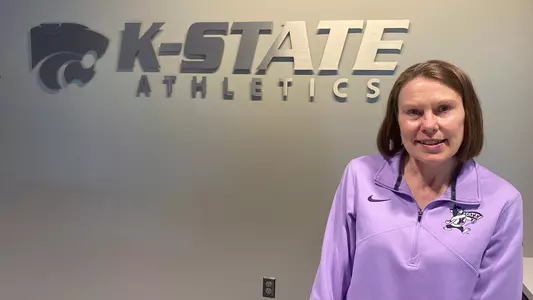
Kansas State Athletic Department's own Deb (Pihl) Torneden continues to show that nothing will stop her. The 62-year-old and 2004 Kansas State Athletics Hall of Fame inductee recently anchored a 4x800 meter relay team that set the world record for the over 60 age group at the USATF Masters National Indoor Track and Field Championships in Louisville, Kentucky.
Torneden, a native of Salina, Kansas, is currently the most accomplished native Kansan women's distance runner. A four-time NCAA All-American and eight-time Big Eight Conference Champion at K-State who still holds school records for the indoor mile (4:39.06) and outdoor 3,000 meters (9:09.60), Torneden was a four-time Olympic Trials qualifier and placed sixth at the 1984 U.S. National Outdoor Track Championships in the 1,500-meter run (4:12.94). Torneden also represented the United States in two Ekiden marathon relays in South Korea and China, and the 1995 World Cup Marathon in Greece.
A six-time Kansas runner of the year (1991, 1997, 1998, 2006, 2013 and 2021), Torneden captured the 2015 USATF National Championship in the 15K road race for masters runners over 40 years of age.
She holds 22 state of Kansas age group records in road running, most recently setting the 60-64 year age group records in the mile, two mile, and 5K.
On July 20, Torneden was national runner-up in the 5,000-meter run at the USATF Masters National Outdoor Track and Field Championships in Greensboro, North Carolina. Her husband, Fred, who also works part-time for K-State Athletics, was national champion in the 65-69 age group in the 5,000-meter run.
"Although I set K-State records and hold a lot of state records, I really don't keep track of those things," she says. "It's always, 'What am I going to do next? What adventure is out there?' Then when I get there it's, 'What's the next one?' I'm never satisfied. I don't look back. I just keep going."
Deb Torneden spoke with K-State Sports Extra's D. Scott Fritchen about her racing journey:
D. SCOTT FRITCHEN: Take me back to March 11. You were on a relay team that beat the world record. That must have felt tremendous.
DEB TORNEDEN: Fred and I were set to travel to Louisville, Kentucky for the USATF Masters Indoor Track and Field Championships, which would take place on March 11-12. Four days before we headed to Louisville, I was approached about joining a 4x800 meter relay. I'm 62 and they were seeking another racer for their over 60 age group. I was already set to run the 1,500-meter run on Saturday and the 800-meter run on Sunday. They recruited me and asked, "Would you be interested? We have a shot at getting the world indoor record for women over 60 years of age." It was after my main event, so I simply couldn't pass up the opportunity. I won the 1,500 meters in the afternoon and six hours later we ran the 4x800 indoor relay. I hadn't run indoors since I graduate from K-State 39 years ago. Indoors was my favorite season in college because you didn't have to deal with the wind and were able to find a rhythm on the track. I anchored our relay, setting the world record with a time of 11:39.79, beating the previous mark by 31 seconds, so we just smashed it. It was a big celebration. I couldn't sleep that night having run two national championships and setting a world record. I thought if I kept at it this long I might set a world record by the time I was 100 years old, but I got to do it now. I'm just very blessed.

FRITCHEN: Was running your first love growing up?
TORNEDEN: Although I was involved in any activity, any sport — I played volleyball and basketball — running, yes, running was definitely my favorite. I began as a sprinter probably because of my sister Barb, who's two years older than me. Barb enrolled at K-State in 1977 and I followed in 1979. At 12 years old, I awoke early in the morning and ran country square miles outside our farm in Falun, Kansas. I just thought there was never a reason to stop running because I enjoyed it so much. I didn't start running the 800 meters until I was a sophomore at Lindsborg High School. Before then, I would compete in the 100- and 200-meter sprints. I have a lot of speed, but it just wasn't long enough, so I thought that I'd have more success running the 800 meters. I could usually beat the boys in my class and that was fun. I enjoyed the sport and the freedom I felt training. It's about being driven to run and push yourself to see what you can do. That's the love of it. You just train and get better and want to race better and that just brings out the best in you. My senior year, I started to race the 1,600-meter run, and then I won 3A state track championships and set state records in the 800- and 1,600-meter runs. I never ran fall cross country until I came to K-State. I actually had never seen a cross country race until I was a freshman walk-on at K-State. My first cross country race, Coach Barry Anderson, told me to just follow somebody, and I ended up taking second place behind one of my teammates. I didn't prefer cross country over track because running 5K was a long way to race. I'd never raced that long before.
FRITCHEN: Was K-State your favorite college? Can you describe your recruiting process and your early success?
TORNEDEN: Kansas and Oklahoma recruited me, and although K-State didn't actively recruit me, I walked on because my sister was already a student at K-State. Barb and I were close, and it was great to be here with her. I enjoyed doing everything with my family. I have a middle brother, Mike, but he didn't run. He thinks I'm crazy with always running even now. I was here during a coaching change and Coach Steve Miller came in and it really pulled the best out of me. The training was different and a lot more intense, and I liked that, so I was able to improve a lot quicker. We had good teams at K-State winning the Big Eight title my senior cross country season in 1982. When we got to the spring for indoor and outdoor track, I loved the rhythm of running on the oval. My senior track season at K-State was most memorable. It was a great honor to be awarded the Most Outstanding Performer at the 1984 Big Eight Indoor Championships, winning the mile, 1,000 meters and 4x800 meter relay.

FRITCHEN: What do you attribute to your success your senior year?
TORNEDEN: We had the coaching change, but it was also just the consistency in training that elevated me because I was able to train harder and at a higher level. I remember in 1983 I had a really bad national meet in Houston, and we made the decision that to get to the next level I need to go to Europe. So I traveled to Scandinavia with Athletes-in-Action, which was a great experience because I was able to race a lot more, and I had some big meets. Track and field is huge over there, so I was fortunate to race in some big races. That helped me to see a bigger perspective. I always wanted to keep running and to be a professional, so I think that really helped me. Interestingly, I broke my foot during the 800-meter preliminaries in the 1982 Big Eight Indoor Meet. I received a redshirt year, so I was able to come back more focused for my fifth year of eligibility. I qualified for my first of four Olympic Trials in 1984 in the 3,000 meters and the 1,500 meters. We chose to run the 3,000. It was the first year that they had the 3,000-meter run in the Olympics for women. Almost everybody who ran the 1,500 and 5,000 converged for the 3,000, so it was the most competitive distance race at the trials. I didn't finish in the top three, so I was unable to make the Olympic team, but it was a really good experience. I qualified for the Olympic Trials 26.2 mile marathon three times after that. I started training a lot more. I've run in 15 marathons. I enjoyed being outside doing long training runs up to three hours in duration. Just before the 1996 Olympic Trials marathon, I slipped on ice and shattered my ankle while training, and doctors said that I wouldn't run again, but I said, "That's unacceptable." I came back six month later ready to run again.
FRITCHEN: What was the experience like competing professionally after college? That must have been thrilling.
TORNEDEN: Right after college, I suffered some stress fracture injuries, so it took me a couple years to get myself back to racing again. I decided that road racing would be the best move for me professionally. I began running 5K and 10K and traveling more. Nike sponsored me after the 1984 Olympic Trials. I've always had some kind of sponsor, which is helpful for shoes and equipment. When I was 30 years old, I began running 26.2 mile marathons. Fred, my husband, best friend and coach, he's my support system and he's my everything to keep running at a high level. It's been so fun to have received prize money for races and travel on USA National Teams to China, South Korea and the World Cup Marathon in Greece. It was an awesome experience because you finished the race at the Athens Olympic Stadium. We ran through the streets of Greece and people lined the streets like it was the Tour De France. I just keep moving on, taking in those experiences, in anticipation for the next one.

FRITCHEN: How many races to do compete in these days and what's your routine?
TORNEDEN: These days, I don't race that much, maybe 10 races a year. I have run full marathons and half-marathons, but now I've settled into 5K and shorter distances just to work on different things like racing indoor track. I think I'll continue to compete at Masters Indoor Nationals because that was just too much fun. The training is half the fun. Sometimes, I run a race and I think, "Oh, good, I get to go back to training." I love to train. Depending upon the day, I run 5-10 miles a day with a weekly track session geared to racing a mile of a 5K. I typically wake up at 5:30 a.m. and do an activation and stretch routine. Fred and I drive to Linear Trail or the Freedom Trail in Junction City for a 10-mile run once or twice weekly. On recovery days, we run easy five milers on a softer, flat surface. We enjoy tackling the hills near our home. Once every 7-10 days, depending upon the kind of race for which we're training, we'll do interval training. A couple days a week I do a weight program called Tabata. It's high intensity to get my heart-rate high. I'm pretty good at pull-ups. I just like being strong as an athlete — regardless of my age. A big part of my training is recovery. I'll do an aqua run in the pool once a week just to get off the pounding. After each run, I stretch and use a vibrating Wave roller, Thera-gun and other rollers to aid in muscle recovery. And I like to cook. So we eat healthy avoiding processed foods. After our morning workout routine, I get to work at the Vanier Family Football Complex at 9 a.m. four days weekly.
FRITCHEN: What are your goals and how much longer do you anticipate racing?
TORNEDEN: Oh, I'll never stop racing and never stop training. There's no reason to. I don't have to get old. Everybody gets older, but you don't have to get old. You don't have to grow up. You can just keep doing what you enjoy doing. I just think that if I keep at it long enough my competition will alleviate itself and I might end up with a couple more world records. So why not keep going? My grandma was 105, so I think I have a lot more room to grow. I have a good 40 years in there to really go at it. It kind of makes you look forward to a birthday because you can move up in an age group. It's just too much fun. I hold most of the Kansas masters records from age 40 on up. To get those records and then go to the national meets is great. We might end up in Sweden where they have the World Masters Outdoor Track and Field Championships next year, so a goal is to qualify for that and see how it goes. I'd love to go back to Sweden. It's a beautiful country. I was there in 1983 when I was traveling with Athletes-in-Action. It's my Swedish heritage, so I'd like to go there.
FRITCHEN: What have you learned most about yourself during your journey?
TORNEDEN: Although I set K-State records and hold a lot of state records, I really don't keep track of those things. It's always, "What am I going to do next? What adventure is out there?" Then when I get there it's, "What's the next one?" I'm never satisfied. I don't look back. I just keep on going forward. I'm a "future" person. I just move on. I really like Coach Chris Klieman's four core goals — discipline, commitment, toughness and be selfless. As an athlete, you need to apply that fire to bring it to life, to the real world. I use those goals every day in everything I do. The main thing is to use your gifts that God has given you for His purpose. We're all on this journey together, so it's about helping each other. I'm not a person who has to be on a pedestal. I like to serve other people. It's always a joy to come to work at K-State Athletics to see how I can bring joy to somebody else's day. That's what's great around here. It's family. It's a great environment here at K-State. I'm blessed to be able to come back here and be around athletics. I'm so blessed to be where God has placed me and my family. Life is good. I want to see what I can do to bring joy to somebody else. I think that just brings it out of me as an athlete. That's what running has done for me. What I've learned is to keep going forward.
Kansas State Athletic Department's own Deb (Pihl) Torneden continues to show that nothing will stop her. The 62-year-old and 2004 Kansas State Athletics Hall of Fame inductee recently anchored a 4x800 meter relay team that set the world record for the over 60 age group at the USATF Masters National Indoor Track and Field Championships in Louisville, Kentucky.
Torneden, a native of Salina, Kansas, is currently the most accomplished native Kansan women's distance runner. A four-time NCAA All-American and eight-time Big Eight Conference Champion at K-State who still holds school records for the indoor mile (4:39.06) and outdoor 3,000 meters (9:09.60), Torneden was a four-time Olympic Trials qualifier and placed sixth at the 1984 U.S. National Outdoor Track Championships in the 1,500-meter run (4:12.94). Torneden also represented the United States in two Ekiden marathon relays in South Korea and China, and the 1995 World Cup Marathon in Greece.
A six-time Kansas runner of the year (1991, 1997, 1998, 2006, 2013 and 2021), Torneden captured the 2015 USATF National Championship in the 15K road race for masters runners over 40 years of age.
She holds 22 state of Kansas age group records in road running, most recently setting the 60-64 year age group records in the mile, two mile, and 5K.
On July 20, Torneden was national runner-up in the 5,000-meter run at the USATF Masters National Outdoor Track and Field Championships in Greensboro, North Carolina. Her husband, Fred, who also works part-time for K-State Athletics, was national champion in the 65-69 age group in the 5,000-meter run.
"Although I set K-State records and hold a lot of state records, I really don't keep track of those things," she says. "It's always, 'What am I going to do next? What adventure is out there?' Then when I get there it's, 'What's the next one?' I'm never satisfied. I don't look back. I just keep going."
Deb Torneden spoke with K-State Sports Extra's D. Scott Fritchen about her racing journey:
D. SCOTT FRITCHEN: Take me back to March 11. You were on a relay team that beat the world record. That must have felt tremendous.
DEB TORNEDEN: Fred and I were set to travel to Louisville, Kentucky for the USATF Masters Indoor Track and Field Championships, which would take place on March 11-12. Four days before we headed to Louisville, I was approached about joining a 4x800 meter relay. I'm 62 and they were seeking another racer for their over 60 age group. I was already set to run the 1,500-meter run on Saturday and the 800-meter run on Sunday. They recruited me and asked, "Would you be interested? We have a shot at getting the world indoor record for women over 60 years of age." It was after my main event, so I simply couldn't pass up the opportunity. I won the 1,500 meters in the afternoon and six hours later we ran the 4x800 indoor relay. I hadn't run indoors since I graduate from K-State 39 years ago. Indoors was my favorite season in college because you didn't have to deal with the wind and were able to find a rhythm on the track. I anchored our relay, setting the world record with a time of 11:39.79, beating the previous mark by 31 seconds, so we just smashed it. It was a big celebration. I couldn't sleep that night having run two national championships and setting a world record. I thought if I kept at it this long I might set a world record by the time I was 100 years old, but I got to do it now. I'm just very blessed.
FRITCHEN: Was running your first love growing up?
TORNEDEN: Although I was involved in any activity, any sport — I played volleyball and basketball — running, yes, running was definitely my favorite. I began as a sprinter probably because of my sister Barb, who's two years older than me. Barb enrolled at K-State in 1977 and I followed in 1979. At 12 years old, I awoke early in the morning and ran country square miles outside our farm in Falun, Kansas. I just thought there was never a reason to stop running because I enjoyed it so much. I didn't start running the 800 meters until I was a sophomore at Lindsborg High School. Before then, I would compete in the 100- and 200-meter sprints. I have a lot of speed, but it just wasn't long enough, so I thought that I'd have more success running the 800 meters. I could usually beat the boys in my class and that was fun. I enjoyed the sport and the freedom I felt training. It's about being driven to run and push yourself to see what you can do. That's the love of it. You just train and get better and want to race better and that just brings out the best in you. My senior year, I started to race the 1,600-meter run, and then I won 3A state track championships and set state records in the 800- and 1,600-meter runs. I never ran fall cross country until I came to K-State. I actually had never seen a cross country race until I was a freshman walk-on at K-State. My first cross country race, Coach Barry Anderson, told me to just follow somebody, and I ended up taking second place behind one of my teammates. I didn't prefer cross country over track because running 5K was a long way to race. I'd never raced that long before.
FRITCHEN: Was K-State your favorite college? Can you describe your recruiting process and your early success?
TORNEDEN: Kansas and Oklahoma recruited me, and although K-State didn't actively recruit me, I walked on because my sister was already a student at K-State. Barb and I were close, and it was great to be here with her. I enjoyed doing everything with my family. I have a middle brother, Mike, but he didn't run. He thinks I'm crazy with always running even now. I was here during a coaching change and Coach Steve Miller came in and it really pulled the best out of me. The training was different and a lot more intense, and I liked that, so I was able to improve a lot quicker. We had good teams at K-State winning the Big Eight title my senior cross country season in 1982. When we got to the spring for indoor and outdoor track, I loved the rhythm of running on the oval. My senior track season at K-State was most memorable. It was a great honor to be awarded the Most Outstanding Performer at the 1984 Big Eight Indoor Championships, winning the mile, 1,000 meters and 4x800 meter relay.
FRITCHEN: What do you attribute to your success your senior year?
TORNEDEN: We had the coaching change, but it was also just the consistency in training that elevated me because I was able to train harder and at a higher level. I remember in 1983 I had a really bad national meet in Houston, and we made the decision that to get to the next level I need to go to Europe. So I traveled to Scandinavia with Athletes-in-Action, which was a great experience because I was able to race a lot more, and I had some big meets. Track and field is huge over there, so I was fortunate to race in some big races. That helped me to see a bigger perspective. I always wanted to keep running and to be a professional, so I think that really helped me. Interestingly, I broke my foot during the 800-meter preliminaries in the 1982 Big Eight Indoor Meet. I received a redshirt year, so I was able to come back more focused for my fifth year of eligibility. I qualified for my first of four Olympic Trials in 1984 in the 3,000 meters and the 1,500 meters. We chose to run the 3,000. It was the first year that they had the 3,000-meter run in the Olympics for women. Almost everybody who ran the 1,500 and 5,000 converged for the 3,000, so it was the most competitive distance race at the trials. I didn't finish in the top three, so I was unable to make the Olympic team, but it was a really good experience. I qualified for the Olympic Trials 26.2 mile marathon three times after that. I started training a lot more. I've run in 15 marathons. I enjoyed being outside doing long training runs up to three hours in duration. Just before the 1996 Olympic Trials marathon, I slipped on ice and shattered my ankle while training, and doctors said that I wouldn't run again, but I said, "That's unacceptable." I came back six month later ready to run again.
FRITCHEN: What was the experience like competing professionally after college? That must have been thrilling.
TORNEDEN: Right after college, I suffered some stress fracture injuries, so it took me a couple years to get myself back to racing again. I decided that road racing would be the best move for me professionally. I began running 5K and 10K and traveling more. Nike sponsored me after the 1984 Olympic Trials. I've always had some kind of sponsor, which is helpful for shoes and equipment. When I was 30 years old, I began running 26.2 mile marathons. Fred, my husband, best friend and coach, he's my support system and he's my everything to keep running at a high level. It's been so fun to have received prize money for races and travel on USA National Teams to China, South Korea and the World Cup Marathon in Greece. It was an awesome experience because you finished the race at the Athens Olympic Stadium. We ran through the streets of Greece and people lined the streets like it was the Tour De France. I just keep moving on, taking in those experiences, in anticipation for the next one.
FRITCHEN: How many races to do compete in these days and what's your routine?
TORNEDEN: These days, I don't race that much, maybe 10 races a year. I have run full marathons and half-marathons, but now I've settled into 5K and shorter distances just to work on different things like racing indoor track. I think I'll continue to compete at Masters Indoor Nationals because that was just too much fun. The training is half the fun. Sometimes, I run a race and I think, "Oh, good, I get to go back to training." I love to train. Depending upon the day, I run 5-10 miles a day with a weekly track session geared to racing a mile of a 5K. I typically wake up at 5:30 a.m. and do an activation and stretch routine. Fred and I drive to Linear Trail or the Freedom Trail in Junction City for a 10-mile run once or twice weekly. On recovery days, we run easy five milers on a softer, flat surface. We enjoy tackling the hills near our home. Once every 7-10 days, depending upon the kind of race for which we're training, we'll do interval training. A couple days a week I do a weight program called Tabata. It's high intensity to get my heart-rate high. I'm pretty good at pull-ups. I just like being strong as an athlete — regardless of my age. A big part of my training is recovery. I'll do an aqua run in the pool once a week just to get off the pounding. After each run, I stretch and use a vibrating Wave roller, Thera-gun and other rollers to aid in muscle recovery. And I like to cook. So we eat healthy avoiding processed foods. After our morning workout routine, I get to work at the Vanier Family Football Complex at 9 a.m. four days weekly.
FRITCHEN: What are your goals and how much longer do you anticipate racing?
TORNEDEN: Oh, I'll never stop racing and never stop training. There's no reason to. I don't have to get old. Everybody gets older, but you don't have to get old. You don't have to grow up. You can just keep doing what you enjoy doing. I just think that if I keep at it long enough my competition will alleviate itself and I might end up with a couple more world records. So why not keep going? My grandma was 105, so I think I have a lot more room to grow. I have a good 40 years in there to really go at it. It kind of makes you look forward to a birthday because you can move up in an age group. It's just too much fun. I hold most of the Kansas masters records from age 40 on up. To get those records and then go to the national meets is great. We might end up in Sweden where they have the World Masters Outdoor Track and Field Championships next year, so a goal is to qualify for that and see how it goes. I'd love to go back to Sweden. It's a beautiful country. I was there in 1983 when I was traveling with Athletes-in-Action. It's my Swedish heritage, so I'd like to go there.
FRITCHEN: What have you learned most about yourself during your journey?
TORNEDEN: Although I set K-State records and hold a lot of state records, I really don't keep track of those things. It's always, "What am I going to do next? What adventure is out there?" Then when I get there it's, "What's the next one?" I'm never satisfied. I don't look back. I just keep on going forward. I'm a "future" person. I just move on. I really like Coach Chris Klieman's four core goals — discipline, commitment, toughness and be selfless. As an athlete, you need to apply that fire to bring it to life, to the real world. I use those goals every day in everything I do. The main thing is to use your gifts that God has given you for His purpose. We're all on this journey together, so it's about helping each other. I'm not a person who has to be on a pedestal. I like to serve other people. It's always a joy to come to work at K-State Athletics to see how I can bring joy to somebody else's day. That's what's great around here. It's family. It's a great environment here at K-State. I'm blessed to be able to come back here and be around athletics. I'm so blessed to be where God has placed me and my family. Life is good. I want to see what I can do to bring joy to somebody else. I think that just brings it out of me as an athlete. That's what running has done for me. What I've learned is to keep going forward.

Thursday, June 11
Wednesday, June 10
Wednesday, June 10
Tuesday, June 09