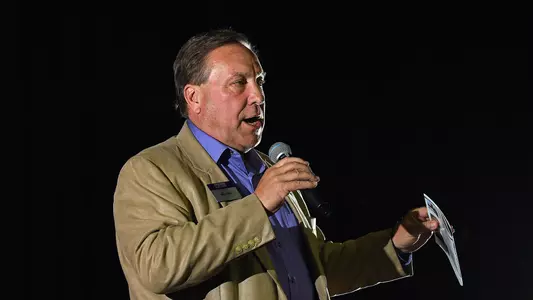
Clark Has Been Part of the Rise
Jul 07, 2023 | Baseball, Sports Extra, Athletics
By: D. Scott Fritchen
They came from across the region to formally extend well wishes to a man who impacted thousands of lives as Kansas State head baseball coach from 1987 to 2003, and helped fundraise millions of dollars for K-State Athletics for two decades. At a retirement ceremony to honor Mike Clark on June 22, Clark stood inside the Shamrock Zone that adjoins Bill Snyder Family Stadium to Bramlage Coliseum, hugging more than 150 attendees. One by one, those locked-away memories flooded back, and smiles and laughter ensued, as Clark and others reminisced the tough times and the good times and all the times in between.
Today is June 30, and Clark sits in a light-blue Nike golf shirt and dark blue shorts and wears a white ballcap with "COACHES VS CANCER" emblazoned upon it in black thread. He's tan. He's relaxed. He just finished playing 18 holes at Colbert Hills Golf Course and he slides into a seat at Colbert's Bar and Grill, ordering the salmon BLT and seasoned fries, and he nurses a large glass of lemonade with a generous lemon slice floating near the bottom. After 37 years at K-State, it's officially Clark's last day as Senior Director of Development at K-State Athletics.
After seemingly always being on the move at K-State, first as baseball head coach for 17 years, then as Director of Development as a major gift fundraiser for facility projects and the Barrett Endowment Society, and then as Senior Director of Development, traveling, shaking hands with old friends across the state, and receiving donations for major athletic department facility projects — "It's about relationships," he says — the 70-year-old appears content, and eager to win Husband of the Year, Dad of the Year, and Grandpa of the Year awards after a lengthy journey.
"People can't believe I'm retiring," he says. "They ask me, 'What will you do?' I say, 'Spend time with my family, play some golf, and go to K-State sporting events.'"

He was hired by K-State athletic director Larry Travis as the program's 19th head baseball coach on July 8, 1986, a spry 33-year-old man with his first Division I coaching gig, and soon understood the problems and financial deficits that dogged the athletic department. And now? He's able to enjoy a cold beverage while watching a football game inside a 50,000-capacity stadium. He's able to stand inside Bramlage Coliseum and cheer for the men's basketball and women's basketball teams in a Power 5 Conference — "If you would've told me in 1986 that K-State would be in a Power 5 Conference, I'd say, 'No way,'" he says — while turning his attention to duties as TV analyst for K-State baseball games during sunny days and starry nights in March, April and May.
"This is home," he says. "It's comfort."
This is Mike Clark — bubbly at times, emotional at others, and leaving nothing to doubt. His contagious energy moves from topic to topic like a wave working its way along the coast, his eyes at times blinking back tears of happiness and loss, his voice pausing as he proverbially drags the diamond of memories unearthed on his final day. For a few final hours, Clark is the last active K-State Athletics employee that vividly remembers the days when K-State's spot in the Big Eight Conference was in question. Heck, Clark became baseball coach at a time when the baseball program's existence remained cloudy amid the dark skies hovering over the Little Apple.
"The athletic department was in bad shape and I didn't know how bad of shape when I took the job," he says. "It didn't take long to find out. Two years in a row, we'd get a 3% increase in our budget and then take a 10% cut in February because the athletic department was losing money. It was tough.
"One of the things I'm most proud of with my career as the baseball coach is when I came to Kansas State, I was the third coach for the senior class. They had Bill Hickey their freshman year, Gary Vaught their sophomore and junior year, and then me. And 37 years later, Kansas State has only had three baseball coaches in that time.
"What was a very unstable program when we came in 1986 is now a very stable program and one that is capable of winning championships."
There was a time when this seemed implausible. Clark was K-State's fourth head coach in five years after the previous four coaches amassed a combined 85-116 record. He signed a contract for $22,000 — a $4,000 cut from what he made at Northeastern Oklahoma A&M College. He had a recruiting budget of $2,000 and his office was a trailer. The stitching of the most important item in the game of baseball — the baseball itself — frayed and at times finally broke, symbiotic of the uphill climb Clark and his teams faced during their formidable years. To wit: The team literally used taped baseballs for batting practice. Players hit the baseballs until their seams ripped open, then Clark taped the balls, so they could be used again. When that tape broke, he strapped on even more tape. Each ball had a number written upon it in black sharpie — 1, 2, 3 4, 5, and so on. In all, they had five buckets of numbered balls. Players were charged with finding lost baseballs to keep the set of balls complete. Three lost baseballs and the team had to run. More than once, Clark took out his personal pocketbook and bought baseballs at Ballard's Sporting Goods in Manhattan just to have enough high-quality baseballs for a midweek non-conference game. Players were responsible for buying their own cleats, gloves and warmup jackets. They had no pregame meal prior to home games and the team maintained the baseball field. They rented three vans for away games. Four players to a hotel room. Each player received $15 per day for food on road trips.
"That's what you did back then," he says. "We held fundraisers for spring trips down south to get some games in."

And yet, K-State baseball found success despite not being fully funded by the athletic department. Clark went 28-24 his first season with the Wildcats and went on to produce four consecutive 30-win seasons for the first time in program history. Clark was named the 1990 Big Eight Coach of the Year after leading the Wildcats to a second-place finish in the league race. It marked just the third time that K-State finished second in the league since the Wildcats joined the Big Eight in 1958. Clark went on to take K-State to a 127-96 record through his first four seasons. He passed Phil Wilson (138 wins) as the program's all-time winningest coach in his fifth season.
"In 1990, I think back to a pop up to third base at Nebraska and we won the game and qualified for the Big Eight Tournament for the first time in a while," Clark says. "That was a huge one. We finished second in the league. They didn't have a 64-team national tournament like they do now, but we would've definitely been a bubble team. That's a great memory."
The K-State athletic department gained financial footing as Hall-of-Famer Bill Snyder engineered the greatest turnaround in the history of college football. Money came in. Spirits soared. Purple passion ran thick and it touched many sports, including baseball, whose crown jewel, of course, is Tointon Family Stadium. Bob and Betty Tointon were the principle benefactors of the original $3.1 million structure, serving as lead donors for a project that all but gutted the old Frank Myers Field, which was opened in 1961 after years of playing at Griffith Park in downtown Manhattan. Tointon Family Stadium opened in 2001 and debuted its expansion in 2020 after the completion of a $15 million project finalizing a two-year refurbishment of the facility. The stadium's latest improvement came prior to the 2023 season with the installation of a new artificial turf surface.

But here was the plight facing Clark and the Wildcats: The demolition of Frank Myers Field began after the final game of the 1998 season. Financial and construction delays caused the facility project to creep along, forcing the 1999 Wildcats to play their 55-game schedule without a home field — there were T-shirts produced that read: "Year of The 55-Game Road Trip" — and 46 games were played outside Manhattan city limits in Wichita, Salina and St. Joseph, Missouri. The team traveled 17,500 miles and played at 19 different sites during the 1999 season. Almost fitting, the public-address system went dead prior to Senior Day in St. Joseph, forcing Clark to shout the names of his graduating seniors as they were recognized prior to the game. The Wildcats went 26-29 overall and 11-18 in the Big 12 and all but seven of those losses came to ranked teams. The Wildcats excruciatingly finished a half-game short of qualifying for the Big 12 Tournament.
"The 1999 season…it was tough," Clark says. "I had great kids, God I loved those kids. It wasn't just that we didn't have a place to play, but we didn't even have a place to practice. We'd take outfield and infield for an hour at Cico Park and then visit the high school field and then go to intramural fields for batting practice. Pitchers went to the Brandeberry Indoor Facility to pitch because we didn't have a mound to throw on.
"Then we're…"
He pauses.
"I'm still not the same person I was before that season," he says of going through the trying 1999 campaign only to finish a half-game short of making the league tournament. "Julie will tell you that emotionally I'm a different person now than I was, and not anything breakdown wise or anything like that, but I just didn't know if I could coach again. I felt like I let the kids down. I felt like I let K-State down. And then we had this new stadium and I actually took 10 days before I let (athletic director) Max Urick and (university president) Dr. Jon Wefald know if I was going to come back and coach, because I was beyond devastated."
Clark returned and K-State baseball did, too.
"This will be the 25th year anniversary of that 1999 team and here we are with our second stadium and I'm hoping we can have a reunion for those kids so they can come back and say, 'Look at what we've done,'" Clark says. "We held this thing together."

Clark became the first K-State coach in any team sport to reach 400 wins, earning his 400th victory in a dramatic come-from-behind 8-7 victory over Wisconsin-Milwaukee in Homestead, Florida, on March 18, 2002. The 2002 season was one of the most successful in the 102-year history of K-State baseball, as the Wildcats advanced to their first-ever Big 12 Tournament, their first league tournament since the 1996 Big Eight Conference Tournament, and their fifth league tournament in the Clark era (1990, 1993, 1995, 1996 and 2002).
"Hearing that fight song in 2002 when we took the field in Arlington for the Big 12 Tournament, our first time making the Big 12 Tournament, to hear that fight song and see the kids take the field," he says, "I had tears in my eyes."
Additionally, K-State reached 30 wins in 2002 (30-25). At the time, six of the program's nine 30-game seasons came under Clark.
"A tremendous feeling, a little empty at times, but tremendous, and something I was always proud of," he says. "More than that, the graduation rate was 90-something percent. We got to the middle of the 1990s and we were finishing in the middle or upper part of the Big Eight. We had a good thing going and football was winning. Manhattan was awesome. It's always awesome. It was one of those deals where every year I thought we've got a chance, we really have a chance. Great kids. Loved the kids."

The son of Bob and Pat Clark, Mike was born in Osage, Iowa, before the family eventually moved to Traer, Iowa, when Mike was in the third grade. Bob served as high school principal for 36 years, including 33 at small school Class A North Tama High School in Traer, where Bob also spent several years as girls high school varsity basketball coach.
"I have a lot of my dad's traits," Clark says. "To be in a small Class A school for 33 years as an administrator you have to have great people skills. Dad had great people skills."
Clark's first love was basketball. He was a gym rat and a baseball-diamond rat. As years passed, baseball shared the big stage. Clark's varsity baseball coach, Jerry Lister, coached him in little leagues when he was 10. Lister took North Tama High to the 1971 state tournament for the first time in Clark's senior year. North Tama High went 43-6, which 52 years later still ranks top 5 in wins in the state of Iowa. Clark was a left-handed pitcher and went 14-2 with a 0.63 ERA his senior season, typically facing tough non-conference opponents in midweek contests. Clark accepted a scholarship to play basketball and baseball at Southern Utah State College before he transferred to Missouri Western his sophomore year. A three-year letterwinner, he garnered 1975 District 16 Pitcher of the Year honors, and he graduated from Missouri Western in 1975 before earning his master's degree in education from Northwest Missouri State in 1977. He married Julie on August 6, 1977. He also served as an assistant baseball coach in charge of pitchers at Missouri Western from 1976-77.
"To be honest, all I wanted to do when I graduated was replace Jerry (Lister) as our high school coach because he was one of my heroes, and he had built this great program and had done it the right way and was such a great individual," Clark says. "I mean, that's what I wanted to do. Dad was like a coach, and those were two great role models. Mom gave support, but as far as coaching is concerned, dad and Jerry were it, and I couldn't have had two better role models."
Clark began his head coaching career at Coweta High School in Arkansas in 1978 and served as the school's assistant basketball and football coach. Then he took over a Northeastern Oklahoma A&M program that had won just 13 games in three years and built it into a consistent winner. He went 293-136 in seven years, including a 53-23 mark in 1986 prior to taking over at K-State.
After 17 seasons at K-State, Clark announced his resignation as head coach on May 5, 2003. With Julie, son Casey, and daughter Kelli seated behind him at a news conference inside the Legend's Room, Clark blinked back tears and said, "With my batteries as low as they are now, it's time," he said.

Clark found a rebirth. He leaves K-State after a tremendous career as a fundraiser. He helped the Ahearn Fund to set unprecedented records for total and annual giving, including a record $58.9 million in total giving in 2021-22 and a record $20.4 million in annual giving. Clark was a part of a staff that eclipsed the $40 million mark two out of three times in K-State history, once in FY19 and in FY22. Most recently, Clark helped fundraise for K-State's "Building Champions" — a $126.5 million capital campaign with over $100 million raised with the south end zone of Bill Snyder Family Stadium completed in July 2021. Other projects within the initiative included the Shamrock Practice Facility, Morris Family Olympic Training Center and Morgan Family Volleyball Arena. This comes after finishing a successful $25 million capital campaign for Buser Family Park soccer complex and Tointon Family Stadium baseball upgrades.
"I have so many friends out there," he says. "I mean, some people drive four hours to come to Manhattan. At first, you might not know them, but then over the years you celebrate kids being born and 18 years later they're in college. You tailgate with these people and see their families and grandkids and it's a life-changing experience. If you do development right, it's not about the numbers, but about the relationships you have, and the numbers will take care of itself."
Clark also helped steer the Ahearn Fund past its desired goal of $340 million to over $393 million.
"I'm just proud of our whole athletic department," he says. "When we came here in 1986 — you gotta be kidding me. We just tried to win one damn football game. We were just trying to do the basics of an athletic department. Now? Here we are. I'm proud of everybody involved. Fans, the athletes, the coaches — everybody did this. You talk about family, and person by person, and donation by donation, and player by player did this. It's pretty cool."
He smiles at this past 2022-23 athletic year in which K-State football won the Big 12 Championship and played in the Sugar Bowl. He smiles at memories of the men's basketball team reaching the Elite Eight. He looks back on K-State's baseball success over the past decade, including the 2013 Big 12 Championship title, Big 12 Tournament appearances, NCAA Regional appearances – including once as a host – a Super Regional appearance, while the past year's squad came excruciatingly close to reaching a NCAA Regional as well. It's those times when he takes the elevator up to the press box at Tointon Family Stadium and steps into the TV booth – one that is named in his honor – that Clark at times looks around and marvels at the journey.
"It's phenomenal," he says. "We're going to win another conference championship and we're going to another regional, and hopefully someday we'll go to a College World Series."
Clark is a testament of giving and caring, which culminated in a tremendous farewell gathering as his career reached an end. He's forged hundreds of friendships that'll carry on. Now the husband, father and grandfather embarks on a new chapter while optimism runs high for K-State and one of the most efficient athletic departments in the country.
Things have come a long way since taping up baseballs.
"What we have now," he says, "is amazing."
He is a fan forevermore.
They came from across the region to formally extend well wishes to a man who impacted thousands of lives as Kansas State head baseball coach from 1987 to 2003, and helped fundraise millions of dollars for K-State Athletics for two decades. At a retirement ceremony to honor Mike Clark on June 22, Clark stood inside the Shamrock Zone that adjoins Bill Snyder Family Stadium to Bramlage Coliseum, hugging more than 150 attendees. One by one, those locked-away memories flooded back, and smiles and laughter ensued, as Clark and others reminisced the tough times and the good times and all the times in between.
Today is June 30, and Clark sits in a light-blue Nike golf shirt and dark blue shorts and wears a white ballcap with "COACHES VS CANCER" emblazoned upon it in black thread. He's tan. He's relaxed. He just finished playing 18 holes at Colbert Hills Golf Course and he slides into a seat at Colbert's Bar and Grill, ordering the salmon BLT and seasoned fries, and he nurses a large glass of lemonade with a generous lemon slice floating near the bottom. After 37 years at K-State, it's officially Clark's last day as Senior Director of Development at K-State Athletics.
After seemingly always being on the move at K-State, first as baseball head coach for 17 years, then as Director of Development as a major gift fundraiser for facility projects and the Barrett Endowment Society, and then as Senior Director of Development, traveling, shaking hands with old friends across the state, and receiving donations for major athletic department facility projects — "It's about relationships," he says — the 70-year-old appears content, and eager to win Husband of the Year, Dad of the Year, and Grandpa of the Year awards after a lengthy journey.
"People can't believe I'm retiring," he says. "They ask me, 'What will you do?' I say, 'Spend time with my family, play some golf, and go to K-State sporting events.'"
He was hired by K-State athletic director Larry Travis as the program's 19th head baseball coach on July 8, 1986, a spry 33-year-old man with his first Division I coaching gig, and soon understood the problems and financial deficits that dogged the athletic department. And now? He's able to enjoy a cold beverage while watching a football game inside a 50,000-capacity stadium. He's able to stand inside Bramlage Coliseum and cheer for the men's basketball and women's basketball teams in a Power 5 Conference — "If you would've told me in 1986 that K-State would be in a Power 5 Conference, I'd say, 'No way,'" he says — while turning his attention to duties as TV analyst for K-State baseball games during sunny days and starry nights in March, April and May.
"This is home," he says. "It's comfort."
This is Mike Clark — bubbly at times, emotional at others, and leaving nothing to doubt. His contagious energy moves from topic to topic like a wave working its way along the coast, his eyes at times blinking back tears of happiness and loss, his voice pausing as he proverbially drags the diamond of memories unearthed on his final day. For a few final hours, Clark is the last active K-State Athletics employee that vividly remembers the days when K-State's spot in the Big Eight Conference was in question. Heck, Clark became baseball coach at a time when the baseball program's existence remained cloudy amid the dark skies hovering over the Little Apple.
"The athletic department was in bad shape and I didn't know how bad of shape when I took the job," he says. "It didn't take long to find out. Two years in a row, we'd get a 3% increase in our budget and then take a 10% cut in February because the athletic department was losing money. It was tough.
"One of the things I'm most proud of with my career as the baseball coach is when I came to Kansas State, I was the third coach for the senior class. They had Bill Hickey their freshman year, Gary Vaught their sophomore and junior year, and then me. And 37 years later, Kansas State has only had three baseball coaches in that time.
"What was a very unstable program when we came in 1986 is now a very stable program and one that is capable of winning championships."
There was a time when this seemed implausible. Clark was K-State's fourth head coach in five years after the previous four coaches amassed a combined 85-116 record. He signed a contract for $22,000 — a $4,000 cut from what he made at Northeastern Oklahoma A&M College. He had a recruiting budget of $2,000 and his office was a trailer. The stitching of the most important item in the game of baseball — the baseball itself — frayed and at times finally broke, symbiotic of the uphill climb Clark and his teams faced during their formidable years. To wit: The team literally used taped baseballs for batting practice. Players hit the baseballs until their seams ripped open, then Clark taped the balls, so they could be used again. When that tape broke, he strapped on even more tape. Each ball had a number written upon it in black sharpie — 1, 2, 3 4, 5, and so on. In all, they had five buckets of numbered balls. Players were charged with finding lost baseballs to keep the set of balls complete. Three lost baseballs and the team had to run. More than once, Clark took out his personal pocketbook and bought baseballs at Ballard's Sporting Goods in Manhattan just to have enough high-quality baseballs for a midweek non-conference game. Players were responsible for buying their own cleats, gloves and warmup jackets. They had no pregame meal prior to home games and the team maintained the baseball field. They rented three vans for away games. Four players to a hotel room. Each player received $15 per day for food on road trips.
"That's what you did back then," he says. "We held fundraisers for spring trips down south to get some games in."
And yet, K-State baseball found success despite not being fully funded by the athletic department. Clark went 28-24 his first season with the Wildcats and went on to produce four consecutive 30-win seasons for the first time in program history. Clark was named the 1990 Big Eight Coach of the Year after leading the Wildcats to a second-place finish in the league race. It marked just the third time that K-State finished second in the league since the Wildcats joined the Big Eight in 1958. Clark went on to take K-State to a 127-96 record through his first four seasons. He passed Phil Wilson (138 wins) as the program's all-time winningest coach in his fifth season.
"In 1990, I think back to a pop up to third base at Nebraska and we won the game and qualified for the Big Eight Tournament for the first time in a while," Clark says. "That was a huge one. We finished second in the league. They didn't have a 64-team national tournament like they do now, but we would've definitely been a bubble team. That's a great memory."
The K-State athletic department gained financial footing as Hall-of-Famer Bill Snyder engineered the greatest turnaround in the history of college football. Money came in. Spirits soared. Purple passion ran thick and it touched many sports, including baseball, whose crown jewel, of course, is Tointon Family Stadium. Bob and Betty Tointon were the principle benefactors of the original $3.1 million structure, serving as lead donors for a project that all but gutted the old Frank Myers Field, which was opened in 1961 after years of playing at Griffith Park in downtown Manhattan. Tointon Family Stadium opened in 2001 and debuted its expansion in 2020 after the completion of a $15 million project finalizing a two-year refurbishment of the facility. The stadium's latest improvement came prior to the 2023 season with the installation of a new artificial turf surface.
But here was the plight facing Clark and the Wildcats: The demolition of Frank Myers Field began after the final game of the 1998 season. Financial and construction delays caused the facility project to creep along, forcing the 1999 Wildcats to play their 55-game schedule without a home field — there were T-shirts produced that read: "Year of The 55-Game Road Trip" — and 46 games were played outside Manhattan city limits in Wichita, Salina and St. Joseph, Missouri. The team traveled 17,500 miles and played at 19 different sites during the 1999 season. Almost fitting, the public-address system went dead prior to Senior Day in St. Joseph, forcing Clark to shout the names of his graduating seniors as they were recognized prior to the game. The Wildcats went 26-29 overall and 11-18 in the Big 12 and all but seven of those losses came to ranked teams. The Wildcats excruciatingly finished a half-game short of qualifying for the Big 12 Tournament.
"The 1999 season…it was tough," Clark says. "I had great kids, God I loved those kids. It wasn't just that we didn't have a place to play, but we didn't even have a place to practice. We'd take outfield and infield for an hour at Cico Park and then visit the high school field and then go to intramural fields for batting practice. Pitchers went to the Brandeberry Indoor Facility to pitch because we didn't have a mound to throw on.
"Then we're…"
He pauses.
"I'm still not the same person I was before that season," he says of going through the trying 1999 campaign only to finish a half-game short of making the league tournament. "Julie will tell you that emotionally I'm a different person now than I was, and not anything breakdown wise or anything like that, but I just didn't know if I could coach again. I felt like I let the kids down. I felt like I let K-State down. And then we had this new stadium and I actually took 10 days before I let (athletic director) Max Urick and (university president) Dr. Jon Wefald know if I was going to come back and coach, because I was beyond devastated."
Clark returned and K-State baseball did, too.
"This will be the 25th year anniversary of that 1999 team and here we are with our second stadium and I'm hoping we can have a reunion for those kids so they can come back and say, 'Look at what we've done,'" Clark says. "We held this thing together."
Clark became the first K-State coach in any team sport to reach 400 wins, earning his 400th victory in a dramatic come-from-behind 8-7 victory over Wisconsin-Milwaukee in Homestead, Florida, on March 18, 2002. The 2002 season was one of the most successful in the 102-year history of K-State baseball, as the Wildcats advanced to their first-ever Big 12 Tournament, their first league tournament since the 1996 Big Eight Conference Tournament, and their fifth league tournament in the Clark era (1990, 1993, 1995, 1996 and 2002).
"Hearing that fight song in 2002 when we took the field in Arlington for the Big 12 Tournament, our first time making the Big 12 Tournament, to hear that fight song and see the kids take the field," he says, "I had tears in my eyes."
Additionally, K-State reached 30 wins in 2002 (30-25). At the time, six of the program's nine 30-game seasons came under Clark.
"A tremendous feeling, a little empty at times, but tremendous, and something I was always proud of," he says. "More than that, the graduation rate was 90-something percent. We got to the middle of the 1990s and we were finishing in the middle or upper part of the Big Eight. We had a good thing going and football was winning. Manhattan was awesome. It's always awesome. It was one of those deals where every year I thought we've got a chance, we really have a chance. Great kids. Loved the kids."
The son of Bob and Pat Clark, Mike was born in Osage, Iowa, before the family eventually moved to Traer, Iowa, when Mike was in the third grade. Bob served as high school principal for 36 years, including 33 at small school Class A North Tama High School in Traer, where Bob also spent several years as girls high school varsity basketball coach.
"I have a lot of my dad's traits," Clark says. "To be in a small Class A school for 33 years as an administrator you have to have great people skills. Dad had great people skills."
Clark's first love was basketball. He was a gym rat and a baseball-diamond rat. As years passed, baseball shared the big stage. Clark's varsity baseball coach, Jerry Lister, coached him in little leagues when he was 10. Lister took North Tama High to the 1971 state tournament for the first time in Clark's senior year. North Tama High went 43-6, which 52 years later still ranks top 5 in wins in the state of Iowa. Clark was a left-handed pitcher and went 14-2 with a 0.63 ERA his senior season, typically facing tough non-conference opponents in midweek contests. Clark accepted a scholarship to play basketball and baseball at Southern Utah State College before he transferred to Missouri Western his sophomore year. A three-year letterwinner, he garnered 1975 District 16 Pitcher of the Year honors, and he graduated from Missouri Western in 1975 before earning his master's degree in education from Northwest Missouri State in 1977. He married Julie on August 6, 1977. He also served as an assistant baseball coach in charge of pitchers at Missouri Western from 1976-77.
"To be honest, all I wanted to do when I graduated was replace Jerry (Lister) as our high school coach because he was one of my heroes, and he had built this great program and had done it the right way and was such a great individual," Clark says. "I mean, that's what I wanted to do. Dad was like a coach, and those were two great role models. Mom gave support, but as far as coaching is concerned, dad and Jerry were it, and I couldn't have had two better role models."
Clark began his head coaching career at Coweta High School in Arkansas in 1978 and served as the school's assistant basketball and football coach. Then he took over a Northeastern Oklahoma A&M program that had won just 13 games in three years and built it into a consistent winner. He went 293-136 in seven years, including a 53-23 mark in 1986 prior to taking over at K-State.
After 17 seasons at K-State, Clark announced his resignation as head coach on May 5, 2003. With Julie, son Casey, and daughter Kelli seated behind him at a news conference inside the Legend's Room, Clark blinked back tears and said, "With my batteries as low as they are now, it's time," he said.
Clark found a rebirth. He leaves K-State after a tremendous career as a fundraiser. He helped the Ahearn Fund to set unprecedented records for total and annual giving, including a record $58.9 million in total giving in 2021-22 and a record $20.4 million in annual giving. Clark was a part of a staff that eclipsed the $40 million mark two out of three times in K-State history, once in FY19 and in FY22. Most recently, Clark helped fundraise for K-State's "Building Champions" — a $126.5 million capital campaign with over $100 million raised with the south end zone of Bill Snyder Family Stadium completed in July 2021. Other projects within the initiative included the Shamrock Practice Facility, Morris Family Olympic Training Center and Morgan Family Volleyball Arena. This comes after finishing a successful $25 million capital campaign for Buser Family Park soccer complex and Tointon Family Stadium baseball upgrades.
"I have so many friends out there," he says. "I mean, some people drive four hours to come to Manhattan. At first, you might not know them, but then over the years you celebrate kids being born and 18 years later they're in college. You tailgate with these people and see their families and grandkids and it's a life-changing experience. If you do development right, it's not about the numbers, but about the relationships you have, and the numbers will take care of itself."
Clark also helped steer the Ahearn Fund past its desired goal of $340 million to over $393 million.
"I'm just proud of our whole athletic department," he says. "When we came here in 1986 — you gotta be kidding me. We just tried to win one damn football game. We were just trying to do the basics of an athletic department. Now? Here we are. I'm proud of everybody involved. Fans, the athletes, the coaches — everybody did this. You talk about family, and person by person, and donation by donation, and player by player did this. It's pretty cool."
He smiles at this past 2022-23 athletic year in which K-State football won the Big 12 Championship and played in the Sugar Bowl. He smiles at memories of the men's basketball team reaching the Elite Eight. He looks back on K-State's baseball success over the past decade, including the 2013 Big 12 Championship title, Big 12 Tournament appearances, NCAA Regional appearances – including once as a host – a Super Regional appearance, while the past year's squad came excruciatingly close to reaching a NCAA Regional as well. It's those times when he takes the elevator up to the press box at Tointon Family Stadium and steps into the TV booth – one that is named in his honor – that Clark at times looks around and marvels at the journey.
"It's phenomenal," he says. "We're going to win another conference championship and we're going to another regional, and hopefully someday we'll go to a College World Series."
Clark is a testament of giving and caring, which culminated in a tremendous farewell gathering as his career reached an end. He's forged hundreds of friendships that'll carry on. Now the husband, father and grandfather embarks on a new chapter while optimism runs high for K-State and one of the most efficient athletic departments in the country.
Things have come a long way since taping up baseballs.
"What we have now," he says, "is amazing."
He is a fan forevermore.


Wednesday, June 17
Monday, June 15
Thursday, June 11
Wednesday, June 10