She Keeps Working Her Way Back
May 03, 2024 | Volleyball, Sports Extra
By: D. Scott Fritchen
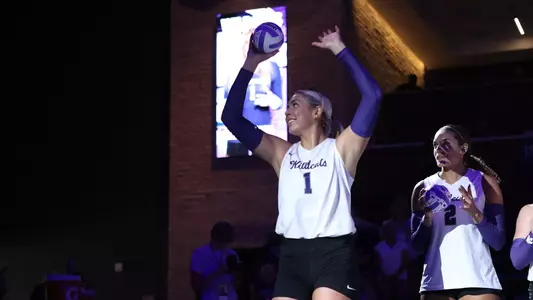
Meet Liz Gregorski, perhaps the most resilient Kansas State women's volleyball player in history — and she's only been in Manhattan a year. Gregorski is a graduate student and an outside/opposite hitter from Appleton, Wisconsin. She came to K-State after majoring in real estate and urban land economics, and marketing at Wisconsin, where she was a part of four Big Ten Championships and a member of the 2021 National Championship squad.
It was a year ago this week that K-State head coach Jason Mansfield announced the addition of Gregorski to the Wildcats' 2023 roster. This past season, she played in a team high-tying 97 sets. She never missed a single set.
That's incredible.
That's remarkable.
That's unheard of.
And here's why.
Once she shattered her left pinky. Then she tore her anterior-cruciate ligament. She tore her medial-collateral ligament. She tore her meniscus. She tore her calf.
She tore each of those…twice.
And, for good measure, she also broke the fibula bone in her left leg.
Those are all injuries that the 5-foot-11 Gregorski sustained prior to joining the Wildcats.
"After my fibula, there was just this wave of frustration," she says, "and it was just kind of like, 'Really, bro? Why this?'"

Gregorski is bubbly on the phone. She loves K-State. She loves her teammates. She's glad that Mansfield appreciated her highlight reel when she opted to leave behind Wisconsin – her dream school – and continue along her journey. Her grandfather, father and sister all attended Wisconsin. But after four years, she sought to see new places, meet new people, and seek new challenges.
"Because I was injured at Wisconsin so frequently, and because of the COVID year, I felt it was a gift from the universe that allowed me to have four great years at an amazing school," she says, "but also use those extra years of eligibility to explore something different. I just wanted to stretch myself."
She felt right at home when she took her visit to Manhattan.
"The girls were so fun, and I had an instant bond with a lot of them right away," she says. "It already felt like I had friends. My meetings with the coaches, the whole athletic department, it just seemed like everyone was so invested in the success of their athletes. It's just the investment they had, especially in the volleyball team, in bringing the volleyball arena to life, and dumping their efforts into cultivating a good program here at K-State. That was really exciting to me. I just felt that whole vibe of how much everybody cared."
Due to her rash of injuries, she was unable to fully find her vibe during parts of her volleyball career. In high school, she dived and jammed her left pinky so hard that it shattered. After surgery, in her first game back, she landed on a girl's foot under the volleyball net and tore her left ACL. A little less than a year later, her first game back during her senior season, she tore the very same ACL again.
"I was committed to Wisconsin, obviously, so that whole first year of college I had to redshirt because I had to relearn entirely how to move," she says. "That was a 12-month recovery, probably. At 6 a.m. I practiced running because my running form was so off, because I'd been out for so long. There were just a lot of weird things that I didn't know would be so affected by back-to-back ACL injuries.
"That first year at Wisconsin, I didn't get to practice, I just rehabbed and was on the sideline. The next year was COVID, and then the next year was exciting. I was playing really well and felt like I was finally getting into the groove because I was able to do a whole fall of practices."
What happened next?
"I broke my fibula," she says. "I broke my left leg by actually landing on another girl's foot under the net. It was the same way I tore my ACL. Again, I was out for 10 weeks. That same year we won the national championship, which was so cool."

For as much as the injuries tested her physical limits, her mental limits were tested as well.
"What is underestimated about any recovery is the impending doom you feel," she says. "I had to go through therapy, honestly, and I was in this long-term injury support group in Wisconsin that helped me so much. I didn't even realize how much — just this anxiety of reinjuring myself, every little movement, I viewed myself as being very fragile, and I was really scared that if I wasn't careful enough something bad would happen again.
"So, the mental aspect of it was super, super hard for me."
As was the recovery process.
"I saw all my teammates, all these volleyball players across the country, they were all getting better, learning more and improving their games day by day and week by week, whereas I pretty much had to go backward," she says. "I had to relearn how to jump, run, dive on a knee, and do my transition footwork without favoring my right side. Doing all the little, tiny things and tiny details was so frustrating to me, because not only was I not getting better, but I was actually getting worse.
"I had to start from zero, pretty much, and work my way up. That part of it really got to me."
She pauses.
"Nothing was harder than the mental part the whole time."
Today, she tightly tapes her right quad — not her left quad, but her right quad. There's a reason for that.
"The funny thing is my left side of the body is my good side now," she says. "With all the injuries to the left side of my body, my right side, I've overcompensated for so long that I have pretty much permanent damage to my right quad. I don't know if you've seen a match, but I don't do anything without taping my quad really tight. It needs a lot of compression just to feel normal."
How does Gregorski feel now?
"I feel better than I have in two years, probably," she replies. "The athletic training staff and our strength staff, they're so good, and Jason is really good at just being preventative and understanding where I'm coming from. He knows my entire history of injuries and those small things that my injuries have caused through the years.
"The quad, last fall, it was pretty bad, I'd say until mid-season, then it started feeling better again. Ever since then it's been doing better and better."

Last season, she led K-State with 33 service aces to go along with 53 kills, 23 assists. She played in all 27 matches for the Wildcats.
Gregorski has learned plenty about herself along the way.
"Oh my gosh, I would say I've learned sport and life are really, really not that different, and I think sports teaches you so much about life and how to handle adversity, and I think that being passionate about volleyball and being able to go through hard times and being driven by that passion allowed myself to work through it," she says. "That's given me a whole new edge on life, and I think I'll take that with me wherever I go.
"I tell people this all the time, and even though it sounds nuts, and if you'd told me three years ago that I'd be saying this now, you wouldn't have believed me, but I would not take my injuries away for anything in the world. They've shaped me into a better human being, a more empathetic person, and they've taught me so much more about cultivating relationships and helping you stay relevant on a team, and how to help the team even without being able to play. And it gave me the extra years, too. Without that, I wouldn't have met these girls and played for Jason, and I wouldn't have been able to come to K-State.
"I love being here, and I love the people I'm meeting. I wouldn't trade it for the world."
Meet Liz Gregorski, perhaps the most resilient Kansas State women's volleyball player in history — and she's only been in Manhattan a year. Gregorski is a graduate student and an outside/opposite hitter from Appleton, Wisconsin. She came to K-State after majoring in real estate and urban land economics, and marketing at Wisconsin, where she was a part of four Big Ten Championships and a member of the 2021 National Championship squad.
It was a year ago this week that K-State head coach Jason Mansfield announced the addition of Gregorski to the Wildcats' 2023 roster. This past season, she played in a team high-tying 97 sets. She never missed a single set.
That's incredible.
That's remarkable.
That's unheard of.
And here's why.
Once she shattered her left pinky. Then she tore her anterior-cruciate ligament. She tore her medial-collateral ligament. She tore her meniscus. She tore her calf.
She tore each of those…twice.
And, for good measure, she also broke the fibula bone in her left leg.
Those are all injuries that the 5-foot-11 Gregorski sustained prior to joining the Wildcats.
"After my fibula, there was just this wave of frustration," she says, "and it was just kind of like, 'Really, bro? Why this?'"
Gregorski is bubbly on the phone. She loves K-State. She loves her teammates. She's glad that Mansfield appreciated her highlight reel when she opted to leave behind Wisconsin – her dream school – and continue along her journey. Her grandfather, father and sister all attended Wisconsin. But after four years, she sought to see new places, meet new people, and seek new challenges.
"Because I was injured at Wisconsin so frequently, and because of the COVID year, I felt it was a gift from the universe that allowed me to have four great years at an amazing school," she says, "but also use those extra years of eligibility to explore something different. I just wanted to stretch myself."
She felt right at home when she took her visit to Manhattan.
"The girls were so fun, and I had an instant bond with a lot of them right away," she says. "It already felt like I had friends. My meetings with the coaches, the whole athletic department, it just seemed like everyone was so invested in the success of their athletes. It's just the investment they had, especially in the volleyball team, in bringing the volleyball arena to life, and dumping their efforts into cultivating a good program here at K-State. That was really exciting to me. I just felt that whole vibe of how much everybody cared."
Due to her rash of injuries, she was unable to fully find her vibe during parts of her volleyball career. In high school, she dived and jammed her left pinky so hard that it shattered. After surgery, in her first game back, she landed on a girl's foot under the volleyball net and tore her left ACL. A little less than a year later, her first game back during her senior season, she tore the very same ACL again.
"I was committed to Wisconsin, obviously, so that whole first year of college I had to redshirt because I had to relearn entirely how to move," she says. "That was a 12-month recovery, probably. At 6 a.m. I practiced running because my running form was so off, because I'd been out for so long. There were just a lot of weird things that I didn't know would be so affected by back-to-back ACL injuries.
"That first year at Wisconsin, I didn't get to practice, I just rehabbed and was on the sideline. The next year was COVID, and then the next year was exciting. I was playing really well and felt like I was finally getting into the groove because I was able to do a whole fall of practices."
What happened next?
"I broke my fibula," she says. "I broke my left leg by actually landing on another girl's foot under the net. It was the same way I tore my ACL. Again, I was out for 10 weeks. That same year we won the national championship, which was so cool."
For as much as the injuries tested her physical limits, her mental limits were tested as well.
"What is underestimated about any recovery is the impending doom you feel," she says. "I had to go through therapy, honestly, and I was in this long-term injury support group in Wisconsin that helped me so much. I didn't even realize how much — just this anxiety of reinjuring myself, every little movement, I viewed myself as being very fragile, and I was really scared that if I wasn't careful enough something bad would happen again.
"So, the mental aspect of it was super, super hard for me."
As was the recovery process.
"I saw all my teammates, all these volleyball players across the country, they were all getting better, learning more and improving their games day by day and week by week, whereas I pretty much had to go backward," she says. "I had to relearn how to jump, run, dive on a knee, and do my transition footwork without favoring my right side. Doing all the little, tiny things and tiny details was so frustrating to me, because not only was I not getting better, but I was actually getting worse.
"I had to start from zero, pretty much, and work my way up. That part of it really got to me."
She pauses.
"Nothing was harder than the mental part the whole time."
Today, she tightly tapes her right quad — not her left quad, but her right quad. There's a reason for that.
"The funny thing is my left side of the body is my good side now," she says. "With all the injuries to the left side of my body, my right side, I've overcompensated for so long that I have pretty much permanent damage to my right quad. I don't know if you've seen a match, but I don't do anything without taping my quad really tight. It needs a lot of compression just to feel normal."
How does Gregorski feel now?
"I feel better than I have in two years, probably," she replies. "The athletic training staff and our strength staff, they're so good, and Jason is really good at just being preventative and understanding where I'm coming from. He knows my entire history of injuries and those small things that my injuries have caused through the years.
"The quad, last fall, it was pretty bad, I'd say until mid-season, then it started feeling better again. Ever since then it's been doing better and better."
Last season, she led K-State with 33 service aces to go along with 53 kills, 23 assists. She played in all 27 matches for the Wildcats.
Gregorski has learned plenty about herself along the way.
"Oh my gosh, I would say I've learned sport and life are really, really not that different, and I think sports teaches you so much about life and how to handle adversity, and I think that being passionate about volleyball and being able to go through hard times and being driven by that passion allowed myself to work through it," she says. "That's given me a whole new edge on life, and I think I'll take that with me wherever I go.
"I tell people this all the time, and even though it sounds nuts, and if you'd told me three years ago that I'd be saying this now, you wouldn't have believed me, but I would not take my injuries away for anything in the world. They've shaped me into a better human being, a more empathetic person, and they've taught me so much more about cultivating relationships and helping you stay relevant on a team, and how to help the team even without being able to play. And it gave me the extra years, too. Without that, I wouldn't have met these girls and played for Jason, and I wouldn't have been able to come to K-State.
"I love being here, and I love the people I'm meeting. I wouldn't trade it for the world."
Players Mentioned
OH/OPP
/ VolleyballK-State Men's Basketball | Postgame Press Conference at Colorado
Thursday, February 26
K-State Rowing | Media Day
Tuesday, February 24
K-State Rowing | Weights Practice
Tuesday, February 24
K-State Tennis | Weekend Recap vs Old Dominion & Minnesota
Tuesday, February 24