Complementing Mental Strength with Physical Skills
Jun 28, 2024 | Sports Extra, Athletics
By: D. Scott Fritchen
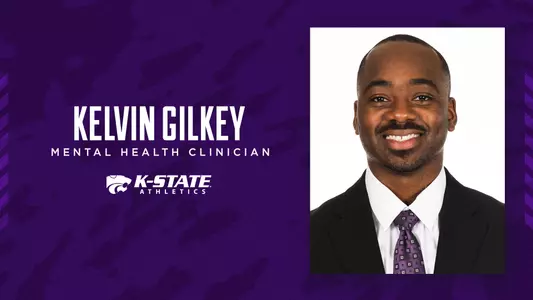
Kelvin Gilkey is one hour from speaking with a roomful of Kansas State football newcomers at the Vanier Family Football Complex. He spoke with the football team numerous times this spring, conducting what he called, "Wellness Wednesdays," where he provided information about mental wellness and performance in athletics. But speaking with newcomers? This is new. Gilkey, a native of Lewisville, Texas, arrived in Manhattan in January. He and wife Ellie have four-year-old Nola and seven-week old Kora, and he's ready to lay down some roots in the Little Apple, because, as he puts it, "This is a natural fit to where I am right now in my life," and sure he's a little bit sleep deprived, but he's a happy, proud father — and during the day he's a guiding force in the lives of young people.
Each student-athlete has a story, of course, and Gilkey, who sees between 15 and 17 student-athletes per week, maintains a soft tone during an interview, befitting of 32-year-old man who no doubt has seen and experienced some of the very challenges that face student-athletes today. He wears clear-frame glasses, a black Nike polo with a white Powercat, and sits on a cushy purple chair to the left of a wall-sized windowsill where houseplants and a 2013 National Championship ring sit on the second floor of the Morris Family Olympic Training Center. High above his desk sits a framed certificate that beams "HALL OF FAME." He was an All-American defensive back who helped Grand View University to its first undefeated season, and he was inducted into the Grand View Athletic Hall of Fame in 2023.

Today, he is a mental health clinician in the Morrison Family Mental Wellness Center, who is an hour away from heading to Vanier to speak to transfer players and freshmen.
"For the most part, I've grown to like public speaking," he says. "I was just telling somebody this morning, if you would've asked me five years ago about public speaking, that wasn't necessarily my strength, but it helps when you know what you're talking about and like what you do. I enjoy what I do. I think I'm good at it because of that.
"It's easier for me to talk about stuff and especially to young men because there aren't a lot of men in this space when it comes to mental health clinicians. There's always been that stigma. The more they can see me being comfortable doing something that's deemed uncomfortable, it kind of goes both ways."
He adds: "There's a lot of mystery behind what a mental health therapist does, so I'll clarify that piece as well as why I got into this field."
Gilkey at times keys on preventative guidance and at others focuses on mental performance. His passion is educating and empowering athletes in mental wellness and performance.
"So, it's integrating mental skills techniques to complement the physical stuff that they do in the weight room and on the field, to mesh it, to bring it together, and really make them go from being a good athlete to an elite athlete," he says. "When you talk about longevity, a lot of it comes from up here (pointing to his head), because there's more a limit to what your body can do at a certain age scientifically. We only tap into 10-15% of our mental capacity."
So how can student-athletes increase their mental capacity?
"What's the secret?" he replies. "At the very least, the person has to be motivated and want to change. That's the foundation. I can be the best at whatever I do, but if you don't want to change then anything I say or recommend doesn't work. The secret? Intrinsic motivation, and internal will to change. That's the secret."
He pauses.
"So," he says, "that's me as a clinician. Why did I get into this? I was a college and pro athlete, so I connect to these athletes just on the level of understanding the pros and cons to being a student-athlete and the sacrifices and just the external and internal factors that weigh in on us. I have a foundation of relating to them.
"Sports are my lifestyle. I feed off that energy. I came up in that setting, so it makes sense for me to mesh the two and be that missing link to some people. Myself, when I was playing, this wasn't really promoted. It may have been there, but you never really knew about it or how to access it and what it meant to access it. So, for me to bring that together and bridge that gap to access it, yeah, I carve out my lane and do the best that I can."
Gilkey is a licensed mental health counselor in Iowa and a licensed professional counselor in Kansas. He graduated with a master's degree in clinical mental health counseling and a bachelor's in health promotion-wellness management from Grand View University. His background includes working internationally, veterans, incarcerated youth, and athletes.
Gilkey's own interest in mental health ignited at an early age.
"When my dad went to prison, that was a shock for me — literally, a shock — because my lifestyle changed a lot," he says. "I went from being a normal kid to being the man of the house with four siblings. It took me to go through that to start seeking out things to really understand how this plays a role in my life to be able to be inside it and recommend things and help guide people through whatever they're going through.
"When I really reflect on it, that was really my first flame that was lit where it was like, 'OK, this is something that'll help me, but then it might also help somebody else.'"

Gilkey's interest in mental wellness further came into focus from when he lived in Denmark in 2017 and 2018 and worked with refugees. Gilkey had just completed an AFL career with the Iowa Barnstormers and through research found that Denmark was touted as the "happiest place to be in the world."
"I thought, 'Man, I'm going to go there,'" he says. "And I went there. And after about five months of touring around, being a tourist almost, I was like, 'I want to do something more purpose driven.' So, I volunteered places and ended up working with an organization. As for happiness? It's an individual thing."

There is happiness inside the Morrison Family Mental Wellness Center, as Gilkey's eyes light up while discussing his profession.
"Ten years ago, even, departments like this didn't really exist and just the evolution of mental health as a profession, it's just 70 years as a profession," he says. "You think about the disparities that come along with this, and just the misunderstandings that come along with this, and I get excited talking about this stuff because where I come from, we just got taught to deal with stuff, but when you're able to be more authentic and gain an identity through understanding and acceptance, you know how to prepare for the future, and you just continue to grow.
"Man, it's a total blessing to have this. I get goosebumps for these athletes because just some of the things that I hear, I sometimes just reflect back to when I was in that position. You just sit back and listen."
One of the most prominent topics: Perfectionism.
"That's one of the biggest things," Gilkey says. "As athletes we over-evaluate ourselves and compare ourselves to people all the time and not really take the chance to understand our strengths. We all have a unique ability and it's not about always wanting to acquire something, always pursuing something, because a lot of times it can be fool's gold. It's really understanding what you're good at and highlighting and celebrating that and letting that guide you forward. Athletes, we always want to have a one-up on our competition. We see everything as competition."
Time inches closer to when Gilkey will head to Vanier and address the football newcomers. He'll describe his occupation. He'll share a lot of wisdom. Within his presentation might be the topic of personal development.
"I think that a lot of times the athletes come in and they want performance training," he says. "One thing I like to always get across to them is that personal development complements performance excellence, so the more that you grow as a person, the more that you balance yourself internally, and that gives you more leeway for you to be more present and more in tune with yourself and in whatever sport that you're in."
Kelvin Gilkey is one hour from speaking with a roomful of Kansas State football newcomers at the Vanier Family Football Complex. He spoke with the football team numerous times this spring, conducting what he called, "Wellness Wednesdays," where he provided information about mental wellness and performance in athletics. But speaking with newcomers? This is new. Gilkey, a native of Lewisville, Texas, arrived in Manhattan in January. He and wife Ellie have four-year-old Nola and seven-week old Kora, and he's ready to lay down some roots in the Little Apple, because, as he puts it, "This is a natural fit to where I am right now in my life," and sure he's a little bit sleep deprived, but he's a happy, proud father — and during the day he's a guiding force in the lives of young people.
Each student-athlete has a story, of course, and Gilkey, who sees between 15 and 17 student-athletes per week, maintains a soft tone during an interview, befitting of 32-year-old man who no doubt has seen and experienced some of the very challenges that face student-athletes today. He wears clear-frame glasses, a black Nike polo with a white Powercat, and sits on a cushy purple chair to the left of a wall-sized windowsill where houseplants and a 2013 National Championship ring sit on the second floor of the Morris Family Olympic Training Center. High above his desk sits a framed certificate that beams "HALL OF FAME." He was an All-American defensive back who helped Grand View University to its first undefeated season, and he was inducted into the Grand View Athletic Hall of Fame in 2023.
Today, he is a mental health clinician in the Morrison Family Mental Wellness Center, who is an hour away from heading to Vanier to speak to transfer players and freshmen.
"For the most part, I've grown to like public speaking," he says. "I was just telling somebody this morning, if you would've asked me five years ago about public speaking, that wasn't necessarily my strength, but it helps when you know what you're talking about and like what you do. I enjoy what I do. I think I'm good at it because of that.
"It's easier for me to talk about stuff and especially to young men because there aren't a lot of men in this space when it comes to mental health clinicians. There's always been that stigma. The more they can see me being comfortable doing something that's deemed uncomfortable, it kind of goes both ways."
He adds: "There's a lot of mystery behind what a mental health therapist does, so I'll clarify that piece as well as why I got into this field."
Gilkey at times keys on preventative guidance and at others focuses on mental performance. His passion is educating and empowering athletes in mental wellness and performance.
"So, it's integrating mental skills techniques to complement the physical stuff that they do in the weight room and on the field, to mesh it, to bring it together, and really make them go from being a good athlete to an elite athlete," he says. "When you talk about longevity, a lot of it comes from up here (pointing to his head), because there's more a limit to what your body can do at a certain age scientifically. We only tap into 10-15% of our mental capacity."
So how can student-athletes increase their mental capacity?
"What's the secret?" he replies. "At the very least, the person has to be motivated and want to change. That's the foundation. I can be the best at whatever I do, but if you don't want to change then anything I say or recommend doesn't work. The secret? Intrinsic motivation, and internal will to change. That's the secret."
He pauses.
"So," he says, "that's me as a clinician. Why did I get into this? I was a college and pro athlete, so I connect to these athletes just on the level of understanding the pros and cons to being a student-athlete and the sacrifices and just the external and internal factors that weigh in on us. I have a foundation of relating to them.
"Sports are my lifestyle. I feed off that energy. I came up in that setting, so it makes sense for me to mesh the two and be that missing link to some people. Myself, when I was playing, this wasn't really promoted. It may have been there, but you never really knew about it or how to access it and what it meant to access it. So, for me to bring that together and bridge that gap to access it, yeah, I carve out my lane and do the best that I can."
Gilkey is a licensed mental health counselor in Iowa and a licensed professional counselor in Kansas. He graduated with a master's degree in clinical mental health counseling and a bachelor's in health promotion-wellness management from Grand View University. His background includes working internationally, veterans, incarcerated youth, and athletes.
Gilkey's own interest in mental health ignited at an early age.
"When my dad went to prison, that was a shock for me — literally, a shock — because my lifestyle changed a lot," he says. "I went from being a normal kid to being the man of the house with four siblings. It took me to go through that to start seeking out things to really understand how this plays a role in my life to be able to be inside it and recommend things and help guide people through whatever they're going through.
"When I really reflect on it, that was really my first flame that was lit where it was like, 'OK, this is something that'll help me, but then it might also help somebody else.'"
Gilkey's interest in mental wellness further came into focus from when he lived in Denmark in 2017 and 2018 and worked with refugees. Gilkey had just completed an AFL career with the Iowa Barnstormers and through research found that Denmark was touted as the "happiest place to be in the world."
"I thought, 'Man, I'm going to go there,'" he says. "And I went there. And after about five months of touring around, being a tourist almost, I was like, 'I want to do something more purpose driven.' So, I volunteered places and ended up working with an organization. As for happiness? It's an individual thing."
There is happiness inside the Morrison Family Mental Wellness Center, as Gilkey's eyes light up while discussing his profession.
"Ten years ago, even, departments like this didn't really exist and just the evolution of mental health as a profession, it's just 70 years as a profession," he says. "You think about the disparities that come along with this, and just the misunderstandings that come along with this, and I get excited talking about this stuff because where I come from, we just got taught to deal with stuff, but when you're able to be more authentic and gain an identity through understanding and acceptance, you know how to prepare for the future, and you just continue to grow.
"Man, it's a total blessing to have this. I get goosebumps for these athletes because just some of the things that I hear, I sometimes just reflect back to when I was in that position. You just sit back and listen."
One of the most prominent topics: Perfectionism.
"That's one of the biggest things," Gilkey says. "As athletes we over-evaluate ourselves and compare ourselves to people all the time and not really take the chance to understand our strengths. We all have a unique ability and it's not about always wanting to acquire something, always pursuing something, because a lot of times it can be fool's gold. It's really understanding what you're good at and highlighting and celebrating that and letting that guide you forward. Athletes, we always want to have a one-up on our competition. We see everything as competition."
Time inches closer to when Gilkey will head to Vanier and address the football newcomers. He'll describe his occupation. He'll share a lot of wisdom. Within his presentation might be the topic of personal development.
"I think that a lot of times the athletes come in and they want performance training," he says. "One thing I like to always get across to them is that personal development complements performance excellence, so the more that you grow as a person, the more that you balance yourself internally, and that gives you more leeway for you to be more present and more in tune with yourself and in whatever sport that you're in."
K State Men's Basketball | Head Coach Casey Alexander Media Availability - April 30, 2026
Thursday, April 30
K-State Rowing | March Rower of the Month
Thursday, April 30
Women's Golf | NCAA Tournament Selection Show Reaction
Wednesday, April 29
K-State Track & Field | Drake Relays Recap
Wednesday, April 29