‘I’ve Always Had Respect for the Powercat’
Dec 31, 2025 | Football, Sports Extra
By: D. Scott Fritchen
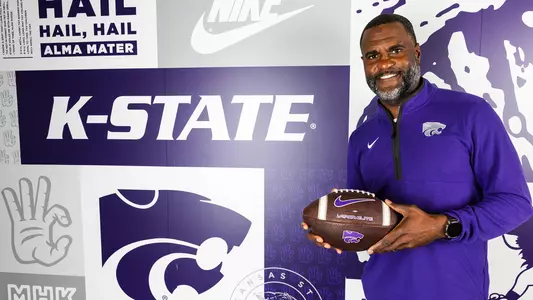
Marcus Woodson is an accomplished defensive secondary coach with 21 years of experience. He made numerous stops along his journey, including Auburn, Florida State, and most recently three years as co-defensive coordinator at Arkansas. Today, Woodson wears a purple quarter-zip and touches the silver Powercat logo on his chest as he talks.
"I've always had respect for the Powercat logo," he says.
K-State head coach Collin Klein hired Woodson as co-defensive coordinator working with the defensive backs on December 22, reuniting Woodson with new K-State defensive coordinator Jordan Peterson. Woodson and Peterson share a storied history as both defensive coaches served together on the same staff at Fresno State in 2014 and 2015.
"We stayed in touch on a regular basis, and we always agreed, 'When I get my opportunity, you're going to be my first hire," and vice versa,' Woodson says. "Once Jordan became the defensive coordinator here with Coach Klein, the opportunity presented itself, and he held to his word."
This will be Woodson's first stint in the Big 12 having previously spent five seasons in the SEC and three in the ACC.
Now Woodson is eager to help the K-State, its defense, and its players experience elite success.
"I just want to come and be a part of this to help Coach Peterson be the best defensive coordinator in America and for Coach Klein to be the best head coach in America," Woodson says. "That is my job — and just to pour into these players on a regular basis to help them to become the best version of themselves."
Woodson demonstrated his commitment to K-State early. He traveled to seven states between December 22 and 24, speaking with current K-State players on roster.
Now Woodson sits after a K-State football photo shoot and discusses his journey with K-State Sports Extra's D. Scott Fritchen:

D. SCOTT FRITCHEN: December 22 you were announced as a member of this K-State coaching staff under Collin Klein. Take me back to that initial conversation with Klein. What were you doing at the time when you received the call? You're obviously very accomplished, but were you at all surprised about hearing from Klein?
MARCUS WOODSON: Yes and no. Coach Jordan Peterson and I have history together. He gave me an idea that Coach Klein would be calling. It was an honor to receive that phone call. I was with my wife and kids at the time, and I had to step away to have the conversation with Coach Klein. We had a really good conversation in terms of who I am, what I stand for, and what I'm trying to accomplish in my career, and he did the same. He laid the vision out for me, what he's trying to accomplish as the head coach at K-State. He gave me history of his background and what led him up into that point. It didn't take long for me to know that I wanted to be a part of this. It's about the people that you're surrounded by that makes an experience, and I knew he was the one I'd love to work for.
FRITCHEN: Did you know much about Collin Klein at the time of the phone call?
WOODSON: Well, I knew more about him when he took the offensive coordinator job at Texas A&M. Obviously, I was coaching at Arkansas, and I did research on him. I always watched him as a player from afar. I really didn't keep up with him as a coach until he got to Texas A&M and with the success they had from an offensive standpoint. I knew he was an elite coach. Word gets around in terms of how a person is to work with and to work for, and once I hung up from that initial phone call, I researched him more as well, and it was all glowing reports from people I trust, and I knew I wanted to be a part of it.
I had just taken an analyst job at Ole Miss, my alma mater, four and a half hours from home, as me and my wife are both from Mississippi. It was somewhat of a hard decision there just because that's my alma mater and where my heart is at, but my relationship with Coach Peterson and the things I found out about Coach Klein, and the history I know of this program with the success Coach Bill Snyder had, I've always had respect for the Powercat logo. Once I prayed about it and talked to my wife and kids about it, I knew it was a go at that point.
FRITCHEN: Tell me about the first time you met Jordan Peterson and your initial impressions of him.
WOODSON: I first met Jordan Peterson in the spring of 2014. I was coaching at Charleston Southern in South Carolina and had just gotten married and had a son, and then I moved all the way to California at Fresno State. He was the first coach I met. It felt like I had known him for years the first time I met him. My wife and I moved into the same neighborhood as Jordan Peterson and his wife. My wife, Chastity, and his wife, Missy, became really good friends. We both had kids that were the same age. Our wives would have play dates on a regular basis. Jordan and I became workout buddies at Fresno State while we were working in the defensive secondary together. He coached the safeties, and I coached the corners. We developed a bond and worked together for two years. Once we had to part ways, we stayed in touch on a regular basis, and we always agreed, "When I get my opportunity, you're going to be my first hire," and vice versa. Once Jordan became the defensive coordinator here with Coach Klein the opportunity presented itself, and he held to his word. That's a reflection to the type of person he is as well. I'm just as excited to work side by side with him as I am with Coach Klein.
FRITCHEN: What kinds of conversations have you and Jordan had since the time you both were hired at K-State?
WOODSON: Mainly the vision he has as the defensive coordinator and with what he wants to accomplish with the defense. He and I, we are wired a lot alike. We are aligned a lot alike. I just want to come and be a part of this to help him be the best defensive coordinator in America and for Coach Klein to be the best head coach in America. That is my job. And just to pour into these players on a regular basis to help them to become the best version of themselves.
FRITCHEN: What are the first orders of business in setting up shop and building a defensive roster?
WOODSON: The main thing is finding out what we have on the current roster and finding out what their strengths and improvements would be and what pieces we'd need to add to make this the best defense in the country, and for sure, in the Big 12. Right now, we're just evaluating our roster and making sure that we can retain the roster with the guys that can help us be successful and that fit what we're trying to accomplish, and then add some pieces we think can really elevate the defense.

FRITCHEN: There are a lot of moving parts in college football right now. You come to a new place. What's the challenge of that with all the moving parts?
WOODSON: Well, the biggest challenge is with all of our players right now being at their respective hometowns is developing relationships from afar. Last week, we were flying and seeing all the different players that we need to make sure we retain and the ones that we couldn't reach in person, we made sure we Zoomed and had phone calls just to develop a relationship, because those guys didn't know who we were. Recently, we covered seven states in two and a half days, which is unique. This is a first with the calendar and the way things are structured right now. It was a challenge, but when change comes, you have to adapt, and just be the best you can be, and do everything you can at a high level.
Just pouring into the relationships side of things with the players, that's what it's all about, and just juggling — kids nowadays have a lot of different voices in their ears about what's best for them, right? Like, "Hey, go here, go there, do this, do that," and the main thing is trying to find that relationship piece where you can convince them and show them what's best for them, and just being able to connect. Then, obviously, adding to the roster requires just as much work in convincing a kid how we can help them achieve their dreams and goals. That's a big part of what we're trying to get done with the kids that are in the portal. Then it's just making sure that the plan of attack in terms of Coach Klein and what he wants to accomplish with this phase is in line as well.
FRITCHEN: You covered seven states in two days speaking to current players?
WOODSON: It was all current student-athletes. It was unique because Coach Klein was coaching in the playoffs, and serving as a husband and father, and serving as offensive coordinator at Texas A&M and the head coach at Kansas State. I didn't envy that part of him at all but at the same time, I know he wanted to finish strong at A&M but also start fast at Kansas State. There were a lot of hats he wore to be able to do that. What a great job he did just balancing everything he was responsible for.
FRITCHEN: When you hear "Kansas State football" what's the first thing that comes to mind?
WOODSON: Blue collar. Tough. Hard-nosed. Physical. Togetherness. That's the one thing that stood out watching from afar with Coach Snyder and the previous staff is just a unity with the Wildcats. Man, it feels good to have the logo on my chest right now.
FRITCHEN: You mention Coach Snyder, and K-State historically has had solid defenses and there has been a strong defensive tradition here. What are the biggest challenges of building and maintaining strong defenses this day in age in college football?
WOODSON: To me, the biggest challenge is just finding a lot of young men that live in the society of selfishness and teaching them to be unselfish to meet a common goal as a team and getting everybody to flow in the same direction and being selfless at a time when everybody is telling them to be selfish, if you will. When you're in coaching to serve your players, you're going to lead in the right way. I think you can be a leader and not necessarily serve and that's what this society and this generation of young men don't need. I'm excited about it.
One thing I do know that hasn't changed in all of the changes that have occurred is that kids still want structure. Once they verbalize to you what they want to accomplish and you bring it back to the present moment and provide the structure they need to get to that point, they'll buy in. Once you provide structure, everybody wants to be held to a high standard whether they say it or not. So, structure and standard, and when that standard isn't met, they want to be held accountable. Accountability is something we provide for our players. That's not something that we do to them. Once they know you care, that accountability, they want it, and they embrace it. So, structure, standard and accountability, if you provide those three things, kids still want that.

FRITCHEN: What would you like for this defensive identity to be in the Collin Klein era?
WOODSON: Great question. First off, playing together as one. I got the same call one-eleven. The eleven is only as good as the one. Everybody doing their job within what we're doing but playing fast, playing disciplined and physical. For us on the back end, I know playing disciplined is going to be our foundation with what I look at with my eyes and in doing my job and just being where you're supposed to be when you're supposed to be there doing what you're supposed to be doing.
FRITCHEN: Working with defensive backs has been a staple in your success. What are the key components you look for in a defensive back and what exactly does it look like on the field when the backend of the defense has gelled?
WOODSON: For me, it's about all the physical traits, the bigger, faster, stronger the better. We look for all that. But at the same time finding guys with that selfless mindset that is willing to give up what they want most and just being disciplined in what they do. The physical traits are obvious. I want to find team guys. That's really what we're looking for.
FRITCHEN: How has your experience at Arkansas in the SEC helped you reach this part of your journey?
WOODSON: I've had many years of success. We had a successful year in 2023 at Arkansas, and 2024 and 2025 weren't as successful. For me, you learn as much from failure as you do from success. It was a great experience and opportunity with the ebbs and flows of the time that I was there, but I grew a lot more just as a servant leader, just truly being here for my players and really pouring into them. That's what it's all about and why I'm in coaching. Helping them to be their best when things aren't going the way we planned is something I improved in during my time there.
FRITCHEN: Obviously, there are a lot of high-octane offenses in the SEC. What's the weekly grind of doing that in the SEC and how do you see that translate in the Big 12?
WOODSON: There are a lot of great coaches in college football, and I have a lot of respect for this conference. The biggest thing now is teaching kids how to go to the next game and staying focused. At Arkansas, we beat Tennessee in 2024, and they were ranked top 5 at the time, and they were scoring like 40 points a game, and we held them to 13 points this particular night. The following week, it was a Thursday leading up to the next opponent, and we had beaten Tennessee the previous week, and I was walking on campus with one of our defensive backs, and a student came up and said, "Great job last week." It was a teachable moment, because that was last week, and it showed me how when kids have success, the pats on the back that they receive, as a coach, you're trying to get them to block out the success or the failures from the previous week and focus on this week.
It showed me that you're never as good as the praise you get from a win but you're never as bad as the criticism from a loss. Being able to teach kids the emotional side of that is a challenge. That's why winning and losing doesn't start in the fall, it starts today, and being able to implement the mindset to block out the outside noise is a journey, and it starts right now.
FRITCHEN: Between Auburn, Florida State, Arkansas and now K-State, you've been entrenched in Power 4 football for quite a while now. How would you describe the landscape of college football today and how do you feel like the Big 12 Conference as a whole fits into that landscape?
WOODSON: I think the landscape of college football right now is very fluid. There's a lot of change happening day in and day out. I do think the calendar is a little unfavorable in a lot of ways. It was Christmas Eve and I'm sitting on the couches of current players trying to make sure they stay put. I think the Big 12, it's all relative. Football is football, recruiting is recruiting, and it's the Big 12, but the SEC, it's all the same. Defending an inside zone at K-State against Texas Tech is no different from stopping it when I was at Arkansas playing against Texas A&M. The fundamentals and the morals and values that it takes to be successful, it's all relative.
FRITCHEN: From the time you were at your hometown of Moss Point, Mississippi, to where you are today, what have you learned most about yourself during your journey?
WOODSON: That's a great, great question. Just the resilience. The grit that I've been able to grow in over the years — I had a lot of success as a player coming out of high school. We won two out of three state titles, I had a lot of offers, and I went to Ole Miss. My freshman year and sophomore years went exactly as I had planned, but my junior and senior years I stayed hurt. That's when the call to become a coach got implemented. If I can go back and do it again, I wouldn't change a thing. But it was a lot of dark nights along the way, a lot of successful moments as well, and I've become very resilient over the years. Regardless of how much success I have or how much failure I have, keep going and the sun will eventually come out. I've lost loved ones along the way, lost a sibling, lost grandparents, and parents separated, life is going to keep moving. But at the end of the day when the Good Lord gives me the opportunity to wake up and let my feet hit the floor, I'm going to make sure I thank Him and go out and be the best I can be that day to serve the people I'm fortunate to be around on a daily basis, the coaches, players, and administrators and everything that goes along with it. Resilience and grit and just the motto to keep going is what I've learned about myself.
Marcus Woodson is an accomplished defensive secondary coach with 21 years of experience. He made numerous stops along his journey, including Auburn, Florida State, and most recently three years as co-defensive coordinator at Arkansas. Today, Woodson wears a purple quarter-zip and touches the silver Powercat logo on his chest as he talks.
"I've always had respect for the Powercat logo," he says.
K-State head coach Collin Klein hired Woodson as co-defensive coordinator working with the defensive backs on December 22, reuniting Woodson with new K-State defensive coordinator Jordan Peterson. Woodson and Peterson share a storied history as both defensive coaches served together on the same staff at Fresno State in 2014 and 2015.
"We stayed in touch on a regular basis, and we always agreed, 'When I get my opportunity, you're going to be my first hire," and vice versa,' Woodson says. "Once Jordan became the defensive coordinator here with Coach Klein, the opportunity presented itself, and he held to his word."
This will be Woodson's first stint in the Big 12 having previously spent five seasons in the SEC and three in the ACC.
Now Woodson is eager to help the K-State, its defense, and its players experience elite success.
"I just want to come and be a part of this to help Coach Peterson be the best defensive coordinator in America and for Coach Klein to be the best head coach in America," Woodson says. "That is my job — and just to pour into these players on a regular basis to help them to become the best version of themselves."
Woodson demonstrated his commitment to K-State early. He traveled to seven states between December 22 and 24, speaking with current K-State players on roster.
Now Woodson sits after a K-State football photo shoot and discusses his journey with K-State Sports Extra's D. Scott Fritchen:
D. SCOTT FRITCHEN: December 22 you were announced as a member of this K-State coaching staff under Collin Klein. Take me back to that initial conversation with Klein. What were you doing at the time when you received the call? You're obviously very accomplished, but were you at all surprised about hearing from Klein?
MARCUS WOODSON: Yes and no. Coach Jordan Peterson and I have history together. He gave me an idea that Coach Klein would be calling. It was an honor to receive that phone call. I was with my wife and kids at the time, and I had to step away to have the conversation with Coach Klein. We had a really good conversation in terms of who I am, what I stand for, and what I'm trying to accomplish in my career, and he did the same. He laid the vision out for me, what he's trying to accomplish as the head coach at K-State. He gave me history of his background and what led him up into that point. It didn't take long for me to know that I wanted to be a part of this. It's about the people that you're surrounded by that makes an experience, and I knew he was the one I'd love to work for.
FRITCHEN: Did you know much about Collin Klein at the time of the phone call?
WOODSON: Well, I knew more about him when he took the offensive coordinator job at Texas A&M. Obviously, I was coaching at Arkansas, and I did research on him. I always watched him as a player from afar. I really didn't keep up with him as a coach until he got to Texas A&M and with the success they had from an offensive standpoint. I knew he was an elite coach. Word gets around in terms of how a person is to work with and to work for, and once I hung up from that initial phone call, I researched him more as well, and it was all glowing reports from people I trust, and I knew I wanted to be a part of it.
I had just taken an analyst job at Ole Miss, my alma mater, four and a half hours from home, as me and my wife are both from Mississippi. It was somewhat of a hard decision there just because that's my alma mater and where my heart is at, but my relationship with Coach Peterson and the things I found out about Coach Klein, and the history I know of this program with the success Coach Bill Snyder had, I've always had respect for the Powercat logo. Once I prayed about it and talked to my wife and kids about it, I knew it was a go at that point.
FRITCHEN: Tell me about the first time you met Jordan Peterson and your initial impressions of him.
WOODSON: I first met Jordan Peterson in the spring of 2014. I was coaching at Charleston Southern in South Carolina and had just gotten married and had a son, and then I moved all the way to California at Fresno State. He was the first coach I met. It felt like I had known him for years the first time I met him. My wife and I moved into the same neighborhood as Jordan Peterson and his wife. My wife, Chastity, and his wife, Missy, became really good friends. We both had kids that were the same age. Our wives would have play dates on a regular basis. Jordan and I became workout buddies at Fresno State while we were working in the defensive secondary together. He coached the safeties, and I coached the corners. We developed a bond and worked together for two years. Once we had to part ways, we stayed in touch on a regular basis, and we always agreed, "When I get my opportunity, you're going to be my first hire," and vice versa. Once Jordan became the defensive coordinator here with Coach Klein the opportunity presented itself, and he held to his word. That's a reflection to the type of person he is as well. I'm just as excited to work side by side with him as I am with Coach Klein.
FRITCHEN: What kinds of conversations have you and Jordan had since the time you both were hired at K-State?
WOODSON: Mainly the vision he has as the defensive coordinator and with what he wants to accomplish with the defense. He and I, we are wired a lot alike. We are aligned a lot alike. I just want to come and be a part of this to help him be the best defensive coordinator in America and for Coach Klein to be the best head coach in America. That is my job. And just to pour into these players on a regular basis to help them to become the best version of themselves.
FRITCHEN: What are the first orders of business in setting up shop and building a defensive roster?
WOODSON: The main thing is finding out what we have on the current roster and finding out what their strengths and improvements would be and what pieces we'd need to add to make this the best defense in the country, and for sure, in the Big 12. Right now, we're just evaluating our roster and making sure that we can retain the roster with the guys that can help us be successful and that fit what we're trying to accomplish, and then add some pieces we think can really elevate the defense.
FRITCHEN: There are a lot of moving parts in college football right now. You come to a new place. What's the challenge of that with all the moving parts?
WOODSON: Well, the biggest challenge is with all of our players right now being at their respective hometowns is developing relationships from afar. Last week, we were flying and seeing all the different players that we need to make sure we retain and the ones that we couldn't reach in person, we made sure we Zoomed and had phone calls just to develop a relationship, because those guys didn't know who we were. Recently, we covered seven states in two and a half days, which is unique. This is a first with the calendar and the way things are structured right now. It was a challenge, but when change comes, you have to adapt, and just be the best you can be, and do everything you can at a high level.
Just pouring into the relationships side of things with the players, that's what it's all about, and just juggling — kids nowadays have a lot of different voices in their ears about what's best for them, right? Like, "Hey, go here, go there, do this, do that," and the main thing is trying to find that relationship piece where you can convince them and show them what's best for them, and just being able to connect. Then, obviously, adding to the roster requires just as much work in convincing a kid how we can help them achieve their dreams and goals. That's a big part of what we're trying to get done with the kids that are in the portal. Then it's just making sure that the plan of attack in terms of Coach Klein and what he wants to accomplish with this phase is in line as well.
FRITCHEN: You covered seven states in two days speaking to current players?
WOODSON: It was all current student-athletes. It was unique because Coach Klein was coaching in the playoffs, and serving as a husband and father, and serving as offensive coordinator at Texas A&M and the head coach at Kansas State. I didn't envy that part of him at all but at the same time, I know he wanted to finish strong at A&M but also start fast at Kansas State. There were a lot of hats he wore to be able to do that. What a great job he did just balancing everything he was responsible for.
FRITCHEN: When you hear "Kansas State football" what's the first thing that comes to mind?
WOODSON: Blue collar. Tough. Hard-nosed. Physical. Togetherness. That's the one thing that stood out watching from afar with Coach Snyder and the previous staff is just a unity with the Wildcats. Man, it feels good to have the logo on my chest right now.
FRITCHEN: You mention Coach Snyder, and K-State historically has had solid defenses and there has been a strong defensive tradition here. What are the biggest challenges of building and maintaining strong defenses this day in age in college football?
WOODSON: To me, the biggest challenge is just finding a lot of young men that live in the society of selfishness and teaching them to be unselfish to meet a common goal as a team and getting everybody to flow in the same direction and being selfless at a time when everybody is telling them to be selfish, if you will. When you're in coaching to serve your players, you're going to lead in the right way. I think you can be a leader and not necessarily serve and that's what this society and this generation of young men don't need. I'm excited about it.
One thing I do know that hasn't changed in all of the changes that have occurred is that kids still want structure. Once they verbalize to you what they want to accomplish and you bring it back to the present moment and provide the structure they need to get to that point, they'll buy in. Once you provide structure, everybody wants to be held to a high standard whether they say it or not. So, structure and standard, and when that standard isn't met, they want to be held accountable. Accountability is something we provide for our players. That's not something that we do to them. Once they know you care, that accountability, they want it, and they embrace it. So, structure, standard and accountability, if you provide those three things, kids still want that.
FRITCHEN: What would you like for this defensive identity to be in the Collin Klein era?
WOODSON: Great question. First off, playing together as one. I got the same call one-eleven. The eleven is only as good as the one. Everybody doing their job within what we're doing but playing fast, playing disciplined and physical. For us on the back end, I know playing disciplined is going to be our foundation with what I look at with my eyes and in doing my job and just being where you're supposed to be when you're supposed to be there doing what you're supposed to be doing.
FRITCHEN: Working with defensive backs has been a staple in your success. What are the key components you look for in a defensive back and what exactly does it look like on the field when the backend of the defense has gelled?
WOODSON: For me, it's about all the physical traits, the bigger, faster, stronger the better. We look for all that. But at the same time finding guys with that selfless mindset that is willing to give up what they want most and just being disciplined in what they do. The physical traits are obvious. I want to find team guys. That's really what we're looking for.
FRITCHEN: How has your experience at Arkansas in the SEC helped you reach this part of your journey?
WOODSON: I've had many years of success. We had a successful year in 2023 at Arkansas, and 2024 and 2025 weren't as successful. For me, you learn as much from failure as you do from success. It was a great experience and opportunity with the ebbs and flows of the time that I was there, but I grew a lot more just as a servant leader, just truly being here for my players and really pouring into them. That's what it's all about and why I'm in coaching. Helping them to be their best when things aren't going the way we planned is something I improved in during my time there.
FRITCHEN: Obviously, there are a lot of high-octane offenses in the SEC. What's the weekly grind of doing that in the SEC and how do you see that translate in the Big 12?
WOODSON: There are a lot of great coaches in college football, and I have a lot of respect for this conference. The biggest thing now is teaching kids how to go to the next game and staying focused. At Arkansas, we beat Tennessee in 2024, and they were ranked top 5 at the time, and they were scoring like 40 points a game, and we held them to 13 points this particular night. The following week, it was a Thursday leading up to the next opponent, and we had beaten Tennessee the previous week, and I was walking on campus with one of our defensive backs, and a student came up and said, "Great job last week." It was a teachable moment, because that was last week, and it showed me how when kids have success, the pats on the back that they receive, as a coach, you're trying to get them to block out the success or the failures from the previous week and focus on this week.
It showed me that you're never as good as the praise you get from a win but you're never as bad as the criticism from a loss. Being able to teach kids the emotional side of that is a challenge. That's why winning and losing doesn't start in the fall, it starts today, and being able to implement the mindset to block out the outside noise is a journey, and it starts right now.
FRITCHEN: Between Auburn, Florida State, Arkansas and now K-State, you've been entrenched in Power 4 football for quite a while now. How would you describe the landscape of college football today and how do you feel like the Big 12 Conference as a whole fits into that landscape?
WOODSON: I think the landscape of college football right now is very fluid. There's a lot of change happening day in and day out. I do think the calendar is a little unfavorable in a lot of ways. It was Christmas Eve and I'm sitting on the couches of current players trying to make sure they stay put. I think the Big 12, it's all relative. Football is football, recruiting is recruiting, and it's the Big 12, but the SEC, it's all the same. Defending an inside zone at K-State against Texas Tech is no different from stopping it when I was at Arkansas playing against Texas A&M. The fundamentals and the morals and values that it takes to be successful, it's all relative.
FRITCHEN: From the time you were at your hometown of Moss Point, Mississippi, to where you are today, what have you learned most about yourself during your journey?
WOODSON: That's a great, great question. Just the resilience. The grit that I've been able to grow in over the years — I had a lot of success as a player coming out of high school. We won two out of three state titles, I had a lot of offers, and I went to Ole Miss. My freshman year and sophomore years went exactly as I had planned, but my junior and senior years I stayed hurt. That's when the call to become a coach got implemented. If I can go back and do it again, I wouldn't change a thing. But it was a lot of dark nights along the way, a lot of successful moments as well, and I've become very resilient over the years. Regardless of how much success I have or how much failure I have, keep going and the sun will eventually come out. I've lost loved ones along the way, lost a sibling, lost grandparents, and parents separated, life is going to keep moving. But at the end of the day when the Good Lord gives me the opportunity to wake up and let my feet hit the floor, I'm going to make sure I thank Him and go out and be the best I can be that day to serve the people I'm fortunate to be around on a daily basis, the coaches, players, and administrators and everything that goes along with it. Resilience and grit and just the motto to keep going is what I've learned about myself.
K-State Rowing | 2026 Sunflower Showdown Recap
Tuesday, April 14
K-State Rowing | Sylvia Cunningham Senior Video
Tuesday, April 14
K-State Tennis | Weekend Recap vs Iowa State & Kansas
Tuesday, April 14
K-State Volleyball | UMKC Tournament Recap
Monday, April 13