‘Adversity Has Made Me Who I Am’
Mar 20, 2025 | Baseball, Sports Extra
By: D. Scott Fritchen
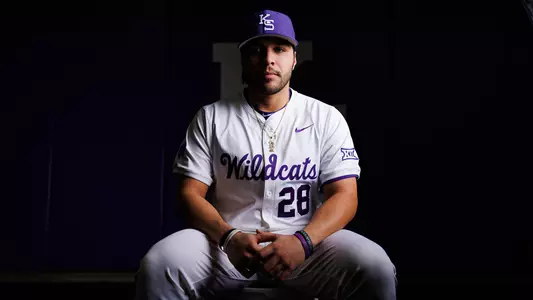
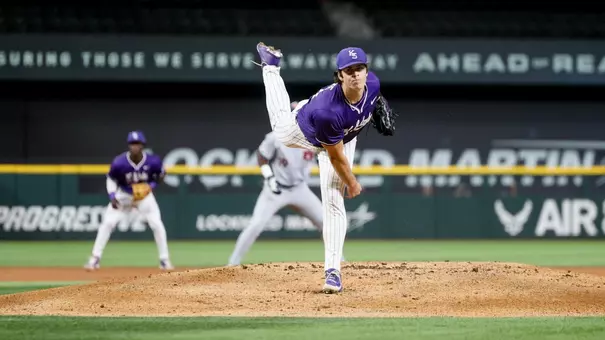
The gift of a lifetime arrived 27 years ago — five years before Michael Quevedo began his life. Today, Quevedo sits in a clean, white pinstripe unform as a member of the Kansas State baseball team. He has just produced his first quality outing in his fifth start as a Wildcat after holding Utah to two earned runs on eight hits over six frames. The senior left-hander fanned seven batters and scattered eight hits without allowing a walk in a 13-2 victory at Tointon Family Stadium.
The 5-foot-11, 215-pound Quevedo, a native of Katy, Texas, is "yes, sir" and "no, sir," and smiles as the sun dips below the Flint Hills, knowing he is home. Not his home, not his parents' home, but home in the sense that there is no other place he'd rather be, what with a caring coaching staff and teammates that he loves like brothers. His first night in Manhattan in August, nervousness and excitement filled his head as he hit the pillow for the first time in his apartment, preparing to embark upon his final season in a collegiate uniform.
"Adversity has made me who I am," he says. "Right now, you see all the great moments, but there are also a lot of moments when things didn't go my way, and it happens in a long season. I feel like it's built a lot of toughness."

Quevedo comes from a loving family. A grateful family. And so, his story unfurls, a handful of years before his birth in Miami, Florida. Grandpa Miguel Garcia gave his daughter and son-in-law, Elizabeth and Ramon, the gift of a lifetime: The opportunity for a new life. They all resided in Cuba. That was about to change.
The "Cuban lottery" or Special Cuban Migration Program (SCMP) was a U.S. program that allowed adult Cubans to emigrate to the U.S. through a lottery system, but it was not used after 1998. Participants submitted biological information, and submissions were randomly drawn to select winners. There were 541,000 qualifying registrants in 1998, and the 20,000 lottery winners were allowed to bring their spouse and children.
Miguel was a lottery winner. He gave his golden ticket to Elizabeth and Ramon. And so began a new life.
"Just having that opportunity, I mean, I was fortunate to be born in the United States," Quevedo says. "My parents tell me all the time, 'When the opportunity presents itself, take advantage of it.' That doesn't mean everything is going to go great all the time. My parents got here, and they struggled but they worked their butts off. They instilled that into me."
Quevedo visited Cuba once, but he was too young to remember.
"My parents have only gone one time," he says. "It's very tough, especially with all the political stuff out there. My grandma is at an eligible age where she could come on a three-month visa, but she hasn't done it in a while because with my grandpa passing away, she doesn't like to leave the house over there. With family over there, it's more like FaceTime and we talk to them all the time.
"I wish I could go back, you know, go back and see my grandma. I know she wants to come back here sometimes, but my parents both work basically every day of the week, so it's really tough to have a set vacation time to me with them. We always talk every day. It's a strong relationship being so far away."
The Quevedos lived in Miami until Michael was 3. They moved four hours north to Deltona.
"Pre-K to graduating and then the first two years of college I was in Deltona," Quevedo says. "I actually went to a baseball academy, TNXL Academy in Altamonte Springs, so I was home schooled, and it was a big sacrifice my parents made for me because they wanted me to get the best baseball experience. For me, it was that. It was long days, but it prepared me for college. It was a very competitive atmosphere, and I loved all the coaches."
Michael grew up watching Ramon Jr., who is 11 years Michael's elder, play catcher. Michael aspired to play catcher as well. For Michael, baseball was the only sport he knew. An avid Marlins fan, he loved star pitchers Dontrelle Willis and Jose Fernandez.
"You can't get this feeling anywhere else," Quevedo says. "It's a tough game, but success tastes so sweet and adversity comes a lot."

His competitive fire for baseball truly took form in middle school.
"My parents always told me, 'You go as far as you want to go. If you really want it, you have to work your butt off.' I wasn't the biggest and I wasn't the strongest, but through work ethic, when I got to high school, I was playing around a lot of guys who were drafted out of high school or going to the big Power 5 schools. I was right there with them. So, I always knew my talent could take me far but also that my work ethic was going to push me through the edge.
"To me, there's competition in every sport, but especially being a pitcher, it's almost like a one-on-one battle. You've got those eight guys behind you. There's no better feeling than going against that hitter. It almost feels personal. Going out there with my guys, it's all of us versus all of them, but most of the time it's really you versus you. This sport prepares you more for life than anything I know."

And how is life? Well, life is pretty great right now as Quevedo battles from the mound in his final collegiate season.
Quevedo was ranked No. 72 overall in the D1Baseball Top 85 Transfers List, as D1Baseball's managing editor Kendall Rogers said that "Quevedo has bulldog written all over him" behind an 88-mile-per-hour fastball and a curveball and changeup in the upper-70s. Quevedo arrived at K-State following a two-year stint at Nicholls State, where he made 28 appearances, including 23 starts. He went 9-3 with a 5.13 ERA and 92 strikeouts over 112 1/3 innings. Prior to his stop at Nicholls, he made his collegiate debut at Little Rock, making seven appearances with two starts for the Trojans. He finished with a 2-1 record and a 5.87 ERA over 23 innings while striking out 12.
Quevedo was driving when K-State assistant coach Thomas Hughes phoned him one day in June. He asked Quevedo if he wanted to visit K-State.
"That was my first Power 5 call," he says. "I'd always come from smaller schools and had never been the guy who had the big name behind him, and it was really cool. I've always been super excited for any opportunity. I guess this past year in the portal was the most buzz my name has ever had and when I really came here and got to meet everybody, I'm a big people person and I'm big on relationships and caring about people, and I felt that here from the instant I got here. I could tell every coach really cared about you."
That includes K-State head coach Pete Hughes, whose 831 career victories are the most by a current Big 12 Conference head coach, and who has sent 89 former players to the Major League Baseball Draft.
"It was a great get," Hughes says. "I love Michael for a lot of reasons. I love his backstory. I love that he's left-handed, I love the fact that he's pitched in big games. He's really talented. You get a high-character kid who loves to compete, and those are always win-wins. He's just a pleasure to be around. He always has a smile on his face and his teammates love him."

That first night in his Manhattan apartment, as Quevedo laid his head on the pillow, a thousand thoughts raced through his mind. But he was ready.
"I was ready to get at it," he says. "Being at a place like this, I know there are 40 guys on the roster, and it's competitive. I've always been somebody who's run toward that challenge, and I was excited. I've always been around talented people, but this was going to be a tough challenge. I think it has made everybody better. It's also made us all love each other. It's not hard when you know you're competing with the guys next to you because you want a spot but at the same time you want him to succeed. That's something we've really built here."
On the mound, Quevedo has made his presence known. He has a 3.91 ERA and is second on the team with 23.0 innings pitched and 30 strikeouts to just 10 walks while allowing 10 earned runs. He posted a team-season-high 10 strikeouts — seven strikeouts looking — in a 14-3 win over Sam Houston in the Frisco Classic in early March. He became the first player to reach double digit strikeouts since Owen Boerema against West Virginia last season.
Quevedo's performance in his first-ever Big 12 game in the 13-2 win over Utah on Saturday was even more impressive.
"Michael loves to compete," Hughes says. "He's tough. He's never going to beat himself. He never takes a moment of growth in this sport for granted. He's a workaholic and the ultimate teammate. He just wants the ball in his hand."
Hughes pauses.
"Michael has been handed an opportunity of a lifetime," he says. "That's really how he approaches every single day. He'll never waste a day or an opportunity that that privilege has given him, that his grandparents' gift has given him.
"It's an amazing story. It's an amazing family."

Ask Quevedo about his journey, about his story, and he'll talk about how much he loves K-State, and he'll talk about how much he loves baseball, but in the end, there's that singular thread that weaves through the fabric of an already accomplished young life, one that is still being woven, and one that might be filled with many beautiful moments. That's Quevedo, who can't help but smile when he speaks, as he leans back in the black leather swivel chair in the coaches meeting room at Tointon Family Stadium. When it comes to Miguel Garcia, his heart swells. He rubs his right pectoral muscle.
"I actually have his death date here, the only tattoo I ever got and probably the only one I'll ever get," he says. "He means a lot. The one time I went to Cuba I was super young and I don't remember, but he passed away a couple years ago now. I'm eternally grateful. When I pray, I feel like I'm talking to him. I know my parents are eternally grateful to him. It's just a special sacrifice. It's hard to put into words.
"Every day, I think about him, I think about it, and it's special."
The gift of a lifetime arrived 27 years ago — five years before Michael Quevedo began his life. Today, Quevedo sits in a clean, white pinstripe unform as a member of the Kansas State baseball team. He has just produced his first quality outing in his fifth start as a Wildcat after holding Utah to two earned runs on eight hits over six frames. The senior left-hander fanned seven batters and scattered eight hits without allowing a walk in a 13-2 victory at Tointon Family Stadium.
The 5-foot-11, 215-pound Quevedo, a native of Katy, Texas, is "yes, sir" and "no, sir," and smiles as the sun dips below the Flint Hills, knowing he is home. Not his home, not his parents' home, but home in the sense that there is no other place he'd rather be, what with a caring coaching staff and teammates that he loves like brothers. His first night in Manhattan in August, nervousness and excitement filled his head as he hit the pillow for the first time in his apartment, preparing to embark upon his final season in a collegiate uniform.
"Adversity has made me who I am," he says. "Right now, you see all the great moments, but there are also a lot of moments when things didn't go my way, and it happens in a long season. I feel like it's built a lot of toughness."
Quevedo comes from a loving family. A grateful family. And so, his story unfurls, a handful of years before his birth in Miami, Florida. Grandpa Miguel Garcia gave his daughter and son-in-law, Elizabeth and Ramon, the gift of a lifetime: The opportunity for a new life. They all resided in Cuba. That was about to change.
The "Cuban lottery" or Special Cuban Migration Program (SCMP) was a U.S. program that allowed adult Cubans to emigrate to the U.S. through a lottery system, but it was not used after 1998. Participants submitted biological information, and submissions were randomly drawn to select winners. There were 541,000 qualifying registrants in 1998, and the 20,000 lottery winners were allowed to bring their spouse and children.
Miguel was a lottery winner. He gave his golden ticket to Elizabeth and Ramon. And so began a new life.
"Just having that opportunity, I mean, I was fortunate to be born in the United States," Quevedo says. "My parents tell me all the time, 'When the opportunity presents itself, take advantage of it.' That doesn't mean everything is going to go great all the time. My parents got here, and they struggled but they worked their butts off. They instilled that into me."
Quevedo visited Cuba once, but he was too young to remember.
"My parents have only gone one time," he says. "It's very tough, especially with all the political stuff out there. My grandma is at an eligible age where she could come on a three-month visa, but she hasn't done it in a while because with my grandpa passing away, she doesn't like to leave the house over there. With family over there, it's more like FaceTime and we talk to them all the time.
"I wish I could go back, you know, go back and see my grandma. I know she wants to come back here sometimes, but my parents both work basically every day of the week, so it's really tough to have a set vacation time to me with them. We always talk every day. It's a strong relationship being so far away."
The Quevedos lived in Miami until Michael was 3. They moved four hours north to Deltona.
"Pre-K to graduating and then the first two years of college I was in Deltona," Quevedo says. "I actually went to a baseball academy, TNXL Academy in Altamonte Springs, so I was home schooled, and it was a big sacrifice my parents made for me because they wanted me to get the best baseball experience. For me, it was that. It was long days, but it prepared me for college. It was a very competitive atmosphere, and I loved all the coaches."
Michael grew up watching Ramon Jr., who is 11 years Michael's elder, play catcher. Michael aspired to play catcher as well. For Michael, baseball was the only sport he knew. An avid Marlins fan, he loved star pitchers Dontrelle Willis and Jose Fernandez.
"You can't get this feeling anywhere else," Quevedo says. "It's a tough game, but success tastes so sweet and adversity comes a lot."
His competitive fire for baseball truly took form in middle school.
"My parents always told me, 'You go as far as you want to go. If you really want it, you have to work your butt off.' I wasn't the biggest and I wasn't the strongest, but through work ethic, when I got to high school, I was playing around a lot of guys who were drafted out of high school or going to the big Power 5 schools. I was right there with them. So, I always knew my talent could take me far but also that my work ethic was going to push me through the edge.
"To me, there's competition in every sport, but especially being a pitcher, it's almost like a one-on-one battle. You've got those eight guys behind you. There's no better feeling than going against that hitter. It almost feels personal. Going out there with my guys, it's all of us versus all of them, but most of the time it's really you versus you. This sport prepares you more for life than anything I know."
And how is life? Well, life is pretty great right now as Quevedo battles from the mound in his final collegiate season.
Quevedo was ranked No. 72 overall in the D1Baseball Top 85 Transfers List, as D1Baseball's managing editor Kendall Rogers said that "Quevedo has bulldog written all over him" behind an 88-mile-per-hour fastball and a curveball and changeup in the upper-70s. Quevedo arrived at K-State following a two-year stint at Nicholls State, where he made 28 appearances, including 23 starts. He went 9-3 with a 5.13 ERA and 92 strikeouts over 112 1/3 innings. Prior to his stop at Nicholls, he made his collegiate debut at Little Rock, making seven appearances with two starts for the Trojans. He finished with a 2-1 record and a 5.87 ERA over 23 innings while striking out 12.
Quevedo was driving when K-State assistant coach Thomas Hughes phoned him one day in June. He asked Quevedo if he wanted to visit K-State.
"That was my first Power 5 call," he says. "I'd always come from smaller schools and had never been the guy who had the big name behind him, and it was really cool. I've always been super excited for any opportunity. I guess this past year in the portal was the most buzz my name has ever had and when I really came here and got to meet everybody, I'm a big people person and I'm big on relationships and caring about people, and I felt that here from the instant I got here. I could tell every coach really cared about you."
That includes K-State head coach Pete Hughes, whose 831 career victories are the most by a current Big 12 Conference head coach, and who has sent 89 former players to the Major League Baseball Draft.
"It was a great get," Hughes says. "I love Michael for a lot of reasons. I love his backstory. I love that he's left-handed, I love the fact that he's pitched in big games. He's really talented. You get a high-character kid who loves to compete, and those are always win-wins. He's just a pleasure to be around. He always has a smile on his face and his teammates love him."
That first night in his Manhattan apartment, as Quevedo laid his head on the pillow, a thousand thoughts raced through his mind. But he was ready.
"I was ready to get at it," he says. "Being at a place like this, I know there are 40 guys on the roster, and it's competitive. I've always been somebody who's run toward that challenge, and I was excited. I've always been around talented people, but this was going to be a tough challenge. I think it has made everybody better. It's also made us all love each other. It's not hard when you know you're competing with the guys next to you because you want a spot but at the same time you want him to succeed. That's something we've really built here."
On the mound, Quevedo has made his presence known. He has a 3.91 ERA and is second on the team with 23.0 innings pitched and 30 strikeouts to just 10 walks while allowing 10 earned runs. He posted a team-season-high 10 strikeouts — seven strikeouts looking — in a 14-3 win over Sam Houston in the Frisco Classic in early March. He became the first player to reach double digit strikeouts since Owen Boerema against West Virginia last season.
Quevedo's performance in his first-ever Big 12 game in the 13-2 win over Utah on Saturday was even more impressive.
"Michael loves to compete," Hughes says. "He's tough. He's never going to beat himself. He never takes a moment of growth in this sport for granted. He's a workaholic and the ultimate teammate. He just wants the ball in his hand."
Hughes pauses.
"Michael has been handed an opportunity of a lifetime," he says. "That's really how he approaches every single day. He'll never waste a day or an opportunity that that privilege has given him, that his grandparents' gift has given him.
"It's an amazing story. It's an amazing family."
Ask Quevedo about his journey, about his story, and he'll talk about how much he loves K-State, and he'll talk about how much he loves baseball, but in the end, there's that singular thread that weaves through the fabric of an already accomplished young life, one that is still being woven, and one that might be filled with many beautiful moments. That's Quevedo, who can't help but smile when he speaks, as he leans back in the black leather swivel chair in the coaches meeting room at Tointon Family Stadium. When it comes to Miguel Garcia, his heart swells. He rubs his right pectoral muscle.
"I actually have his death date here, the only tattoo I ever got and probably the only one I'll ever get," he says. "He means a lot. The one time I went to Cuba I was super young and I don't remember, but he passed away a couple years ago now. I'm eternally grateful. When I pray, I feel like I'm talking to him. I know my parents are eternally grateful to him. It's just a special sacrifice. It's hard to put into words.
"Every day, I think about him, I think about it, and it's special."
Players Mentioned

LHP
/ Baseball
LHP
/ BaseballK-State Baseball | Highlights vs Michigan - Feb. 22, 2026
Monday, February 23
K-State Men's Basketball | Postgame Press Conference at Texas Tech
Sunday, February 22
K-State Women's Basketball | Tess Heal Senior Video
Sunday, February 22
K-State Women's Basketball | Mikayla Parks Senior Video
Sunday, February 22