Integrity and Consistency
Jan 21, 2026 | Baseball, Sports Extra
By: D. Scott Fritchen
It's 11:30 a.m. on a beautiful first Friday in January as Rudy Darrow sides into a chair in his office along the edge of Tointon Family Stadium. The eyes of the 41-year-old Darrow, who enters his fourth season as pitching coach for Kansas State baseball, appear rested — no doubt, trained from years of light, slight sleep. Husband to wife Jessica for 13 years, Darrow is father of three daughters in Rooney (11), Danni (8) and Merrick (4), and Darrow often arrives at his office — his domain — before the first glint of sunlight hits home plate inside a stadium that will soon buzz with the electricity of Bat Cat baseball fever.
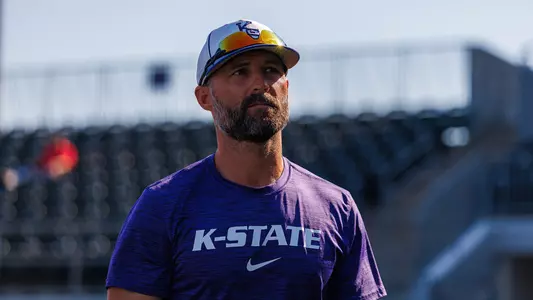
Today, Darrow wears his purple long-sleeved t-shirt under a sleeveless grey hoodie that reads "K-STATE WILDCATS" in purple letters, and sunglasses sit atop the purple bill of his purple-and-white ballcap upon his head. A week-old beard rests upon his face — scruff that would normally befit a man who seldom sleeps; however, this scruff is by design. Spend an hour with Darrow and it becomes apparent that everything is precise and calculated. Hobbies? Darrow writes computer code, rebuilds engines, restores old cars, and is a master wood craftsman. Darrow is a man who has also trained himself to sleep little so that he doesn't lose sleep during the rigors of a season that typically encompasses 55 to 58 games for the Wildcats between February and May. K-State baseball spent 58 nights on the road in 2025. K-State has played into June each of the past two seasons by virtue of its 2024 Super Regional appearance and last season's trip to the Austin Regional — the Wildcats' first back-to-back trips to the NCAA Tournament in 14 years.
"I think about how fortunate I am," Darrow says, flanked by a desktop computer and a laptop on his L-shaped desk, a million notes scattered about. "I think about my journey along the way and never forget where I came from. A lot of people would love to be sitting in my chair right now. I show up every day having that under my hat in knowing that it's really, really important. I'm just really fortunate."

K-State head coach Pete Hughes and the Wildcats have been plenty fortunate with Darrow in control of arguably the lifeblood of the squad: Pitching. More times than not, without quality pitching, teams nosedive. Under Darrow, pitchers flourish. Known for his relentless work ethic and charismatic leadership, Darrow has improved each pitching staff he has been a part of and saw records fall at each stop at Nicholls State, Oklahoma, New Orleans and Central Oklahoma while sending multiple arms to the next level.
More immediate, Darrow, who Hughes hired on July 7, 2022, has guided K-State to record three of the top five seasons in program history for total strikeouts, highlighted by a program-record 590 in 2024. K-State had 507 strikeouts in both 2023 and 2025, tying for fourth all-time. The Wildcats' pitching staff has also produced three of the top seasons in strikeouts per nine innings with 9.7 in 2024 (second), 9.2 in 2025 (fourth) and 9.0 in 2023 (fifth).
Before Darrow's arrival, K-State ranked last in the Big 12 with a Stolen Base Average/Percentage (SBA) of 80%. In Darrow's first season at K-State, the Wildcats ranked first in the Big 12 with a 60.8% SBA.
"Rudy is the gold standard of pitching development in college baseball," Hughes says. "Rudy doesn't talk much about himself much. He's just so humble. He sells himself with the numbers. Especially the pitcher position, it's so critical to win those recruiting battles in college baseball. Those kids have to know they're going to a place where they'll develop and get to the next level. It's not my pregame speeches that do it, it happens with the interaction everyday with Rudy. The numbers don't lie. They're glaring.
"Rudy is integrity and consistency. I've known Rudy a long, long time, and I've never seen him have an off day — ever. And that's rare in any arena in society. I've never seen anybody wired like this. I thought I had a good motor coming up through the ranks, but I've never seen anything like Rudy.
"We don't think he sleeps."
These days, Darrow delights in his opportunity to coach 22 pitchers on the 2026 roster. Each day begins with a 20–30-minute warmup routine. That is followed by catch play, where every rep is game-like and individualized. There's a time-and-distance aspect to the workload number to build endurance. And that's key.
"As you get farther back in your distance, you naturally have to increase the intensity of how you're throwing the baseball," Darrow says. "The duration is big for us because we have to build an endurance to throw a baseball for quite a long time. I think that's what separates us. We throw a lot more here than I think your average pitching staff. So, there's a workload management to it."
Darrow continues.
"How I look at it is what I do today is going to be dependent upon the last two days and what the next two days are," he says. "It's also dependent upon the part of the season and your goals. Right now, it's about building intensity off the mound and being able to recover quickly, and for relievers to be able to throw on a Thursday and come back and throw on a Saturday. It's all about building volume. Each person is completely different. The duration of that could be 16 minutes today from my very first throw to my last at that distance, and then I start working it in, but the biggest thing is called 'acute chronic workload.' It's making sure we have peaks and valleys in throwing in that you're not throwing at a high intensity on a Friday and then next Friday is that same intensity.
"We have to get as close as we can to our game-day scenario on Friday on a Tuesday, and then recover, and then come back up to it. It's good peaks and valleys of how we're playing catch."
Exactly how many pitches does that entail per workout?
"Per minute, depending upon how fast — the farther you get back, it kind of reduces it a little bit, but staring out probably five throws a minute, and then once you get farther back probably three to four a minute," he says. "I'd say anywhere between probably 50 to 100 pitches. What we're trying to get to is get our body adapted to playing catch for a long time. Everybody looks at pitch count.
"Owen Boerema threw a complete game against West Virginia in the tournament. He threw for 3 ½ hours. That's a long-ass time to play catch. It was 139 pitches, a lot of pitches in that game, and that doesn't count every throw in the warmup and the pitches between innings, so it was north of 250 pitches. So, we have to have that base beneath us to handle that workload."

Darrow has developed three K-State pitchers into MLB Draft picks. Tyson Neighbors went to the San Diego Padres in the fourth round of the 2024 MLB Draft and Jackson Wentworth followed in the fifth round to the Toronto Blue Jays. Jacob Frost when to the Los Angeles Dodgers in 2025.
Neighbors, a 6-foot-2 right-handed pitcher from Royce City, Texas, had a strong frame that allowed him to generate a lot of power down the mound and boasted a fastball in the upper-90. His development became a riveting success story.
"It was obvious out of the gate that Tyson's two breaking balls were some of the best in college baseball, but his fastball command wasn't where it needed to be," Darrow says. "As a pitching coach, breaking pitches are harder to throw for strikes, especially the one that Tyson had. His fastball, he couldn't always throw a strike. His first year, Tyson had 16 walks in eight innings. We identified early that we needed to establish the fastball. Once we did, we noticed his extension on his fastball was really low — about 4 ½ feet. He got his extension to 5 ½ feet. Then his fastball was playing, and he had great command, and once the fastball has command, then the breaking pitches take care of themselves. That next year? He had 48 innings with only 14 walks."
Neighbors, a 2023 Consensus All-American, two-time All-Big 12 selection, and finalist for the 2023 NCBWA Stopper of the Year Award, totaled 160 strikeouts in 95 2/3 innings while opponents hit .180 against him in his career. His 20 career saves ranked third in K-State history. His final season in 2024, Neighbors struck out 61 hitters and walked just 19 over 38 2/3 innings.
As a redshirt sophomore, Wentworth struck out 115 hitters, the second most in K-State history and that ranked fourth in the Big 12 in 2024. In his two seasons at K-State, Wentworth had a 5.45 ERA with 124 strikeouts in 38 appearances with 16 starts.
"The biggest thing I saw with Jackson is that he was able to look in the mirror, and he knew what was happening, and what he needed to do," Darrow says. "He was a really good self-evaluator. He trusted me enough to coach him and wanted to be coached."
Frost capped his second season at K-State with All-Big 12 honors in 2025, striking out 75 hitters while holding opponents to a .238 batting average, the eighth-best mark in the league. He had a career-high 10 strikeouts against Kansas and led the Big 12 with 22 strikeouts looking in conference play.
Darrow grins fondly at the memory of how at Hughes' suggestion Frost got the start against No. 5 Arkansas early last season at Globe Life Field in Arlington, Texas. Frost carried a one-hitter into the sixth and held the Razorbacks to two runs in his first start of the season. The senior left-hander allowed four hits and struck out six in the Wildcats' 3-2 victory.
"I tell Coach Hughes this, I think he single-handedly saved our season last year when Coach decided to put him into the rotation against Arkansas and saw what he was able to do," Darrow says. "Jacob was a left-hander, and first year he struggled to get left-handers out. He knew that and knew he needed to attack left-handed hitters a different way and develop a different pitch. We developed a slider and asked him to throw more left-on-left changeups. His batting average his first year was .340 which wasn't good since he's left-handed, and then this last year he was down to .278. That's a testament to who he is and his work ethic."

In sports jargon, Darrow believes that he has some "dudes" for the 2026 season, which gets underway on February 13 at the MLB Desert Invitational in Scottsdale, Arizona. The Wildcats begin the four-day event against Iowa, followed by matchups against UConn, Penn State and Air Force.
"We have lots of depth," Darrow says. "I was counting how many pitchers we actually have who can do it and handle the moment, and I think we have a dude with James Guyette. He's going to help us lead the way. He's come a long way from his freshman year. We have a lot of options in the starting realm."
The list of other potential options starts with senior left-hander Lincoln Sheffield, who had a team-leading 15 starts and was second on the team with 70 strikeouts last season. Redshirt senior transfer right-hander Cohen Feser held opponents scoreless in 10 of 18 appearances last season at TCU. Matt Flores is a senior right-hander who began his career at Hawai'i and spent the last two seasons at UC Riverside, where he had a 3.66 ERA (16 ER, 39.1 IP) last season. Redshirt junior right-hander Tanner Duke, who transferred from Baylor after the 2024 campaign, posted 35 strikeouts in 38 innings while issuing just 15 walks last season. Redshirt senior right-hander Carson Liggett, who transferred from Louisville, returns after missing last season at K-State due to injury and could be a starter or perhaps a closer. Redshirt junior sidewinder lefty Cole Wisenbaker is back after missing last season due to injury but made 22 relief appearances in 2024. Redshirt senior right-hander Tazwell Butler recorded 24 strikeouts in 26 2/3 innings pitched with just nine walks last season. Senior right-hander Billy Eich comes to K-State from Division II Barry University, where he boasted a 4.78 ERA in 15 weekend starts while surrendering 40 earned runs over 75.1 innings.
"I've said a bunch of names and haven't mentioned a couple others," Darrow says. "We have quite a few pieces that are going to be able to help us out. We're going to have options. We did a good job with the transfer portal. We found the pieces we needed, and we retained some pieces that we had on our roster. It definitely benefitted us. On the pitching side, Cohen Feser brings a lot of experience from TCU and can handle the moment. We got a kid who flew under the radar in Matt Flores from UC Riverside. You look at him you don't think very much, but I'm telling you that kid is going to pitch and help us out a lot. A sneaky good one is Billy Eich, a Division II kid, a unique story being on a JV team for two years in college and then having one phenomenal year last year. He has a chance to be pretty good.
"We're versatile and not every pitcher is the same. We're able to attack hitters from a multitude of different scenarios. Sometimes what happens is — last year we had three lefties starting on the weekend, but all three of those lefties attacked in a different way. That's extremely important. What we're going to be able to do is if for some reason James (Guyette) can hit a low-slot righty really well, we're going to be able to flip that and change the look per se. We're very versatile when it comes to that."

Last season, K-State's pitching staff finished seventh in the Big 12 in total strikeouts (507) and strikeouts per nine innings (9.2), ranking 49th nationally. Two players finished among the Big 12's top 10 in strikeouts per nine innings, with Frost at 10.18 (fifth) and right-hander Michael Quevedo at 9.90 (eighth).
Sheffield, who tossed a complete game to secure the Wildcats' series sweep over Utah on May 16, finished fifth in the Big 12 in both strikeout-to-walk ratio (3.68) and walks allowed per nine innings (2.30). With his 6 2/3 scoreless innings against Houston Christian on May 31, Sheffield set the record for most shutout innings by a starter in K-State's NCAA postseason history, helping the Wildcats advance to the NCAA Austin Regional semifinal.
Guyette also received an invitation to the 2025 USA Baseball Collegiate National Team Training Camp, becoming the fourth overall in program history to earn the distinction and second pitcher under Darrow during his time at K-State. Guyette led the team with 24 relief appearances and four saves.
As for the mentality of this 2026 K-State pitching staff?
"We're tough and are attacking the strike zone," Darrow says. "Being able to handle the moment is extremely important to us. Adversity is going to hit us at some point, a bad call, a bad play, a bad pitch, but what we have to have the ability to do is stay in the momentum, handle that moment and move onto the next one.
"Just being able to impact kids' lives is the most important thing to me."

A kid growing up in Perkins, Oklahoma, Darrow didn't start out making a name in baseball. He graduated from Perkins-Tyron High School a 5-foot-2, 125-pound wrestler, secured a wrestling scholarship at Labette Community College and walked onto the baseball team "because I didn't get any looks from colleges because of my size," he says, "but I was naturally good at baseball and could throw really hard." He got his first real shot during his sophomore season when head coach Aaron Keal told him, "You're going to pitch." Darrow threw 93-94 miles-per-hour in the 2003 Jayhawk All-Star Game. Darrow then transferred to Nicholls State, spent his first season recovering from Tommy John surgery, then drew close to new head coach Kerrick Jackson, who suggested Darrow throw sidearm, and who Darrow credits with "the reason I got drafted."
Darrow was taken in the 32nd round by the Detroit Tigers in the 2006 MLB Draft and stuck with the Tigers and Atlanta Braves organizations between 2006 and 2009. In 2008, Darrow went 5-3 with 10 saves and a 2.02 ERA (14 ER, 62.1 IP) along with 57 strikeouts. Over 113 career professional appearances, he was 14-7 with 12 saves and a 3.70 ERA with 139 strikeouts and a career strikeout rate of 8.6 per nine innings.
Then Darrow began a new chapter in his life: Coaching. He returned to his alma mater in 2010 as Nicholls State's volunteer assistant and was promoted to assistant coach and pitching coach one year later. The Colonels lowered their team ERA in each of Darrow's four seasons, as their 4.18 ERA in 2013 was the program's lowest in 15 seasons. In 2012, Nicholls State had a conference-leading 2.08 strikeout-to-walk ratio (3213 strikeouts, 156 walks) while Darrow coached the second-highest draft pick in program history, as Brad Delatte went in the fifth round of the 2012 MLB Draft to the Toronto Blue Jays.
"The older I get, the more I realize I've taken something away from every coach that I've had and try to apply that," Darrow says. "Being able to help kids out and give them all the knowledge I currently have and share it with them at 18 to 22 years old is extremely important. I failed as a baseball player and use my failures to be able to relate to these kids and help them navigate through adversity."
It was toward the end of a two-year stint as an assistant coach at Norman North (Oklahoma) High School that Darrow — he sought to return to the state of Oklahoma to be closer to family while earning an engineering degree and coaching high school baseball — met the man who he now calls "Coach" — Pete Hughes — who at the time was the head coach at Oklahoma. Turned out, Darrow coached two of Hughes' sons — Thomas and Hal — at Norman North High School.
"My boys kept coming back saying, 'We have a great day. Rudy Darrow is so smart, and a great guy and his energy level is through the roof,'" Hughes says. "I thought Rudy would be a great guy to have on our camps. He started working our camps. It's easy to fall in love with Rudy. As soon as I had an opening on my staff, I knew that was going to be an easy plug-in to make our staff better. When we had a chance to hire Rudy as a volunteer and recruiting coordinator, it was a seamless move for me to improve our staff with Rudy Darrow."
Again, the Darrow Effect was on full display. Upon joining Hughes' Oklahoma staff in 2016, Darrow helped the Sooners to a 4.41 ERA and was key to assembling the 2017 recruiting class that aided the Sooners' run to the NCAA Louisville Regional that year. Three arms under Darrow went in the 2016 MLB Draft.
Then Darrow served as pitching coach at New Orleans for four seasons. The Privateers' 580 strikeouts set a Southland Conference record and ranked 21st nationally with 9.4 strikeouts per nine innings. Under Darrow, four more pitchers went to the professional ranks. After serving as assistant coach and pitching coach at Division II member Central Oklahoma in 2019 during which the Bronchos ranked fourth nationally with 11.9 strikeouts per nine innings to go along with 235 strikeouts, Darrow moved back to Norman North High School in 2021-22.
Little did Darrow realize he soon would go from being a high school assistant coach to a pitching coach at a Power 4 school.
"So, you got to back up. Rudy came from being a wrestler and catcher to being traded for a big-leaguer, and he completely willed that to happen," Hughes says. "You want that on your staff. You want that fighter's mentality and work ethic to be in your program. When I got the job at Kansas State, I called Rudy to be our pitching coach."

What happened next? Well, a total of 63 baseball teams play in the Power 4. Since 2023, Darrow has led K-State to a No. 13 ranking nationally in zone percentage, 11th in walk percentage, 35th in strikeout percentage, and 10th in stolen bases allowed percentage. In the Big 12, K-State ranks third in zone percentage, third in walk percentage, seventh in strikeout percentage and second in stolen bases allowed percentage.
"He's brilliant," Hughes says. "I'm telling you. He was never a hidden gem for me. I couldn't wait to get him on our staff. The proof is in the numbers. K-State went from worst to first in walks allowed and opponent's average against us, and he never misses a thing. Kids compete like crazy for him.
"He's an unbelievable pitching coach, but I don't know if it's possible, but he's a better dad and husband. Our kids want to be better people because of Rudy. They want to develop and work and never have a bad day in front of him. They keep stacking those days and make huge jumps individually and as a pitching staff and as a program because of how Rudy approaches his everyday work life.
"Rudy? He's different. He's different."
At the moment, Darrow, the junior college wrestler-turned-MLB Draftee, the computer code writer, who rebuilds engines, restores old cars, and is a master wood craftsman, sits in his office at Tointon Family Stadium. We are about one month from first pitch for the 2026 baseball season. Since K-State ended the 2025 season in Austin, Texas, last June, Darrow's computers have been smoking with pitching prospects and pitching analytics.
"I think if you're a pitching coach in 2026 there's no way you cannot be a numbers guy," Darrow says. "You have to pay attention to those. Our game is everchanging and is always getting better and technology is going to get better. Coach Hughes says, 'Numbers don't lie.' But they also don't mean the same thing, too. I had a hitting coach at Detroit who said, 'Numbers are good to look at, but they don't really tell you anything.' I think you have to have a good combination of new school and old school. I think finding that balance is key in developing a pitching staff.
"'Old School' is competing and numbers don't matter, and I tell our guys we give them a report that's on a piece of paper, and you can take this report and have a 98-mph fastball with the best induced vertical break and the best VAA, but when you cross that white line, if you can't control those emotions, you can throw them in the trash. None of that matters, right? We have to be where our feet are and be tough, and you have to be held accountable. Just being tough, not having to feel great, not having to have my best stuff in order to win and be successful."
New school or old school, hand a pitching staff to Darrow and success will follow.
Hughes calls Darrow "the gold standard of pitching development in college baseball."
In this case, numbers don't lie. The low ERAs, high strikeouts, few stolen bases allowed from Nicholls State to Oklahoma to New Orleans to Central Oklahoma to Norman High School to K-State underscores Darrow's consistency.
And, at times, demands little sleep.
Darrow leans back in his office chair while gazing at a dry-erase board filled with names and numbers. Sunlight pours in. For now, the stadium sleeps, but one day soon it will again fill with purple.
"We could be really good," he says. "We have a chance. I like our makeup, depth, talent level."
He pauses.
"We have a chance to do something really good."
Darrow leans forward in his chair and tries to conceal a grin.
He is eager to see his men go to work.
It's 11:30 a.m. on a beautiful first Friday in January as Rudy Darrow sides into a chair in his office along the edge of Tointon Family Stadium. The eyes of the 41-year-old Darrow, who enters his fourth season as pitching coach for Kansas State baseball, appear rested — no doubt, trained from years of light, slight sleep. Husband to wife Jessica for 13 years, Darrow is father of three daughters in Rooney (11), Danni (8) and Merrick (4), and Darrow often arrives at his office — his domain — before the first glint of sunlight hits home plate inside a stadium that will soon buzz with the electricity of Bat Cat baseball fever.
Today, Darrow wears his purple long-sleeved t-shirt under a sleeveless grey hoodie that reads "K-STATE WILDCATS" in purple letters, and sunglasses sit atop the purple bill of his purple-and-white ballcap upon his head. A week-old beard rests upon his face — scruff that would normally befit a man who seldom sleeps; however, this scruff is by design. Spend an hour with Darrow and it becomes apparent that everything is precise and calculated. Hobbies? Darrow writes computer code, rebuilds engines, restores old cars, and is a master wood craftsman. Darrow is a man who has also trained himself to sleep little so that he doesn't lose sleep during the rigors of a season that typically encompasses 55 to 58 games for the Wildcats between February and May. K-State baseball spent 58 nights on the road in 2025. K-State has played into June each of the past two seasons by virtue of its 2024 Super Regional appearance and last season's trip to the Austin Regional — the Wildcats' first back-to-back trips to the NCAA Tournament in 14 years.
"I think about how fortunate I am," Darrow says, flanked by a desktop computer and a laptop on his L-shaped desk, a million notes scattered about. "I think about my journey along the way and never forget where I came from. A lot of people would love to be sitting in my chair right now. I show up every day having that under my hat in knowing that it's really, really important. I'm just really fortunate."
K-State head coach Pete Hughes and the Wildcats have been plenty fortunate with Darrow in control of arguably the lifeblood of the squad: Pitching. More times than not, without quality pitching, teams nosedive. Under Darrow, pitchers flourish. Known for his relentless work ethic and charismatic leadership, Darrow has improved each pitching staff he has been a part of and saw records fall at each stop at Nicholls State, Oklahoma, New Orleans and Central Oklahoma while sending multiple arms to the next level.
More immediate, Darrow, who Hughes hired on July 7, 2022, has guided K-State to record three of the top five seasons in program history for total strikeouts, highlighted by a program-record 590 in 2024. K-State had 507 strikeouts in both 2023 and 2025, tying for fourth all-time. The Wildcats' pitching staff has also produced three of the top seasons in strikeouts per nine innings with 9.7 in 2024 (second), 9.2 in 2025 (fourth) and 9.0 in 2023 (fifth).
Before Darrow's arrival, K-State ranked last in the Big 12 with a Stolen Base Average/Percentage (SBA) of 80%. In Darrow's first season at K-State, the Wildcats ranked first in the Big 12 with a 60.8% SBA.
"Rudy is the gold standard of pitching development in college baseball," Hughes says. "Rudy doesn't talk much about himself much. He's just so humble. He sells himself with the numbers. Especially the pitcher position, it's so critical to win those recruiting battles in college baseball. Those kids have to know they're going to a place where they'll develop and get to the next level. It's not my pregame speeches that do it, it happens with the interaction everyday with Rudy. The numbers don't lie. They're glaring.
"Rudy is integrity and consistency. I've known Rudy a long, long time, and I've never seen him have an off day — ever. And that's rare in any arena in society. I've never seen anybody wired like this. I thought I had a good motor coming up through the ranks, but I've never seen anything like Rudy.
"We don't think he sleeps."
These days, Darrow delights in his opportunity to coach 22 pitchers on the 2026 roster. Each day begins with a 20–30-minute warmup routine. That is followed by catch play, where every rep is game-like and individualized. There's a time-and-distance aspect to the workload number to build endurance. And that's key.
"As you get farther back in your distance, you naturally have to increase the intensity of how you're throwing the baseball," Darrow says. "The duration is big for us because we have to build an endurance to throw a baseball for quite a long time. I think that's what separates us. We throw a lot more here than I think your average pitching staff. So, there's a workload management to it."
Darrow continues.
"How I look at it is what I do today is going to be dependent upon the last two days and what the next two days are," he says. "It's also dependent upon the part of the season and your goals. Right now, it's about building intensity off the mound and being able to recover quickly, and for relievers to be able to throw on a Thursday and come back and throw on a Saturday. It's all about building volume. Each person is completely different. The duration of that could be 16 minutes today from my very first throw to my last at that distance, and then I start working it in, but the biggest thing is called 'acute chronic workload.' It's making sure we have peaks and valleys in throwing in that you're not throwing at a high intensity on a Friday and then next Friday is that same intensity.
"We have to get as close as we can to our game-day scenario on Friday on a Tuesday, and then recover, and then come back up to it. It's good peaks and valleys of how we're playing catch."
Exactly how many pitches does that entail per workout?
"Per minute, depending upon how fast — the farther you get back, it kind of reduces it a little bit, but staring out probably five throws a minute, and then once you get farther back probably three to four a minute," he says. "I'd say anywhere between probably 50 to 100 pitches. What we're trying to get to is get our body adapted to playing catch for a long time. Everybody looks at pitch count.
"Owen Boerema threw a complete game against West Virginia in the tournament. He threw for 3 ½ hours. That's a long-ass time to play catch. It was 139 pitches, a lot of pitches in that game, and that doesn't count every throw in the warmup and the pitches between innings, so it was north of 250 pitches. So, we have to have that base beneath us to handle that workload."
Darrow has developed three K-State pitchers into MLB Draft picks. Tyson Neighbors went to the San Diego Padres in the fourth round of the 2024 MLB Draft and Jackson Wentworth followed in the fifth round to the Toronto Blue Jays. Jacob Frost when to the Los Angeles Dodgers in 2025.
Neighbors, a 6-foot-2 right-handed pitcher from Royce City, Texas, had a strong frame that allowed him to generate a lot of power down the mound and boasted a fastball in the upper-90. His development became a riveting success story.
"It was obvious out of the gate that Tyson's two breaking balls were some of the best in college baseball, but his fastball command wasn't where it needed to be," Darrow says. "As a pitching coach, breaking pitches are harder to throw for strikes, especially the one that Tyson had. His fastball, he couldn't always throw a strike. His first year, Tyson had 16 walks in eight innings. We identified early that we needed to establish the fastball. Once we did, we noticed his extension on his fastball was really low — about 4 ½ feet. He got his extension to 5 ½ feet. Then his fastball was playing, and he had great command, and once the fastball has command, then the breaking pitches take care of themselves. That next year? He had 48 innings with only 14 walks."
Neighbors, a 2023 Consensus All-American, two-time All-Big 12 selection, and finalist for the 2023 NCBWA Stopper of the Year Award, totaled 160 strikeouts in 95 2/3 innings while opponents hit .180 against him in his career. His 20 career saves ranked third in K-State history. His final season in 2024, Neighbors struck out 61 hitters and walked just 19 over 38 2/3 innings.
As a redshirt sophomore, Wentworth struck out 115 hitters, the second most in K-State history and that ranked fourth in the Big 12 in 2024. In his two seasons at K-State, Wentworth had a 5.45 ERA with 124 strikeouts in 38 appearances with 16 starts.
"The biggest thing I saw with Jackson is that he was able to look in the mirror, and he knew what was happening, and what he needed to do," Darrow says. "He was a really good self-evaluator. He trusted me enough to coach him and wanted to be coached."
Frost capped his second season at K-State with All-Big 12 honors in 2025, striking out 75 hitters while holding opponents to a .238 batting average, the eighth-best mark in the league. He had a career-high 10 strikeouts against Kansas and led the Big 12 with 22 strikeouts looking in conference play.
Darrow grins fondly at the memory of how at Hughes' suggestion Frost got the start against No. 5 Arkansas early last season at Globe Life Field in Arlington, Texas. Frost carried a one-hitter into the sixth and held the Razorbacks to two runs in his first start of the season. The senior left-hander allowed four hits and struck out six in the Wildcats' 3-2 victory.
"I tell Coach Hughes this, I think he single-handedly saved our season last year when Coach decided to put him into the rotation against Arkansas and saw what he was able to do," Darrow says. "Jacob was a left-hander, and first year he struggled to get left-handers out. He knew that and knew he needed to attack left-handed hitters a different way and develop a different pitch. We developed a slider and asked him to throw more left-on-left changeups. His batting average his first year was .340 which wasn't good since he's left-handed, and then this last year he was down to .278. That's a testament to who he is and his work ethic."
In sports jargon, Darrow believes that he has some "dudes" for the 2026 season, which gets underway on February 13 at the MLB Desert Invitational in Scottsdale, Arizona. The Wildcats begin the four-day event against Iowa, followed by matchups against UConn, Penn State and Air Force.
"We have lots of depth," Darrow says. "I was counting how many pitchers we actually have who can do it and handle the moment, and I think we have a dude with James Guyette. He's going to help us lead the way. He's come a long way from his freshman year. We have a lot of options in the starting realm."
The list of other potential options starts with senior left-hander Lincoln Sheffield, who had a team-leading 15 starts and was second on the team with 70 strikeouts last season. Redshirt senior transfer right-hander Cohen Feser held opponents scoreless in 10 of 18 appearances last season at TCU. Matt Flores is a senior right-hander who began his career at Hawai'i and spent the last two seasons at UC Riverside, where he had a 3.66 ERA (16 ER, 39.1 IP) last season. Redshirt junior right-hander Tanner Duke, who transferred from Baylor after the 2024 campaign, posted 35 strikeouts in 38 innings while issuing just 15 walks last season. Redshirt senior right-hander Carson Liggett, who transferred from Louisville, returns after missing last season at K-State due to injury and could be a starter or perhaps a closer. Redshirt junior sidewinder lefty Cole Wisenbaker is back after missing last season due to injury but made 22 relief appearances in 2024. Redshirt senior right-hander Tazwell Butler recorded 24 strikeouts in 26 2/3 innings pitched with just nine walks last season. Senior right-hander Billy Eich comes to K-State from Division II Barry University, where he boasted a 4.78 ERA in 15 weekend starts while surrendering 40 earned runs over 75.1 innings.
"I've said a bunch of names and haven't mentioned a couple others," Darrow says. "We have quite a few pieces that are going to be able to help us out. We're going to have options. We did a good job with the transfer portal. We found the pieces we needed, and we retained some pieces that we had on our roster. It definitely benefitted us. On the pitching side, Cohen Feser brings a lot of experience from TCU and can handle the moment. We got a kid who flew under the radar in Matt Flores from UC Riverside. You look at him you don't think very much, but I'm telling you that kid is going to pitch and help us out a lot. A sneaky good one is Billy Eich, a Division II kid, a unique story being on a JV team for two years in college and then having one phenomenal year last year. He has a chance to be pretty good.
"We're versatile and not every pitcher is the same. We're able to attack hitters from a multitude of different scenarios. Sometimes what happens is — last year we had three lefties starting on the weekend, but all three of those lefties attacked in a different way. That's extremely important. What we're going to be able to do is if for some reason James (Guyette) can hit a low-slot righty really well, we're going to be able to flip that and change the look per se. We're very versatile when it comes to that."
Last season, K-State's pitching staff finished seventh in the Big 12 in total strikeouts (507) and strikeouts per nine innings (9.2), ranking 49th nationally. Two players finished among the Big 12's top 10 in strikeouts per nine innings, with Frost at 10.18 (fifth) and right-hander Michael Quevedo at 9.90 (eighth).
Sheffield, who tossed a complete game to secure the Wildcats' series sweep over Utah on May 16, finished fifth in the Big 12 in both strikeout-to-walk ratio (3.68) and walks allowed per nine innings (2.30). With his 6 2/3 scoreless innings against Houston Christian on May 31, Sheffield set the record for most shutout innings by a starter in K-State's NCAA postseason history, helping the Wildcats advance to the NCAA Austin Regional semifinal.
Guyette also received an invitation to the 2025 USA Baseball Collegiate National Team Training Camp, becoming the fourth overall in program history to earn the distinction and second pitcher under Darrow during his time at K-State. Guyette led the team with 24 relief appearances and four saves.
As for the mentality of this 2026 K-State pitching staff?
"We're tough and are attacking the strike zone," Darrow says. "Being able to handle the moment is extremely important to us. Adversity is going to hit us at some point, a bad call, a bad play, a bad pitch, but what we have to have the ability to do is stay in the momentum, handle that moment and move onto the next one.
"Just being able to impact kids' lives is the most important thing to me."
A kid growing up in Perkins, Oklahoma, Darrow didn't start out making a name in baseball. He graduated from Perkins-Tyron High School a 5-foot-2, 125-pound wrestler, secured a wrestling scholarship at Labette Community College and walked onto the baseball team "because I didn't get any looks from colleges because of my size," he says, "but I was naturally good at baseball and could throw really hard." He got his first real shot during his sophomore season when head coach Aaron Keal told him, "You're going to pitch." Darrow threw 93-94 miles-per-hour in the 2003 Jayhawk All-Star Game. Darrow then transferred to Nicholls State, spent his first season recovering from Tommy John surgery, then drew close to new head coach Kerrick Jackson, who suggested Darrow throw sidearm, and who Darrow credits with "the reason I got drafted."
Darrow was taken in the 32nd round by the Detroit Tigers in the 2006 MLB Draft and stuck with the Tigers and Atlanta Braves organizations between 2006 and 2009. In 2008, Darrow went 5-3 with 10 saves and a 2.02 ERA (14 ER, 62.1 IP) along with 57 strikeouts. Over 113 career professional appearances, he was 14-7 with 12 saves and a 3.70 ERA with 139 strikeouts and a career strikeout rate of 8.6 per nine innings.
Then Darrow began a new chapter in his life: Coaching. He returned to his alma mater in 2010 as Nicholls State's volunteer assistant and was promoted to assistant coach and pitching coach one year later. The Colonels lowered their team ERA in each of Darrow's four seasons, as their 4.18 ERA in 2013 was the program's lowest in 15 seasons. In 2012, Nicholls State had a conference-leading 2.08 strikeout-to-walk ratio (3213 strikeouts, 156 walks) while Darrow coached the second-highest draft pick in program history, as Brad Delatte went in the fifth round of the 2012 MLB Draft to the Toronto Blue Jays.
"The older I get, the more I realize I've taken something away from every coach that I've had and try to apply that," Darrow says. "Being able to help kids out and give them all the knowledge I currently have and share it with them at 18 to 22 years old is extremely important. I failed as a baseball player and use my failures to be able to relate to these kids and help them navigate through adversity."
It was toward the end of a two-year stint as an assistant coach at Norman North (Oklahoma) High School that Darrow — he sought to return to the state of Oklahoma to be closer to family while earning an engineering degree and coaching high school baseball — met the man who he now calls "Coach" — Pete Hughes — who at the time was the head coach at Oklahoma. Turned out, Darrow coached two of Hughes' sons — Thomas and Hal — at Norman North High School.
"My boys kept coming back saying, 'We have a great day. Rudy Darrow is so smart, and a great guy and his energy level is through the roof,'" Hughes says. "I thought Rudy would be a great guy to have on our camps. He started working our camps. It's easy to fall in love with Rudy. As soon as I had an opening on my staff, I knew that was going to be an easy plug-in to make our staff better. When we had a chance to hire Rudy as a volunteer and recruiting coordinator, it was a seamless move for me to improve our staff with Rudy Darrow."
Again, the Darrow Effect was on full display. Upon joining Hughes' Oklahoma staff in 2016, Darrow helped the Sooners to a 4.41 ERA and was key to assembling the 2017 recruiting class that aided the Sooners' run to the NCAA Louisville Regional that year. Three arms under Darrow went in the 2016 MLB Draft.
Then Darrow served as pitching coach at New Orleans for four seasons. The Privateers' 580 strikeouts set a Southland Conference record and ranked 21st nationally with 9.4 strikeouts per nine innings. Under Darrow, four more pitchers went to the professional ranks. After serving as assistant coach and pitching coach at Division II member Central Oklahoma in 2019 during which the Bronchos ranked fourth nationally with 11.9 strikeouts per nine innings to go along with 235 strikeouts, Darrow moved back to Norman North High School in 2021-22.
Little did Darrow realize he soon would go from being a high school assistant coach to a pitching coach at a Power 4 school.
"So, you got to back up. Rudy came from being a wrestler and catcher to being traded for a big-leaguer, and he completely willed that to happen," Hughes says. "You want that on your staff. You want that fighter's mentality and work ethic to be in your program. When I got the job at Kansas State, I called Rudy to be our pitching coach."
What happened next? Well, a total of 63 baseball teams play in the Power 4. Since 2023, Darrow has led K-State to a No. 13 ranking nationally in zone percentage, 11th in walk percentage, 35th in strikeout percentage, and 10th in stolen bases allowed percentage. In the Big 12, K-State ranks third in zone percentage, third in walk percentage, seventh in strikeout percentage and second in stolen bases allowed percentage.
"He's brilliant," Hughes says. "I'm telling you. He was never a hidden gem for me. I couldn't wait to get him on our staff. The proof is in the numbers. K-State went from worst to first in walks allowed and opponent's average against us, and he never misses a thing. Kids compete like crazy for him.
"He's an unbelievable pitching coach, but I don't know if it's possible, but he's a better dad and husband. Our kids want to be better people because of Rudy. They want to develop and work and never have a bad day in front of him. They keep stacking those days and make huge jumps individually and as a pitching staff and as a program because of how Rudy approaches his everyday work life.
"Rudy? He's different. He's different."
At the moment, Darrow, the junior college wrestler-turned-MLB Draftee, the computer code writer, who rebuilds engines, restores old cars, and is a master wood craftsman, sits in his office at Tointon Family Stadium. We are about one month from first pitch for the 2026 baseball season. Since K-State ended the 2025 season in Austin, Texas, last June, Darrow's computers have been smoking with pitching prospects and pitching analytics.
"I think if you're a pitching coach in 2026 there's no way you cannot be a numbers guy," Darrow says. "You have to pay attention to those. Our game is everchanging and is always getting better and technology is going to get better. Coach Hughes says, 'Numbers don't lie.' But they also don't mean the same thing, too. I had a hitting coach at Detroit who said, 'Numbers are good to look at, but they don't really tell you anything.' I think you have to have a good combination of new school and old school. I think finding that balance is key in developing a pitching staff.
"'Old School' is competing and numbers don't matter, and I tell our guys we give them a report that's on a piece of paper, and you can take this report and have a 98-mph fastball with the best induced vertical break and the best VAA, but when you cross that white line, if you can't control those emotions, you can throw them in the trash. None of that matters, right? We have to be where our feet are and be tough, and you have to be held accountable. Just being tough, not having to feel great, not having to have my best stuff in order to win and be successful."
New school or old school, hand a pitching staff to Darrow and success will follow.
Hughes calls Darrow "the gold standard of pitching development in college baseball."
In this case, numbers don't lie. The low ERAs, high strikeouts, few stolen bases allowed from Nicholls State to Oklahoma to New Orleans to Central Oklahoma to Norman High School to K-State underscores Darrow's consistency.
And, at times, demands little sleep.
Darrow leans back in his office chair while gazing at a dry-erase board filled with names and numbers. Sunlight pours in. For now, the stadium sleeps, but one day soon it will again fill with purple.
"We could be really good," he says. "We have a chance. I like our makeup, depth, talent level."
He pauses.
"We have a chance to do something really good."
Darrow leans forward in his chair and tries to conceal a grin.
He is eager to see his men go to work.
Players Mentioned

RHP
/ Baseball
RHP
/ Baseball
RHP
/ Baseball
RHP
/ Baseball
RHP
/ Baseball
LHP
/ Baseball
RHP
/ Baseball
RHP
/ Baseball
LHP
/ Baseball
LHP
/ Baseball
LHP
/ BaseballSaturday, September 19
Saturday, September 19
Saturday, September 19
Saturday, September 19