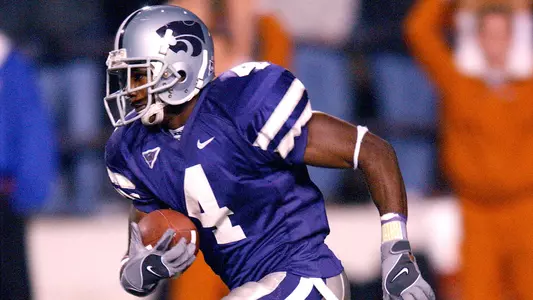
From Relatively Unknown to College Football Royalty
Jan 22, 2026 | Football, Sports Extra
By: D. Scott Fritchen
A little more than a week ago in the large, urbanized San Fernando Valley, located north of the Hollywood Hills and Santa Monica Mountains in Los Angeles, California, a 47-year-old by the name of Terence Newman was taking his daughter to an afternoon school performance, when his phone began to chime. Would Newman be available to join former Hall of Fame head coach Bill Snyder and new Kansas State head coach Collin Klein for a Zoom call? Newman, a dedicated father, was in a rush and wouldn't allow his daughter to be late to school.
More texts. More messages. Then arrived the copy of a Twitter post, which revealed a grand announcement: Newman had been selected to the College Football Hall of Fame as a part of the 2026 Class. The inclusion was a long time coming for Newman, who had already been nominated twice for the award, and who long before his 15-year NFL career with two Pro Bowl selections, was one of the most electrifying players in college football, earning 2002 Consensus All-America honors as a cornerback and returner, winning the 2002 Jim Thorpe Award that is given annually to the nation's top defensive back, and earning 2002 Big 12 Defensive Player of the Year. Newman was inducted into the K-State Athletics Hall of Fame and K-State Football Ring of Honor.
"I was excited," Newman said. "Personally, the College Football Hall of Fame has dual meanings. A lot of guys who had these types of careers were day-one starters. Everybody wants to be a great college football player, set every record possible, and win every award possible. My career was delayed, as I didn't play my freshman year in 1998, then didn't play in 1999, and didn't play much in 2000, as I played behind such great competitors and guys who were on NFL rosters. To be from Salina, Kansas — most people don't know where that is on a map — and go 45 minutes to play in Manhattan, Kansas, and be enshrined with some of the greatest college athletes the world has ever known, it's surreal."

During a 53-minute interview, the memories race back. It starts with the boy — small, skinny, gaunt. So many words described the child who ran briskly across the football field in his jersey and in a helmet that nearly overpowered his body. The helmet nonetheless couldn't house the silo-sized ego of 10-year-old Newman. He was constantly cutting up, wrapped in the abrasive, tougher-than-life mentality that rugged Cornel Hutton, a coach in Salina's Salvation Army football league, couldn't stand.
Finally, when Newman picked a fight, Hutton pulled the string. He kicked Newman off the squad with permission, of course, from grandfather, Ernest Newman, one of Hutton's close friends. Newman was ordered to clean the house for a month and wasn't allowed to go outside. When Hutton allowed Newman to return to the team a month later, the point was made.
Living in north Salina, an area tabbed "north of the tracks," Wanda Newman raised Terence and Quet, his older sister, alone. Often, Wanda was called to the principal's office.
"I was a bad kid, an ornery kid," Newman says. "I ran the streets of Salina getting into trouble every day."
Something caused Newman to change: Football, baseball and basketball. It was Hutton's helping hand that day on the football field that offered the turning point, which snapped a young, humbled Newman into reality as he walked home. He quickly discovered the path was green grass on the football field or the hardwood of a basketball court.
"College was an afterthought," Newman says. "We didn't come from money, so the only way I'd go to college would be on a college scholarship. My grandfather was tough on me. He knew that I had some greatness that could come out, and it was their world to get it out of me. Cornel was someone who truly cared about me. He put the whole idea of going to college on a scholarship into my brain. If it wasn't for him, I would've never gotten on that path."
Newman joined the Salina Central freshman team at a modest 5-foot-4 and 110 pounds. He played because he wanted to be around his friends, but his penchant for getting run over due to his lack of size contributed to him not even going out for football his sophomore season.
Salina knew Newman first as a thrilling basketball player who could rip down rebounds near the cusp of the rim. However, a broken wrist suffered while playing basketball spurred the seeds of determination within Newman, whose five-inch growth spurt as a sophomore coupled with a sudden passion for weight training initiated an unforeseen fairy tale.
Newman's gift of blazing speed led the track team, and he played defensive back during a junior year in which Salina Central defeated Liberal for the state football championship. As a junior, Newman claimed state titles with times of 10.36 in the 100 meters and 21.6 in the 200.
"After my junior year, I ran track and a gentleman watching me was associated with the University of Tulsa," Newman says. "He asked me if I played football. He said, 'We're going to start recruiting you.' But when I truly realized that I could play, I was doing drills at a Kansas traveling football camp at my high school. Kansas head coach Terry Allen offered me a scholarship on the spot. I said to myself, 'You know what? I can do this.' I committed to KU. K-State didn't enter the picture my whole senior year."
Eventually, K-State linebackers coach Brent Venables, also a Salina native, came calling.
"I'm thinking, 'I'd rather go to K-State because they have a better defense,'" Newman says. "I took a trip to Manhattan, decommitted from KU, and committed to K-State. It didn't hurt that I had Jonathan Beasley and Michael Bishop as my hosts on my recruiting trip."
He redshirted his freshman season in 1998. He hardly saw the field in 1999. Newman believed that he might be better off someplace else — a revelation that Newman has never shared publicly, until now.
"There was a point where I was going to leave K-State," Newman says. "I was like every other college kid that's out there – it's exacerbated now – that when you come to college in a highly competitive environment and feel like you're ready to take that next step, but somebody is holding you back, that's what I felt," he says. "I felt like I could go out and contribute and compete. In hindsight, yeah, you're not going to just leap over the two guys who are the incumbent starters, but even with that, I felt that they could find a place and put me in some games and get my feet wet a little bit.
"But I also felt like I wasn't in the system and wasn't a player who was going to be useful in the scheme we were in after Mike Stoops left (to become defensive coordinator at Oklahoma after the 1998 season). So, I literally called my mom and said, 'Coach Stoops went to Oklahoma. I think I'm going to transfer.' She said, 'It's still early. Why don't you wait out the year and just see what happens.' I listened to her, I stayed, I competed, and maybe there were some rumblings that they knew I was thinking about leaving, but I started seeing a little bit of playing time."

Newman had to grow as a student and as an athlete.
"Dyshod Carter was my guy," Newman says. "When we were in the summer program, I was at his place, and he'd come down to Salina on some breaks and spend time with my family. He pretty much taught me the ins and outs of what it was to be a college athlete. Honestly, without him, I would've struggled mightily. My first year at K-State, I was on academic probation with a 1.8 GPA. I thought I could go to class and do a couple skim readings and get away with some of the tests, but it was so much more extensive in college than in high school, so I had to actually put in that work.
"Dyshod said, 'Man, buckle down, and do what you have to do.' Then I got back into the lab and started doing study hall, and got off academic probation, and became an honor-roll student with a 3.0 GPA. That's because of Dyshod."
Noted as an outstanding special teams player, Newman saw his development in the defensive backfield take a major step as No. 11 K-State rolled to a 35-21 victory over No. 21 Tennessee in the 2001 Cotton Bowl in Dallas. The 5-foot-11, 185-pound Newman, who played in all 14 games and earned his first career start in the nickel package against Louisiana Tech, had a career high-tying two pass breakups after coming off the sideline against the Volunteers.
Although cornerbacks Jerametrius Butler and Dyshod Carter each started against quarterback Casey Clausen and a dangerous pool of Volunteer receivers, Newman made a name for himself in a hurry when he took the field to start the second quarter in place of an injured Butler.
For the first time in his career, the up-and-comer with sprinter speed clearly tackled the challenge set forth early in the season by defensive coordinator Phil Bennett: he demonstrated explosive football speed.
K-State entered the second quarter with a 7-0 lead, but Clausen and the Volunteers had the ball and were looking to engineer a scoring drive of their own. Facing third-and-10 at the Tennessee 29-yard line, Clausen fired a pass toward the right sideline. Wide receiver Cedrick Wilson was there. So was Newman. Incompletion. Tennessee had to punt.
On the second play of the Volunteers' next possession, Clausen saw Eric Parker on a slant route across the middle. Again, Newman forced and incompletion, marking the second time that he defended a pass in three plays. In fact, Clausen never found a receiver in Newman's territory. That Newman finished without a tackle was due to him blanketing Wilson and other pass catchers — at least three other times Newman was the closest defender on an incomplete pass – forcing Clausen to look at other options on the field. Clausen finished just 7-of-25 for 120 yards with one touchdown and three interceptions.
"I remember that like it was yesterday — Casey Clausen, Jason Witten, Travis Henry, Dante Stallworth," Newman says. "I remember Jerametrius Butler went down in the first quarter, and I had to come in. Leading up to the Cotton Bowl, I felt like I was ready. I felt like I'd been ready for a while. I truly wasn't ready, but it just so happened that that style of game with those players that they had, that fit what I was built for. It was Dante Stallworth, the speed guy, and they put speed on speed. The difference is, when talent meets talent, you have to have something else that's going to set you apart from the other person.
"I didn't know about that part until Dyshod Carter started educating me on watching film. That's all he did was watch film religiously. Coming out and being able to play in that type of game against that type of talent, for me, that's all I needed. At that point, the sky was the limit, and it gave me nothing but confidence going into the 2001 season. To compete and make plays against that caliber of players in the Cotton Bowl, I was on cloud nine."

What did Newman do next? He had a season-high seven tackles and broke-up three passes in the Wildcats' 2001 season opener against Southern California. He had two interceptions and broke up seven more passes to go along with six solo tackles against Oklahoma. He tied his season high with seven tackles and blocked his second kick of the season against Nebraska, then recorded his third interception and added three other pass break ups and had five tackles against Missouri.
One of eight Wildcats to start all 11 games at the same position in 2001, Newman emerged as a midseason addition to the Jim Thorpe Award list, and he finished fifth on the team with 51 tackles, including 44 solo stops. He had a team-leading 14 pass break-ups and two blocked kicks, and he was third on the team with three interceptions, earning All-Big 12 Second Team selection by the coaches and as an honorable mention selection by the Associated Press.

That same year, Newman set a school record with a 10.22 mark in the 100-meter dash to qualify for the Big 12 Outdoor Championship, where he earned the title "Big 12's Fastest Man" by winning the event with a time of 10.29. Newman defended his title during the 2002 track season with a time of 10.34. The list of track records and honors, which reads like an expansive tickertape, further peaked when Newman collected his first All-America honor, finishing fifth in the 60 meters at the 2002 NCAA Indoor Championship with a time of 6.67.
There are so many Newman moments to cover. Here's one: K-State faced No. 11 USC on September 21, 2002, at KSU Stadium and with 32 seconds remaining in the second quarter, K-State blocked an extra-point attempt, Newman scooped up the football and zig-zagged 98 yards to score two points for the Wildcats in an eventual 27-20 win over the Trojans. Newman's return brought the cheers of 49,276 to ear-popping levels in what's believed to be the loudest decibel level in stadium history.
"I didn't hear the cheers," Newman says. "I picked up the football, snaked left and snaked back right and then snaked back left. It was a very long play, but what I remember most was when I turned around, my teammates were running the whole distance. Once I got to a certain point nobody was catching me, but I had a calvary of teammates behind me, and that was the coolest thing. I know the stadium was crazy, but I blacked out, and just saw my teammates, and that was the coolest thing, my teammates running behind me, which was crazy."
Newman, voted a team captain for his 2002 senior season, put together one of the most impressive individual seasons in K-State history.
In the second game of the season, Newman burned hapless Louisiana-Monroe three times in the opening half of a 68-0 thumping. Newman caught a 51-yard over-the-shoulder touchdown pass on the first play he was inserted on offense, which was also his first career reception. When the Indians punted on their next possession, Newman returned the punt 40 yards for another touchdown. Five days later, Newman returned a kickoff 95-yards for a touchdown in a 63-13 throttling over Eastern Illinois. And who could forget when Newman returned the opening punt against Missouri 71 yards for a score to initiate a 38-0 victory to conclude the Big 12 season in sizzling style?

Newman put a stamp on his senior season when he performed a backflip during Senior Day introductions, delighting the crowd of 52,221 before K-State rolled to a 49-13 win over the Huskers. Newman posted a career-high 10 tackles, but he remembers the backflip the most.
"What my teammates know is when we did offseason workouts, we'd go into the indoor facility and they had a foam mat off to the side," Newman says. "We'd go in there, me and Taco Wallace, and we'd try and do flips on this mat. I told myself I'd teach myself to do a backflip, and on Senior Day, I'd do a backflip when I came out and was introduced. So, every day in offseason workouts, I was on that mat trying to do a backflip. It took me the whole offseason to learn that. It was crazy that when I came out and did the backflip, walked out, turned around, and did the backflip, I remember the roar from the fans. That was crazy. Never expected that type of reaction.
"Looking back, I'm like, well, how many people come out and do a backflip on Senior Day. Could you imagine if I'd had one little mishap on that? That would've been so bad."
Instead, Newman was brilliant.
While Newman as a senior wouldn't place himself in the elite class of the best cornerbacks in recent college football history, statistics proved he couldn't evade the limelight as one of the most versatile athletes. Entering bowl season, Newman had the same number of tackles (44) as Charles Woodson did his final year at Michigan in 1997, which was a higher total than Deion Sanders (37) had as a senior at Florida State in 1988. Additionally, Newman's 14 pass break ups topped the charts among an All-American class of the top cornerbacks in the past 25 years.
There's more. Newman's stunning average of 32.4 yards per kickoff return, and 16.3 yards per punt return far exceeded what Heisman Trophy-winner Tim Brown of Notre Dame produced in averaging 19.8 yards per kickoff and 11.7 yards per punt return in 1987.

Newman didn't need to tell anybody he was the best in 2002. The proof sat directly in front of him at the ESPN College Football Awards show at Disney World in Orlando. Dressed in customary K-State football business attire — khaki pants and a navy-blue blazer with a silver Powercat sewn near his heart — Newman approached center stage as recipient of the Jim Thorpe Award, annually given to the top defensive back in the nation.
With "Wildcat Victory" blaring in the background, Newman rose above cornerback Mike Doss of Ohio State and strong safety Troy Polamalu of USC and stood alone underneath the spotlight, taking in the sweet applause.
It capped a glitzy, weeklong victory tour of sorts in which Newman was applauded and pampered by national admirers and whisked from city to city. First stop was the Charlotte, N. C., Touchdown Club, where Newman finished as a runner-up to Arizona State defensive end Terrell Suggs for the Nagurski Award, given annually to the nation's top defensive player. When Newman flew into Manhattan, he raced to the Vanier Football Complex to join his teammates at practice. He remained emphatic about keeping his place in perspective.
The following morning, he caught a 6:05 a.m. flight to Orlando. Even while flying high in the sky and among NFL Draft projection lists, Newman stayed grounded as witnessed by the first decision he made upon arriving in Orlando. Newman could have dined at anyplace he desired.
His choice? Red Lobster.
At a time in which Newman gobbled up accolades and honors, he feasted on the fact that he was blessed to play in the midst of the most successful days in the history of K-State football. Newman finished his 48-game career at K-State with 134 tackles and 10 interceptions, and he was a part of four 11-win teams in his five years — 11-2, 11-1, 11-3, 11-2 — and the Wildcats finished outside the Top 10 in the final Associated Press Poll just once during his time in Manhattan.
"Honestly, when I got to K-State, it was like the pinnacle with an undefeated regular season and a Big 12 Championship game," Newman says. "The number of times we had to reload — we had guys come in and step up and make plays and make the team better and make the people around them better. Once Michael Bishop and those guys left, everybody was like, 'What are you guys going to do?' I mean, we were K-State. We were going to be tough on defense and have tough guys on offense, run it and throw it, and the quarterback is going to run it.
"In 2001, we hit that rough patch and finished 6-6, then we rebounded my senior year and went 11-2. To be a part of that, even with a down season, to reload and play well in 2002, that was the epitome of what it meant to play for Bill Snyder. Coach Snyder was one of the greatest mentors that a lot of us had in our lives. He instilled a lot of knowledge into everybody who played under him. If I didn't make it to K-State, my trajectory could've been completely different, and I would've never been the player that I was in college or afterwards."

Newman was picked No. 5 overall by the Dallas Cowboys in the 2003 NFL Draft, the second-highest draft pick in K-State history, and the first pick of head coach Bill Parcells in Dallas. Newman enjoyed a celebrated 15-year career in the NFL and was a two-time Pro Bowl selection during a 12-year stint in Dallas before playing for the Cincinnati Bengals (2012-14) and Minnesota Vikings (2015-17). At age 39, Newman was the oldest active defensive player in the NFL when he announced his retirement on September 1, 2018, and he joined the Vikings coaching staff for one season. He finished his NFL career with 221 games, including 205 starts, and his 42 interceptions ranked second amount active NFL players before he took off his pads for good.
As Newman reflects on his journey from Salina to K-State to the NFL, he wonders how he, a relative unknown out of high school, might've fared in today's climate of college football.
"Everybody focuses on these five stars who command a million dollars in NIL money, but dude, don't forget about the guys who are three-stars that are just committed and want to be good football players," Newman says. "It's not about the money, it's just about the drive and the challenge to better yourself, right? Don't forget about those guys. Because I was that guy. I wasn't a shiny thing. Don't forget about those types of guys. Don't forget about Darren Sproles and Jordy Nelson and those guys. K-State was made on those types of guys.
"You can look at any NFL roster. Tony Romo was undrafted from Eastern Illinois. There are so many guys on NFL rosters that just needed a chance in college. They just needed somebody to believe in them and give them the opportunity to compete and grow. That's probably the hardest part about it is everybody wants to be competitive in the landscape and try and get the four- and five-star guys.
"K-State has never been about that and has been successful. So why change it? That's why most of the guys went to K-State. It's because of the K-State culture."
From the skinny kid in Salina to the freshman redshirt and third-string K-State cornerback who fought to the top of college football, Newman embraced and sustained the K-State culture over the course of one of the most outstanding careers in school history.
Now he's a part of the 2026 College Football Hall of Fame Class that will be officially inducted during the 68th National Football Foundation Annual Awards Dinner on December 8, 2026, at the Bellagio Resort and Casino in Las Vegas.
Once the 2026 Hall of Fame Class is officially inducted, only 1,129 players and 241 coaches will have been inducted into the College Football Hall of Fame out of the nearly 5.86 million who have played or coached the game during the past 157 years.
To put it another way: Less than two one-hundredths of a percent (.02%) of the individuals who have played or coached the game have earned this distinction.
What a journey it's been.
"It was more about self-discovery," Newman says. "I felt more like a journeyman. I had all the talent in the world, and I was slight in build and was very fast and athletic, but I didn't know how to put all that stuff together and make it into a final product. There was a point where I'd literally go in after K-State practice, go into our meeting room, load the one-on-ones, I'd load up the film of me, and just be critical of myself and look at the things I needed to work on. I did this all by myself, on my own. I saw a tremendous jump in 2000 when I started doing this, and I just saw my play go from one spot to the next spot. It just elevated.
"I had guys like Dyshod helping me out, trying to get my footwork right. That was probably the hardest thing for me, going from just an athlete and covering guys to transitioning and doing the things that you need to do to come back on a route or break on a curl or dissect the post and know it's coming before it's actually there. I wanted to be a great player, and I knew that if I wanted to be a great player, what happens when talent meets talent, and I thought, 'How many of the guys come in and self-correct to become better? Do you just do it when the team comes in, or do you take the initiative to better yourself.' If I'm hoping to be what I want to be, I knew I had to do extra. Do you want to be good or great? Because the great costs a little bit extra.
"So, I watched film and corrected my footwork, and once I did that I felt if I continued that ascension that the sky was the limit. If I wanted to be the best, I had to work that way and do the little things and watch the film even though I was tired from going to class and doubling it up with track — I had to do it. That's what I wanted to do, and I had to find a way. That was my mentality as a kid. I found a way to get a college scholarship, and to get on the field, and help our teams win some football games."
He pauses.
"I'm excited to be enshrined with some of the greatest college athletes the world has ever seen."
A little more than a week ago in the large, urbanized San Fernando Valley, located north of the Hollywood Hills and Santa Monica Mountains in Los Angeles, California, a 47-year-old by the name of Terence Newman was taking his daughter to an afternoon school performance, when his phone began to chime. Would Newman be available to join former Hall of Fame head coach Bill Snyder and new Kansas State head coach Collin Klein for a Zoom call? Newman, a dedicated father, was in a rush and wouldn't allow his daughter to be late to school.
More texts. More messages. Then arrived the copy of a Twitter post, which revealed a grand announcement: Newman had been selected to the College Football Hall of Fame as a part of the 2026 Class. The inclusion was a long time coming for Newman, who had already been nominated twice for the award, and who long before his 15-year NFL career with two Pro Bowl selections, was one of the most electrifying players in college football, earning 2002 Consensus All-America honors as a cornerback and returner, winning the 2002 Jim Thorpe Award that is given annually to the nation's top defensive back, and earning 2002 Big 12 Defensive Player of the Year. Newman was inducted into the K-State Athletics Hall of Fame and K-State Football Ring of Honor.
"I was excited," Newman said. "Personally, the College Football Hall of Fame has dual meanings. A lot of guys who had these types of careers were day-one starters. Everybody wants to be a great college football player, set every record possible, and win every award possible. My career was delayed, as I didn't play my freshman year in 1998, then didn't play in 1999, and didn't play much in 2000, as I played behind such great competitors and guys who were on NFL rosters. To be from Salina, Kansas — most people don't know where that is on a map — and go 45 minutes to play in Manhattan, Kansas, and be enshrined with some of the greatest college athletes the world has ever known, it's surreal."
During a 53-minute interview, the memories race back. It starts with the boy — small, skinny, gaunt. So many words described the child who ran briskly across the football field in his jersey and in a helmet that nearly overpowered his body. The helmet nonetheless couldn't house the silo-sized ego of 10-year-old Newman. He was constantly cutting up, wrapped in the abrasive, tougher-than-life mentality that rugged Cornel Hutton, a coach in Salina's Salvation Army football league, couldn't stand.
Finally, when Newman picked a fight, Hutton pulled the string. He kicked Newman off the squad with permission, of course, from grandfather, Ernest Newman, one of Hutton's close friends. Newman was ordered to clean the house for a month and wasn't allowed to go outside. When Hutton allowed Newman to return to the team a month later, the point was made.
Living in north Salina, an area tabbed "north of the tracks," Wanda Newman raised Terence and Quet, his older sister, alone. Often, Wanda was called to the principal's office.
"I was a bad kid, an ornery kid," Newman says. "I ran the streets of Salina getting into trouble every day."
Something caused Newman to change: Football, baseball and basketball. It was Hutton's helping hand that day on the football field that offered the turning point, which snapped a young, humbled Newman into reality as he walked home. He quickly discovered the path was green grass on the football field or the hardwood of a basketball court.
"College was an afterthought," Newman says. "We didn't come from money, so the only way I'd go to college would be on a college scholarship. My grandfather was tough on me. He knew that I had some greatness that could come out, and it was their world to get it out of me. Cornel was someone who truly cared about me. He put the whole idea of going to college on a scholarship into my brain. If it wasn't for him, I would've never gotten on that path."
Newman joined the Salina Central freshman team at a modest 5-foot-4 and 110 pounds. He played because he wanted to be around his friends, but his penchant for getting run over due to his lack of size contributed to him not even going out for football his sophomore season.
Salina knew Newman first as a thrilling basketball player who could rip down rebounds near the cusp of the rim. However, a broken wrist suffered while playing basketball spurred the seeds of determination within Newman, whose five-inch growth spurt as a sophomore coupled with a sudden passion for weight training initiated an unforeseen fairy tale.
Newman's gift of blazing speed led the track team, and he played defensive back during a junior year in which Salina Central defeated Liberal for the state football championship. As a junior, Newman claimed state titles with times of 10.36 in the 100 meters and 21.6 in the 200.
"After my junior year, I ran track and a gentleman watching me was associated with the University of Tulsa," Newman says. "He asked me if I played football. He said, 'We're going to start recruiting you.' But when I truly realized that I could play, I was doing drills at a Kansas traveling football camp at my high school. Kansas head coach Terry Allen offered me a scholarship on the spot. I said to myself, 'You know what? I can do this.' I committed to KU. K-State didn't enter the picture my whole senior year."
Eventually, K-State linebackers coach Brent Venables, also a Salina native, came calling.
"I'm thinking, 'I'd rather go to K-State because they have a better defense,'" Newman says. "I took a trip to Manhattan, decommitted from KU, and committed to K-State. It didn't hurt that I had Jonathan Beasley and Michael Bishop as my hosts on my recruiting trip."
He redshirted his freshman season in 1998. He hardly saw the field in 1999. Newman believed that he might be better off someplace else — a revelation that Newman has never shared publicly, until now.
"There was a point where I was going to leave K-State," Newman says. "I was like every other college kid that's out there – it's exacerbated now – that when you come to college in a highly competitive environment and feel like you're ready to take that next step, but somebody is holding you back, that's what I felt," he says. "I felt like I could go out and contribute and compete. In hindsight, yeah, you're not going to just leap over the two guys who are the incumbent starters, but even with that, I felt that they could find a place and put me in some games and get my feet wet a little bit.
"But I also felt like I wasn't in the system and wasn't a player who was going to be useful in the scheme we were in after Mike Stoops left (to become defensive coordinator at Oklahoma after the 1998 season). So, I literally called my mom and said, 'Coach Stoops went to Oklahoma. I think I'm going to transfer.' She said, 'It's still early. Why don't you wait out the year and just see what happens.' I listened to her, I stayed, I competed, and maybe there were some rumblings that they knew I was thinking about leaving, but I started seeing a little bit of playing time."
Newman had to grow as a student and as an athlete.
"Dyshod Carter was my guy," Newman says. "When we were in the summer program, I was at his place, and he'd come down to Salina on some breaks and spend time with my family. He pretty much taught me the ins and outs of what it was to be a college athlete. Honestly, without him, I would've struggled mightily. My first year at K-State, I was on academic probation with a 1.8 GPA. I thought I could go to class and do a couple skim readings and get away with some of the tests, but it was so much more extensive in college than in high school, so I had to actually put in that work.
"Dyshod said, 'Man, buckle down, and do what you have to do.' Then I got back into the lab and started doing study hall, and got off academic probation, and became an honor-roll student with a 3.0 GPA. That's because of Dyshod."
Noted as an outstanding special teams player, Newman saw his development in the defensive backfield take a major step as No. 11 K-State rolled to a 35-21 victory over No. 21 Tennessee in the 2001 Cotton Bowl in Dallas. The 5-foot-11, 185-pound Newman, who played in all 14 games and earned his first career start in the nickel package against Louisiana Tech, had a career high-tying two pass breakups after coming off the sideline against the Volunteers.
Although cornerbacks Jerametrius Butler and Dyshod Carter each started against quarterback Casey Clausen and a dangerous pool of Volunteer receivers, Newman made a name for himself in a hurry when he took the field to start the second quarter in place of an injured Butler.
For the first time in his career, the up-and-comer with sprinter speed clearly tackled the challenge set forth early in the season by defensive coordinator Phil Bennett: he demonstrated explosive football speed.
K-State entered the second quarter with a 7-0 lead, but Clausen and the Volunteers had the ball and were looking to engineer a scoring drive of their own. Facing third-and-10 at the Tennessee 29-yard line, Clausen fired a pass toward the right sideline. Wide receiver Cedrick Wilson was there. So was Newman. Incompletion. Tennessee had to punt.
On the second play of the Volunteers' next possession, Clausen saw Eric Parker on a slant route across the middle. Again, Newman forced and incompletion, marking the second time that he defended a pass in three plays. In fact, Clausen never found a receiver in Newman's territory. That Newman finished without a tackle was due to him blanketing Wilson and other pass catchers — at least three other times Newman was the closest defender on an incomplete pass – forcing Clausen to look at other options on the field. Clausen finished just 7-of-25 for 120 yards with one touchdown and three interceptions.
"I remember that like it was yesterday — Casey Clausen, Jason Witten, Travis Henry, Dante Stallworth," Newman says. "I remember Jerametrius Butler went down in the first quarter, and I had to come in. Leading up to the Cotton Bowl, I felt like I was ready. I felt like I'd been ready for a while. I truly wasn't ready, but it just so happened that that style of game with those players that they had, that fit what I was built for. It was Dante Stallworth, the speed guy, and they put speed on speed. The difference is, when talent meets talent, you have to have something else that's going to set you apart from the other person.
"I didn't know about that part until Dyshod Carter started educating me on watching film. That's all he did was watch film religiously. Coming out and being able to play in that type of game against that type of talent, for me, that's all I needed. At that point, the sky was the limit, and it gave me nothing but confidence going into the 2001 season. To compete and make plays against that caliber of players in the Cotton Bowl, I was on cloud nine."
What did Newman do next? He had a season-high seven tackles and broke-up three passes in the Wildcats' 2001 season opener against Southern California. He had two interceptions and broke up seven more passes to go along with six solo tackles against Oklahoma. He tied his season high with seven tackles and blocked his second kick of the season against Nebraska, then recorded his third interception and added three other pass break ups and had five tackles against Missouri.
One of eight Wildcats to start all 11 games at the same position in 2001, Newman emerged as a midseason addition to the Jim Thorpe Award list, and he finished fifth on the team with 51 tackles, including 44 solo stops. He had a team-leading 14 pass break-ups and two blocked kicks, and he was third on the team with three interceptions, earning All-Big 12 Second Team selection by the coaches and as an honorable mention selection by the Associated Press.
That same year, Newman set a school record with a 10.22 mark in the 100-meter dash to qualify for the Big 12 Outdoor Championship, where he earned the title "Big 12's Fastest Man" by winning the event with a time of 10.29. Newman defended his title during the 2002 track season with a time of 10.34. The list of track records and honors, which reads like an expansive tickertape, further peaked when Newman collected his first All-America honor, finishing fifth in the 60 meters at the 2002 NCAA Indoor Championship with a time of 6.67.
There are so many Newman moments to cover. Here's one: K-State faced No. 11 USC on September 21, 2002, at KSU Stadium and with 32 seconds remaining in the second quarter, K-State blocked an extra-point attempt, Newman scooped up the football and zig-zagged 98 yards to score two points for the Wildcats in an eventual 27-20 win over the Trojans. Newman's return brought the cheers of 49,276 to ear-popping levels in what's believed to be the loudest decibel level in stadium history.
"I didn't hear the cheers," Newman says. "I picked up the football, snaked left and snaked back right and then snaked back left. It was a very long play, but what I remember most was when I turned around, my teammates were running the whole distance. Once I got to a certain point nobody was catching me, but I had a calvary of teammates behind me, and that was the coolest thing. I know the stadium was crazy, but I blacked out, and just saw my teammates, and that was the coolest thing, my teammates running behind me, which was crazy."
Newman, voted a team captain for his 2002 senior season, put together one of the most impressive individual seasons in K-State history.
In the second game of the season, Newman burned hapless Louisiana-Monroe three times in the opening half of a 68-0 thumping. Newman caught a 51-yard over-the-shoulder touchdown pass on the first play he was inserted on offense, which was also his first career reception. When the Indians punted on their next possession, Newman returned the punt 40 yards for another touchdown. Five days later, Newman returned a kickoff 95-yards for a touchdown in a 63-13 throttling over Eastern Illinois. And who could forget when Newman returned the opening punt against Missouri 71 yards for a score to initiate a 38-0 victory to conclude the Big 12 season in sizzling style?
Newman put a stamp on his senior season when he performed a backflip during Senior Day introductions, delighting the crowd of 52,221 before K-State rolled to a 49-13 win over the Huskers. Newman posted a career-high 10 tackles, but he remembers the backflip the most.
"What my teammates know is when we did offseason workouts, we'd go into the indoor facility and they had a foam mat off to the side," Newman says. "We'd go in there, me and Taco Wallace, and we'd try and do flips on this mat. I told myself I'd teach myself to do a backflip, and on Senior Day, I'd do a backflip when I came out and was introduced. So, every day in offseason workouts, I was on that mat trying to do a backflip. It took me the whole offseason to learn that. It was crazy that when I came out and did the backflip, walked out, turned around, and did the backflip, I remember the roar from the fans. That was crazy. Never expected that type of reaction.
"Looking back, I'm like, well, how many people come out and do a backflip on Senior Day. Could you imagine if I'd had one little mishap on that? That would've been so bad."
Instead, Newman was brilliant.
While Newman as a senior wouldn't place himself in the elite class of the best cornerbacks in recent college football history, statistics proved he couldn't evade the limelight as one of the most versatile athletes. Entering bowl season, Newman had the same number of tackles (44) as Charles Woodson did his final year at Michigan in 1997, which was a higher total than Deion Sanders (37) had as a senior at Florida State in 1988. Additionally, Newman's 14 pass break ups topped the charts among an All-American class of the top cornerbacks in the past 25 years.
There's more. Newman's stunning average of 32.4 yards per kickoff return, and 16.3 yards per punt return far exceeded what Heisman Trophy-winner Tim Brown of Notre Dame produced in averaging 19.8 yards per kickoff and 11.7 yards per punt return in 1987.
Newman didn't need to tell anybody he was the best in 2002. The proof sat directly in front of him at the ESPN College Football Awards show at Disney World in Orlando. Dressed in customary K-State football business attire — khaki pants and a navy-blue blazer with a silver Powercat sewn near his heart — Newman approached center stage as recipient of the Jim Thorpe Award, annually given to the top defensive back in the nation.
With "Wildcat Victory" blaring in the background, Newman rose above cornerback Mike Doss of Ohio State and strong safety Troy Polamalu of USC and stood alone underneath the spotlight, taking in the sweet applause.
It capped a glitzy, weeklong victory tour of sorts in which Newman was applauded and pampered by national admirers and whisked from city to city. First stop was the Charlotte, N. C., Touchdown Club, where Newman finished as a runner-up to Arizona State defensive end Terrell Suggs for the Nagurski Award, given annually to the nation's top defensive player. When Newman flew into Manhattan, he raced to the Vanier Football Complex to join his teammates at practice. He remained emphatic about keeping his place in perspective.
The following morning, he caught a 6:05 a.m. flight to Orlando. Even while flying high in the sky and among NFL Draft projection lists, Newman stayed grounded as witnessed by the first decision he made upon arriving in Orlando. Newman could have dined at anyplace he desired.
His choice? Red Lobster.
At a time in which Newman gobbled up accolades and honors, he feasted on the fact that he was blessed to play in the midst of the most successful days in the history of K-State football. Newman finished his 48-game career at K-State with 134 tackles and 10 interceptions, and he was a part of four 11-win teams in his five years — 11-2, 11-1, 11-3, 11-2 — and the Wildcats finished outside the Top 10 in the final Associated Press Poll just once during his time in Manhattan.
"Honestly, when I got to K-State, it was like the pinnacle with an undefeated regular season and a Big 12 Championship game," Newman says. "The number of times we had to reload — we had guys come in and step up and make plays and make the team better and make the people around them better. Once Michael Bishop and those guys left, everybody was like, 'What are you guys going to do?' I mean, we were K-State. We were going to be tough on defense and have tough guys on offense, run it and throw it, and the quarterback is going to run it.
"In 2001, we hit that rough patch and finished 6-6, then we rebounded my senior year and went 11-2. To be a part of that, even with a down season, to reload and play well in 2002, that was the epitome of what it meant to play for Bill Snyder. Coach Snyder was one of the greatest mentors that a lot of us had in our lives. He instilled a lot of knowledge into everybody who played under him. If I didn't make it to K-State, my trajectory could've been completely different, and I would've never been the player that I was in college or afterwards."
Newman was picked No. 5 overall by the Dallas Cowboys in the 2003 NFL Draft, the second-highest draft pick in K-State history, and the first pick of head coach Bill Parcells in Dallas. Newman enjoyed a celebrated 15-year career in the NFL and was a two-time Pro Bowl selection during a 12-year stint in Dallas before playing for the Cincinnati Bengals (2012-14) and Minnesota Vikings (2015-17). At age 39, Newman was the oldest active defensive player in the NFL when he announced his retirement on September 1, 2018, and he joined the Vikings coaching staff for one season. He finished his NFL career with 221 games, including 205 starts, and his 42 interceptions ranked second amount active NFL players before he took off his pads for good.
As Newman reflects on his journey from Salina to K-State to the NFL, he wonders how he, a relative unknown out of high school, might've fared in today's climate of college football.
"Everybody focuses on these five stars who command a million dollars in NIL money, but dude, don't forget about the guys who are three-stars that are just committed and want to be good football players," Newman says. "It's not about the money, it's just about the drive and the challenge to better yourself, right? Don't forget about those guys. Because I was that guy. I wasn't a shiny thing. Don't forget about those types of guys. Don't forget about Darren Sproles and Jordy Nelson and those guys. K-State was made on those types of guys.
"You can look at any NFL roster. Tony Romo was undrafted from Eastern Illinois. There are so many guys on NFL rosters that just needed a chance in college. They just needed somebody to believe in them and give them the opportunity to compete and grow. That's probably the hardest part about it is everybody wants to be competitive in the landscape and try and get the four- and five-star guys.
"K-State has never been about that and has been successful. So why change it? That's why most of the guys went to K-State. It's because of the K-State culture."
From the skinny kid in Salina to the freshman redshirt and third-string K-State cornerback who fought to the top of college football, Newman embraced and sustained the K-State culture over the course of one of the most outstanding careers in school history.
Now he's a part of the 2026 College Football Hall of Fame Class that will be officially inducted during the 68th National Football Foundation Annual Awards Dinner on December 8, 2026, at the Bellagio Resort and Casino in Las Vegas.
Once the 2026 Hall of Fame Class is officially inducted, only 1,129 players and 241 coaches will have been inducted into the College Football Hall of Fame out of the nearly 5.86 million who have played or coached the game during the past 157 years.
To put it another way: Less than two one-hundredths of a percent (.02%) of the individuals who have played or coached the game have earned this distinction.
What a journey it's been.
"It was more about self-discovery," Newman says. "I felt more like a journeyman. I had all the talent in the world, and I was slight in build and was very fast and athletic, but I didn't know how to put all that stuff together and make it into a final product. There was a point where I'd literally go in after K-State practice, go into our meeting room, load the one-on-ones, I'd load up the film of me, and just be critical of myself and look at the things I needed to work on. I did this all by myself, on my own. I saw a tremendous jump in 2000 when I started doing this, and I just saw my play go from one spot to the next spot. It just elevated.
"I had guys like Dyshod helping me out, trying to get my footwork right. That was probably the hardest thing for me, going from just an athlete and covering guys to transitioning and doing the things that you need to do to come back on a route or break on a curl or dissect the post and know it's coming before it's actually there. I wanted to be a great player, and I knew that if I wanted to be a great player, what happens when talent meets talent, and I thought, 'How many of the guys come in and self-correct to become better? Do you just do it when the team comes in, or do you take the initiative to better yourself.' If I'm hoping to be what I want to be, I knew I had to do extra. Do you want to be good or great? Because the great costs a little bit extra.
"So, I watched film and corrected my footwork, and once I did that I felt if I continued that ascension that the sky was the limit. If I wanted to be the best, I had to work that way and do the little things and watch the film even though I was tired from going to class and doubling it up with track — I had to do it. That's what I wanted to do, and I had to find a way. That was my mentality as a kid. I found a way to get a college scholarship, and to get on the field, and help our teams win some football games."
He pauses.
"I'm excited to be enshrined with some of the greatest college athletes the world has ever seen."
Tuesday, August 25
Monday, August 24
Monday, August 24
Monday, August 24