Jan 05, 2026 | Football, Sports Extra
By: D. Scott Fritchen
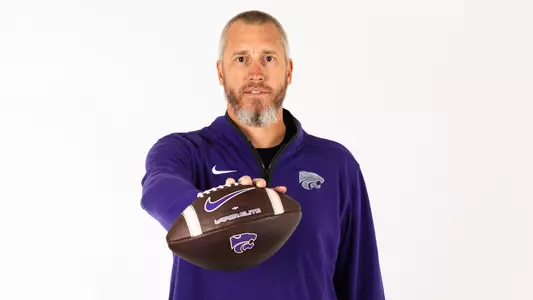
Jeremiah Johnson, a native of Scandia, Kansas, remembers the two-hour drives southeast to Manhattan for summer coaching clinics at Bill Snyder Family Stadium. A 2000 graduate of the University of Kansas, Johnson also remembers Kansas State's dominance on the gridiron.
A 24-year coaching career, including 13 years as a coordinator, Johnson is now back in the Sunflower State. After stints at Wyoming, Loras College, Northern Iowa, Kent State, Louisiana Tech and Coastal Carolina, Johnson will coach defensive backs — more specifically, safeties — for the Wildcats, eager to continue a tradition built over the years in the Little Apple.
"Being violent, flying around and being really good?" Johnson says. "I remember Kansas State defenses. Oh yeah, I remember."
Johnson first met K-State head coach Collin Klein when both were on the coaching staff at Northern Iowa in 2016. The two remained in contact ever since. As Johnson served as both defensive coordinator and interim head coach this past season at Coastal Carolina, he had an idea heading toward bowl season that Klein might take a head coaching position.
"We didn't know where," Johnson says, "but we had just started talking about the possibility of getting back together at that point."
Johnson arrived in Manhattan on December 31 — about 24 hours after Coastal Carolina played in the Independence Bowl. His first day at the Vanier Family Football Complex began January 1 shortly after daybreak. There were many people to meet and tons of film of prospective players to evaluate. It was the beginning of an exciting journey wearing the Powercat.
"It's very exciting," Johnson says. "I've been doing this long enough that for me, the most important thing is to be around the right people. I've been coordinating defenses since 2013, and my whole goal with every staff that I was a part of was to surround myself with really good people, and people I wanted to be around.
"Coach Klein is doing the same thing. We sat in that staff room with Coach Peterson and Coach Marcus Woodson, and Coach Nick Toth, and Coach Buddy Wyatt, and all the analysts, and it's just easy to communicate and to get along. There's great energy in the room. It's just exciting for everybody to feel it, and there's not a lot of ego. I really think it's going to be a phenomenal experience for everybody."
Johnson spoke with K-State Sports Extra's D. Scott Fritchen about his journey to K-State — and what's next as he hits an extremely busy time locating and bringing in talented prospective players to help the Wildcats during the 2026 season.

D. SCOTT FRITCHEN: December 24 it was announced that you had been hired to the K-State football coaching staff. I'm interested in when you spoke with Collin for the first time and exactly how the gears got set into motion for you to join this coaching staff?
JEREMIAH JOHNSON: The first time we talked about getting together this year was whenever we were getting ready to play Georgia Southern, so there were three weeks, I guess, in the season, and it was preliminary. We just talked about him maybe having some things, some people were starting to reach out to him. We didn't know where, but we had just started talking about the possibility of getting back together at that point.
My thoughts really were to keep winning football games at Coastal Carolina. But Collin is one of the best people in this business, and we'd worked together a long time ago at Northern Iowa and had always stayed in touch. Shalin and my wife had stayed very close through the years as well. It was just one of those things where we knew if the right opportunity came and he wanted us to be a part of his staff, we were going to do that regardless of where we were or what phase of life we were in. It was going to be very hard for us to say no to Coach Klein.
FRITCHEN: This past year, you were defensive coordinator and interim head coach at Coastal Carolina. You had a lot of balls to juggle. Was there any thought about assuming the permanent head coaching position for the first time?
JOHNSON: Not really. We weren't really good enough at Coastal to where I felt like we'd have a real shot to get that head coaching job. I didn't interview for it. My focus once they named me the interim head coach was just to keep everything together so we could give our kids an opportunity to compete in a bowl game. The kids enjoyed that month. I was just happy they had an opportunity to go play.
FRITCHEN: When you first spoke with Collin, did he discuss any possible position groups that you might work with?
JOHNSON: We didn't really start talking about the specifics of anything until probably two or three days before we made the decision to make it happen. I talked with he and (new defensive coordinator) Jordan Peterson pretty extensively one evening, and that was where we kind of figured out how everything was going to work. That's when we kind of knew this was how it was going to go and how Jordan Peterson saw it and how Collin saw it. So, there was real clarity there, which made it very simple for us to make our decision at that point.
FRITCHEN: You're from Scandia, Kansas, and graduated from KU in 2000. How good does it feel to be back in Kansas?
JOHNSON: It feels awesome. Having not lived here since 2002, I left and we went to Wyoming and I did a long tour in Iowa and I've been north of I-80 for a long time. Then in the last couple years I've been in the south, so I haven't worn a heavy coat for the past couple of years until I got here on December 31. We played the bowl game in Shreveport, flew back to Myrtle Beach, and had to turn my stuff in the next morning, and then caught a flight at noon and I got here at 10:30 p.m.
FRITCHEN: So, you arrived on December 31. What did you do January 1?
JOHNSON: We came up to the office. Christian Ellsworth picked me up. He's the guy who played for us at Northern Iowa, so I've known Christian for a long time. He picked me up at the hotel, we went to the office early, and I just started evaluating portal kids. We did that for about 12 hours. Then the Kleins threw a mixer for us all so we could get to know each other and the families were invited, so I got to meet a lot of people, which was a phenomenal experience for us. There was a lot of energy. I told Collin when we were standing there that there are just so many good people that he's brought into this building. Like, everyone is a good person, which is what you'd expect from Coach Klein and Shalin. They're good people and they're going to surround themselves with really good people and the kind of people you want to be around. Everybody is pretty excited about the direction that this thing is headed.

FRITCHEN: When you hear "Kansas State football" what first come to mind?
JOHNSON: Winning. Powercat. Toughness. Physicality. When I was really young, Kansas State wasn't great. When Coach Snyder got here, everything changed, and he completely flipped everything about what America thought about Kansas State football. Since then, the narrative has been that you expect Kansas State to win, and you know they're going to be physical and disciplined, and that's really what we're going to do. That's not going to change.
FRITCHEN: What do remember about the K-State defense over the years?
JOHNSON: Being violent, flying around and being really good? I remember Kansas State defenses. Oh yeah, I remember. Coach Chris Klieman was in my wedding. I've known Coach Klieman since 1998, so we're very close, and I've known Coach Joe Klanderman for a while. Before that, I knew Blake Seiler. I recruited here for so long in Kansas that I used to come into this building even before Coach Klieman was head coach and clinic with guys. I've been pretty familiar with Kansas State football for a long time, and I'm pretty excited to have this logo on my shirt.
FRITCHEN: You're a 24-year coaching veteran, and this is your first job at a Power 4 school. What's the sense of excitement you feel being a part of this staff and being at K-State?
JOHNSON: It's very exciting. I've been doing this long enough that for me, the most important thing is to be around the right people. I've been coordinating defenses since 2013, and my whole goal with every staff that I was a part of was to surround myself with really good people, and people I wanted to be around. Coach Klein is doing the same thing. We sat in that staff room yesterday with Coach Peterson and Coach Marcus Woodson, and Coach Nick Toth, and Coach Buddy Wyatt, and all the analysts and it's just easy to communicate and to get along. There's great energy in the room. It's just exciting for everybody to feel it and there's not a lot of ego. I really think it's going to be a phenomenal experience for everybody.
FRITCHEN: Collin Klein calls you a "relentless recruiter." What qualities make you a high-level recruiter, what areas of the country do you particularly enjoy recruiting, and how do you plan to sell prospective student-athletes on K-State football?
JOHNSON: The biggest thing with recruiting is you have to have a work ethic. That's the key with recruiting is you have to work. I've recruited Kansas City since 2007. When I was at Northern Iowa, I recruited Kansas City all the time. So, I was able to pull really good players out of there over the years. Fortunately, over those years a lot of those coaches are the same, so I know a ton of high school coaches in the Kansas City area – and really the whole state of Kansas – so I do enjoy recruiting there. I've got recruiting ties in Georgia, Charlotte, but recruiting, to me, is about building relationships. You have to build relationships with the high school coach, with those young people, and then with the people that they're close to. Ultimately, that's how you can get those kids to come be a part of your program.
In terms of what you sell at Kansas State? Number one, you have phenomenal facilities, a culture that's going to be family oriented, a culture that's going to be based on wins and losses, and we're going to win football games and go to bowl games and compete to play in the College Football Playoff. There's a lot of great things for us to sell. Plus, you can get a world-class education here. The things you can sell is endless, really. That'll be phenomenal. Walking in places with this logo on my shirt is going to fun for me, I think.
FRITCHEN: With the transfer portal, you said you were looking at film for 12 hours your first day here. This is a different age of college football. What's the challenge of adjusting to it. We talk about recruiting, and it appears you're recruiting over and then over again.
JOHNSON: We've always had to recruit, but you're now recruiting college kids as well as high school kids, so sometimes your focus is different, but transfer portal recruiting is more like speed dating, and high school recruiting is more like relationship dating. When you're in the portal, you're looking for something very specific and the kids are looking for something very specific as well. You have to make a lot of phone calls, find the right fit really for that kid and for you, so it's really the right fit for everybody. So, you spend a lot of time evaluating, and on the phone making sure what you have to offer is really what that kid is looking for, but also because those kids who are in the portal are in the portal for a reason. Generally, it's playing time on the football field. If it's a kid who has one year, is he looking to be a starter? Maybe you don't have that spot.
You just have to go through and be honest with kids and tell them this is what we need and what we're looking for, and ask them what they're looking for, and go through it that way. With high school kids, it's a little bit different, because they're looking for brand recognition sometimes, the education piece, the family atmosphere piece. Most of these portal kids don't care. They're looking for something completely different. It's a completely different type of recruiting with the portal than with your tradition high school recruiting. You have to flip the switch depending upon who you're talking to at that moment.

FRITCHEN: Describe your leadership and coaching style.
JOHNSON: People would call it servant leadership, I guess. I do believe that my role is to empower people and to show them how to do the things that they need to do to be successful in life. I'm not a yeller. I'm more likely to put my arm around a young man and ask him questions to try to communicate with him, to help him to see how he can get better. I really don't yell hardly at all. Even when I was a coordinator I didn't yell. I just don't think that's a great form of communication, generally because kids will tune you out. So, when I do yell, people are like, "What the heck? Why is JJ yelling? Somebody must've done something really bad." I try to empower people and let them do what they're supposed to do and give them the keys to the car so they can do what they need to do to be successful. That's how I always try to do it. I try to give them the tools to be successful so I can help them in any way that they need me to help him, so they can do what they need to do.
FRITCHEN: You have many years of experience as a defensive coordinator and have coached several different positions along the way to this point in your journey. Let's talk about Northern Iowa, Kent State, Louisiana Tech and Coastal Carolina for a minute. How did those experiences shape you into the coach and teacher you are today?
JOHNSON: They've all been phenomenal. I've met tons and tons of unbelievable mentors. You can learn from every experience you have in life, whether it's good or it's bad. Sometimes you learn things like, "I'd never want to do that," and other times you're like, "Man, that really worked. I'm going to continue to do things this way." But you also learn different parts of the world have different kinds of people so you can learn to communicate differently with different people in different places. Ultimately, what I've learned doesn't matter where you are, if you can make people feel good about themselves, they're going to give you everything they have. That's really what I've always tried to do, is to help kids to believe in themselves, so they can reach their full potential in every aspect of their lives.
FRITCHEN: You've coached talent, and your defenses have produced impressive statistics. What are some achievements you're most proud of in your career?
JOHNSON: Probably the one that's most impressive defensively is the defense we inherited at Louisiana Tech was ranked No. 130 in the country and we took them to 12th in the country in one season. We had really, really good coaches on that staff and tremendous players and they all bought into what we were doing from a culture aspect, and it was a phenomenal experience. We were very proud of that group. Statistics? You can make them say whatever you want. I'm more proud of the kids that came in as a walk-on and found a way to be a starter at some point in their career — guys who really made growth because they really believed in the things we were trying to get them to do. You can impact lives that way. From a football perspective, we've found ways to create takeaways and stop people. Generally, those are the kids. Coaches get too much credit for that. The kids do the work. We just try to put them into position to make plays. But they have to make the plays.
FRITCHEN: Again, you've coached various positions over the years. What do you enjoy about coaching the defensive back position group? What makes the defensive back group unique?
JOHNSON: Primarily, I'll be coaching the safeties and Coach Woodson will coach corners and Coach Peterson will be over all of us. I like coaching defensive backs because if you really think about it, there are very few people in the world that are trained to go backward. So, you train them to go backward and then at some point you ask them to go forward as fast as they can and run into something that's running at them as fast as they can. So, it's kind of a unique thing. But that's what I like about it. Also, I believe that the defensive backs, just from a skill set, athletically, the things we ask them to do, you have to be pretty athletic to be able to do all those things — from the physical movements they have do with flipping their hips, to being able to transfer from backward to forward, or side to side, a lot of those movements take elite athleticism, and then there are the ball skills, and I do like to get kids who will attack a football.
As we move forward, back in old days, a lot of kids played multiple sports, so I always tried to find kids in the secondary who played baseball because a good outfielder that knows how to track the ball can track a football, too, in the post. But you find less and less of those guys now, so you really have to work hard to evaluate those ball skills. We were actually talking about it in the staff room, just teaching guys ball skills or teaching guys how to catch, and I just asked Coach Peterson what he had done to teach ball skills, and we talked about what I had done and what he had done over the years to try and work with that. But I do enjoy the secondary probably the most of any position on the football field.

FRITCHEN: Have you seen any of the K-State safeties on this current roster yet?
JOHNSON: Yep, and I've talked to all of them. I'm trying to build relationships with those kids. I started that even when I was back in Myrtle Beach. I just want to start building that relationship before they get back to campus so at least the first time they see me it's not the first time they've talked to me. That'll continue here as we go through the next weeks until the 18th when everybody gets back to campus. They all have different skillsets, and what's not fair is I'm not 100% sure how we're going to play schematically yet. We haven't had a chance to sit down and talk about that. So, in terms of how everything is going to fit right now, I don't know exactly what that would look like. That's what I said on the phone when I talked to them, is hopefully in the next weeks we can sit down as a staff and start saying, "OK, this guy is going to be here, and this guy is going to be here," so then we can start talking more specifically about, "This is what we have to do with this guy," to get those guys ready before we start spring ball to give them the best opportunity to win a job.
FRITCHEN: How many safeties do you currently have?
JOHNSON: Seven or eight. I'll have to look at my board. I played with three-high the last seven or eight years, so I carried 12 safeties, but schematically we won't carry that many, but you really want to have a four- or five-deep so we'll carry 8 to 10. Then you want to have that guy who can swing and maybe play some nickel. So, nine or 10 is what I think we'll have on the roster.
FRITCHEN: What's the standard you'll demand from your defensive backs at K-State?
JOHNSON: Their best. The cool thing about it is they get to set their own standard. But I want their best in all that they do all the time. If they get an "A" on a test, the next time they take that test I expect them to get an "A." If they get a "C" on a test, the next time I hope they can get a "B-minus." But the standard is what it is, so if they come out of a post and make a play at the top of the numbers, why wouldn't I expect them to do that every time? They've shown us that they can do that. If you can do it one time, the standard is that you can do it every time. That's what I'm going to expect from them is their best in everything they do all the time.
FRITCHEN: What are the plans moving forward?
JOHNSON: I'm going to sit down and evaluate and get ready for some guys who are coming in on visits here, and get my film ready, so if we get some safeties coming in here, I'm probably only going to take one or two, but I want to make sure it's the right one or two, and that I'm ready when they get here, so I have a good visit lined up, so we can get them if we want them.
FRITCHEN: From that boy in Scandia, Kansas, to where you sit today, what has Jeremiah Johnson learned most about himself during his journey?
JOHNSON: If you surround yourself with good people, and you treat people the right way and work really hard, you can do anything you want to do.
Jeremiah Johnson, a native of Scandia, Kansas, remembers the two-hour drives southeast to Manhattan for summer coaching clinics at Bill Snyder Family Stadium. A 2000 graduate of the University of Kansas, Johnson also remembers Kansas State's dominance on the gridiron.
A 24-year coaching career, including 13 years as a coordinator, Johnson is now back in the Sunflower State. After stints at Wyoming, Loras College, Northern Iowa, Kent State, Louisiana Tech and Coastal Carolina, Johnson will coach defensive backs — more specifically, safeties — for the Wildcats, eager to continue a tradition built over the years in the Little Apple.
"Being violent, flying around and being really good?" Johnson says. "I remember Kansas State defenses. Oh yeah, I remember."
Johnson first met K-State head coach Collin Klein when both were on the coaching staff at Northern Iowa in 2016. The two remained in contact ever since. As Johnson served as both defensive coordinator and interim head coach this past season at Coastal Carolina, he had an idea heading toward bowl season that Klein might take a head coaching position.
"We didn't know where," Johnson says, "but we had just started talking about the possibility of getting back together at that point."
Johnson arrived in Manhattan on December 31 — about 24 hours after Coastal Carolina played in the Independence Bowl. His first day at the Vanier Family Football Complex began January 1 shortly after daybreak. There were many people to meet and tons of film of prospective players to evaluate. It was the beginning of an exciting journey wearing the Powercat.
"It's very exciting," Johnson says. "I've been doing this long enough that for me, the most important thing is to be around the right people. I've been coordinating defenses since 2013, and my whole goal with every staff that I was a part of was to surround myself with really good people, and people I wanted to be around.
"Coach Klein is doing the same thing. We sat in that staff room with Coach Peterson and Coach Marcus Woodson, and Coach Nick Toth, and Coach Buddy Wyatt, and all the analysts, and it's just easy to communicate and to get along. There's great energy in the room. It's just exciting for everybody to feel it, and there's not a lot of ego. I really think it's going to be a phenomenal experience for everybody."
Johnson spoke with K-State Sports Extra's D. Scott Fritchen about his journey to K-State — and what's next as he hits an extremely busy time locating and bringing in talented prospective players to help the Wildcats during the 2026 season.
D. SCOTT FRITCHEN: December 24 it was announced that you had been hired to the K-State football coaching staff. I'm interested in when you spoke with Collin for the first time and exactly how the gears got set into motion for you to join this coaching staff?
JEREMIAH JOHNSON: The first time we talked about getting together this year was whenever we were getting ready to play Georgia Southern, so there were three weeks, I guess, in the season, and it was preliminary. We just talked about him maybe having some things, some people were starting to reach out to him. We didn't know where, but we had just started talking about the possibility of getting back together at that point.
My thoughts really were to keep winning football games at Coastal Carolina. But Collin is one of the best people in this business, and we'd worked together a long time ago at Northern Iowa and had always stayed in touch. Shalin and my wife had stayed very close through the years as well. It was just one of those things where we knew if the right opportunity came and he wanted us to be a part of his staff, we were going to do that regardless of where we were or what phase of life we were in. It was going to be very hard for us to say no to Coach Klein.
FRITCHEN: This past year, you were defensive coordinator and interim head coach at Coastal Carolina. You had a lot of balls to juggle. Was there any thought about assuming the permanent head coaching position for the first time?
JOHNSON: Not really. We weren't really good enough at Coastal to where I felt like we'd have a real shot to get that head coaching job. I didn't interview for it. My focus once they named me the interim head coach was just to keep everything together so we could give our kids an opportunity to compete in a bowl game. The kids enjoyed that month. I was just happy they had an opportunity to go play.
FRITCHEN: When you first spoke with Collin, did he discuss any possible position groups that you might work with?
JOHNSON: We didn't really start talking about the specifics of anything until probably two or three days before we made the decision to make it happen. I talked with he and (new defensive coordinator) Jordan Peterson pretty extensively one evening, and that was where we kind of figured out how everything was going to work. That's when we kind of knew this was how it was going to go and how Jordan Peterson saw it and how Collin saw it. So, there was real clarity there, which made it very simple for us to make our decision at that point.
FRITCHEN: You're from Scandia, Kansas, and graduated from KU in 2000. How good does it feel to be back in Kansas?
JOHNSON: It feels awesome. Having not lived here since 2002, I left and we went to Wyoming and I did a long tour in Iowa and I've been north of I-80 for a long time. Then in the last couple years I've been in the south, so I haven't worn a heavy coat for the past couple of years until I got here on December 31. We played the bowl game in Shreveport, flew back to Myrtle Beach, and had to turn my stuff in the next morning, and then caught a flight at noon and I got here at 10:30 p.m.
FRITCHEN: So, you arrived on December 31. What did you do January 1?
JOHNSON: We came up to the office. Christian Ellsworth picked me up. He's the guy who played for us at Northern Iowa, so I've known Christian for a long time. He picked me up at the hotel, we went to the office early, and I just started evaluating portal kids. We did that for about 12 hours. Then the Kleins threw a mixer for us all so we could get to know each other and the families were invited, so I got to meet a lot of people, which was a phenomenal experience for us. There was a lot of energy. I told Collin when we were standing there that there are just so many good people that he's brought into this building. Like, everyone is a good person, which is what you'd expect from Coach Klein and Shalin. They're good people and they're going to surround themselves with really good people and the kind of people you want to be around. Everybody is pretty excited about the direction that this thing is headed.
FRITCHEN: When you hear "Kansas State football" what first come to mind?
JOHNSON: Winning. Powercat. Toughness. Physicality. When I was really young, Kansas State wasn't great. When Coach Snyder got here, everything changed, and he completely flipped everything about what America thought about Kansas State football. Since then, the narrative has been that you expect Kansas State to win, and you know they're going to be physical and disciplined, and that's really what we're going to do. That's not going to change.
FRITCHEN: What do remember about the K-State defense over the years?
JOHNSON: Being violent, flying around and being really good? I remember Kansas State defenses. Oh yeah, I remember. Coach Chris Klieman was in my wedding. I've known Coach Klieman since 1998, so we're very close, and I've known Coach Joe Klanderman for a while. Before that, I knew Blake Seiler. I recruited here for so long in Kansas that I used to come into this building even before Coach Klieman was head coach and clinic with guys. I've been pretty familiar with Kansas State football for a long time, and I'm pretty excited to have this logo on my shirt.
FRITCHEN: You're a 24-year coaching veteran, and this is your first job at a Power 4 school. What's the sense of excitement you feel being a part of this staff and being at K-State?
JOHNSON: It's very exciting. I've been doing this long enough that for me, the most important thing is to be around the right people. I've been coordinating defenses since 2013, and my whole goal with every staff that I was a part of was to surround myself with really good people, and people I wanted to be around. Coach Klein is doing the same thing. We sat in that staff room yesterday with Coach Peterson and Coach Marcus Woodson, and Coach Nick Toth, and Coach Buddy Wyatt, and all the analysts and it's just easy to communicate and to get along. There's great energy in the room. It's just exciting for everybody to feel it and there's not a lot of ego. I really think it's going to be a phenomenal experience for everybody.
FRITCHEN: Collin Klein calls you a "relentless recruiter." What qualities make you a high-level recruiter, what areas of the country do you particularly enjoy recruiting, and how do you plan to sell prospective student-athletes on K-State football?
JOHNSON: The biggest thing with recruiting is you have to have a work ethic. That's the key with recruiting is you have to work. I've recruited Kansas City since 2007. When I was at Northern Iowa, I recruited Kansas City all the time. So, I was able to pull really good players out of there over the years. Fortunately, over those years a lot of those coaches are the same, so I know a ton of high school coaches in the Kansas City area – and really the whole state of Kansas – so I do enjoy recruiting there. I've got recruiting ties in Georgia, Charlotte, but recruiting, to me, is about building relationships. You have to build relationships with the high school coach, with those young people, and then with the people that they're close to. Ultimately, that's how you can get those kids to come be a part of your program.
In terms of what you sell at Kansas State? Number one, you have phenomenal facilities, a culture that's going to be family oriented, a culture that's going to be based on wins and losses, and we're going to win football games and go to bowl games and compete to play in the College Football Playoff. There's a lot of great things for us to sell. Plus, you can get a world-class education here. The things you can sell is endless, really. That'll be phenomenal. Walking in places with this logo on my shirt is going to fun for me, I think.
FRITCHEN: With the transfer portal, you said you were looking at film for 12 hours your first day here. This is a different age of college football. What's the challenge of adjusting to it. We talk about recruiting, and it appears you're recruiting over and then over again.
JOHNSON: We've always had to recruit, but you're now recruiting college kids as well as high school kids, so sometimes your focus is different, but transfer portal recruiting is more like speed dating, and high school recruiting is more like relationship dating. When you're in the portal, you're looking for something very specific and the kids are looking for something very specific as well. You have to make a lot of phone calls, find the right fit really for that kid and for you, so it's really the right fit for everybody. So, you spend a lot of time evaluating, and on the phone making sure what you have to offer is really what that kid is looking for, but also because those kids who are in the portal are in the portal for a reason. Generally, it's playing time on the football field. If it's a kid who has one year, is he looking to be a starter? Maybe you don't have that spot.
You just have to go through and be honest with kids and tell them this is what we need and what we're looking for, and ask them what they're looking for, and go through it that way. With high school kids, it's a little bit different, because they're looking for brand recognition sometimes, the education piece, the family atmosphere piece. Most of these portal kids don't care. They're looking for something completely different. It's a completely different type of recruiting with the portal than with your tradition high school recruiting. You have to flip the switch depending upon who you're talking to at that moment.
FRITCHEN: Describe your leadership and coaching style.
JOHNSON: People would call it servant leadership, I guess. I do believe that my role is to empower people and to show them how to do the things that they need to do to be successful in life. I'm not a yeller. I'm more likely to put my arm around a young man and ask him questions to try to communicate with him, to help him to see how he can get better. I really don't yell hardly at all. Even when I was a coordinator I didn't yell. I just don't think that's a great form of communication, generally because kids will tune you out. So, when I do yell, people are like, "What the heck? Why is JJ yelling? Somebody must've done something really bad." I try to empower people and let them do what they're supposed to do and give them the keys to the car so they can do what they need to do to be successful. That's how I always try to do it. I try to give them the tools to be successful so I can help them in any way that they need me to help him, so they can do what they need to do.
FRITCHEN: You have many years of experience as a defensive coordinator and have coached several different positions along the way to this point in your journey. Let's talk about Northern Iowa, Kent State, Louisiana Tech and Coastal Carolina for a minute. How did those experiences shape you into the coach and teacher you are today?
JOHNSON: They've all been phenomenal. I've met tons and tons of unbelievable mentors. You can learn from every experience you have in life, whether it's good or it's bad. Sometimes you learn things like, "I'd never want to do that," and other times you're like, "Man, that really worked. I'm going to continue to do things this way." But you also learn different parts of the world have different kinds of people so you can learn to communicate differently with different people in different places. Ultimately, what I've learned doesn't matter where you are, if you can make people feel good about themselves, they're going to give you everything they have. That's really what I've always tried to do, is to help kids to believe in themselves, so they can reach their full potential in every aspect of their lives.
FRITCHEN: You've coached talent, and your defenses have produced impressive statistics. What are some achievements you're most proud of in your career?
JOHNSON: Probably the one that's most impressive defensively is the defense we inherited at Louisiana Tech was ranked No. 130 in the country and we took them to 12th in the country in one season. We had really, really good coaches on that staff and tremendous players and they all bought into what we were doing from a culture aspect, and it was a phenomenal experience. We were very proud of that group. Statistics? You can make them say whatever you want. I'm more proud of the kids that came in as a walk-on and found a way to be a starter at some point in their career — guys who really made growth because they really believed in the things we were trying to get them to do. You can impact lives that way. From a football perspective, we've found ways to create takeaways and stop people. Generally, those are the kids. Coaches get too much credit for that. The kids do the work. We just try to put them into position to make plays. But they have to make the plays.
FRITCHEN: Again, you've coached various positions over the years. What do you enjoy about coaching the defensive back position group? What makes the defensive back group unique?
JOHNSON: Primarily, I'll be coaching the safeties and Coach Woodson will coach corners and Coach Peterson will be over all of us. I like coaching defensive backs because if you really think about it, there are very few people in the world that are trained to go backward. So, you train them to go backward and then at some point you ask them to go forward as fast as they can and run into something that's running at them as fast as they can. So, it's kind of a unique thing. But that's what I like about it. Also, I believe that the defensive backs, just from a skill set, athletically, the things we ask them to do, you have to be pretty athletic to be able to do all those things — from the physical movements they have do with flipping their hips, to being able to transfer from backward to forward, or side to side, a lot of those movements take elite athleticism, and then there are the ball skills, and I do like to get kids who will attack a football.
As we move forward, back in old days, a lot of kids played multiple sports, so I always tried to find kids in the secondary who played baseball because a good outfielder that knows how to track the ball can track a football, too, in the post. But you find less and less of those guys now, so you really have to work hard to evaluate those ball skills. We were actually talking about it in the staff room, just teaching guys ball skills or teaching guys how to catch, and I just asked Coach Peterson what he had done to teach ball skills, and we talked about what I had done and what he had done over the years to try and work with that. But I do enjoy the secondary probably the most of any position on the football field.
FRITCHEN: Have you seen any of the K-State safeties on this current roster yet?
JOHNSON: Yep, and I've talked to all of them. I'm trying to build relationships with those kids. I started that even when I was back in Myrtle Beach. I just want to start building that relationship before they get back to campus so at least the first time they see me it's not the first time they've talked to me. That'll continue here as we go through the next weeks until the 18th when everybody gets back to campus. They all have different skillsets, and what's not fair is I'm not 100% sure how we're going to play schematically yet. We haven't had a chance to sit down and talk about that. So, in terms of how everything is going to fit right now, I don't know exactly what that would look like. That's what I said on the phone when I talked to them, is hopefully in the next weeks we can sit down as a staff and start saying, "OK, this guy is going to be here, and this guy is going to be here," so then we can start talking more specifically about, "This is what we have to do with this guy," to get those guys ready before we start spring ball to give them the best opportunity to win a job.
FRITCHEN: How many safeties do you currently have?
JOHNSON: Seven or eight. I'll have to look at my board. I played with three-high the last seven or eight years, so I carried 12 safeties, but schematically we won't carry that many, but you really want to have a four- or five-deep so we'll carry 8 to 10. Then you want to have that guy who can swing and maybe play some nickel. So, nine or 10 is what I think we'll have on the roster.
FRITCHEN: What's the standard you'll demand from your defensive backs at K-State?
JOHNSON: Their best. The cool thing about it is they get to set their own standard. But I want their best in all that they do all the time. If they get an "A" on a test, the next time they take that test I expect them to get an "A." If they get a "C" on a test, the next time I hope they can get a "B-minus." But the standard is what it is, so if they come out of a post and make a play at the top of the numbers, why wouldn't I expect them to do that every time? They've shown us that they can do that. If you can do it one time, the standard is that you can do it every time. That's what I'm going to expect from them is their best in everything they do all the time.
FRITCHEN: What are the plans moving forward?
JOHNSON: I'm going to sit down and evaluate and get ready for some guys who are coming in on visits here, and get my film ready, so if we get some safeties coming in here, I'm probably only going to take one or two, but I want to make sure it's the right one or two, and that I'm ready when they get here, so I have a good visit lined up, so we can get them if we want them.
FRITCHEN: From that boy in Scandia, Kansas, to where you sit today, what has Jeremiah Johnson learned most about himself during his journey?
JOHNSON: If you surround yourself with good people, and you treat people the right way and work really hard, you can do anything you want to do.
Thursday, October 22
Wednesday, October 21
Wednesday, October 21
Wednesday, October 21