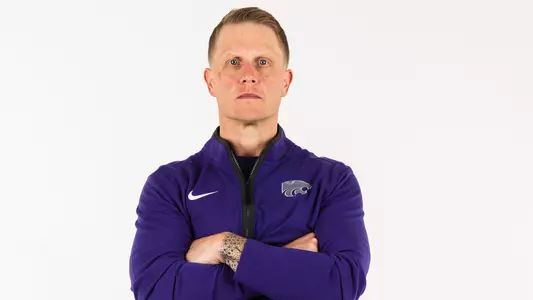
A Life of Service to Others
Jan 06, 2026 | Football, Sports Extra
By: D. Scott Fritchen
You notice the eyes first, piercing, narrowed when he discusses his stints at three Power 4 schools over the last 10 seasons, most recently at Texas A&M, and now as Kansas State's Director of Strength and Conditioning. Jeremy Jacobs and the weight room is like Schroeder and his piano. Jacobs has been at other football programs — LSU, Duke and Texas A&M — and spent the past two seasons as the Associate Director of Football Strength and Conditioning/Director of Football Applied Sports Science at Texas A&M, serving on the same staff as new K-State head coach Collin Klein.
Jacobs has been recognized by the National Strength and Conditioning Association and Collegiate Strength & Conditioning Coaches Association. He's also a Level 1 USA weightlifting sports performance coach and a functional range conditioning specialist.
His eyes lighten when he talks about his family — his wife, Alyssa, daughter, Beau, and sons Fitzgerald and Milo.
His eyes trail back as memories race back from combat rotations to Operation Iraqi Freedom and Operation Enduring Freedom. A U.S. Army veteran, Jacobs spent time as a team leader from 2003 to 2007, and he was charged with educating, training and supervising personnel on all tactics, standard operating procedure and weapon systems.
"When I was deployed to Iraq, we had a mission that was supposed to be about 24 hours," Jacobs says. "Due to a downed helicopter and other circumstances, it turned into nine days. It was nine days of rationing food and water. We were out, it was 127 degrees in the desert, and you had to ration your water and drink it at night because it was too hot during the day to drink it."
Now Jacobs is at K-State. And the word "MANHAPPINESS" floods the videoboards at Bill Snyder Family Stadium, and Jacobs has been in town for less than 24 hours — he left in his truck from College Station, Texas, as 3:30 a.m. and reached the Little Apple at 1:30 p.m. — and he saw the inside of the K-State weight room for the first time just a little while ago.
His gears are already turning for what he has planned for the Wildcats. He says words like "gratitude" and "service" and "consistency" and "standard" and "toughness" and "resiliency."
You ask him to describe his excitement at this undertaking at K-State. And he is speechless.
"I don't even think I can put that into words right now," he says.
"From the minute Collin got the job," Jacobs says, "this has been a dream of mine since I got into this industry, and to do it at a program like this with a rich culture and tradition and standards and a phenomenal fan base, I couldn't ask for a better spot — and to do it with the quality people he's bringing into the building, too.
"I love college football in general, and K-State was always one of those programs I respected from afar. K-State was always that team you never wanted to play. It's something I'm really excited about. Just being here for the last 24 hours, you can see the pride and what people put into this program."
Jeremy Jacobs spoke with K-State Sports Extra's D. Scott Fritchen about his exciting career and visions for K-State:

D. SCOTT FRITCHEN: Take me back to your initial discussion with Collin about this opportunity. When did you speak to him about this position and what were some of the deciding factors in making the move to K-State?
JEREMY JACOBS: Good questions. First of all, I developed a relationship with Collin over the last two seasons because I trained all the quarterbacks, receivers and running backs — all the skill-position players on offense — but mostly the quarterbacks. Collin was the offensive coordinator plus quarterbacks coach there, so every single day we were building a relationship and talking about what we were going to do in recruiting and that kind of stuff. He saw how I did it and my philosophies of how you communicate with the players and train them. So, after the announcement that he got the job here, I sent him a text saying, "Congratulations!" Knowing we had a playoff run coming at Texas A&M, I wanted to stay focused on that. So, it was really the week before the playoff game he shot me a text saying, "Hey, after the game would you like to have a conversation regarding this." I said, "Absolutely."
After the game, we sat down and had a formal conversation about what this would look like. From the minute Collin got the job, this has been a dream of mine since I got into this industry, and to do it at a program like this with a rich culture and tradition and standards and a phenomenal fan base, I couldn't ask for a better spot — and to do it with the quality people he's bringing into the building, too. My wife has gotten to know his wife, and she's super excited about it. We have a young family, and he has a young family. All those factors played into it. I'm from Wisconsin and grew up in the Midwest. I love college football in general, and K-State was always one of those programs I respected from afar. K-State was always that team you never wanted to play. It's something I'm really excited about. Just being here for the last 24 hours, you can see the pride and what people put into this program.
FRITCHEN: You said you arrived at K-State about 24 hours ago. What time did you step into your new weight room for the first time?
JACOBS: Yesterday at 2:00 p.m. I got into the truck at 3:30 a.m. and got here by 1:30 p.m., and as soon as I walked into the building, they walked me down and I stepped into the weight room.
FRITCHEN: What was going through you mind at that time?
JACOBS: A lot of things — gratitude and just being very thankful and feeling that feeling of being blessed for this opportunity. Then also, I can't turn my brain off, so I immediately started going to work about, "OK, what do I like and what do I want to change?" I just wanted to figure out what they had been doing and what differences there are so I can prepare for the teaching aspect of all that's new. Then just walking around the whole thing, getting eyes on it, and how can my program fit into what we currently have, and what do we need to get, and what are we going to do from an athletic development standpoint.
Everything is going to be about getting the best out of each player. Everyone has a different set of DNA, so you can't treat everybody the same. I've been in the Sports Science realm over the last six seasons, and really it started at LSU because we didn't have a sports scientist, and all this data was coming in and we had to start doing something with it. I'm very blessed to work with Coach Tommy Moffitt (Texas A&M director of football strength and conditioning). What I learned from him, being around college for 30 years now, he sticks to what he knows works and the fundamentals, but he's always looking for an edge. He's OK with change, so I watched him as a well-established head strength coach for years, every year trying to find out what he could do better with this program. What we did 10 years ago and what we did this last season isn't the same. It's cool to keep forward thinking and check your program and what you believe in and not get rooted and stuck in your ways, and then having a staff around you who supports that and giving them some autonomy to challenge you and make sure we're doing everything we can for these guys.
FRITCHEN: From a physical standpoint, when you inspected the weight room, what impressed you the most?
JACOBS: It's got great size, it has all your basic fundamental implements and equipment you need to get started. It's a good flow and logistics of how we can do things. It has everything you need to get started Day 1 and get some work in. How it will change will be probably a gradual change over time. I'm more of an Olympic-based coach, so there are going to be some new movements with the bar, and a lot of free-weight movements, but it's all going to be rooted in the fundamentals of strength and conditioning, and we're going to do a lot of dedicated speed-development work. How you couple your speed work with how you couple your work in the weight room that day is important. Most important, you must be consistent. Consistency is king in all this, whether it's lifting, conditioning, recovery, and how do we get them all to work together. There's a really good nutritionist on staff here and really good sports scientists on staff here. It's not just me, it's all of us together to maximize all the things that players need to be the best version of them.

FRITCHEN: One of the things that Collin appears excited about is you helping to build "our K-State culture." Laying a foundation is so important in developing the bedrock of a program or organization. What do you envision the K-State football culture to be and what are the steps in building a culture?
JACOBS: You gotta do hard things. Toughness — you can build toughness through doing hard things. Resiliency — you build resiliency through doing hard things. That's where you build grit. Sometimes by doing hard things it also exposes on your team who has those qualities that you're looking for as well. Going back to consistency, it's not about when you feel good or when you want to — the really great ones find ways to do it when they don't want to and to find the motivation they need to. Motivation is a fleeting thing, so when you build discipline and consistency in your work schedule, you fall back to that as opposed to waiting for you to feel good to do it. Then we'll probably put them into positions where situations change, and they have to adapt. How often in football game does the momentum sway and something doesn't go your way and how do you adapt and keep finishing and play for 60 minutes. There's a physical component that we need to develop to make sure they can play in the game for that long, but there's a mental component to stay locked in.
Learning is a skill, so teaching them how to learn. In today's world, it's even harder. These kids have so many things coming at them. Their attention spans, obviously, are challenged every day, so how do we get them to lock in and focus? The details in how you lift matter. If I'm going to teach a player on the field that his footwork and mechanics matter on how a quarterback throws the ball. Where he puts his hands on the barbell and where his feet are and how he starts in a spring stance, those small details matter, too. Letting him know you can't just be half-hearted in this and then think you can be super locked-in on this — it carries over. I think I'm a good teacher.
Something Coach Saban said was, "Coaching is teaching, and teaching is motivating people to learn." Getting them in that environment, first and foremost, I'm a teacher, and then we have to have a standard, and if you don't meet it there will be consequences, and if you do meet it here are good things that happen. You promote winning and there are consequences for losing, and consequences for lack of accountability. The consistency piece, as a coach, if I have one standard one day, and I change it the next, it's not going to work. Being open and honest with the players, you have to be yourself, because if they see me trying to be somebody I'm not, they're going to see it from a mile away.
Authenticity from all of that — the energy you bring every day and is this important to you? If you really want to be a great player here, then where are you spending your time? Now we're living in an era where these players can't claim to be a broke college kid anymore. I've talked with our players that, "If you don't like something nutritionally, you can fix that." I want to teach all of these guys to be a pro, so when they go to the next level, they know how to train, recover, and know what it feels like to feel good on a game day — all that stuff. At the next level, they're not going to teach you, they're going to expect you to have it. If you don't have it, they're going to find somebody who does. So, how do I build that into our players — this is the K-State way, this is how we've done it.

FRITCHEN: You just mentioned the "K-State Way." What's the standard you want for this program?
JACOBS: My biggest compliment I can ever get is when somebody coaches one of our players and says, "That guy knows how to lift, move, and he looks like he's trained, and he eats well." I want them to know that guy was coached up on how to do it right, and there was a standard of quality of movement We're going to be a technique-first program, and I want them to lift well before we just start loading the bar. Then the foundational piece is every day being that guy when you come in here and having the right attitude and calculating the attitude they need to have first when they come in the door with energy and an openness to change, because there are a lot of new faces in the building, and know that what we do — I look at my job as a customer service-based industry. So, I'm here for them, and they're not here for me. They need to know we are a space they can come to and be a part of as opposed to feeling like they have to.
FRITCHEN: On the news release that announced your hiring, you were quoted as saying, "Time to get to work!" Reviewing your background, you define discipline, hard work, leader, communicator, and teammate. What emotions do you bring to the table as you begin this journey at K-State?
JACOBS: I don't even think I can put that into words right now. There is so much to do in the weight room that I know the next three weeks before we really get rolling, I'm going to be busy every day preparing for it. I can't wait for the first day when the guys walk in and you're just coaching. That's where my passion comes from, is just teaching what we're doing and why we're doing it, and this is why it's important to them as a player and get them to love their teammates. This is a team game that culture is built throughout. It's got to be a team thing in having guys come together and embrace each other. As far as my own excitement, I mean, yeah, I don't even know how to put that into words right now.
FRITCHEN: About 22 years ago, you were in a vastly different realm. You were defending the greatest nation in the world while serving in the U.S. Army. You were a team leader from 2003 to 2007. You were in charge of men and women in their education and training of all tactics, standard operating procedures and weapons systems. In what ways did those experiences shape you into the man you are today?
JACOBS: I learned very much that when you think you've given everything that you probably have only expelled about 50% of your energy. I got pushed to limits I didn't think I could go to. What you realize is when you expand those boundaries, and when you go back to them, they don't seem so hard anymore. How much of it is mental? Your brain will quit far before your body. It was about teaching myself and other people that you haven't even touched the surface of what you're capable of. We live in a world where everyone is comparing to somebody else through a social media app or whatever. The quote is, "Comparison is the thief of all joy." What I learned in a position of leadership was authenticity and that there are good leaders and bad leaders. You have to lead by example. If you ever want to lose a winner, tolerate a loser. I think about that all the time. Sometimes holding the standard is hard and it's uncomfortable. When you hold people accountable, they're going to push back, so you have to be the bad guy, and be OK with that, and be firm enough in the belief of what you're teaching is right, and those guys will normally come back to you, but they're testing and finding out. Learning how to hold your standard when it's uncomfortable and when everybody is looking at you like you might be the bad guy, but that's OK.
FRITCHEN: What was an exercise or mission you were able to accomplish during your time in the U.S. Army that really tested you but that you're most proud of?
JACOBS: There are so many. It's funny because when you first go in, you think road marching is easy — at least I did. I can walk with weight. I can do that. When you learn what the standard of walking with weight and speed feels like after 20 miles, it's a different feeling on your body. The pain that I endured for hours on end — there's a different level of physical preparedness that I need to get myself to for some of this stuff. It was one of the most eye-opening experiences. I remember I had a distinct moment through all those decision processes, whether it be basic, infantry, air-borne or ranger, all through it. When I was deployed to Iraq, we had a mission that was supposed to be about 24 hours. Due to a downed helicopter and other circumstances, it turned into nine days. It was nine days of rationing food and water. We were out, it was 127 degrees in the desert, and you had to ration your water and drink it at night because it was too hot during the day to drink it. I remember I had a moment, thinking, "Now, I get why you go through those things."
I was 21 years old. At a young age, I'm having that realization that what they did in training totally made sense to me now, because we went through all that training, and you learn to improvise, adapt and overcome. That's pressing on regardless of what happens to you is a message to the team that it doesn't matter what happens to you — keep going. Don't let your circumstance dictate your actions. Keep going. Keep going. So, what now? Even on the football field, when something bad happens? Cool. What's next? What's next? Keep pushing. Keep pushing. If you learn that and get to that mentality you can accomplish a lot of great things if you don't get sidetracked by your negative circumstances of the current moment in time.
FRITCHEN: Final question, from being that boy growing up in Waukesha, Wisconsin, to where you sit today, what have you learned most about yourself during your journey?
JACOBS: Tough question. What have I learned most about myself? Probably that I'm not as great as I think I am and that's OK. I think I'm OK with it. And I've learned that life is really about service to others, and you find a certain gratitude from that. Some of that is my faith and growth as I've become an adult. Doing things for others, there's a certain reward, a certain fulfillment, and it's the only piece that I've learned, that I really do feel fulfilled. Put the focus on other people instead of yourself. I have selfishly gained a ton of fulfillment in that myself.
You notice the eyes first, piercing, narrowed when he discusses his stints at three Power 4 schools over the last 10 seasons, most recently at Texas A&M, and now as Kansas State's Director of Strength and Conditioning. Jeremy Jacobs and the weight room is like Schroeder and his piano. Jacobs has been at other football programs — LSU, Duke and Texas A&M — and spent the past two seasons as the Associate Director of Football Strength and Conditioning/Director of Football Applied Sports Science at Texas A&M, serving on the same staff as new K-State head coach Collin Klein.
Jacobs has been recognized by the National Strength and Conditioning Association and Collegiate Strength & Conditioning Coaches Association. He's also a Level 1 USA weightlifting sports performance coach and a functional range conditioning specialist.
His eyes lighten when he talks about his family — his wife, Alyssa, daughter, Beau, and sons Fitzgerald and Milo.
His eyes trail back as memories race back from combat rotations to Operation Iraqi Freedom and Operation Enduring Freedom. A U.S. Army veteran, Jacobs spent time as a team leader from 2003 to 2007, and he was charged with educating, training and supervising personnel on all tactics, standard operating procedure and weapon systems.
"When I was deployed to Iraq, we had a mission that was supposed to be about 24 hours," Jacobs says. "Due to a downed helicopter and other circumstances, it turned into nine days. It was nine days of rationing food and water. We were out, it was 127 degrees in the desert, and you had to ration your water and drink it at night because it was too hot during the day to drink it."
Now Jacobs is at K-State. And the word "MANHAPPINESS" floods the videoboards at Bill Snyder Family Stadium, and Jacobs has been in town for less than 24 hours — he left in his truck from College Station, Texas, as 3:30 a.m. and reached the Little Apple at 1:30 p.m. — and he saw the inside of the K-State weight room for the first time just a little while ago.
His gears are already turning for what he has planned for the Wildcats. He says words like "gratitude" and "service" and "consistency" and "standard" and "toughness" and "resiliency."
You ask him to describe his excitement at this undertaking at K-State. And he is speechless.
"I don't even think I can put that into words right now," he says.
"From the minute Collin got the job," Jacobs says, "this has been a dream of mine since I got into this industry, and to do it at a program like this with a rich culture and tradition and standards and a phenomenal fan base, I couldn't ask for a better spot — and to do it with the quality people he's bringing into the building, too.
"I love college football in general, and K-State was always one of those programs I respected from afar. K-State was always that team you never wanted to play. It's something I'm really excited about. Just being here for the last 24 hours, you can see the pride and what people put into this program."
Jeremy Jacobs spoke with K-State Sports Extra's D. Scott Fritchen about his exciting career and visions for K-State:
D. SCOTT FRITCHEN: Take me back to your initial discussion with Collin about this opportunity. When did you speak to him about this position and what were some of the deciding factors in making the move to K-State?
JEREMY JACOBS: Good questions. First of all, I developed a relationship with Collin over the last two seasons because I trained all the quarterbacks, receivers and running backs — all the skill-position players on offense — but mostly the quarterbacks. Collin was the offensive coordinator plus quarterbacks coach there, so every single day we were building a relationship and talking about what we were going to do in recruiting and that kind of stuff. He saw how I did it and my philosophies of how you communicate with the players and train them. So, after the announcement that he got the job here, I sent him a text saying, "Congratulations!" Knowing we had a playoff run coming at Texas A&M, I wanted to stay focused on that. So, it was really the week before the playoff game he shot me a text saying, "Hey, after the game would you like to have a conversation regarding this." I said, "Absolutely."
After the game, we sat down and had a formal conversation about what this would look like. From the minute Collin got the job, this has been a dream of mine since I got into this industry, and to do it at a program like this with a rich culture and tradition and standards and a phenomenal fan base, I couldn't ask for a better spot — and to do it with the quality people he's bringing into the building, too. My wife has gotten to know his wife, and she's super excited about it. We have a young family, and he has a young family. All those factors played into it. I'm from Wisconsin and grew up in the Midwest. I love college football in general, and K-State was always one of those programs I respected from afar. K-State was always that team you never wanted to play. It's something I'm really excited about. Just being here for the last 24 hours, you can see the pride and what people put into this program.
FRITCHEN: You said you arrived at K-State about 24 hours ago. What time did you step into your new weight room for the first time?
JACOBS: Yesterday at 2:00 p.m. I got into the truck at 3:30 a.m. and got here by 1:30 p.m., and as soon as I walked into the building, they walked me down and I stepped into the weight room.
FRITCHEN: What was going through you mind at that time?
JACOBS: A lot of things — gratitude and just being very thankful and feeling that feeling of being blessed for this opportunity. Then also, I can't turn my brain off, so I immediately started going to work about, "OK, what do I like and what do I want to change?" I just wanted to figure out what they had been doing and what differences there are so I can prepare for the teaching aspect of all that's new. Then just walking around the whole thing, getting eyes on it, and how can my program fit into what we currently have, and what do we need to get, and what are we going to do from an athletic development standpoint.
Everything is going to be about getting the best out of each player. Everyone has a different set of DNA, so you can't treat everybody the same. I've been in the Sports Science realm over the last six seasons, and really it started at LSU because we didn't have a sports scientist, and all this data was coming in and we had to start doing something with it. I'm very blessed to work with Coach Tommy Moffitt (Texas A&M director of football strength and conditioning). What I learned from him, being around college for 30 years now, he sticks to what he knows works and the fundamentals, but he's always looking for an edge. He's OK with change, so I watched him as a well-established head strength coach for years, every year trying to find out what he could do better with this program. What we did 10 years ago and what we did this last season isn't the same. It's cool to keep forward thinking and check your program and what you believe in and not get rooted and stuck in your ways, and then having a staff around you who supports that and giving them some autonomy to challenge you and make sure we're doing everything we can for these guys.
FRITCHEN: From a physical standpoint, when you inspected the weight room, what impressed you the most?
JACOBS: It's got great size, it has all your basic fundamental implements and equipment you need to get started. It's a good flow and logistics of how we can do things. It has everything you need to get started Day 1 and get some work in. How it will change will be probably a gradual change over time. I'm more of an Olympic-based coach, so there are going to be some new movements with the bar, and a lot of free-weight movements, but it's all going to be rooted in the fundamentals of strength and conditioning, and we're going to do a lot of dedicated speed-development work. How you couple your speed work with how you couple your work in the weight room that day is important. Most important, you must be consistent. Consistency is king in all this, whether it's lifting, conditioning, recovery, and how do we get them all to work together. There's a really good nutritionist on staff here and really good sports scientists on staff here. It's not just me, it's all of us together to maximize all the things that players need to be the best version of them.
FRITCHEN: One of the things that Collin appears excited about is you helping to build "our K-State culture." Laying a foundation is so important in developing the bedrock of a program or organization. What do you envision the K-State football culture to be and what are the steps in building a culture?
JACOBS: You gotta do hard things. Toughness — you can build toughness through doing hard things. Resiliency — you build resiliency through doing hard things. That's where you build grit. Sometimes by doing hard things it also exposes on your team who has those qualities that you're looking for as well. Going back to consistency, it's not about when you feel good or when you want to — the really great ones find ways to do it when they don't want to and to find the motivation they need to. Motivation is a fleeting thing, so when you build discipline and consistency in your work schedule, you fall back to that as opposed to waiting for you to feel good to do it. Then we'll probably put them into positions where situations change, and they have to adapt. How often in football game does the momentum sway and something doesn't go your way and how do you adapt and keep finishing and play for 60 minutes. There's a physical component that we need to develop to make sure they can play in the game for that long, but there's a mental component to stay locked in.
Learning is a skill, so teaching them how to learn. In today's world, it's even harder. These kids have so many things coming at them. Their attention spans, obviously, are challenged every day, so how do we get them to lock in and focus? The details in how you lift matter. If I'm going to teach a player on the field that his footwork and mechanics matter on how a quarterback throws the ball. Where he puts his hands on the barbell and where his feet are and how he starts in a spring stance, those small details matter, too. Letting him know you can't just be half-hearted in this and then think you can be super locked-in on this — it carries over. I think I'm a good teacher.
Something Coach Saban said was, "Coaching is teaching, and teaching is motivating people to learn." Getting them in that environment, first and foremost, I'm a teacher, and then we have to have a standard, and if you don't meet it there will be consequences, and if you do meet it here are good things that happen. You promote winning and there are consequences for losing, and consequences for lack of accountability. The consistency piece, as a coach, if I have one standard one day, and I change it the next, it's not going to work. Being open and honest with the players, you have to be yourself, because if they see me trying to be somebody I'm not, they're going to see it from a mile away.
Authenticity from all of that — the energy you bring every day and is this important to you? If you really want to be a great player here, then where are you spending your time? Now we're living in an era where these players can't claim to be a broke college kid anymore. I've talked with our players that, "If you don't like something nutritionally, you can fix that." I want to teach all of these guys to be a pro, so when they go to the next level, they know how to train, recover, and know what it feels like to feel good on a game day — all that stuff. At the next level, they're not going to teach you, they're going to expect you to have it. If you don't have it, they're going to find somebody who does. So, how do I build that into our players — this is the K-State way, this is how we've done it.
FRITCHEN: You just mentioned the "K-State Way." What's the standard you want for this program?
JACOBS: My biggest compliment I can ever get is when somebody coaches one of our players and says, "That guy knows how to lift, move, and he looks like he's trained, and he eats well." I want them to know that guy was coached up on how to do it right, and there was a standard of quality of movement We're going to be a technique-first program, and I want them to lift well before we just start loading the bar. Then the foundational piece is every day being that guy when you come in here and having the right attitude and calculating the attitude they need to have first when they come in the door with energy and an openness to change, because there are a lot of new faces in the building, and know that what we do — I look at my job as a customer service-based industry. So, I'm here for them, and they're not here for me. They need to know we are a space they can come to and be a part of as opposed to feeling like they have to.
FRITCHEN: On the news release that announced your hiring, you were quoted as saying, "Time to get to work!" Reviewing your background, you define discipline, hard work, leader, communicator, and teammate. What emotions do you bring to the table as you begin this journey at K-State?
JACOBS: I don't even think I can put that into words right now. There is so much to do in the weight room that I know the next three weeks before we really get rolling, I'm going to be busy every day preparing for it. I can't wait for the first day when the guys walk in and you're just coaching. That's where my passion comes from, is just teaching what we're doing and why we're doing it, and this is why it's important to them as a player and get them to love their teammates. This is a team game that culture is built throughout. It's got to be a team thing in having guys come together and embrace each other. As far as my own excitement, I mean, yeah, I don't even know how to put that into words right now.
FRITCHEN: About 22 years ago, you were in a vastly different realm. You were defending the greatest nation in the world while serving in the U.S. Army. You were a team leader from 2003 to 2007. You were in charge of men and women in their education and training of all tactics, standard operating procedures and weapons systems. In what ways did those experiences shape you into the man you are today?
JACOBS: I learned very much that when you think you've given everything that you probably have only expelled about 50% of your energy. I got pushed to limits I didn't think I could go to. What you realize is when you expand those boundaries, and when you go back to them, they don't seem so hard anymore. How much of it is mental? Your brain will quit far before your body. It was about teaching myself and other people that you haven't even touched the surface of what you're capable of. We live in a world where everyone is comparing to somebody else through a social media app or whatever. The quote is, "Comparison is the thief of all joy." What I learned in a position of leadership was authenticity and that there are good leaders and bad leaders. You have to lead by example. If you ever want to lose a winner, tolerate a loser. I think about that all the time. Sometimes holding the standard is hard and it's uncomfortable. When you hold people accountable, they're going to push back, so you have to be the bad guy, and be OK with that, and be firm enough in the belief of what you're teaching is right, and those guys will normally come back to you, but they're testing and finding out. Learning how to hold your standard when it's uncomfortable and when everybody is looking at you like you might be the bad guy, but that's OK.
FRITCHEN: What was an exercise or mission you were able to accomplish during your time in the U.S. Army that really tested you but that you're most proud of?
JACOBS: There are so many. It's funny because when you first go in, you think road marching is easy — at least I did. I can walk with weight. I can do that. When you learn what the standard of walking with weight and speed feels like after 20 miles, it's a different feeling on your body. The pain that I endured for hours on end — there's a different level of physical preparedness that I need to get myself to for some of this stuff. It was one of the most eye-opening experiences. I remember I had a distinct moment through all those decision processes, whether it be basic, infantry, air-borne or ranger, all through it. When I was deployed to Iraq, we had a mission that was supposed to be about 24 hours. Due to a downed helicopter and other circumstances, it turned into nine days. It was nine days of rationing food and water. We were out, it was 127 degrees in the desert, and you had to ration your water and drink it at night because it was too hot during the day to drink it. I remember I had a moment, thinking, "Now, I get why you go through those things."
I was 21 years old. At a young age, I'm having that realization that what they did in training totally made sense to me now, because we went through all that training, and you learn to improvise, adapt and overcome. That's pressing on regardless of what happens to you is a message to the team that it doesn't matter what happens to you — keep going. Don't let your circumstance dictate your actions. Keep going. Keep going. So, what now? Even on the football field, when something bad happens? Cool. What's next? What's next? Keep pushing. Keep pushing. If you learn that and get to that mentality you can accomplish a lot of great things if you don't get sidetracked by your negative circumstances of the current moment in time.
FRITCHEN: Final question, from being that boy growing up in Waukesha, Wisconsin, to where you sit today, what have you learned most about yourself during your journey?
JACOBS: Tough question. What have I learned most about myself? Probably that I'm not as great as I think I am and that's OK. I think I'm OK with it. And I've learned that life is really about service to others, and you find a certain gratitude from that. Some of that is my faith and growth as I've become an adult. Doing things for others, there's a certain reward, a certain fulfillment, and it's the only piece that I've learned, that I really do feel fulfilled. Put the focus on other people instead of yourself. I have selfishly gained a ton of fulfillment in that myself.

Wednesday, September 16
Tuesday, September 15
Monday, September 14
Monday, September 14