Nov 09, 2026 | Sports Extra, Athletics
By: D. Scott Fritchen
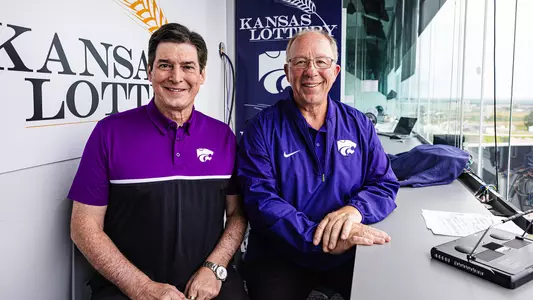
It's hard to mention one without the other. Virtually inseparable, Wyatt Thompson and Stan Weber have been together on the airwaves broadcasting Kansas State football and men's basketball games for so long — 25 years, in fact — making them perhaps the longest-tenured radio broadcasting duo in college athletics today. Since Thompson, now a seven-time Kansas Sportscaster of the Year, arrived as Voice of The Wildcats in 2002, and joined forces with longtime color analyst Stan Weber, the two have welcomed listeners into their purple world hundreds of times during their time together.
It's easy to state the obvious: They are legendary.
Thompson began his broadcasting career in 1976 as a sportscaster for various high schools, colleges and universities in Kansas, spending time at stations in Garden City and Abilene. He worked for KAYS radio and television in Hays from 1985-89 as play-by-play voice at Fort Hays State, earning the Kansas Association of Broadcasters Play-by-Play Award in 1982 and the Oscar Stauffer Sportscaster of the Year Award in 1989.
After serving as play-by-play voice for Colorado State's football and men's basketball teams for five years, Thompson was hired by K-State athletics director Tim Weiser as Voice of the Wildcats in 2002, following Greg Sharpe.
For the last 25 years, Thompson's voice has been unmistakable on the radio across K-State Nation, and he was inducted into the Kansas Association of Broadcasters Hall of Fame in 2022.
Weber started out as K-State quarterback from 1980-84. Little did Weber know that when he stepped into the K-State radio booth as color analyst to Mitch Holthus in 1987 that it would be the start of a broadcasting career that has spanned four decades, as Weber celebrates his 40th season in helping bring the K-State Wildcats into our living rooms — a span of 489 K-State football games.
Weber holds the longest tenure for a K-State radio broadcaster.
From that first phone call between Thompson and Weber upon Thompson's hiring at K-State prior to the 2002 K-State football season to this 2026 K-State football season, the duo has shined unlike any other play-by-play/color analyst duo in the Midwest while enjoying arguably the longest tenure in college athletics.
It's a wonderful story.
With more chapters to write.

Wyatt Thompson and Stan Weber spoke with K-State Sports Extra's D. Scott Fritchen as they commemorate their 25th anniversary working together with K-State Athletics:
It's 2002, and Wyatt, you come to K-State as its new Voice of the Wildcats, and Stan, you're served as football analyst and commentator for a number of years. Take me back to that initial introduction between you two? What does each of you recall about that first encounter?
STAN: When I found out Wyatt was going to be the new broadcaster, I got his number and called him. I was in my office in Kansas City talking to Wyatt. I'd never met him in person, but I remember saying to him that in my mind, if we were going to broadcast together, we were a team, and there was no period of transition in my mind. It was that it's time to start going, and we're going to start working together and let's be as great of a team as we possibly can. What I was trying to say right away was I hope that he understood that even though Greg Sharpe was a great friend of mine and I'd done games with Mitch Holthus, when the game started, it was the two of us, and that's what I was going to hone in on. I don't know how Wyatt interpreted it, but we had a great conversation. It was easy to talk to Wyatt, and I was very optimistic that this was going to work very well. We were a team and let's get going right away.
WYATT: One-hundred percent agree with that, and one of my favorite memories as a broadcaster here was our first flight together to Dallas for Big 12 Media Days. It seemed like a five-minute flight down and back. We spent the whole time talking about how we wanted to do things with him giving me the ins and outs of K-State football. I've said this a lot of times. I know how he felt about Mitch and Greg, and yet he treated me like gold from the first day, and I've always admired that. It was probably a little bit hard for him to do it, but he did it, and it made it so comfortable. I felt like we were going to make this go. The phone call and trip to Dallas for me made me most relaxed possible.
This year makes 25 years that Wyatt Thompson and Stan Weber have shared the same booth as play-by-play and color commentator. You'd be hard pressed to find another duo in a radio booth today with a longer tenure together in college athletics. When you hear those words, what is the first thing you think about?
WYATT: For me, in all due respect, the 40 years of Stan is remarkable, so I think about that first and all that Stan has seen and done and the commitment he's made to this. Like me, to be honest, he in a left-handed way became a broadcaster and so was I. I was an animal science major my first year in college, so it wasn't like I had everything figured out, but the thing that I think about is that longevity and how well he's done. Mitch Holthus is a pretty good teacher, and one of the things he said to me about Sharpie was that listening to him was like sitting in a rocking chair. You were totally comfortable and all into it, K-Stater through and through. That resonates with everybody, right? Every K-State fan alive would say that. I went into it just so thrilled to have the job because I grew up close to here and was a lifelong K-State fan, but Stan's 40 years matters – not that the 25 years together doesn't – but sometimes you fall into a situation and you don't realize how good it is until you've been into it for a while, and maybe that's part of it. Can you think of a better partner? I can't. It's the truth. Stan is remarkable, man. I hope we've done a good job together. I think we have. I hope we have.
STAN: The thing about radio is the play-by-play is the main thing to set the tone, and you think about Dev Nelson was the play-by-play voice for 25 years, so immediately I'm aware that I've done 40 years of broadcasting but the play-by-play position, you have the team and the quarterback, so we're reaching the Dev Nelson level, and I think of the team that we are. I talk about athletics all the time in life. Life is one big football game, and I give speeches about that. The teamwork of it and how many people come up to me and say, 'I was listening to you and Wyatt,' and they just can't separate us. It's great to hear people say our names together. To me, it's always been about how our broadcast together sounds. We're so connected, and it's really nice that it seems like the fans' reaction is the same connection and that they hear us together and feel that comfortable feeling. That's the whole goal, is to be a team, and it does matter how good we are together.
WYATT: If I had a dollar for every time someone said to me, "What did Stan think about this?" over the last 25 years, I'd be driving a Bentley.

Wyatt, you're obviously a Hall of Famer, but who were some of your sports radio heroes growing up and what makes a great play-by-play guy?
WYATT: You have to start with Dev Nelson from the K-State side of it. He was just so unique, so good, so professional and so loved. The unique part sticks out — everybody knew he was unique and knew his longevity. God rest his soul, Dev has been gone a long time and people still talk about him. Through the years, I'm just happy to be a part of the party, to be honest. I feel so fortunate about that. As a kid, I was a big baseball fan, and I listened to a lot of baseball, and dad grew up in Jacksonville, Illinois, about 90 miles north of St. Louis, so I was a big Harry Caray and Jack Buck guy, and yet, young enough in Kansas that when the Royals came along, I remember that first year with all those guys. You take a little bit from a lot of different people in a lot of different sports, at least that's my opinion. I tell young people always that if they want to hear the difference between TV play-by-play and radio play-by-play, listen to Kevin Harlan. End of story. He does it two different ways and he's great at both.
Stan, I don't think there's any question that you are the most prepared color commentator in all of college athletics. Who were some sports radio heroes of yours growing up and what made them so good at their craft?
STAN: Well, there's a different answer for radio and TV. For radio, Denny Matthews was who we grew up listening to on baseball on radio. I listened to colleges as well, some, and then as a grown up you have to mention Kevin Harlan, because he's brilliant on the radio. He was the Missouri color analyst when I first became the K-State color analyst. He and I had the peer job and we both lived in Kansas City and would go to the Big Eight offices every Monday to listen to the coaches on the speakerphone. Kevin Harlan taught me a lot. Mitch is who taught me to broadcast, but Kevin Harlan was the second voice that surged my confidence level. He taught me how to become better in a few ways, and how I track a game right now started with Kevin Harlan. It's 50 times more intense than how Kevin Harlan does it, but it's something he showed me. TV is where I learned about broadcasting and feel in love with it, not ever thinking I'd become a broadcaster. One of my favorite stories is I was watching TV as a kid and a play happened, and I said, "That was a great run to the right side," and my mom walked by and the color analyst said, "That was a great run to the right side," and my mom said, "You ought to be an announcer." I was an embarrassed 12 year old, and said, "Mom you're crazy." My priority was I needed to be a great broadcaster, and then the fact I bring football knowledge, hopefully that's a bonus. Bud Wilkinson was so good and John Madden opened up the world to me because he really got to talk about intense football. When he started talking to football fans, it changed everything. Everybody understands football really well now. People nowadays say, "That's Cover 2," and you couldn't say, 'That's Cover 2" before John Madden. People would've been like, I don't know what you're talking about. It had a big influence because when I became a broadcaster and John Madden was still broadcasting, I said, "I can talk more intensely about the game." I mention two guys who were color analysts because it was probably more appropriate and just learning how to broadcast, when I was super young, I loved listening to Ray Scott. It just felt so good listening to him. Al Michaels has been great for my whole life and still today. Dick Enberg, I like the ability for Dick Enberg to go to many sports and make his color commentary brilliant. He adjusted. It didn't matter if it was baseball, football or tennis. I'm a team guy, I don't do individual sports, I do team sports, and I have a quarterback mentality of, "How does the whole team get better?" I learned a lot from Dick Enbarg. From a color analyst point of view, John Madden really launched the opportunity for me to talk about football more intensely.
Wyatt, there was obviously a great life long before arriving at K-State, probably a life and upbringing and then later a passion for radio that a lot of your fans might not know about. Who was Wyatt Thompson as a child, how did he become interested in radio, and exactly what was the journey like to this point?
WYATT: I grew up on a farm and was very much into agriculture. I showed livestock, and I loved 4-H and FFA, and thought I'd run some animal test station somewhere after college, but I couldn't ever get the love of sports out of my head. I was the kid who had a bat and threw rocks and hit them off grain bins while calling play-by-play and trying to be Jack Buck, and that never left. When I went to school and stumbled upon broadcast journalism from a friend, I had to try it, and my instructor said that I didn't read well, and I had to get better there, but I had the ability. Even the first couple games I did, my instructor said I had some God-given skill there, and I had the ability to ad-lib, and it was important. This job is all about communication and identifying what's going on and presenting it in the most gracious and good way, but it's also the description and the excitement. This is people's getaway, right? I mean, people get into this to get away from their everyday job. It's entertainment. One of the first instructors I had said, "Remember, man, this is entertainment, and it's not brain surgery, so have fun with it, too."

Stan, everybody knows you as the former K-State quarterback who's been embedded in the purple K-State fabric for 40 years now. Exactly what does 40 years at K-State mean to you, and describe your journey from a young boy to reaching this point of your journey?
STAN: The broadcasting part of 40 years is an unbelievable blessing, because I never thought about being a broadcaster. My faith is by far the most important thing in my life, and God's plan is always better than mind. So, the fact that I'm probably more known for broadcasting K-State games than anything else that I do or have done is something that is amazing and never planned. I was out of college when the K-State athletic director, Larry Travis, gave me a call. You look at my involvement at K-State and it's actually been 47 years. When I was recruited in 1979, I went to three or four K-State games, because every recruiting trip I went on, that particular school happened to be playing K-State. So, the K-State coaches would come over and talk to me and have a side recruiting trip, even when I was on the road at KU or Oklahoma State. Everywhere I went, it was K-State. So, it's been maybe 48 years since I've been around it. That all mixes together. The K-State experience of coming here – and Bill Snyder said it's about the people – and that's why I came here. K-State wasn't great at football, but I said, "I think I can help us win and these are the kinds of people I believe in 100%." As a kid, no one loved sports more than me. And as an old man, no one loves sports more than me. The fact I was able to play college football is crazy. I didn't work out and play every sport as a kid to be anything. Every year, they asked, "What do you want to do?" And you'd say, "I want to be an NFL player." But that wasn't on my mind. That wasn't realistic. The fact I got to play college football at K-State was awesome. I never thought about broadcasting, but the greatest connection ever, God has put me into a position where I'm in the game and get to stay a part of it like a coach or a player. I realized broadcasting was even better calling than coaching and playing. Broadcasters are genuinely really good people in the industry. So, it's been a great joy and honor to learn their field. I had no training, no dream of doing broadcasting, but I focused hard. Mitch Holthus and Kevin Harlan, they told me, "You're going to be really good, but here are a few simple steps. Believe in yourself." So, I listened to every tape of every one of my games for 25 years. It was like a coach watching tape. I took every tape and listened to it. I evaluated myself. It's crazy. I shouldn't be doing this. It's a surprise thing. God sent me on a great adventure, and now I'm living and dying on every play just like I did when I was on the field. There has been absolutely zero nervousness. In any of the 40 years, I have never been nervous getting ready for the broadcast because I've been with three elite people who want to make it a team sport. We didn't win a game my first two years. Mitch Holthus said we'd wear a suit and tie, and until COVID, Wyatt and I wore a suit and tie. Mitch said, "We're going to sound like the best broadcast in the country. We're going to win a championship every game no matter how our team plays." That mindset has been there for all of the 40 years and the 489th game today.

Wyatt and Stan, you are like peanut butter and jelly, Bert and Ernie, Batman and Robin, John Lennon and Paul McCartney. In the great lore of K-State Athletics, it is almost impossible to mention one of you without mentioning the other. Wyatt, what do you admire most about Stan? Stan, what do you admire most about Wyatt?
STAN: Wyatt has a great voice, which is so important. When you say quarterback, you say Patrick Mahomes has great athletic ability, that's a compliment. Wyatt has a great voice and an unbelievable ability to do his job the way you're supposed to do it with timing, pronunciation, and all the moving parts going on, and it sounds smooth. It's like a duck. Underneath, there's a lot going on, but it shouldn't sound that way to the listeners. They should hear it's very calm during those four hours. His professionalism of being a team, he absolutely believes that and loves it and has the perfect attitude as the game is unfolding you cannot believe the emotions we're going through. Every time Wyatt stops talking, I can talk about five things. My brain is firing and so is his, and how do we talk about each one and what do we do with our emotions. Do we want to start yelling at officials or crying? I don't want to. Wyatt's professionalism, he keeps his head, and says, "No matter our emotions are as a fan, we're have a deeper calling to keep this from going off the rail, to not divert or get distracted and bring the great broadcast. We do that for four hours and after a loss, guess what, we keep going. It's our job to keep going. When we get a win, we don't do backflips — we keep going." To have that capability as the leader and play-by-play guy and to have those skills, you put those things together, and it's so hard to do, and Wyatt makes it look easy.
WYATT: I realized from the very first game I did in 2002 looking at Stan's charts that this was somebody different because it wasn't just the depth chart and a few of the trends and where K-State ranks in scoring and scoring defense and all that. That's a part of it, but it's probably in his case probably half or less than half. He has detail on every player on both teams more than two deep. Most guys will have six or eight receivers on their chart and Stan will have 12. What sticks out for me is if I said to him, "When was the last time a K-State guy rushed for 240 yards or more?" He'd find it instantly. I always admired that because it's at his fingertips. A lot of people think it's a big book, but no, Stan's layout of a few pages there – the good thing for him being an accountant at heart is he writes smaller than anybody I've ever worked with, which allows him to have more information. That's part of his success. As the game is going, the hardest thing to do is I describe the play, and he tells you why it worked or didn't work or whatever the formula is, and yet when we go back in postgame and we're doing our postgame review, he can reference two or three drives at any point in the game. Man, not everybody can do that. Some people just have natural recall. He has that, too, so you put that on top of that, and you have the perfect cake.

You both know this question was coming. Wyatt, what are some of your all-time favorite K-State memories during your time as Voice of the Wildcats? Stan, what are some of your all-time favorite memories during your time in the booth?
WYATT: I always go back to the 2003 Big 12 Championship Game, but it doesn't really have anything to do with me other than the euphoria for K-State. It had to do with the excitement I had for my broadcast partner and Coach Snyder and all the work that had been done since 1989. When he came to K-State, I was leaving the state and going to Colorado for 13 years. When I came back in 2002, I knew the groundwork. For K-State to do it in 2003 and against that team and the middle screen to Darren Sproles and all the things we reminisce about, that has to be where it starts. We've won three football league titles since I've been here, and that's good fortune. We've been to the Elite Eight three different times. There's the double-overtime game against Xavier in the tournament, Markquis Nowell against Michigan State, the 44-point game Denis Clemente had against Texas, and Michael Beasley – and I'm leaving so much out – but it probably starts with the 2003 Big 12 Championship Game because I was so excited for Coach Snyder. It was like he finally got there and that feeling was awesome. I don't know that I'll ever top that, honestly, and that may be OK.
STAN: K-State football just floods your mind with so many meaningful times. When my son Stanton was getting his first action as a redshirt freshman on the road in 2012 and made the traveling squad and then got into the field as a special teams player on two different units and Collin Klein won the game against Texas, which led to the 2012 Big 12 Championship, that has a lot of great memories for me because of Stanton and my relationship with Collin and just how significant it was to be back where we were earlier. Then when Phillip Brooks returned all the punts for touchdowns, Stanton was calling the plays for special teams, and my son, Landry, was on the punt-return unit when Phillip broke the record with two touchdown returns and one over 50 yards against KU. We knew K-State was going to win, but to see my two boys smashing Jayhawks in the punt-return game was really cool.
Obviously, 1993 was getting over the hump against Oklahoma, the 1997 Fiesta Bowl against a great Syracuse team stuffed with NFL players on a big stage, and that was a coming-out party that K-State wasn't just good but at a national championship level. We said that on December 31 after the game, then 1998 was about beating Nebraska, and 2003 winning at Nebraska for the first time we'd won at Nebraska, those things ring out. Winning the championship in overtime against TCU in AT&T Stadium in 2022 Big 12 Championship Game. Then obviously, there's the rivalry with KU, which is so important. So to get that first win 16-12 in 1991, that was so big, and then in 1994, K-State had won a decent amount of games against KU in history, but it was very rare to go to Lawrence and get the win, and in 1994 on a Thursday night game, they brought in the lights to Lawrence, and K-State won the game, and didn't look back for a long, long time. The real separating game that people need to know was in 1995 when K-State was a highly ranked up-and-coming team and KU was ranked in the Top 10. K-State wasn't the higher-ranked team and K-State won 41-7, and that launched K-State to be a much better program than KU and it's never been close since that day in 1995. It was a fight that the nation took notice of and that K-State tore them apart was such a significant boost in the Bill Snyder era.
When it's all said and done and you take off the headset for that final time and walk out of that booth for good, what would you like people to say about Wyatt Thompson?
WYATT: Worked hard, good guy. I don't know that it's any more complex than that. I've loved my time here. Stan earlier referenced Coach Snyder and the people, and that's it — you can't mask that. I was asked recently about some of the athletes that I've connected with at least to some degree over 25 years, and one of these days when I have more time, I want to make a list. It would be remarkable. Being at K-State isn't just football and men's basketball – but most of it is because that's my focus – but when I first got here we had women's basketball with Nicole Ohlde, and you just keep going on and on, and it was just crazy. And it isn't just the athletic prowess but these fine people these coaches have recruited for 25 years. I've loved that a lot. I hope there's been consistency in being a good guy and trying to do it right.
When it's all said and done and you take off the headset for that final time and walk out of that booth for good, what would you like people to say about Stan Weber?
STAN: I hope number one that they'll say that I represented K-State in the appropriate way and in way they'd be proud. If we talk about being a team as a broadcast crew and trying to be excellent almost like it's a competition, a game, that may be taken as it's about us, but it isn't. It's about us representing K-State. We all have different opportunities. When I was a quarterback, I definitely was representing K-State, no doubt, but as a broadcaster, probably more than anything else, that's what I get a chance to do. There are a lot of people who get introduced to what K-State is all about based upon listening to Wyatt and me now, or my broadcasts over the past 40 years, and I hope everyone understands that I've done my best and I hope it's good enough that people feel positive and that I'm representing the university as well as I could. If I can bring joy to fans who enjoyed the game and they understand the passion that I love K-State but won't allow the passion to override the actual and factual presentation and blow purple smoke to people. My first broadcast I said, "I'm going to present the accurate information to K-State fans."

Wyatt, from that first day at K-State Athletics in 2022 to the man you are today here in 2026, either in the booth or outside of the booth, what has Wyatt Thompson learned most about himself during his journey?
WYATT: What have I learned most about myself? When you open yourself up and there's a lot of that to this job you get to experience some things that some don't. I talked about the athletics, but I can't tell you over the years all the great people — just speaking, Catbacker Tour, all of it — that I've met. It just seems like just like on a game day. I can't tell you how many texts I'll get from somebody I played golf with in Garden City, and stuff like that. Coach Snyder always said this place was special, and he's not wrong. Recently, when Collin had him speak to the players after that practice, Coach Snyder said, "Love this place, it'll love you back." That is it. I've said a lot of times when I came here, man, I grew up by Abilene and K-State was my team, but until you experience it here every day, it's just, it's hard to equate how special it really is and how blessed I feel.
Stan, from that former K-State quarterback who became the K-State color analyst in 1987 to the man you are today in 2026, either in the booth our outside of the booth, what has Stan Weber learned most about himself during his journey?
STAN: I really learned that Bill Snyder's goal No. 12 – which by the way was my number and my sons' numbers – it's the goal I like the best: There are no self-limitations. I never thought I'd be a broadcaster, and I'm more known for that. I've achieved more growth in broadcasting than in anything else. You could've said as a young person, "He could play college football." You could say, "I could see him being a CEO of a company or a CFO, CPA or an accountant." Those things were within the realm of possibility, but the fact that I became a broadcaster is easy to define. There's really no limit if you get yourself around things that you believe in, and don't cut corners, and have high ethics and surrounded yourself around good people who God's plan and trajectory of what you can do and how you may represent God most importantly and those around you, it was confirmed. It's not that I didn't believe it, but you have to mature and grow and experience it, and now when I mentor young people, I say, if you can, select the school or job where you surround yourself with good people. As the CEO of Tower Property Company, I'm constantly telling my employees and people who want to be mentored that you are way better than you think you are. We all doubt ourselves the most. We look in the mirror and see the things that might hold us back. Others doubt and you don't need to worry about it. We all are so much better than we think we are. It's not a cocky statement. It's no different than Kevin Harlan and Mitch Holthus when I got started doing this that this isn't too big for me and I can do this. There was no doubt in my mind. I think I've learned through broadcasting that if you surround yourself with good people and do it for the right reason and do your best, you can do surprising things better than you can imagine.
It's hard to mention one without the other. Virtually inseparable, Wyatt Thompson and Stan Weber have been together on the airwaves broadcasting Kansas State football and men's basketball games for so long — 25 years, in fact — making them perhaps the longest-tenured radio broadcasting duo in college athletics today. Since Thompson, now a seven-time Kansas Sportscaster of the Year, arrived as Voice of The Wildcats in 2002, and joined forces with longtime color analyst Stan Weber, the two have welcomed listeners into their purple world hundreds of times during their time together.
It's easy to state the obvious: They are legendary.
Thompson began his broadcasting career in 1976 as a sportscaster for various high schools, colleges and universities in Kansas, spending time at stations in Garden City and Abilene. He worked for KAYS radio and television in Hays from 1985-89 as play-by-play voice at Fort Hays State, earning the Kansas Association of Broadcasters Play-by-Play Award in 1982 and the Oscar Stauffer Sportscaster of the Year Award in 1989.
After serving as play-by-play voice for Colorado State's football and men's basketball teams for five years, Thompson was hired by K-State athletics director Tim Weiser as Voice of the Wildcats in 2002, following Greg Sharpe.
For the last 25 years, Thompson's voice has been unmistakable on the radio across K-State Nation, and he was inducted into the Kansas Association of Broadcasters Hall of Fame in 2022.
Weber started out as K-State quarterback from 1980-84. Little did Weber know that when he stepped into the K-State radio booth as color analyst to Mitch Holthus in 1987 that it would be the start of a broadcasting career that has spanned four decades, as Weber celebrates his 40th season in helping bring the K-State Wildcats into our living rooms — a span of 489 K-State football games.
Weber holds the longest tenure for a K-State radio broadcaster.
From that first phone call between Thompson and Weber upon Thompson's hiring at K-State prior to the 2002 K-State football season to this 2026 K-State football season, the duo has shined unlike any other play-by-play/color analyst duo in the Midwest while enjoying arguably the longest tenure in college athletics.
It's a wonderful story.
With more chapters to write.
Wyatt Thompson and Stan Weber spoke with K-State Sports Extra's D. Scott Fritchen as they commemorate their 25th anniversary working together with K-State Athletics:
It's 2002, and Wyatt, you come to K-State as its new Voice of the Wildcats, and Stan, you're served as football analyst and commentator for a number of years. Take me back to that initial introduction between you two? What does each of you recall about that first encounter?
STAN: When I found out Wyatt was going to be the new broadcaster, I got his number and called him. I was in my office in Kansas City talking to Wyatt. I'd never met him in person, but I remember saying to him that in my mind, if we were going to broadcast together, we were a team, and there was no period of transition in my mind. It was that it's time to start going, and we're going to start working together and let's be as great of a team as we possibly can. What I was trying to say right away was I hope that he understood that even though Greg Sharpe was a great friend of mine and I'd done games with Mitch Holthus, when the game started, it was the two of us, and that's what I was going to hone in on. I don't know how Wyatt interpreted it, but we had a great conversation. It was easy to talk to Wyatt, and I was very optimistic that this was going to work very well. We were a team and let's get going right away.
WYATT: One-hundred percent agree with that, and one of my favorite memories as a broadcaster here was our first flight together to Dallas for Big 12 Media Days. It seemed like a five-minute flight down and back. We spent the whole time talking about how we wanted to do things with him giving me the ins and outs of K-State football. I've said this a lot of times. I know how he felt about Mitch and Greg, and yet he treated me like gold from the first day, and I've always admired that. It was probably a little bit hard for him to do it, but he did it, and it made it so comfortable. I felt like we were going to make this go. The phone call and trip to Dallas for me made me most relaxed possible.
This year makes 25 years that Wyatt Thompson and Stan Weber have shared the same booth as play-by-play and color commentator. You'd be hard pressed to find another duo in a radio booth today with a longer tenure together in college athletics. When you hear those words, what is the first thing you think about?
WYATT: For me, in all due respect, the 40 years of Stan is remarkable, so I think about that first and all that Stan has seen and done and the commitment he's made to this. Like me, to be honest, he in a left-handed way became a broadcaster and so was I. I was an animal science major my first year in college, so it wasn't like I had everything figured out, but the thing that I think about is that longevity and how well he's done. Mitch Holthus is a pretty good teacher, and one of the things he said to me about Sharpie was that listening to him was like sitting in a rocking chair. You were totally comfortable and all into it, K-Stater through and through. That resonates with everybody, right? Every K-State fan alive would say that. I went into it just so thrilled to have the job because I grew up close to here and was a lifelong K-State fan, but Stan's 40 years matters – not that the 25 years together doesn't – but sometimes you fall into a situation and you don't realize how good it is until you've been into it for a while, and maybe that's part of it. Can you think of a better partner? I can't. It's the truth. Stan is remarkable, man. I hope we've done a good job together. I think we have. I hope we have.
STAN: The thing about radio is the play-by-play is the main thing to set the tone, and you think about Dev Nelson was the play-by-play voice for 25 years, so immediately I'm aware that I've done 40 years of broadcasting but the play-by-play position, you have the team and the quarterback, so we're reaching the Dev Nelson level, and I think of the team that we are. I talk about athletics all the time in life. Life is one big football game, and I give speeches about that. The teamwork of it and how many people come up to me and say, 'I was listening to you and Wyatt,' and they just can't separate us. It's great to hear people say our names together. To me, it's always been about how our broadcast together sounds. We're so connected, and it's really nice that it seems like the fans' reaction is the same connection and that they hear us together and feel that comfortable feeling. That's the whole goal, is to be a team, and it does matter how good we are together.
WYATT: If I had a dollar for every time someone said to me, "What did Stan think about this?" over the last 25 years, I'd be driving a Bentley.
Wyatt, you're obviously a Hall of Famer, but who were some of your sports radio heroes growing up and what makes a great play-by-play guy?
WYATT: You have to start with Dev Nelson from the K-State side of it. He was just so unique, so good, so professional and so loved. The unique part sticks out — everybody knew he was unique and knew his longevity. God rest his soul, Dev has been gone a long time and people still talk about him. Through the years, I'm just happy to be a part of the party, to be honest. I feel so fortunate about that. As a kid, I was a big baseball fan, and I listened to a lot of baseball, and dad grew up in Jacksonville, Illinois, about 90 miles north of St. Louis, so I was a big Harry Caray and Jack Buck guy, and yet, young enough in Kansas that when the Royals came along, I remember that first year with all those guys. You take a little bit from a lot of different people in a lot of different sports, at least that's my opinion. I tell young people always that if they want to hear the difference between TV play-by-play and radio play-by-play, listen to Kevin Harlan. End of story. He does it two different ways and he's great at both.
Stan, I don't think there's any question that you are the most prepared color commentator in all of college athletics. Who were some sports radio heroes of yours growing up and what made them so good at their craft?
STAN: Well, there's a different answer for radio and TV. For radio, Denny Matthews was who we grew up listening to on baseball on radio. I listened to colleges as well, some, and then as a grown up you have to mention Kevin Harlan, because he's brilliant on the radio. He was the Missouri color analyst when I first became the K-State color analyst. He and I had the peer job and we both lived in Kansas City and would go to the Big Eight offices every Monday to listen to the coaches on the speakerphone. Kevin Harlan taught me a lot. Mitch is who taught me to broadcast, but Kevin Harlan was the second voice that surged my confidence level. He taught me how to become better in a few ways, and how I track a game right now started with Kevin Harlan. It's 50 times more intense than how Kevin Harlan does it, but it's something he showed me. TV is where I learned about broadcasting and feel in love with it, not ever thinking I'd become a broadcaster. One of my favorite stories is I was watching TV as a kid and a play happened, and I said, "That was a great run to the right side," and my mom walked by and the color analyst said, "That was a great run to the right side," and my mom said, "You ought to be an announcer." I was an embarrassed 12 year old, and said, "Mom you're crazy." My priority was I needed to be a great broadcaster, and then the fact I bring football knowledge, hopefully that's a bonus. Bud Wilkinson was so good and John Madden opened up the world to me because he really got to talk about intense football. When he started talking to football fans, it changed everything. Everybody understands football really well now. People nowadays say, "That's Cover 2," and you couldn't say, 'That's Cover 2" before John Madden. People would've been like, I don't know what you're talking about. It had a big influence because when I became a broadcaster and John Madden was still broadcasting, I said, "I can talk more intensely about the game." I mention two guys who were color analysts because it was probably more appropriate and just learning how to broadcast, when I was super young, I loved listening to Ray Scott. It just felt so good listening to him. Al Michaels has been great for my whole life and still today. Dick Enberg, I like the ability for Dick Enberg to go to many sports and make his color commentary brilliant. He adjusted. It didn't matter if it was baseball, football or tennis. I'm a team guy, I don't do individual sports, I do team sports, and I have a quarterback mentality of, "How does the whole team get better?" I learned a lot from Dick Enbarg. From a color analyst point of view, John Madden really launched the opportunity for me to talk about football more intensely.
Wyatt, there was obviously a great life long before arriving at K-State, probably a life and upbringing and then later a passion for radio that a lot of your fans might not know about. Who was Wyatt Thompson as a child, how did he become interested in radio, and exactly what was the journey like to this point?
WYATT: I grew up on a farm and was very much into agriculture. I showed livestock, and I loved 4-H and FFA, and thought I'd run some animal test station somewhere after college, but I couldn't ever get the love of sports out of my head. I was the kid who had a bat and threw rocks and hit them off grain bins while calling play-by-play and trying to be Jack Buck, and that never left. When I went to school and stumbled upon broadcast journalism from a friend, I had to try it, and my instructor said that I didn't read well, and I had to get better there, but I had the ability. Even the first couple games I did, my instructor said I had some God-given skill there, and I had the ability to ad-lib, and it was important. This job is all about communication and identifying what's going on and presenting it in the most gracious and good way, but it's also the description and the excitement. This is people's getaway, right? I mean, people get into this to get away from their everyday job. It's entertainment. One of the first instructors I had said, "Remember, man, this is entertainment, and it's not brain surgery, so have fun with it, too."
Stan, everybody knows you as the former K-State quarterback who's been embedded in the purple K-State fabric for 40 years now. Exactly what does 40 years at K-State mean to you, and describe your journey from a young boy to reaching this point of your journey?
STAN: The broadcasting part of 40 years is an unbelievable blessing, because I never thought about being a broadcaster. My faith is by far the most important thing in my life, and God's plan is always better than mind. So, the fact that I'm probably more known for broadcasting K-State games than anything else that I do or have done is something that is amazing and never planned. I was out of college when the K-State athletic director, Larry Travis, gave me a call. You look at my involvement at K-State and it's actually been 47 years. When I was recruited in 1979, I went to three or four K-State games, because every recruiting trip I went on, that particular school happened to be playing K-State. So, the K-State coaches would come over and talk to me and have a side recruiting trip, even when I was on the road at KU or Oklahoma State. Everywhere I went, it was K-State. So, it's been maybe 48 years since I've been around it. That all mixes together. The K-State experience of coming here – and Bill Snyder said it's about the people – and that's why I came here. K-State wasn't great at football, but I said, "I think I can help us win and these are the kinds of people I believe in 100%." As a kid, no one loved sports more than me. And as an old man, no one loves sports more than me. The fact I was able to play college football is crazy. I didn't work out and play every sport as a kid to be anything. Every year, they asked, "What do you want to do?" And you'd say, "I want to be an NFL player." But that wasn't on my mind. That wasn't realistic. The fact I got to play college football at K-State was awesome. I never thought about broadcasting, but the greatest connection ever, God has put me into a position where I'm in the game and get to stay a part of it like a coach or a player. I realized broadcasting was even better calling than coaching and playing. Broadcasters are genuinely really good people in the industry. So, it's been a great joy and honor to learn their field. I had no training, no dream of doing broadcasting, but I focused hard. Mitch Holthus and Kevin Harlan, they told me, "You're going to be really good, but here are a few simple steps. Believe in yourself." So, I listened to every tape of every one of my games for 25 years. It was like a coach watching tape. I took every tape and listened to it. I evaluated myself. It's crazy. I shouldn't be doing this. It's a surprise thing. God sent me on a great adventure, and now I'm living and dying on every play just like I did when I was on the field. There has been absolutely zero nervousness. In any of the 40 years, I have never been nervous getting ready for the broadcast because I've been with three elite people who want to make it a team sport. We didn't win a game my first two years. Mitch Holthus said we'd wear a suit and tie, and until COVID, Wyatt and I wore a suit and tie. Mitch said, "We're going to sound like the best broadcast in the country. We're going to win a championship every game no matter how our team plays." That mindset has been there for all of the 40 years and the 489th game today.
Wyatt and Stan, you are like peanut butter and jelly, Bert and Ernie, Batman and Robin, John Lennon and Paul McCartney. In the great lore of K-State Athletics, it is almost impossible to mention one of you without mentioning the other. Wyatt, what do you admire most about Stan? Stan, what do you admire most about Wyatt?
STAN: Wyatt has a great voice, which is so important. When you say quarterback, you say Patrick Mahomes has great athletic ability, that's a compliment. Wyatt has a great voice and an unbelievable ability to do his job the way you're supposed to do it with timing, pronunciation, and all the moving parts going on, and it sounds smooth. It's like a duck. Underneath, there's a lot going on, but it shouldn't sound that way to the listeners. They should hear it's very calm during those four hours. His professionalism of being a team, he absolutely believes that and loves it and has the perfect attitude as the game is unfolding you cannot believe the emotions we're going through. Every time Wyatt stops talking, I can talk about five things. My brain is firing and so is his, and how do we talk about each one and what do we do with our emotions. Do we want to start yelling at officials or crying? I don't want to. Wyatt's professionalism, he keeps his head, and says, "No matter our emotions are as a fan, we're have a deeper calling to keep this from going off the rail, to not divert or get distracted and bring the great broadcast. We do that for four hours and after a loss, guess what, we keep going. It's our job to keep going. When we get a win, we don't do backflips — we keep going." To have that capability as the leader and play-by-play guy and to have those skills, you put those things together, and it's so hard to do, and Wyatt makes it look easy.
WYATT: I realized from the very first game I did in 2002 looking at Stan's charts that this was somebody different because it wasn't just the depth chart and a few of the trends and where K-State ranks in scoring and scoring defense and all that. That's a part of it, but it's probably in his case probably half or less than half. He has detail on every player on both teams more than two deep. Most guys will have six or eight receivers on their chart and Stan will have 12. What sticks out for me is if I said to him, "When was the last time a K-State guy rushed for 240 yards or more?" He'd find it instantly. I always admired that because it's at his fingertips. A lot of people think it's a big book, but no, Stan's layout of a few pages there – the good thing for him being an accountant at heart is he writes smaller than anybody I've ever worked with, which allows him to have more information. That's part of his success. As the game is going, the hardest thing to do is I describe the play, and he tells you why it worked or didn't work or whatever the formula is, and yet when we go back in postgame and we're doing our postgame review, he can reference two or three drives at any point in the game. Man, not everybody can do that. Some people just have natural recall. He has that, too, so you put that on top of that, and you have the perfect cake.
You both know this question was coming. Wyatt, what are some of your all-time favorite K-State memories during your time as Voice of the Wildcats? Stan, what are some of your all-time favorite memories during your time in the booth?
WYATT: I always go back to the 2003 Big 12 Championship Game, but it doesn't really have anything to do with me other than the euphoria for K-State. It had to do with the excitement I had for my broadcast partner and Coach Snyder and all the work that had been done since 1989. When he came to K-State, I was leaving the state and going to Colorado for 13 years. When I came back in 2002, I knew the groundwork. For K-State to do it in 2003 and against that team and the middle screen to Darren Sproles and all the things we reminisce about, that has to be where it starts. We've won three football league titles since I've been here, and that's good fortune. We've been to the Elite Eight three different times. There's the double-overtime game against Xavier in the tournament, Markquis Nowell against Michigan State, the 44-point game Denis Clemente had against Texas, and Michael Beasley – and I'm leaving so much out – but it probably starts with the 2003 Big 12 Championship Game because I was so excited for Coach Snyder. It was like he finally got there and that feeling was awesome. I don't know that I'll ever top that, honestly, and that may be OK.
STAN: K-State football just floods your mind with so many meaningful times. When my son Stanton was getting his first action as a redshirt freshman on the road in 2012 and made the traveling squad and then got into the field as a special teams player on two different units and Collin Klein won the game against Texas, which led to the 2012 Big 12 Championship, that has a lot of great memories for me because of Stanton and my relationship with Collin and just how significant it was to be back where we were earlier. Then when Phillip Brooks returned all the punts for touchdowns, Stanton was calling the plays for special teams, and my son, Landry, was on the punt-return unit when Phillip broke the record with two touchdown returns and one over 50 yards against KU. We knew K-State was going to win, but to see my two boys smashing Jayhawks in the punt-return game was really cool.
Obviously, 1993 was getting over the hump against Oklahoma, the 1997 Fiesta Bowl against a great Syracuse team stuffed with NFL players on a big stage, and that was a coming-out party that K-State wasn't just good but at a national championship level. We said that on December 31 after the game, then 1998 was about beating Nebraska, and 2003 winning at Nebraska for the first time we'd won at Nebraska, those things ring out. Winning the championship in overtime against TCU in AT&T Stadium in 2022 Big 12 Championship Game. Then obviously, there's the rivalry with KU, which is so important. So to get that first win 16-12 in 1991, that was so big, and then in 1994, K-State had won a decent amount of games against KU in history, but it was very rare to go to Lawrence and get the win, and in 1994 on a Thursday night game, they brought in the lights to Lawrence, and K-State won the game, and didn't look back for a long, long time. The real separating game that people need to know was in 1995 when K-State was a highly ranked up-and-coming team and KU was ranked in the Top 10. K-State wasn't the higher-ranked team and K-State won 41-7, and that launched K-State to be a much better program than KU and it's never been close since that day in 1995. It was a fight that the nation took notice of and that K-State tore them apart was such a significant boost in the Bill Snyder era.
When it's all said and done and you take off the headset for that final time and walk out of that booth for good, what would you like people to say about Wyatt Thompson?
WYATT: Worked hard, good guy. I don't know that it's any more complex than that. I've loved my time here. Stan earlier referenced Coach Snyder and the people, and that's it — you can't mask that. I was asked recently about some of the athletes that I've connected with at least to some degree over 25 years, and one of these days when I have more time, I want to make a list. It would be remarkable. Being at K-State isn't just football and men's basketball – but most of it is because that's my focus – but when I first got here we had women's basketball with Nicole Ohlde, and you just keep going on and on, and it was just crazy. And it isn't just the athletic prowess but these fine people these coaches have recruited for 25 years. I've loved that a lot. I hope there's been consistency in being a good guy and trying to do it right.
When it's all said and done and you take off the headset for that final time and walk out of that booth for good, what would you like people to say about Stan Weber?
STAN: I hope number one that they'll say that I represented K-State in the appropriate way and in way they'd be proud. If we talk about being a team as a broadcast crew and trying to be excellent almost like it's a competition, a game, that may be taken as it's about us, but it isn't. It's about us representing K-State. We all have different opportunities. When I was a quarterback, I definitely was representing K-State, no doubt, but as a broadcaster, probably more than anything else, that's what I get a chance to do. There are a lot of people who get introduced to what K-State is all about based upon listening to Wyatt and me now, or my broadcasts over the past 40 years, and I hope everyone understands that I've done my best and I hope it's good enough that people feel positive and that I'm representing the university as well as I could. If I can bring joy to fans who enjoyed the game and they understand the passion that I love K-State but won't allow the passion to override the actual and factual presentation and blow purple smoke to people. My first broadcast I said, "I'm going to present the accurate information to K-State fans."
Wyatt, from that first day at K-State Athletics in 2022 to the man you are today here in 2026, either in the booth or outside of the booth, what has Wyatt Thompson learned most about himself during his journey?
WYATT: What have I learned most about myself? When you open yourself up and there's a lot of that to this job you get to experience some things that some don't. I talked about the athletics, but I can't tell you over the years all the great people — just speaking, Catbacker Tour, all of it — that I've met. It just seems like just like on a game day. I can't tell you how many texts I'll get from somebody I played golf with in Garden City, and stuff like that. Coach Snyder always said this place was special, and he's not wrong. Recently, when Collin had him speak to the players after that practice, Coach Snyder said, "Love this place, it'll love you back." That is it. I've said a lot of times when I came here, man, I grew up by Abilene and K-State was my team, but until you experience it here every day, it's just, it's hard to equate how special it really is and how blessed I feel.
Stan, from that former K-State quarterback who became the K-State color analyst in 1987 to the man you are today in 2026, either in the booth our outside of the booth, what has Stan Weber learned most about himself during his journey?
STAN: I really learned that Bill Snyder's goal No. 12 – which by the way was my number and my sons' numbers – it's the goal I like the best: There are no self-limitations. I never thought I'd be a broadcaster, and I'm more known for that. I've achieved more growth in broadcasting than in anything else. You could've said as a young person, "He could play college football." You could say, "I could see him being a CEO of a company or a CFO, CPA or an accountant." Those things were within the realm of possibility, but the fact that I became a broadcaster is easy to define. There's really no limit if you get yourself around things that you believe in, and don't cut corners, and have high ethics and surrounded yourself around good people who God's plan and trajectory of what you can do and how you may represent God most importantly and those around you, it was confirmed. It's not that I didn't believe it, but you have to mature and grow and experience it, and now when I mentor young people, I say, if you can, select the school or job where you surround yourself with good people. As the CEO of Tower Property Company, I'm constantly telling my employees and people who want to be mentored that you are way better than you think you are. We all doubt ourselves the most. We look in the mirror and see the things that might hold us back. Others doubt and you don't need to worry about it. We all are so much better than we think we are. It's not a cocky statement. It's no different than Kevin Harlan and Mitch Holthus when I got started doing this that this isn't too big for me and I can do this. There was no doubt in my mind. I think I've learned through broadcasting that if you surround yourself with good people and do it for the right reason and do your best, you can do surprising things better than you can imagine.
Sunday, November 08
Sunday, November 08
Sunday, November 08
Sunday, November 08


