A Contagious Energy
Apr 27, 2026 | Football, Sports Extra
By: D. Scott Fritchen
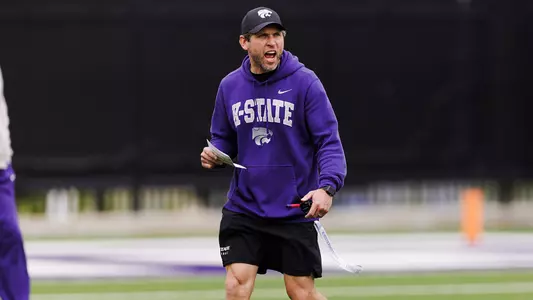
As he excitedly jumps from his chair following a news conference at Vanier Family Football Complex, 38-year-old Kansas State defensive coordinator Jordan Peterson, wearing an old-school purple sweatshirt with a white "K-STATE" along with a toothy smile, shouts as he heads out the door, "I may or may not have pulled a hamstring during the spring!"
As K-State football bids farewell to its first spring practice season of the Collin Klein era, several things stand out about the 2026 Wildcats, who open the season against Nicholls on September 5 at Bill Snyder Family Stadium. Perhaps one of the most prominent fixtures over the 15 spring practices? One word: Energy.
And that cracking, contagious energy that filled the Shamrock Facility over the spring began with one man: Peterson.
Not since the days of Mike Stoops and Brent Venables in the 1990s has K-State perhaps had a defensive coach as high-octane as Peterson, a Texas A&M alum who faced the purple and white as a player and then a member of the Aggies' coaching staff, and who spent the previous two seasons as co-defensive coordinator and sharing the coaching offices with Klein, the Texas A&M offensive coordinator, during a pair of memorable seasons in College Station, Texas.
The two masterminds talked. They talked all right. And Peterson's talent, personality, and insatiable desire for his defenses to excel made Klein's decision easy to bring Peterson along to Manhattan in late December, after the Aggies' appearance in the College Football Playoff.
Peterson, whose defenses boast multiple looks and a bevy of adjustments and that seemingly learns and corrects and executes and at times dominates as the game wears on, only becoming stronger by the quarter, helped guide Texas A&M to an 11-2 record last season, and the Aggies led the nation in third-down defense (22.9%), and they ranked second in sacks (3.31 per game) and tackles for loss (8.5), eighth in first down defense (205), 16th in passing yards allowed (176.6), 18th in total defense (307.4) and 19th in fourth-down defense (41.2%).
In Manhattan, Peterson, who has five years of coordinator experience and has spent six years on Big 12 staffs, has set up shop in the Little Apple, and days after his arrival to the football program that once dominated college football behind fierce, smart defenses that defined energy and annually boasted top-10 rankings, Peterson, who actually played against K-State as a Texas A&M defensive back, knows full well the reputation the Wildcats carry — along with their old-school nickname and bite.
"If you want to be the MOB, you'd better come with the MOB mentality," Peterson says. "We're going to play fast, physical, violent freaking football. That's what it's going to be."

Now Peterson sits in his spring football news conference wearing an old-school purple sweatshirt with the white "K-STATE" and he looks like a guy you'd want to eat a steak with, the guy you'd like to run into at a dinner party, yet Peterson's idea of eating is seeing his defensive players punish opponents with such viciousness that ball carriers, wideouts and quarterbacks think twice about crossing them again.
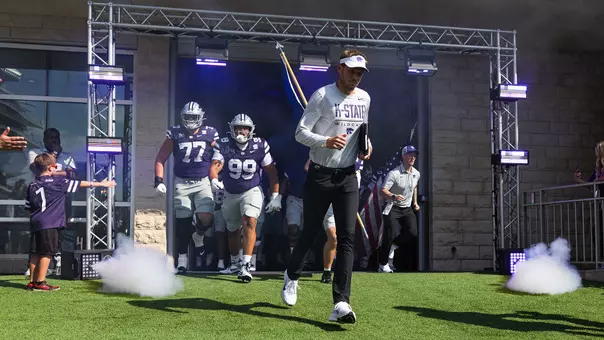
And for every one of K-State's achievements on defense during spring football, there was Peterson, racing down the sideline, his burst of energy, so second nature, adrenaline carrying his legs as he follows the play to its completion, which is what he did on one specific sequence when cornerback Donovan McIntosh intercepted a pass and returned it for a 50-yard pick-6 in practice.
"I can neither confirm nor deny that happened," Peterson says, smiling widely. "I just think it's passion. When you're passionate about something, whether it's me correcting a guy with immediate reinforcements or me celebrating with a play that's made, those go hand in hand. At times, coaches can be too one way or the other — too rah-rah or always negative.
"I think the reinforcements both ways really help the guys feel like you're in it with them a little bit. I'll challenge them to a race if I need to."

Peterson's journey began at Fresno State, first as a defensive secondary coach in 2012-14 and then as outside linebackers coach and recruiting coordinator in 2015-16. He coached safeties and served as defensive passing game coordinator and the defensive coordinator at New Mexico between 2017-2019. Then reached the Power 4 level at Kansas. In 2020, he coached safeties. In 2021, he was senior defensive analyst. In 2022, he coached defensive backs. In 2023, he served as defensive backs coach and defensive passing game coordinator.
When Texas A&M head coach Mike Elko came calling, Peterson's return home was a no-brainer.
Now he has a new home. And he couldn't wait to get started when he arrived in Manhattan.
"It's an honor and a privilege to be the leader of the defense and to serve these young men and this staff," he says. "You build relationships, but you do it with a servant mentality. We're here to help other people, whether that's on or off the field. Honestly, coming here to a very football rich-tradition school is a bigger honor… It is truly an honor. Going back with Bill Snyder and everything he built from a foundational standpoint — I've experienced it plenty first-hand as a competitor against those guys — I couldn't be more fired up about being here."
That fire carries onto the football field.
"Energy one way or the other is contagious," Peterson says. "I believe that with every ounce of my being. If you come in moping or come in with an energy vampire-type mentality, that permeates the rest of the room. The same goes the other way. You come in excited about what we're doing and passionate about what we're doing, it just instills another level of confidence that, 'This is it.' Right, wrong or indifferent, it's contagious. I just feel that. I felt that as a player all the way through my coaching career that at the end of the day, these guys want to be a part of something that's exciting and they want to do something when everybody about them are excited about it and are passionate about it.
"That always starts from the top with Coach Klein and all the way through the building, and obviously, I'm a part of that hierarchy, too, so I better bring it every day. We ask our kids to be consistent. Well, we better be the same guys day in and day out. There can't be the ebbs and flows. We can't bring it one day and not bring it the next day. That's exactly what we're preaching to our players about. Hopefully, if you ask every one of our players across the board, they answer to 'What is the staff like?' that they are consistent day in and day out and they bring energy, they bring juice, and they expect us to play at an elite standard."
Before K-State coaches and players began bringing the juice and performing at an elite level, the thing began with a foundation built through drills, drills, drills, and fundamentals.
"It's an overall mindset and a mentality," Peterson says. "We're not live every single play and every single day, but when you talk about the nature of the fundamentals — your hand strike, your body position — all the little fundamentals that matter, there's been a tremendous amount of growth over the course of spring ball.
"I'm never going to say that I'm satisfied with anything. We're making a lot of progress. The guys are grasping what we're trying to make that look like. We had a meeting this morning about it, and it had a cut-up of what it should look like, and what it shouldn't look like. Continuing to communicate that and making that very clear to them is what we need to do as coaches in continuing to take those strides."
And exactly where has the K-State defense made its most strides?
"It's so funny because there are no starters for us right now," Peterson says. "We're not going to get into that world until guys have established themselves throughout a complete body of work. At the same time, you get to eat what you kill. Your reps kind of change from day to day and you see some of those swings. I like the progress. You see a tremendous amount of growth in the back end as far as the communication and being on the same page and body position and the competition level with the receivers. You've seeing a tremendous amount of flash on the edges, and we have a really good linebacking corps.
"What that ends up looking like when we get to Week 1 of the season may not be what it feels like right now, and that's the most beautiful thing about having a healthy competition at every position across the board."

The road to this juncture began months ago — immediately after Peterson arrived in Manhattan on December 21, in fact — when he took a 36-hour whirlwind trip covering seven states in an attempt to nail down commitments from current K-State players to remain on the team. Peterson flew to his in-laws in Katy, Texas, and Zoomed with three more current players, woke up Christmas morning, kissed his wife and kids, and got back to work. More Zoom calls on December 26 followed by a 10-hour drive to evaluate prospects, followed by another 36-hour journey to meet with more players.
This came as Peterson and the K-State coaching staff also delved into another world — the transfer portal. That was another monster.
"Working toward evaluating and the transfer portal, we wanted guys who wanted to be here and had a love and a passion for what we're doing and that see our vision and who were bought into our vision," Peterson says. "If they weren't, good luck to them, because we're going to recruit our butt off to make sure we put ourselves into the best position possible."
K-State has 34 returning letterwinners, its fewest since 2005, but it secured the services of 27 transfers who have combined to play in 484 games. In all, K-State welcomed 43 new players this spring, and that number will grow to 53 new players when 10 high school players arrive in June.
Peterson carried his philosophy to K-State, and he introduced it to his new defensive players.
"When you talk about the MOB, what that means is this: There are fewer and fewer young men these days that really know what it is like to strain, whether that's straining in pursuit, straining to fight and shed blocks, whether that's straining for leverage, and not taking the easy way out. Defensive football is all about leverage. When you talk about what it really means to strain, that's our first priority. These young men will understand what it really means to strain their bodies. Number two, you play with one heartbeat. Everybody being on the same page and them being able to look to their right and left and trust that they're all invested at the same level because you're willing to go the extra mile when you're truly invested in one another.
"The way we're designed is we're going to be very multiple from a coverage systems standpoint, but simplify it in a package to where it's not complex to our guys. The quarterbacks and wide receivers these days grew up since they were four years old attacking certain coverages. So, they have the answers. We have to make it very difficult on offenses to identify what coverages we're in from a coverage standpoint and from a mixing-concepts standpoint, and that's what you're going to see."
And exactly what will that look like from a schematic standpoint on Saturdays in the fall?
"We're primarily a four-down front," Peterson continues. "Obviously, we'll mix in some three-down stuff, and some looks for the offense to create some multiplicity up front in the blocking schemes and changing the targets for the offensive line and protection concepts. When you're always one thing, you become predictable, and it's easier for — to me, it's all about the players. You always have to adapt your scheme to a certain extent to what the skillset of what your individual team is for that year. That's still yet to be determined. There are obviously certain things that are guaranteed to be in there, but we have to be able to adapt as we go based upon how we're able to build this roster. That's where sometimes coaches mess it up, is that they try to use a guy in a spot where that's not really what his skillset is, and it is what it is.
"You have who you have on the roster, so you better make the best of it, and you better put those guys into places to be successful. It's our job to put those pieces together to make sure we're putting our guys at a schematic advantage based upon their individual skillsets."

Several new players that K-State acquired in the transfer portal stepped up in spring practice. Peterson, using no notes, rattles off a list in his news conference.
"Oh shoot, just starting up front, having defensive ends Wendell Gregory (Oklahoma State) and Elijah Hill (Kennesaw State) on the edges, they have twitch, they have explosion and power," Peterson says. "On the inside, defensive tackle Kamari Burns (Cincinnati) has done an awfully good job, and Austin Ramsey (Kentucky) has continued to take steps forward. All those guys on the inside have at times done the things that we're wanting them to do, and we just need to see it on a consistent basis.
"At linebacker, Mekhi Mason (Louisiana Tech) is one of the most explosive guys we have on defense. You see when he triggers, he goes. He's a violent football player by nature. In the back end on the outside, cornerback Kaleb Patterson (Illinois) has done a really nice job of being Mr. Consistent and pushing that envelope a little bit. His maturity is really, really good. As you work inside, safety Michael Graham Jr. (Hutchinson Community College) isn't a transfer portal guy, but being a junior college player and new to the program. He's done a good job so far. It's kind of newer position as we're playing him primarily at the nickel spot so far. The combination of Adrian Maddox (Georgia) and Ja'Son Prevard (Virginia), they've done a good job of coming in and understanding what the culture is."
Ah, yes, the culture. The K-State culture. The old-school culture. The MOB culture.
"That's what this whole big picture of spring ball is really about, is when you have that many guys who are new to the program, the No. 1 thing you have to do is make sure they understand the culture of what we're trying to get done — the culture of K-State, the culture of what we want to be schematically, and what we want it to be from a mentality standpoint," Peterson says. "I think big picture with the number of new guys we have we're in a really good spot."
Peterson says that he installed about 80% of the defense in the spring.
"There are some situational things that aren't in and some true game-plan adjustments that aren't in, but we really wanted to develop a significant foundation moving into the summer," Peterson says. "It's combination of two things: 1) You want to give them time on task on it to understand what the scheme looks like big picture, so they understand the different pieces to the puzzle, and 2) you also want to make sure you're not walking into the summer and fall camp blind. You want to truly evaluate the retention level of the guys.
"You can say, 'Hey, we're going to install this,' but if they can't grasp it, it doesn't matter. You have to figure out a way to make sure guys play fast. So, part of it was challenging them with as much as they possibly could in a really short amount of time. That part I've been really, really pleased with. Cut it loose now and know what you're doing. The communication errors have become less and less throughout the spring, which is what you'd expect. Now let's cut this thing loose a little bit, play fast, communicate well, and execute at an elite level."
Used to be that K-State assistant coaches were saddled in the offseason with the grueling responsibility of scouting and breaking down each opponent for the fall. Those times are apparently over thanks to the influx of graduate assistants and analysts on Klein's staff along with new-age technologically crazed football software.
"Then there's obviously the experience level of being in this conference before," Peterson says. "There's been a decent amount of turnover among coaching staffs since I was last in the conference. The look to the fall started when we first got here, like what does that look like from a package percentage standpoint, but the full in-depth dive will start Monday. We'll hit the road recruiting and guys are going to make sure all the breakdowns are completely ready for every opponent, every game of every opponent, to give us all 100% of what that looks like or what that should look like going into the season, which will frame some of the extra work that we get in the summer with the guys, which again will bleed into fall camp."
Fall camp. That's when the energy and juice will really flow to the next level. Every movement and every play will become so precious as time ticks down to the regular season.
And Peterson will be right there, yes, he will, wearing his old-school purple sweats on the sideline, racing down the football field, shouting, hootin' and hollerin', and leading the charge in celebrating each on-field defensive accomplishment.
As he excitedly jumps from his chair following a news conference at Vanier Family Football Complex, 38-year-old Kansas State defensive coordinator Jordan Peterson, wearing an old-school purple sweatshirt with a white "K-STATE" along with a toothy smile, shouts as he heads out the door, "I may or may not have pulled a hamstring during the spring!"
As K-State football bids farewell to its first spring practice season of the Collin Klein era, several things stand out about the 2026 Wildcats, who open the season against Nicholls on September 5 at Bill Snyder Family Stadium. Perhaps one of the most prominent fixtures over the 15 spring practices? One word: Energy.
And that cracking, contagious energy that filled the Shamrock Facility over the spring began with one man: Peterson.
Not since the days of Mike Stoops and Brent Venables in the 1990s has K-State perhaps had a defensive coach as high-octane as Peterson, a Texas A&M alum who faced the purple and white as a player and then a member of the Aggies' coaching staff, and who spent the previous two seasons as co-defensive coordinator and sharing the coaching offices with Klein, the Texas A&M offensive coordinator, during a pair of memorable seasons in College Station, Texas.
The two masterminds talked. They talked all right. And Peterson's talent, personality, and insatiable desire for his defenses to excel made Klein's decision easy to bring Peterson along to Manhattan in late December, after the Aggies' appearance in the College Football Playoff.
Peterson, whose defenses boast multiple looks and a bevy of adjustments and that seemingly learns and corrects and executes and at times dominates as the game wears on, only becoming stronger by the quarter, helped guide Texas A&M to an 11-2 record last season, and the Aggies led the nation in third-down defense (22.9%), and they ranked second in sacks (3.31 per game) and tackles for loss (8.5), eighth in first down defense (205), 16th in passing yards allowed (176.6), 18th in total defense (307.4) and 19th in fourth-down defense (41.2%).
In Manhattan, Peterson, who has five years of coordinator experience and has spent six years on Big 12 staffs, has set up shop in the Little Apple, and days after his arrival to the football program that once dominated college football behind fierce, smart defenses that defined energy and annually boasted top-10 rankings, Peterson, who actually played against K-State as a Texas A&M defensive back, knows full well the reputation the Wildcats carry — along with their old-school nickname and bite.
"If you want to be the MOB, you'd better come with the MOB mentality," Peterson says. "We're going to play fast, physical, violent freaking football. That's what it's going to be."
Now Peterson sits in his spring football news conference wearing an old-school purple sweatshirt with the white "K-STATE" and he looks like a guy you'd want to eat a steak with, the guy you'd like to run into at a dinner party, yet Peterson's idea of eating is seeing his defensive players punish opponents with such viciousness that ball carriers, wideouts and quarterbacks think twice about crossing them again.
And for every one of K-State's achievements on defense during spring football, there was Peterson, racing down the sideline, his burst of energy, so second nature, adrenaline carrying his legs as he follows the play to its completion, which is what he did on one specific sequence when cornerback Donovan McIntosh intercepted a pass and returned it for a 50-yard pick-6 in practice.
"I can neither confirm nor deny that happened," Peterson says, smiling widely. "I just think it's passion. When you're passionate about something, whether it's me correcting a guy with immediate reinforcements or me celebrating with a play that's made, those go hand in hand. At times, coaches can be too one way or the other — too rah-rah or always negative.
"I think the reinforcements both ways really help the guys feel like you're in it with them a little bit. I'll challenge them to a race if I need to."
Peterson's journey began at Fresno State, first as a defensive secondary coach in 2012-14 and then as outside linebackers coach and recruiting coordinator in 2015-16. He coached safeties and served as defensive passing game coordinator and the defensive coordinator at New Mexico between 2017-2019. Then reached the Power 4 level at Kansas. In 2020, he coached safeties. In 2021, he was senior defensive analyst. In 2022, he coached defensive backs. In 2023, he served as defensive backs coach and defensive passing game coordinator.
When Texas A&M head coach Mike Elko came calling, Peterson's return home was a no-brainer.
Now he has a new home. And he couldn't wait to get started when he arrived in Manhattan.
"It's an honor and a privilege to be the leader of the defense and to serve these young men and this staff," he says. "You build relationships, but you do it with a servant mentality. We're here to help other people, whether that's on or off the field. Honestly, coming here to a very football rich-tradition school is a bigger honor… It is truly an honor. Going back with Bill Snyder and everything he built from a foundational standpoint — I've experienced it plenty first-hand as a competitor against those guys — I couldn't be more fired up about being here."
That fire carries onto the football field.
"Energy one way or the other is contagious," Peterson says. "I believe that with every ounce of my being. If you come in moping or come in with an energy vampire-type mentality, that permeates the rest of the room. The same goes the other way. You come in excited about what we're doing and passionate about what we're doing, it just instills another level of confidence that, 'This is it.' Right, wrong or indifferent, it's contagious. I just feel that. I felt that as a player all the way through my coaching career that at the end of the day, these guys want to be a part of something that's exciting and they want to do something when everybody about them are excited about it and are passionate about it.
"That always starts from the top with Coach Klein and all the way through the building, and obviously, I'm a part of that hierarchy, too, so I better bring it every day. We ask our kids to be consistent. Well, we better be the same guys day in and day out. There can't be the ebbs and flows. We can't bring it one day and not bring it the next day. That's exactly what we're preaching to our players about. Hopefully, if you ask every one of our players across the board, they answer to 'What is the staff like?' that they are consistent day in and day out and they bring energy, they bring juice, and they expect us to play at an elite standard."
Before K-State coaches and players began bringing the juice and performing at an elite level, the thing began with a foundation built through drills, drills, drills, and fundamentals.
"It's an overall mindset and a mentality," Peterson says. "We're not live every single play and every single day, but when you talk about the nature of the fundamentals — your hand strike, your body position — all the little fundamentals that matter, there's been a tremendous amount of growth over the course of spring ball.
"I'm never going to say that I'm satisfied with anything. We're making a lot of progress. The guys are grasping what we're trying to make that look like. We had a meeting this morning about it, and it had a cut-up of what it should look like, and what it shouldn't look like. Continuing to communicate that and making that very clear to them is what we need to do as coaches in continuing to take those strides."
And exactly where has the K-State defense made its most strides?
"It's so funny because there are no starters for us right now," Peterson says. "We're not going to get into that world until guys have established themselves throughout a complete body of work. At the same time, you get to eat what you kill. Your reps kind of change from day to day and you see some of those swings. I like the progress. You see a tremendous amount of growth in the back end as far as the communication and being on the same page and body position and the competition level with the receivers. You've seeing a tremendous amount of flash on the edges, and we have a really good linebacking corps.
"What that ends up looking like when we get to Week 1 of the season may not be what it feels like right now, and that's the most beautiful thing about having a healthy competition at every position across the board."
The road to this juncture began months ago — immediately after Peterson arrived in Manhattan on December 21, in fact — when he took a 36-hour whirlwind trip covering seven states in an attempt to nail down commitments from current K-State players to remain on the team. Peterson flew to his in-laws in Katy, Texas, and Zoomed with three more current players, woke up Christmas morning, kissed his wife and kids, and got back to work. More Zoom calls on December 26 followed by a 10-hour drive to evaluate prospects, followed by another 36-hour journey to meet with more players.
This came as Peterson and the K-State coaching staff also delved into another world — the transfer portal. That was another monster.
"Working toward evaluating and the transfer portal, we wanted guys who wanted to be here and had a love and a passion for what we're doing and that see our vision and who were bought into our vision," Peterson says. "If they weren't, good luck to them, because we're going to recruit our butt off to make sure we put ourselves into the best position possible."
K-State has 34 returning letterwinners, its fewest since 2005, but it secured the services of 27 transfers who have combined to play in 484 games. In all, K-State welcomed 43 new players this spring, and that number will grow to 53 new players when 10 high school players arrive in June.
Peterson carried his philosophy to K-State, and he introduced it to his new defensive players.
"When you talk about the MOB, what that means is this: There are fewer and fewer young men these days that really know what it is like to strain, whether that's straining in pursuit, straining to fight and shed blocks, whether that's straining for leverage, and not taking the easy way out. Defensive football is all about leverage. When you talk about what it really means to strain, that's our first priority. These young men will understand what it really means to strain their bodies. Number two, you play with one heartbeat. Everybody being on the same page and them being able to look to their right and left and trust that they're all invested at the same level because you're willing to go the extra mile when you're truly invested in one another.
"The way we're designed is we're going to be very multiple from a coverage systems standpoint, but simplify it in a package to where it's not complex to our guys. The quarterbacks and wide receivers these days grew up since they were four years old attacking certain coverages. So, they have the answers. We have to make it very difficult on offenses to identify what coverages we're in from a coverage standpoint and from a mixing-concepts standpoint, and that's what you're going to see."
And exactly what will that look like from a schematic standpoint on Saturdays in the fall?
"We're primarily a four-down front," Peterson continues. "Obviously, we'll mix in some three-down stuff, and some looks for the offense to create some multiplicity up front in the blocking schemes and changing the targets for the offensive line and protection concepts. When you're always one thing, you become predictable, and it's easier for — to me, it's all about the players. You always have to adapt your scheme to a certain extent to what the skillset of what your individual team is for that year. That's still yet to be determined. There are obviously certain things that are guaranteed to be in there, but we have to be able to adapt as we go based upon how we're able to build this roster. That's where sometimes coaches mess it up, is that they try to use a guy in a spot where that's not really what his skillset is, and it is what it is.
"You have who you have on the roster, so you better make the best of it, and you better put those guys into places to be successful. It's our job to put those pieces together to make sure we're putting our guys at a schematic advantage based upon their individual skillsets."
Several new players that K-State acquired in the transfer portal stepped up in spring practice. Peterson, using no notes, rattles off a list in his news conference.
"Oh shoot, just starting up front, having defensive ends Wendell Gregory (Oklahoma State) and Elijah Hill (Kennesaw State) on the edges, they have twitch, they have explosion and power," Peterson says. "On the inside, defensive tackle Kamari Burns (Cincinnati) has done an awfully good job, and Austin Ramsey (Kentucky) has continued to take steps forward. All those guys on the inside have at times done the things that we're wanting them to do, and we just need to see it on a consistent basis.
"At linebacker, Mekhi Mason (Louisiana Tech) is one of the most explosive guys we have on defense. You see when he triggers, he goes. He's a violent football player by nature. In the back end on the outside, cornerback Kaleb Patterson (Illinois) has done a really nice job of being Mr. Consistent and pushing that envelope a little bit. His maturity is really, really good. As you work inside, safety Michael Graham Jr. (Hutchinson Community College) isn't a transfer portal guy, but being a junior college player and new to the program. He's done a good job so far. It's kind of newer position as we're playing him primarily at the nickel spot so far. The combination of Adrian Maddox (Georgia) and Ja'Son Prevard (Virginia), they've done a good job of coming in and understanding what the culture is."
Ah, yes, the culture. The K-State culture. The old-school culture. The MOB culture.
"That's what this whole big picture of spring ball is really about, is when you have that many guys who are new to the program, the No. 1 thing you have to do is make sure they understand the culture of what we're trying to get done — the culture of K-State, the culture of what we want to be schematically, and what we want it to be from a mentality standpoint," Peterson says. "I think big picture with the number of new guys we have we're in a really good spot."
Peterson says that he installed about 80% of the defense in the spring.
"There are some situational things that aren't in and some true game-plan adjustments that aren't in, but we really wanted to develop a significant foundation moving into the summer," Peterson says. "It's combination of two things: 1) You want to give them time on task on it to understand what the scheme looks like big picture, so they understand the different pieces to the puzzle, and 2) you also want to make sure you're not walking into the summer and fall camp blind. You want to truly evaluate the retention level of the guys.
"You can say, 'Hey, we're going to install this,' but if they can't grasp it, it doesn't matter. You have to figure out a way to make sure guys play fast. So, part of it was challenging them with as much as they possibly could in a really short amount of time. That part I've been really, really pleased with. Cut it loose now and know what you're doing. The communication errors have become less and less throughout the spring, which is what you'd expect. Now let's cut this thing loose a little bit, play fast, communicate well, and execute at an elite level."
Used to be that K-State assistant coaches were saddled in the offseason with the grueling responsibility of scouting and breaking down each opponent for the fall. Those times are apparently over thanks to the influx of graduate assistants and analysts on Klein's staff along with new-age technologically crazed football software.
"Then there's obviously the experience level of being in this conference before," Peterson says. "There's been a decent amount of turnover among coaching staffs since I was last in the conference. The look to the fall started when we first got here, like what does that look like from a package percentage standpoint, but the full in-depth dive will start Monday. We'll hit the road recruiting and guys are going to make sure all the breakdowns are completely ready for every opponent, every game of every opponent, to give us all 100% of what that looks like or what that should look like going into the season, which will frame some of the extra work that we get in the summer with the guys, which again will bleed into fall camp."
Fall camp. That's when the energy and juice will really flow to the next level. Every movement and every play will become so precious as time ticks down to the regular season.
And Peterson will be right there, yes, he will, wearing his old-school purple sweats on the sideline, racing down the football field, shouting, hootin' and hollerin', and leading the charge in celebrating each on-field defensive accomplishment.
Players Mentioned

DT
/ Football
DE
/ Football
DE
/ Football
S
/ Football
LB
/ Football
CB
/ Football
CB
/ Football
S
/ Football
DT
/ FootballMonday, October 12
Monday, October 12
Monday, October 12
Sunday, October 11