Special Teams is a Big Part of the Identity
May 04, 2026 | Football, Sports Extra
By: D. Scott Fritchen
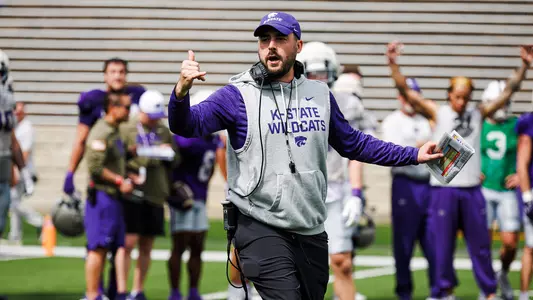
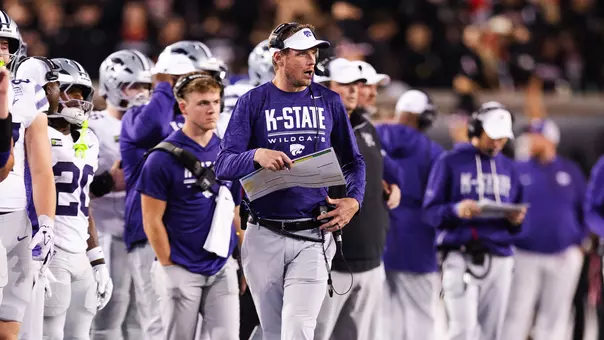
Perhaps no Kansas State assistant coach knows what he signed up for more than Stanton Weber. A 32-year-old native of Overland Park, Kansas, who was a three-time First Team Academic All-Big 12 performer as a wide receiver and special teams standout for the Wildcats from 2011-15, Stanton is the son of former K-State quarterback Stan Weber, and during a three-year stint at Toledo he was a finalist for 2024 Special Teams Coordinator of the Year by FootballScoop in addition to the American Football Coaches Association 35 Under 35 Leadership Institute.
For Weber, hired as special teams coordinator by head coach Collin Klein, K-State and special teams are purple fabrics of his being.
"For me, it's a tremendous responsibility to be in charge of this because it has to be good," Weber says, "and it has to be something that we utilize to be a team that has that edge and brings that edge every time we enter the field."
At K-State, special teams has long had a reputation for being special — that added ingredient that opponents have feared through the years and that momentum-changing weapon that the Wildcats have utilized to win games for decades. At times, K-State's special teams, which for many years has been regarded as "Special Teams U," has dominated headlines, with playmakers such as Andre Coleman, Martin Gramatica, David Allen, Jamie Rheem, Corey Adams, Deon Murphy, Brandon Banks, William Powell, Tyler Lockett, Morgan Burns, D.J. Reed, Josh Youngblood, Malik Knowles, Phillip Brooks and Deuce Vaughn — all All-Americans in the last 30 years — the individual benefactors of days and months of preparation and execution by 11-man special teams unit that prides itself on excellence.
Many players, such as Weber, a special teams captain during his playing days at K-State, darned near made a career out of mightily contributing to the all-important phase of Wildcats tradition.
Which is what Weber and Klein hammered home to K-State players at the outset of spring practice in March.
"You get to that first spring practice, and you want to educate these guys about what special teams means to this place and how it's been a part of our formula, and we've done that in a lot of great ways," Weber says. "Coach Klein has a plan to win that he's talked about with the team and bullet point No. 2 reads: 'Win the special teams battle.' He presented some of the craziest statistics that even shook me sometimes, how we've been so successful in the return game over the last 15 years and so successful in scoring non-offensive touchdowns in the last 25 years."

How has special teams impacted K-State? Here are a few ways:
Since 1999, K-State leads the FBS with 137 non-offensive touchdowns.
Since 2005, K-State's 63 total kickoff and punt return touchdowns lead the FBS are 23 more than the next school on the list, Alabama (40).
Since 2005, K-State leads the FBS in total return yards (25,217), punt return average (12.5) and kickoff return average (23.7).
Since 2013, K-State hasn't allowed a kickoff return touchdown — a streak that spans 163 games and 465 returns, and that is an active streak that is twice as long as any other school in the Big 12 Conference.
"It doesn't seem when you look at the numbers, but it's important that these guys understand this is going to be something that helps us, and it's our identity," Weber says. "Coach Klein emphasizes it, and he has, and the staff has been on board, and the guys are totally bought in with that."
Part of Weber's charge for the 2026 season and beyond will be to bring the entirety of the Wildcats' special teams to its accustomed spot as one of the best and most well-rounded in college football.
Consider K-State finished in the top 25 in special teams efficiency in 11 of 14 seasons between 2007 and 2020, and it spent eight seasons ranked in the top 10. But since 2020, K-State has ranked in the top 25 in special teams efficiency only once (2022) while its No. 81 special teams efficiency ranking in 2025 marked its lowest such ranking since special teams efficiency became a statistic in 2007.
"When it comes to what I want to accomplish, I want us to be the very best that we can be, and that's a daily thing," Weber says. "I'm not going to throw out goals or numbers, but we want to impact the game in a positive way – and we anticipate we will do that – but we've got a long way to go, and every day we're getting a little better. The players see the passion in myself and in Coach Klein and in our staff and in each other. There are quite a few guys who understand and have been here a long time. These guys get it.
"As we really bring in more than usual, almost a new team every year, it's important that we re-educate with a bigger number of transfers entering our teams. It's a battle that we are fighting every day, but I've been pleased with the attitude that people have for special teams."

Weber came to K-State after three seasons at Toledo, where he coached five All-Mid-American Conference honorees, including three-straight kickoff return specialists, one punter and one kicker. In 2025, Weber helped Toledo lead the FBS with five blocked kicks, and rank fifth nationally with three blocked punts, 19th in punt-return defense (4.22) and 34th in punt returns (11.48). In 2025, Bryson Hammer ranked 15th in the FBS with 12.3 yards per punt return. In 2024, Jacquez Stuart ranked fifth in the FBS with 34.0 yards per kickoff return. In 2023, Stuart ranked third with 29.1 yards per kickoff return.
In 2024, Weber's special teams ranked among the best in the FBS in blocked punts (20th), kickoff returns (21st), punt returns (22nd), punt return defense (27th), blocked kicks (27th). In 2023, Weber's special teams ranked third in the FBS in blocked punts and 11th in kickoff return defense.
Prior to his time at Toledo, Weber spent two seasons as a special teams analyst at South Carolina after getting his start in coaching at K-State, first as an offensive graduate assistant in 2017 and 2018 before becoming a special teams quality control coach in 2019 and 2020.
Now, Weber is home.
"It's huge," Klein says. "We're going to develop every phase of the game and spend a lot of time on special teams every single day. Watching Stanton grow into the coach he is today from literally being teammates and him jumping on the sled that first day on the other side of me in 2011 – I remember that day vividly – and being able to now watch him lead, and his passion for this place, and his passion for detail and excellence, and how that permeates every aspects of our special teams unit, is tremendous."
One of the top storylines to come out of special teams in spring practice was 6-foot-4, 219-pound senior backup quarterback Jacob Knuth volunteering to be a part of special teams. Knuth, who has seen action in four games at quarterback during two seasons at K-State, is believed to be the first K-State quarterback to play on special teams since Josh Freeman in 2008.
"It's a bit unique to have a quarterback playing on special teams, but he's a guy late in his career, and he cares a lot about this place and wants to find any way to help the team, which I admire a lot," Weber says. "When you get through our winter workouts and talk about his numbers in terms of top speed, acceleration and size, he could potentially help us, so why not turn over every rock when you look at players with those body types.
"He's been going through the whole gamut and competing with the rest of them, and he has improved tremendously this spring. With the roster reduction, you're trying to find value anywhere, and I admire Jacob to propose being utilized in that special teams role. It's been a lot of fun watching him."
Roster reduction will play big in special teams moving forward. Starting with the 2025-26 season, FBS rosters moved to a maximum cap of 105 players, eliminating traditional walk-ons, and changing the model from an 85-scholarship limit to a maximum of 105 scholarships, or roster spots, per team. The days of FBS teams such as K-State having 120 players on roster, including those players who just want to be a part of the team, are over.
That makes every player on the 105-man roster critical.
"The roster is getting a little bit more squeezed, and you have to find value in guys a little sooner than normal," Weber says. "With the way college football has gone where you have almost your entire class enrolling, we get a chance in spring to see quite a few guys. I've been pleased with seeing a handful step up. Garrick Dixon had a great winter, and he's really shown that he's capable. Max Lovett is a guy I anticipate we might see some stuff from. Oliver Miller is a guy who has a great attitude and isn't looking like a freshman.
"It's going to be a really critical time for them to digest this whole spring and then come back in the fall and shake off the I'm-a-freshman type swagger. A lot of us who started as fall-start guys back in my career, you felt like you were drowning until a whole year really passed. With this enrollment thing, I'm encouraged by the fact that these guys may have had a couple moments during the spring where it was, 'OK, he's a freshman,' and they get that out of their system, and it allows us to utilize some much quicker than usual."

Weber comes out of spring practice saying "a handful of guys" could assume kickoff- and punt-return duties aside from returning starter Sterling Lockett.
"Brandon White has a shot," Weber says. "He's a quick guy and has some speed as well. Rodney Fields Jr. has been a guy we've tried back there a little bit. Monterrio Elston Jr. has a shot as well. It's a big competition. Izaiah Williams, we're throwing a lot of them back there, getting a chance to see a lot of them catch kicks and punts. Every day we're sending them back there. I couldn't tell you there's a clear-cut favorite in my mind, but we're going to find a couple guys who can do it and we're going to see who wants it the most."
If there are two inherent luxuries for Weber, it comes with the returns of junior kicker Luis Rodriguez and junior punter Simon McClannan, who each come off solid seasons.
Rodriguez connected on 13-of-15 field goal attempts, including a 51-yarder at Arizona, and he made all 42 extra-point attempts while finishing 22nd in the FBS and second in the Big 12 with an 86.7% conversion rate on field goals. His 81 total points ranked fourth in K-State history among sophomores. Rodriguez came to K-State prior to the 2025 season after putting together the third-best season by a community-college kicker at College of the Canyons in 2024.
"I love Luis' attitude," Weber says. "He is a next-kick guy. You couldn't tell if he missed it or made it. He's a guy who has some swagger to him as well. When he steps up in front of the whole team, he's not intimidated, and he sticks the kick through."
McClannan is fifth all-time in K-State history with a career punting average of 42.43 yards. Last season, he averaged 42.5 yards on 48 punts with 13 punts of 50 or more yards and 18 that landed inside the opponent 20-yard line. He earned Ray Guy Award National Punter of the Week after averaging 51.0 yards per punt on four punts against UCF — a game that included a career-long 65-yard punt. McClannan also averaged 62.6 yards on 70 kickoffs with 39 touchbacks.
"Simon has done a nice job of emerging as a bit of a leader in our room," Weber says. "I'm encouraged by what I've seen from him. He's improving in a lot of ways that I've asked him to, to be conducive to some things that we might change with what we're doing or not. He's a guy who's going to help us."

One of Weber's fondest memories at Toledo came on December 3 — after his cellphone exploded at 10:30 a.m. during a Toledo football practice with news of Klein's hiring at K-State. Weber had 25 texts and one missed call from his father. Klein texted Weber one hour later to officially share the news. Weber knew he was headed to Manhattan.
But what stuck out to Weber as much as the invite to join Klein back in the Little Apple was the sight of his Toledo players after practice. Toledo players lined the hallway inside the football facility and patiently waited to enter Weber's office to say thanks and good-bye, illustrating the bond forged between Weber and his special teams players.
Over K-State's spring practice, Weber acquired another pack of players — eager K-State players looking to contribute in any way possible due to their love for the Wildcats and the possibility to help what Klein plans to build at Bill Snyder Family Stadium.
"There's been a baton that's been passed, and I was very happy to see it alive here," Weber says. "Guys are living in my office right now – Isaac Koch, Weston Polk, Mike Bergeron, Jack Fabris — these guys will do whatever it takes, and they're talented players who can play on offense and defense, too, but they're hanging out with me a lot.
"They're reminding me a lot of the guys I was running around with when I was a player."
Bottom line for Weber: "They've bought in."
And that bodes well going forward.
"When I asked them to do things in a competitive nature, they competed their butts off, and every day I saw good improvements," he says. "I'm excited, but it's a long journey still."
Perhaps no Kansas State assistant coach knows what he signed up for more than Stanton Weber. A 32-year-old native of Overland Park, Kansas, who was a three-time First Team Academic All-Big 12 performer as a wide receiver and special teams standout for the Wildcats from 2011-15, Stanton is the son of former K-State quarterback Stan Weber, and during a three-year stint at Toledo he was a finalist for 2024 Special Teams Coordinator of the Year by FootballScoop in addition to the American Football Coaches Association 35 Under 35 Leadership Institute.
For Weber, hired as special teams coordinator by head coach Collin Klein, K-State and special teams are purple fabrics of his being.
"For me, it's a tremendous responsibility to be in charge of this because it has to be good," Weber says, "and it has to be something that we utilize to be a team that has that edge and brings that edge every time we enter the field."
At K-State, special teams has long had a reputation for being special — that added ingredient that opponents have feared through the years and that momentum-changing weapon that the Wildcats have utilized to win games for decades. At times, K-State's special teams, which for many years has been regarded as "Special Teams U," has dominated headlines, with playmakers such as Andre Coleman, Martin Gramatica, David Allen, Jamie Rheem, Corey Adams, Deon Murphy, Brandon Banks, William Powell, Tyler Lockett, Morgan Burns, D.J. Reed, Josh Youngblood, Malik Knowles, Phillip Brooks and Deuce Vaughn — all All-Americans in the last 30 years — the individual benefactors of days and months of preparation and execution by 11-man special teams unit that prides itself on excellence.
Many players, such as Weber, a special teams captain during his playing days at K-State, darned near made a career out of mightily contributing to the all-important phase of Wildcats tradition.
Which is what Weber and Klein hammered home to K-State players at the outset of spring practice in March.
"You get to that first spring practice, and you want to educate these guys about what special teams means to this place and how it's been a part of our formula, and we've done that in a lot of great ways," Weber says. "Coach Klein has a plan to win that he's talked about with the team and bullet point No. 2 reads: 'Win the special teams battle.' He presented some of the craziest statistics that even shook me sometimes, how we've been so successful in the return game over the last 15 years and so successful in scoring non-offensive touchdowns in the last 25 years."
How has special teams impacted K-State? Here are a few ways:
Since 1999, K-State leads the FBS with 137 non-offensive touchdowns.
Since 2005, K-State's 63 total kickoff and punt return touchdowns lead the FBS are 23 more than the next school on the list, Alabama (40).
Since 2005, K-State leads the FBS in total return yards (25,217), punt return average (12.5) and kickoff return average (23.7).
Since 2013, K-State hasn't allowed a kickoff return touchdown — a streak that spans 163 games and 465 returns, and that is an active streak that is twice as long as any other school in the Big 12 Conference.
"It doesn't seem when you look at the numbers, but it's important that these guys understand this is going to be something that helps us, and it's our identity," Weber says. "Coach Klein emphasizes it, and he has, and the staff has been on board, and the guys are totally bought in with that."
Part of Weber's charge for the 2026 season and beyond will be to bring the entirety of the Wildcats' special teams to its accustomed spot as one of the best and most well-rounded in college football.
Consider K-State finished in the top 25 in special teams efficiency in 11 of 14 seasons between 2007 and 2020, and it spent eight seasons ranked in the top 10. But since 2020, K-State has ranked in the top 25 in special teams efficiency only once (2022) while its No. 81 special teams efficiency ranking in 2025 marked its lowest such ranking since special teams efficiency became a statistic in 2007.
"When it comes to what I want to accomplish, I want us to be the very best that we can be, and that's a daily thing," Weber says. "I'm not going to throw out goals or numbers, but we want to impact the game in a positive way – and we anticipate we will do that – but we've got a long way to go, and every day we're getting a little better. The players see the passion in myself and in Coach Klein and in our staff and in each other. There are quite a few guys who understand and have been here a long time. These guys get it.
"As we really bring in more than usual, almost a new team every year, it's important that we re-educate with a bigger number of transfers entering our teams. It's a battle that we are fighting every day, but I've been pleased with the attitude that people have for special teams."
Weber came to K-State after three seasons at Toledo, where he coached five All-Mid-American Conference honorees, including three-straight kickoff return specialists, one punter and one kicker. In 2025, Weber helped Toledo lead the FBS with five blocked kicks, and rank fifth nationally with three blocked punts, 19th in punt-return defense (4.22) and 34th in punt returns (11.48). In 2025, Bryson Hammer ranked 15th in the FBS with 12.3 yards per punt return. In 2024, Jacquez Stuart ranked fifth in the FBS with 34.0 yards per kickoff return. In 2023, Stuart ranked third with 29.1 yards per kickoff return.
In 2024, Weber's special teams ranked among the best in the FBS in blocked punts (20th), kickoff returns (21st), punt returns (22nd), punt return defense (27th), blocked kicks (27th). In 2023, Weber's special teams ranked third in the FBS in blocked punts and 11th in kickoff return defense.
Prior to his time at Toledo, Weber spent two seasons as a special teams analyst at South Carolina after getting his start in coaching at K-State, first as an offensive graduate assistant in 2017 and 2018 before becoming a special teams quality control coach in 2019 and 2020.
Now, Weber is home.
"It's huge," Klein says. "We're going to develop every phase of the game and spend a lot of time on special teams every single day. Watching Stanton grow into the coach he is today from literally being teammates and him jumping on the sled that first day on the other side of me in 2011 – I remember that day vividly – and being able to now watch him lead, and his passion for this place, and his passion for detail and excellence, and how that permeates every aspects of our special teams unit, is tremendous."
One of the top storylines to come out of special teams in spring practice was 6-foot-4, 219-pound senior backup quarterback Jacob Knuth volunteering to be a part of special teams. Knuth, who has seen action in four games at quarterback during two seasons at K-State, is believed to be the first K-State quarterback to play on special teams since Josh Freeman in 2008.
"It's a bit unique to have a quarterback playing on special teams, but he's a guy late in his career, and he cares a lot about this place and wants to find any way to help the team, which I admire a lot," Weber says. "When you get through our winter workouts and talk about his numbers in terms of top speed, acceleration and size, he could potentially help us, so why not turn over every rock when you look at players with those body types.
"He's been going through the whole gamut and competing with the rest of them, and he has improved tremendously this spring. With the roster reduction, you're trying to find value anywhere, and I admire Jacob to propose being utilized in that special teams role. It's been a lot of fun watching him."
Roster reduction will play big in special teams moving forward. Starting with the 2025-26 season, FBS rosters moved to a maximum cap of 105 players, eliminating traditional walk-ons, and changing the model from an 85-scholarship limit to a maximum of 105 scholarships, or roster spots, per team. The days of FBS teams such as K-State having 120 players on roster, including those players who just want to be a part of the team, are over.
That makes every player on the 105-man roster critical.
"The roster is getting a little bit more squeezed, and you have to find value in guys a little sooner than normal," Weber says. "With the way college football has gone where you have almost your entire class enrolling, we get a chance in spring to see quite a few guys. I've been pleased with seeing a handful step up. Garrick Dixon had a great winter, and he's really shown that he's capable. Max Lovett is a guy I anticipate we might see some stuff from. Oliver Miller is a guy who has a great attitude and isn't looking like a freshman.
"It's going to be a really critical time for them to digest this whole spring and then come back in the fall and shake off the I'm-a-freshman type swagger. A lot of us who started as fall-start guys back in my career, you felt like you were drowning until a whole year really passed. With this enrollment thing, I'm encouraged by the fact that these guys may have had a couple moments during the spring where it was, 'OK, he's a freshman,' and they get that out of their system, and it allows us to utilize some much quicker than usual."
Weber comes out of spring practice saying "a handful of guys" could assume kickoff- and punt-return duties aside from returning starter Sterling Lockett.
"Brandon White has a shot," Weber says. "He's a quick guy and has some speed as well. Rodney Fields Jr. has been a guy we've tried back there a little bit. Monterrio Elston Jr. has a shot as well. It's a big competition. Izaiah Williams, we're throwing a lot of them back there, getting a chance to see a lot of them catch kicks and punts. Every day we're sending them back there. I couldn't tell you there's a clear-cut favorite in my mind, but we're going to find a couple guys who can do it and we're going to see who wants it the most."
If there are two inherent luxuries for Weber, it comes with the returns of junior kicker Luis Rodriguez and junior punter Simon McClannan, who each come off solid seasons.
Rodriguez connected on 13-of-15 field goal attempts, including a 51-yarder at Arizona, and he made all 42 extra-point attempts while finishing 22nd in the FBS and second in the Big 12 with an 86.7% conversion rate on field goals. His 81 total points ranked fourth in K-State history among sophomores. Rodriguez came to K-State prior to the 2025 season after putting together the third-best season by a community-college kicker at College of the Canyons in 2024.
"I love Luis' attitude," Weber says. "He is a next-kick guy. You couldn't tell if he missed it or made it. He's a guy who has some swagger to him as well. When he steps up in front of the whole team, he's not intimidated, and he sticks the kick through."
McClannan is fifth all-time in K-State history with a career punting average of 42.43 yards. Last season, he averaged 42.5 yards on 48 punts with 13 punts of 50 or more yards and 18 that landed inside the opponent 20-yard line. He earned Ray Guy Award National Punter of the Week after averaging 51.0 yards per punt on four punts against UCF — a game that included a career-long 65-yard punt. McClannan also averaged 62.6 yards on 70 kickoffs with 39 touchbacks.
"Simon has done a nice job of emerging as a bit of a leader in our room," Weber says. "I'm encouraged by what I've seen from him. He's improving in a lot of ways that I've asked him to, to be conducive to some things that we might change with what we're doing or not. He's a guy who's going to help us."
One of Weber's fondest memories at Toledo came on December 3 — after his cellphone exploded at 10:30 a.m. during a Toledo football practice with news of Klein's hiring at K-State. Weber had 25 texts and one missed call from his father. Klein texted Weber one hour later to officially share the news. Weber knew he was headed to Manhattan.
But what stuck out to Weber as much as the invite to join Klein back in the Little Apple was the sight of his Toledo players after practice. Toledo players lined the hallway inside the football facility and patiently waited to enter Weber's office to say thanks and good-bye, illustrating the bond forged between Weber and his special teams players.
Over K-State's spring practice, Weber acquired another pack of players — eager K-State players looking to contribute in any way possible due to their love for the Wildcats and the possibility to help what Klein plans to build at Bill Snyder Family Stadium.
"There's been a baton that's been passed, and I was very happy to see it alive here," Weber says. "Guys are living in my office right now – Isaac Koch, Weston Polk, Mike Bergeron, Jack Fabris — these guys will do whatever it takes, and they're talented players who can play on offense and defense, too, but they're hanging out with me a lot.
"They're reminding me a lot of the guys I was running around with when I was a player."
Bottom line for Weber: "They've bought in."
And that bodes well going forward.
"When I asked them to do things in a competitive nature, they competed their butts off, and every day I saw good improvements," he says. "I'm excited, but it's a long journey still."
Players Mentioned
CB
/ Football
RB
/ Football
S
/ Football
RB
/ Football
QB
/ Football
WR
/ Football
WR
/ Football
WR
/ Football
P/K
/ Football
OL
/ Football
LB
/ Football
K
/ Football
WR
/ Football
WR
/ FootballTuesday, October 06
Monday, October 05
Sunday, October 04
Friday, October 02