SE: Thomason, Hoffman Bring Award Winning Care, Successful Stability to K-State Sports Medicine
Sep 18, 2018 | Football, Athletics, Evans Student-Athlete Success Program
By Corbin McGuire
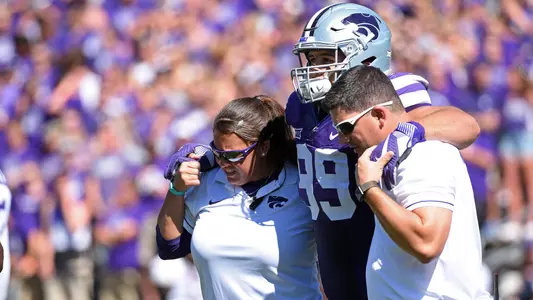
For the last 12 years, Matt Thomason and Mindy Hoffman have been the first two people to the side of an injured K-State football player. The trust and respect between the K-State athletic trainers exceeds the size of any of the countless players they have helped walk off the field.
"I feel like we probably could finish each other's sentences some days," Hoffman said of Thomason, K-State's Director of Sports Medicine for the last 14 years. "He is my boss but he's also like a brother."
Despite their longevity working with one another, the two admitted they are very different people.
"No, I don't think there's anything similar between us," Thomason, "and she'd probably say the same."
"Opposites attract, probably," laughed Hoffman, K-State's associate athletic trainer since 2013 who has been with the Wildcats for 13 years.
As different as they may be personality-wise, their professional similarities have kept them in Manhattan and helped create a culture of successful continuity amongst K-State's department of sports medicine.
In 2017, K-State received the Big 12 Sports Medicine Staff of the Year award. Last weekend, Hoffman was recognized as the Texas Tech Health Sciences Center Department of Rehabilitation Science Distinguished Alumni award winner. She can add the honor along with being named the 2016 Big 12 Assistant Athletic Trainer of the Year.
"Matt and Mindy are very good athletic trainers. Mindy helped me a ton with my injury (last season). She showed up every day and did everything she could to get me back. I credit her for getting me back on the field as quick as she did and getting me back in the weight room as quick as she did. They both do a good job of just showing up and getting everyone right every single day," K-State senior offensive tackle Dalton Risner said. "They have an extreme value. When someone goes down and they (are injured) on the field, they're the first ones to be out there. They're the ones to calm us down, the ones that let us know how we are.
"They're not just helping people come back from injury. They're there for emotional support. We go through a lot on a football team. We go through a lot of ups and downs and they're there for us through all that. Mindy does a very, very good job of being there for her athletes and being there for the athletes that go down. The ones that she takes care of, she's got their back 110 percent."
Senior safety Kendall Adams, who suffered a season-ending injury last season, agreed.
"Obviously things wouldn't run without those people. I really appreciate them," Adams said. "You appreciate them more after you have an injury and you're in there with them every day. Even before then, I had a great appreciation for them, but my injury made it even greater."
Hoffman and Thomason said it's the returns from injuries and the gratitude from student-athletes like Risner and Adams that bring the greatest joy in their profession. Sometimes it's realized while they are in college. Other times, they hear "thank you" years later. Thankfully because of the amount of time Hoffman and Thomason spend with their student-athletes, often at low points of their lives, the relationships built en route back to full health are long-term.
"As I always tell recruits and I tell recruits' parents when they ask me if I have any children, I say I have 130 sons. That's the kind of rapport I build," Hoffman said. "I keep in touch with a lot of past players. A lot of players I've worked really close with that have had injuries that have gone on to play in the NFL, to become professionals in their own career, they still come back and keep in touch with me. They're lifelong friendships now."
"We have an opportunity to really get to know those student-athletes on a level that very few people know," Thomason added. "You get to see them grow as a person. That's probably one of the most rewarding things."
Thomason and Hoffman's path to athletic training were very similar with subtle differences. To start, each suffered various injuries in high school that planted the seed.
Both also received degrees from Texas Tech before coming to K-State, just at different levels.
Hoffman received her bachelor's degree in physical education from Purdue. She spent four years as a teacher and coach in Indiana, the latter alongside her father, before finding another calling along the way.
"We didn't have a full-time athletic trainer at the high school I was working at, so I was taping ankles. I was doing the things that a normal athletic trainer would do and I wasn't getting paid for it," she said. "I thought I might as well go back and get my master's degree. I applied at Texas Tech because my sister was already there. I got accepted there and then the rest is basically history."
Thomason entered Texas Tech with the intention of becoming a physical therapist. Like Hoffman, he eventually made his way into athletic training.
He worked as a student athletic trainer for Texas Tech for more than two years. After graduating with cum laude honors, he then received a chance to complete his master's degree in kinesiology as a graduate assistant for K-State Athletics, where he's been the last 17 years.
"Why stay?" Thomason said. "It comes down to people that care."
Those people, Thomason added, include everyone from local medical providers (i.e., team physicians, physical therapists and surgeons, for example) to coaching staffs, administration and everyone in the sports medicine department he oversees.
In a nutshell, he said it's a good place to come to work every day.
"We're all trying to do the best thing for the department and the student-athletes, and that's our number one goal," he said. "If you get good people that want to help not only their student-athletes but also help their colleagues, that makes it to where you want to continue to work here."
Hoffman echoed his thoughts.
"The people here are great. The community's great. They support you," she said. "The athletic training staff has only gotten better since I've been here. We're probably the strongest we've ever been as a staff right now. I think that makes you want to keep coming back to work every day. When you have people who support you, you have coaches who support you and you surround yourself with good people, that's what K-State's all about — surrounding yourself with good people."
The continuity within K-State's sports medicine department goes well beyond Thomason and Hoffman, too.
Simeon Seiler (football) is in his eighth year at K-State. Luke Sauber (men's basketball) and Blaine Burris (baseball) will be entering their fifth seasons with their sports. Emily Trausch (volleyball) is in her fifth season at K-State and Becca Fitzgerald (women's basketball) starts her third soon.
K-State's full-time staff of athletic trainers has also grown immensely since Thomason and Hoffman arrived. Thomason said when he became the director in 2005, there were five full-time athletic trainers and three graduate assistants. Now, there are 12 full-time positions, of which only Hoffman is responsible for more than one sport, along with two graduate assistants.
"I think we're getting good people in here, great athletic trainers that love to be here, and they love who we are, what our goals are," Hoffman, who also works with the men's and women's golf teams, said. "We're definitely getting more stability. When I first got here, there was major turnover in athletic training. Now, we're getting a steady group that has been here four or five years. I think that says a lot about our program and the leadership that Matt provides to help keep that stability."
"The continuity is a small piece that people don't think about," Thomason added, "but if you can maintain it I think there's a huge advantage."
For the last 12 years, Matt Thomason and Mindy Hoffman have been the first two people to the side of an injured K-State football player. The trust and respect between the K-State athletic trainers exceeds the size of any of the countless players they have helped walk off the field.
"I feel like we probably could finish each other's sentences some days," Hoffman said of Thomason, K-State's Director of Sports Medicine for the last 14 years. "He is my boss but he's also like a brother."
Despite their longevity working with one another, the two admitted they are very different people.
"No, I don't think there's anything similar between us," Thomason, "and she'd probably say the same."
"Opposites attract, probably," laughed Hoffman, K-State's associate athletic trainer since 2013 who has been with the Wildcats for 13 years.
As different as they may be personality-wise, their professional similarities have kept them in Manhattan and helped create a culture of successful continuity amongst K-State's department of sports medicine.
In 2017, K-State received the Big 12 Sports Medicine Staff of the Year award. Last weekend, Hoffman was recognized as the Texas Tech Health Sciences Center Department of Rehabilitation Science Distinguished Alumni award winner. She can add the honor along with being named the 2016 Big 12 Assistant Athletic Trainer of the Year.
"Matt and Mindy are very good athletic trainers. Mindy helped me a ton with my injury (last season). She showed up every day and did everything she could to get me back. I credit her for getting me back on the field as quick as she did and getting me back in the weight room as quick as she did. They both do a good job of just showing up and getting everyone right every single day," K-State senior offensive tackle Dalton Risner said. "They have an extreme value. When someone goes down and they (are injured) on the field, they're the first ones to be out there. They're the ones to calm us down, the ones that let us know how we are.
"They're not just helping people come back from injury. They're there for emotional support. We go through a lot on a football team. We go through a lot of ups and downs and they're there for us through all that. Mindy does a very, very good job of being there for her athletes and being there for the athletes that go down. The ones that she takes care of, she's got their back 110 percent."
Senior safety Kendall Adams, who suffered a season-ending injury last season, agreed.
"Obviously things wouldn't run without those people. I really appreciate them," Adams said. "You appreciate them more after you have an injury and you're in there with them every day. Even before then, I had a great appreciation for them, but my injury made it even greater."
Hoffman and Thomason said it's the returns from injuries and the gratitude from student-athletes like Risner and Adams that bring the greatest joy in their profession. Sometimes it's realized while they are in college. Other times, they hear "thank you" years later. Thankfully because of the amount of time Hoffman and Thomason spend with their student-athletes, often at low points of their lives, the relationships built en route back to full health are long-term.
"As I always tell recruits and I tell recruits' parents when they ask me if I have any children, I say I have 130 sons. That's the kind of rapport I build," Hoffman said. "I keep in touch with a lot of past players. A lot of players I've worked really close with that have had injuries that have gone on to play in the NFL, to become professionals in their own career, they still come back and keep in touch with me. They're lifelong friendships now."
"We have an opportunity to really get to know those student-athletes on a level that very few people know," Thomason added. "You get to see them grow as a person. That's probably one of the most rewarding things."
Thomason and Hoffman's path to athletic training were very similar with subtle differences. To start, each suffered various injuries in high school that planted the seed.
Both also received degrees from Texas Tech before coming to K-State, just at different levels.
Hoffman received her bachelor's degree in physical education from Purdue. She spent four years as a teacher and coach in Indiana, the latter alongside her father, before finding another calling along the way.
"We didn't have a full-time athletic trainer at the high school I was working at, so I was taping ankles. I was doing the things that a normal athletic trainer would do and I wasn't getting paid for it," she said. "I thought I might as well go back and get my master's degree. I applied at Texas Tech because my sister was already there. I got accepted there and then the rest is basically history."
Thomason entered Texas Tech with the intention of becoming a physical therapist. Like Hoffman, he eventually made his way into athletic training.
He worked as a student athletic trainer for Texas Tech for more than two years. After graduating with cum laude honors, he then received a chance to complete his master's degree in kinesiology as a graduate assistant for K-State Athletics, where he's been the last 17 years.
"Why stay?" Thomason said. "It comes down to people that care."
Those people, Thomason added, include everyone from local medical providers (i.e., team physicians, physical therapists and surgeons, for example) to coaching staffs, administration and everyone in the sports medicine department he oversees.
In a nutshell, he said it's a good place to come to work every day.
"We're all trying to do the best thing for the department and the student-athletes, and that's our number one goal," he said. "If you get good people that want to help not only their student-athletes but also help their colleagues, that makes it to where you want to continue to work here."
Hoffman echoed his thoughts.
"The people here are great. The community's great. They support you," she said. "The athletic training staff has only gotten better since I've been here. We're probably the strongest we've ever been as a staff right now. I think that makes you want to keep coming back to work every day. When you have people who support you, you have coaches who support you and you surround yourself with good people, that's what K-State's all about — surrounding yourself with good people."
The continuity within K-State's sports medicine department goes well beyond Thomason and Hoffman, too.
Simeon Seiler (football) is in his eighth year at K-State. Luke Sauber (men's basketball) and Blaine Burris (baseball) will be entering their fifth seasons with their sports. Emily Trausch (volleyball) is in her fifth season at K-State and Becca Fitzgerald (women's basketball) starts her third soon.
K-State's full-time staff of athletic trainers has also grown immensely since Thomason and Hoffman arrived. Thomason said when he became the director in 2005, there were five full-time athletic trainers and three graduate assistants. Now, there are 12 full-time positions, of which only Hoffman is responsible for more than one sport, along with two graduate assistants.
"I think we're getting good people in here, great athletic trainers that love to be here, and they love who we are, what our goals are," Hoffman, who also works with the men's and women's golf teams, said. "We're definitely getting more stability. When I first got here, there was major turnover in athletic training. Now, we're getting a steady group that has been here four or five years. I think that says a lot about our program and the leadership that Matt provides to help keep that stability."
"The continuity is a small piece that people don't think about," Thomason added, "but if you can maintain it I think there's a huge advantage."

Players Mentioned
DB
/ Football
OL
/ FootballK-State FB | Welcome back Collin Klein
Monday, December 08
K-State FB | Head Coach Collin Klein Radio Interview
Friday, December 05
K-State FB | Head Coach Collin Klein Official Introductory Event
Friday, December 05
K-State FB | Thank You Coach Klieman
Wednesday, December 03