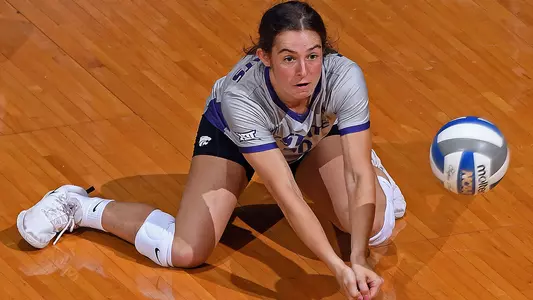
SE: Why Dyslexia Does Not Define K-State VB Senior Mckenzi Weber, But Laid Foundation for Her Success
Oct 09, 2019 | Volleyball, Sports Extra
By Corbin McGuire
About three minutes into an interview for a senior profile story, K-State volleyball's Mckenzi Weber covered all the expected questions.
An impressively fast speaker — at about 225 words per minute in this interview, nearly the pace of an auctioneer — Weber talked about being put on scholarship this August, the same day as her younger brother, Landry, received his scholarship from K-State's football staff.
The defensive specialist/libero shared what that day meant, after growing up in an extremely pro-K-State household. Her father, Stan, played quarterback at K-State and now a radio analyst for Wildcat football and basketball games. Her older brother, Stanton, also walked on to K-State's football team, earned a scholarship and is now a special teams quality control coach for the Wildcats.
Weber even admitted that she tried to be the "black sheep" of the family, as she had signed to play volleyball at Division II Central Missouri. She changed her mind last minute, however, when K-State said it might have a walk-on spot open in the spring of her freshman year.
Still, she had to try out for the team to prove she deserved a chance to walk on. K-State offered her a four-week stretch in the spring of 2016. She never doubted it would turn into the four-plus year stint that it did.
"You know, you can't really doubt. You just have to wake up and keep trying, because when you doubt yourself, you're only going to make yourself incapable of reaching your potential," she said. "I, luckily, have a growth mindset."
This, at about 3:33 of the interview, is where Weber opened up about a part of her that she's not ashamed of, or afraid to talk about, but few outside of her teammates, coaches and family know of. It's where a large part of that "growth mindset" came from.
"I have dyslexia, and all my life I've had to get over hurdles," Weber, a 4.0 student at K-State, said. "Honestly, every day waking up and being, like, 'It's not going to be handed you,' was nothing new to me."
It's been that way as long as she can remember.
Weber said thinks she was diagnosed in kindergarten with dyslexia, which mayoclinic.org defines as "a learning disorder that involves difficulty reading due to problems identifying speech sounds and learning how they relate to letters and words."
"It's not anything that really defines me, by any means," she said. "It's just something you deal with."
How Weber dealt with it, she said, "laid the foundation for everything" in life. She described it this way: While most people can get from Point A to Point B in a straight line, she takes a curvy road. But she still gets there.
"Maybe it's a two-mile walk when it should be only a mile," Weber said. "The fact is that I can get to (Point) B. I just need to figure out how."
With reading, Weber found that audiobooks helped. She learned to sound out words correctly by following along with someone's voice. Likewise, she said watching film helped develop her volleyball IQ at K-State.
"It just made a more resilient person. It's made me cleverer person," she said of her dyslexia. "Also, in college, it's made me a more disciplined person because for a lot of people in high school, it wasn't hard for them to get A's. For me, I had to really try to get A's. Then, I got to college and no one's holding you accountable. You have to find a way to study and learn uniquely because each professor is different.
"The thing is, each day (growing up) I had to learn uniquely to get to the same point. So, honestly, college was easier for me than any other school because I already knew how to do it."
Repetition has been another important piece in her learning puzzle. It goes hand in hand with her persistence.
Weber often will be at practice early and stay late. On campus, her professors know her well, whether they want to or not. She's in their office hours every chance she can get. A bakery science and management major, she credited this habit for her A in engineering physics II.
"I fully believe I got an A in that class because a teacher saw me every time he had office hours. I missed 45 percent of the class because of volleyball in the fall, and I think he just, out of pity, was, 'She tried so hard. I'll bump her grade,'" Weber said, laughing, before getting serious. "I think people appreciate hard work and I think people understand the importance of it, how it's going to propel you in life, in general."
K-State volleyball head coach Suzie Fritz shared a similar story about why she let Weber try out for the team four years ago.
"She, I think, talked me into being on the team. I don't say that lightly. She came in and said, 'Just give me a chance and I'll show you.' I said, 'Well, let's try it for a couple weeks and see where it goes,'" Fritz said. "Then, a couple weeks turned into a month, and then it turned into six weeks. Then, six weeks turned into a year, and then it turned into another year. The next thing you know, she's telling everybody what to do all the time."
Now, Weber is a senior leader for a team with 13 underclassmen. She's earned a spot on the Big 12 Commissioner's Honor Roll five times. Last season, she received Academic All-Big 12 First Team recognition. This season, she's even played in 14 matches and 54 sets, significantly more than the previous three seasons combined. She's also picked up 65 digs this season.
"She does a really good job of managing volleyball with all the other goals she has in life. She's a really high achiever both academically and in her social life," senior setter Sarah Dixon said, as K-State hosts No. 4 Texas on Wednesday at 7 p.m., on FSN. "Whenever we have a free moment, she's working on homework. She's reading her bible. She's getting the word in. She's praying. She's communicating with her friends and family. I think that is really admirable because, even on the road, she's always making the most of every free moment she has."
"It's awfully impressive. She's a 4.0 student with a learning disability," Fritz added. "That's just kind of who she is. She's an incredibly hard worker that overcomes just about whatever's in front of her. When she puts her mind to something, you just need to stay out of her way."
Like, this season when Weber brought some unique pastries (with crickets and worms, for instance) to practice and tried to get people to eat her classwork. Dixon and Fritz both caved to her insistent requests.
"She's just a really unusual and unique person in the best of ways, both on and off the court," Dixon said, with a laugh. "Weber's great. I love her a lot. I'm just very grateful for what she provides. She's such a unique human, and I'm really grateful to have had the chance to play with her and get to know her on and off the court."
Unique in many ways, including that she prefers four hours of sleep, as opposed to, say, a normal amount like six.
"That little kick of adrenaline rush gets me through the day," Weber said.
Then, there's her competitiveness. It's partly innate and partly developed, but it started with something she said her father taught her to use in the classroom.
"This is such a Stan Weber thing to say…he's, like, 'Every test, every class is like a game and the teacher is the opponent, and you have to learn their strategies. If you beat their strategies, you win the game and get an A,'" she said. "So, every time I walk into class or I walk into sports, I'm, like, 'This is a game. I need to win. How do I win? Let's find a way to win.' That's how I approach life.
"I'm kind of an intense human, people tell me, but I like it."
Intense and intentional. Weber's handled a lifelong adversity like a daily challenge, and she loves challenges. To her, dyslexia is not who she is. It's what she gets to overcome.
"I really look at difficulties or hardships or suffering as an opportunity to grow. Without them, I'd be stagnant. And who wants to be stagnant? That sounds boring. I judge every day off productivity. So, if I was productive, it was a good day. If I wasn't, it wasn't. There's pros and cons to that mindset, don't get me wrong, but it's kind of the truth," Weber said. "If I didn't learn something today, if I didn't grow in some way or I wasn't challenged in some way, I don't think I had a good day. That's why I love college athletics because I walk off this court every day saying, 'I was challenged, I was humbled, and my body hurts.'
"What else would I need?"
About three minutes into an interview for a senior profile story, K-State volleyball's Mckenzi Weber covered all the expected questions.
An impressively fast speaker — at about 225 words per minute in this interview, nearly the pace of an auctioneer — Weber talked about being put on scholarship this August, the same day as her younger brother, Landry, received his scholarship from K-State's football staff.
The defensive specialist/libero shared what that day meant, after growing up in an extremely pro-K-State household. Her father, Stan, played quarterback at K-State and now a radio analyst for Wildcat football and basketball games. Her older brother, Stanton, also walked on to K-State's football team, earned a scholarship and is now a special teams quality control coach for the Wildcats.
Weber even admitted that she tried to be the "black sheep" of the family, as she had signed to play volleyball at Division II Central Missouri. She changed her mind last minute, however, when K-State said it might have a walk-on spot open in the spring of her freshman year.
Still, she had to try out for the team to prove she deserved a chance to walk on. K-State offered her a four-week stretch in the spring of 2016. She never doubted it would turn into the four-plus year stint that it did.
"You know, you can't really doubt. You just have to wake up and keep trying, because when you doubt yourself, you're only going to make yourself incapable of reaching your potential," she said. "I, luckily, have a growth mindset."
This, at about 3:33 of the interview, is where Weber opened up about a part of her that she's not ashamed of, or afraid to talk about, but few outside of her teammates, coaches and family know of. It's where a large part of that "growth mindset" came from.
"I have dyslexia, and all my life I've had to get over hurdles," Weber, a 4.0 student at K-State, said. "Honestly, every day waking up and being, like, 'It's not going to be handed you,' was nothing new to me."
It's been that way as long as she can remember.
Weber said thinks she was diagnosed in kindergarten with dyslexia, which mayoclinic.org defines as "a learning disorder that involves difficulty reading due to problems identifying speech sounds and learning how they relate to letters and words."
"It's not anything that really defines me, by any means," she said. "It's just something you deal with."
How Weber dealt with it, she said, "laid the foundation for everything" in life. She described it this way: While most people can get from Point A to Point B in a straight line, she takes a curvy road. But she still gets there.
"Maybe it's a two-mile walk when it should be only a mile," Weber said. "The fact is that I can get to (Point) B. I just need to figure out how."
With reading, Weber found that audiobooks helped. She learned to sound out words correctly by following along with someone's voice. Likewise, she said watching film helped develop her volleyball IQ at K-State.
"It just made a more resilient person. It's made me cleverer person," she said of her dyslexia. "Also, in college, it's made me a more disciplined person because for a lot of people in high school, it wasn't hard for them to get A's. For me, I had to really try to get A's. Then, I got to college and no one's holding you accountable. You have to find a way to study and learn uniquely because each professor is different.
"The thing is, each day (growing up) I had to learn uniquely to get to the same point. So, honestly, college was easier for me than any other school because I already knew how to do it."
Repetition has been another important piece in her learning puzzle. It goes hand in hand with her persistence.
Weber often will be at practice early and stay late. On campus, her professors know her well, whether they want to or not. She's in their office hours every chance she can get. A bakery science and management major, she credited this habit for her A in engineering physics II.
"I fully believe I got an A in that class because a teacher saw me every time he had office hours. I missed 45 percent of the class because of volleyball in the fall, and I think he just, out of pity, was, 'She tried so hard. I'll bump her grade,'" Weber said, laughing, before getting serious. "I think people appreciate hard work and I think people understand the importance of it, how it's going to propel you in life, in general."
K-State volleyball head coach Suzie Fritz shared a similar story about why she let Weber try out for the team four years ago.
"She, I think, talked me into being on the team. I don't say that lightly. She came in and said, 'Just give me a chance and I'll show you.' I said, 'Well, let's try it for a couple weeks and see where it goes,'" Fritz said. "Then, a couple weeks turned into a month, and then it turned into six weeks. Then, six weeks turned into a year, and then it turned into another year. The next thing you know, she's telling everybody what to do all the time."
Now, Weber is a senior leader for a team with 13 underclassmen. She's earned a spot on the Big 12 Commissioner's Honor Roll five times. Last season, she received Academic All-Big 12 First Team recognition. This season, she's even played in 14 matches and 54 sets, significantly more than the previous three seasons combined. She's also picked up 65 digs this season.
"She does a really good job of managing volleyball with all the other goals she has in life. She's a really high achiever both academically and in her social life," senior setter Sarah Dixon said, as K-State hosts No. 4 Texas on Wednesday at 7 p.m., on FSN. "Whenever we have a free moment, she's working on homework. She's reading her bible. She's getting the word in. She's praying. She's communicating with her friends and family. I think that is really admirable because, even on the road, she's always making the most of every free moment she has."
"It's awfully impressive. She's a 4.0 student with a learning disability," Fritz added. "That's just kind of who she is. She's an incredibly hard worker that overcomes just about whatever's in front of her. When she puts her mind to something, you just need to stay out of her way."
Like, this season when Weber brought some unique pastries (with crickets and worms, for instance) to practice and tried to get people to eat her classwork. Dixon and Fritz both caved to her insistent requests.
"She's just a really unusual and unique person in the best of ways, both on and off the court," Dixon said, with a laugh. "Weber's great. I love her a lot. I'm just very grateful for what she provides. She's such a unique human, and I'm really grateful to have had the chance to play with her and get to know her on and off the court."
Unique in many ways, including that she prefers four hours of sleep, as opposed to, say, a normal amount like six.
"That little kick of adrenaline rush gets me through the day," Weber said.
Then, there's her competitiveness. It's partly innate and partly developed, but it started with something she said her father taught her to use in the classroom.
"This is such a Stan Weber thing to say…he's, like, 'Every test, every class is like a game and the teacher is the opponent, and you have to learn their strategies. If you beat their strategies, you win the game and get an A,'" she said. "So, every time I walk into class or I walk into sports, I'm, like, 'This is a game. I need to win. How do I win? Let's find a way to win.' That's how I approach life.
"I'm kind of an intense human, people tell me, but I like it."
Intense and intentional. Weber's handled a lifelong adversity like a daily challenge, and she loves challenges. To her, dyslexia is not who she is. It's what she gets to overcome.
"I really look at difficulties or hardships or suffering as an opportunity to grow. Without them, I'd be stagnant. And who wants to be stagnant? That sounds boring. I judge every day off productivity. So, if I was productive, it was a good day. If I wasn't, it wasn't. There's pros and cons to that mindset, don't get me wrong, but it's kind of the truth," Weber said. "If I didn't learn something today, if I didn't grow in some way or I wasn't challenged in some way, I don't think I had a good day. That's why I love college athletics because I walk off this court every day saying, 'I was challenged, I was humbled, and my body hurts.'
"What else would I need?"
Players Mentioned

S
/ Volleyball
DS/L
/ VolleyballK-State Volleyball | 2025 Season Recap
Thursday, December 18
K-State Volleyball | Postmatch Press Conference vs Nebraska (NCAA Tournament Second Round)
Sunday, December 07
K-State VB | Postmatch Press Conference vs Nebraska (NCAA Tournament Second Round)
Saturday, December 06
K-State VB | Recap vs San Diego (NCAA Tournament First Round)
Saturday, December 06